P0748 on a GM 6T70 or 6T75 reads as "Pressure Control Solenoid 1 Control Circuit," and the word doing all the work is circuit. This is the electrical-side test. The module commanded a current through the line pressure control solenoid, measured what actually flowed, and the two numbers did not agree closely enough for long enough. That is an open, a short, a high-resistance joint or a dead driver — not a stuck valve.
The performance-side codes are separate and they matter for triage. P0746 is the same solenoid stuck off, P0747 stuck on. Those are hydraulic stories. P0748 is a wiring story, and if your first move on a lone P0748 is dropping the pan, you have spent an hour on the wrong end of the problem.
What makes this code awkward on the 6T70 family is that the solenoid you want to test is not reachable. It lives inside the TEHCM with every other solenoid and the TCM itself, with no individual connector to unplug. Everything below is built around that constraint.
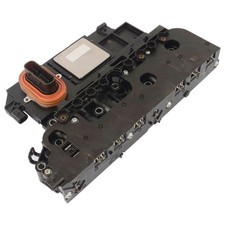
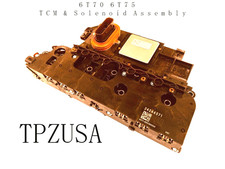
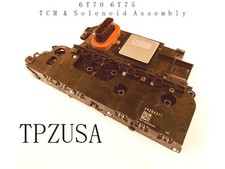
Step zero: which generation is on the bench?
The 6T70 series went through a major mid-life change and the diagnostic path branches on it. Gen. 1 units carry fluid pressure switches inside the TEHCM; Gen. 2 units do not. The two modules are not interchangeable even when the OE number off the old module shows up in a replacement's fitment list.
Jim Mobley laid out the process in Transmission Digest: identify by VIN and RPO, never by the part number on the module you pulled out. The Regular Production Option code sits on the Service Parts Identification placard, usually in the glove box, sometimes the trunk or door jamb. Transmission RPOs start with M, though not every M code is a transmission — Mobley notes RPO "MNK" covers both a five-speed Allison and a GM Gen. 3 6T40 — so match it against year and model together. If the placard is gone, the ACDelco TDS site returns RPO codes from a VIN. Mobley has a name for skipping this: "Follower Syndrome," where one shop installs the wrong TEHCM by matching the old module's serial ID and everyone downstream copies the mistake.
What actually sets P0748 on this unit
In rough order of how often it turns out to be the answer:
- The external circuit, not the transmission. The case connector pass-through, the chassis-side harness, and the TCM power and ground feeds. Corrosion in the pass-through and chafe damage on underbody routing are the two that repeat. Low system voltage belongs here too — a weak charging system or a bad ground sets electrical codes on a perfectly good module.
- An internal open or short in the solenoid winding or the module's internal harness. Common on high-mileage units, and not repairable in the vehicle.
- A failed driver inside the TCM. Same repair, since they are one assembly.
- Contamination-driven module failure. Its own section below, because the decision rule is different.
Note what is not on that list: valve body wear. Bore wear in the actuator feed limit circuit is a very common 6T70 problem, but it produces solenoid performance and ratio codes, not P0748.
Diagnosing it in an order that converges
1. Fluid and voltage before anything else
Check level and condition at the temperature the service procedure specifies, not cold and not right after a highway pull. The 6T70 series calls for DEXRON-VI, which ACDelco specifies for GM transmissions from the 2006 model year forward; a universal or multi-vehicle ATF does not behave the same way in a clutch-to-clutch unit that adapts its own apply timing. Then put a meter on the battery and check charging voltage and the transmission ground. An electrical DTC on a vehicle running at 11.8 volts is not necessarily a transmission fault. Note what is on the magnet and in the pan while you are under there — that reading changes a decision later.
2. Read the whole code set, not the first line
Write down every stored and history code before you clear anything. The pattern tells you which problem you have.
| What you see | What it usually means | Where to go next |
|---|---|---|
| P0748 alone, no performance codes | Circuit fault, external or internal | Harness, connector, power and ground first |
| P0748 with P0747 or P0746 | The circuit fault is upstream of both tests | Still electrical — do not chase hydraulics yet |
| P0748 plus a spread of shift solenoid and ratio codes | Module or feed circuit affecting several solenoids at once | Check the AFL circuit and module condition |
| P0748 plus P0716 or P0717 and metal in the pan | Debris has moved through the unit | Internal damage — the code is downstream of it |
| Gen. 1 unit with P0752, P0872, P0877 or P0989 alongside | TEHCM pressure switch laminate disc failure | Switch rebuild, not a whole module |
3. Live data worth watching
On a bidirectional tool with GM transmission coverage, the PIDs that earn their keep are transmission fluid temperature, commanded versus actual current on pressure control solenoid 1, desired versus actual line pressure, and on a Gen. 1 unit the individual pressure switch states. A commanded current the module reports as zero actual, in every range and at every temperature, is a hard open. One that tracks correctly cold and drops out once the unit is fully hot is the classic intermittent — and ATRA's Keith Clark makes the same point about this family generally: the 6T70 behaves perfectly on a short test drive and only misbehaves at full operating temperature. Never sign off from a cold drive.
4. Testing solenoids you cannot reach
Because the solenoids sit in a single housing wired to the TCM, you cannot put a meter across one at the case connector. Transmission Digest covers the tooling: Kent-Moore builds model-specific test kits, and the DT-47825 kit covers the 6L80 and 6T70. The catch worth knowing before you order is that the harness supplied in that kit is the 6L80 harness — the 6T70 harness is part number DT-47825-20, sold separately. With the kit and a scan tool you can air test each solenoid individually. The equivalent kit for the smaller 6T40 is DT-48616.
Without that kit, Clark's assessment in Gears is blunt: static resistance tests are the only thing you can perform on a TEHCM unless you have the original GM OEM bench tester, and bench testing does not qualify a module's real performance. His alternative is to drive the vehicle cold to hot under heavy and light throttle and watch as many shift sequences as you can.
5. The contamination rule
Clark's rule of thumb keeps comebacks off your board: call for a TEHCM replacement whenever you have electrical TCM or solenoid DTCs and excessive metal contamination. Both together mean the solenoids and circuits are already compromised, and module failure is coming whether or not the vehicle drives correctly the day you deliver it.
The valve body wear that piles codes on top
P0748 is not caused by bore wear, but the two land in the same bay often enough to matter, because installing an expensive module over a worn valve body is how a job comes back.
On Gen. 1 units, actuator feed limit pressure feeds the shift and line pressure control solenoids. Sonnax documents the failure directly: AFL/solenoid pressure regulator bore wear results in low pressure at the shift and control solenoid valve assembly. The OE valve has a large reaction area and is heavily side-loaded, which wears the bore, and as the wear increases the oil pressure reaching the solenoids drops — solenoid and ratio codes plus low line pressure. The repair is Sonnax kit 124740-32K, a drop-in sleeve-and-valve assembly with a hardcoat anodized aluminum valve, a billet sleeve that seals off existing wear and a new spring for correct limit pressure.
Clark points at the same circuit from the bench side: Gen. 1 units use three accumulators to damp the pulses PWM solenoid operation generates, Gen. 2 uses six. Those bores wear too, and the leakage shows up as clutch apply durability problems.
You do not have to guess whether the bores are worn. Sonnax publishes a vacuum test guide for the Gen. 1 valve body with the wear areas and test ports mapped: test the valve in its rest position unless the guide says otherwise, and a low reading means wear. The guide also lists what each worn valve produces — the isolator valve gives low line pressure, instability and no line rise; the pressure regulator valve gives erratic line pressure, poor shift quality, low converter and lube flow and overheating.
The Gen. 1 fix that saves a module
If your code set includes pressure switch codes alongside the P0748 on a Gen. 1 unit, there is a repair path that does not involve buying a TEHCM. The OE pressure switches use a laminate disc that breaches over time, and once it does the switch stops operating correctly. Sonnax lists the symptoms as pressure switch codes, pressure control out-of-range codes, slips, flares and bind-ups, failsafe mode, erratic TCC apply and harsh shifts.
The 124740-70K pressure switch rebuild kit changes that. It carries laminate discs and seals covering 6L45, 6L50, 6L80, 6L90 and Gen. 1 6T70/6T75, enough for ten modules, with tooling 124740-TL70. Note the limitation Sonnax states plainly: test the switches for proper electrical operation before installing the kit — it repairs disc and seal failures only, not the solenoid circuit fault that set your P0748.
Sonnax 124740-70K pressure switch rebuild kit
The same Sonnax kit covers 6L45/50/80/90 and Gen. 1 6T70/6T75 — it sits on the 6L80 shelf, but the part number is the one that fits your Gen. 1 6T70. Discs and seals for ten modules, so it pays for itself on the second job. Test the switches electrically first; this repairs disc and seal failures, not electrical breakdown.
View the 124740-70K kit at Core Transmission Parts →Not the part you need? The full solenoid shelf at Core Transmission Parts covers the rest of the electrical side.
Doing the repair so it stays fixed
If the diagnosis lands on the module, four things have to be right or you will see the code again:
- Correct generation, ordered by VIN and RPO. Not by the number on the module you removed.
- Programmed on the vehicle with a J2534 device after installation. There is no drop-in.
- Adaptives cleared, then relearned hot. A cold relearn tells you nothing.
- The reason the old one died, addressed. If metal put it there, the metal has to be gone — new filter, clean pan, magnet cleaned, cooler and lines flushed or replaced. Otherwise you have installed a countdown.
Verify with data, not by feel: watch commanded versus actual current on PCS1 through a full warm-up before you call it done.
Keeping it from coming back
- Service the fluid on schedule with DEXRON-VI. Debris is what kills switches and solenoids in this family, and fluid service is the part of that you control.
- Vacuum test the Gen. 1 valve body any time the pan is off for a solenoid-related repair. The AFL circuit feeds the solenoids you just paid for.
- Treat charging and ground problems as transmission problems. Electrical DTCs on this unit are sensitive to supply voltage.
Need parts for this job?
Solenoid kits, valve bodies, filter and pan gasket kits, pressure switch seal tooling and DEXRON-VI — the 6T70 and 6T75 shelf in one place, shipped from the USA.
Shop 6T70 parts →FAQ
Is P0748 on a 6T70 an electrical fault or a hydraulic one?
Electrical, by definition. The test watches the pressure control solenoid 1 circuit and sets when commanded current and measured current do not agree, which means an open, a short, a high-resistance connection or a failed driver. Hydraulic problems in the same circuit set the performance codes instead: P0746 stuck off, P0747 stuck on.
Can you replace just the pressure control solenoid on a 6T70?
No. The solenoids, the Gen. 1 pressure switches and the transmission control module are all built into one assembly, the TEHCM. There is no serviceable individual solenoid. If the solenoid or its internal circuit is bad, the module gets replaced or remanufactured as a unit.
Do you have to program a replacement TEHCM?
Yes. It has to be programmed on the vehicle with a J2534 pass-through device before it will operate correctly, and the adaptives cleared afterward. A used module still carrying another VIN will look like a hardware failure.
Why did P0748 come back after I replaced the module?
Three usual reasons: the wrong generation module went in, the module was never programmed, or the fault was never in the module and lives in the case connector pass-through, the chassis harness or the TCM power and ground feeds.
Does metal in the pan change the decision on a 6T70 TEHCM?
It does. ATRA's bench guidance is to call for a module replacement when electrical TCM or solenoid DTCs occur together with excessive metal contamination. Metal in the fluid means the solenoids and circuits have already been through it, and a module that passes a static test today fails soon after the vehicle leaves.
Related reading: our 6T70 limp mode causes, 6T70 slipping under load, and reading transmission live data.
Sources
- Transmission Digest — "Video: Solenoid testing with GM transmissions," August 11, 2020. Backs the statement that GM TEHCM solenoids are contained in a single housing connected to a TCM and are therefore difficult to test individually, the Kent-Moore model-specific test kits, kit DT-48616 for the 6T40 and DT-47825 for the 6L80 and 6T70, the fact that the harness included in DT-47825 is the 6L80 harness only, that the 6T70 harness is part number DT-47825-20 sold separately, and the scan-tool air test of individual solenoids. transmissiondigest.com
- Gears Magazine (ATRA) — "Things That Go Bump: 6T70 Transmission Shift Quality Issues," Keith Clark, April 5, 2022. Backs the point that 6T70 shift quality problems do not appear until full operating temperature and that a short test drive is misleading, that static resistance tests are the only bench test available without the original GM OEM tester and that bench testing does not adequately qualify a module, the rule of thumb to replace the module when electrical TCM or solenoid DTCs occur together with excessive metal contamination, the AFL/solenoid accumulator bore wear, and the Gen. 1 three-accumulator versus Gen. 2 six-accumulator AFL circuit damping the pulses from PWM solenoid operation. gearsmagazine.com
- Sonnax — AFL/Solenoid Pressure Regulator Valve Kit 124740-32K product page. Backs the statement that AFL/solenoid pressure regulator bore wear results in low pressure at the shift and control solenoid valve assembly, that the OE valve has a large reaction area and is heavily side-loaded, that increasing bore wear reduces oil pressure to the shift solenoids and causes solenoid and ratio codes plus low line pressure, the kit's hardcoat anodized aluminum valve and billet sleeve construction and included spring, and its coverage of Ford 6F50/6F55 and GM Gen. 1 6T70/6T75. sonnax.com
- Sonnax — Pressure Switch Rebuild Kit 124740-70K product page. Backs the OE pressure switch laminate disc breach as the cause, the symptom list (pressure switch codes, pressure control out-of-range codes, slips, flares and bind-ups, failsafe mode, erratic TCC apply, harsh shifts, shift codes), the fact that the switches are not available through OE channels and that TEHCM replacement was previously the only remedy, the kit's coverage of 6L45, 6L50, 6L80, 6L90 and Gen. 1 6T70/6T75, enough discs and seals for ten modules, required tooling 124740-TL70, and the warning to test switches electrically first because the kit repairs disc and seal failures only. sonnax.com
- Sonnax — "GM 6T70, 6T75 (Gen. 1) Vacuum Test Guide," December 2, 2014. Backs the vacuum test method (test valves in rest position unless otherwise indicated, a low vacuum reading indicates wear), the mapped critical wear areas and test locations on the Gen. 1 valve body, and the per-valve symptom lists cited above — isolator valve giving low line pressure, line pressure instability, no line rise and burnt clutches; pressure regulator valve giving erratic line pressure, poor shift quality, low converter and lube flow, burnt clutches and overheating. sonnax.com
- Transmission Digest — "Identifying GM 6T70 TEHCM generations using VIN and RPO codes," Jim Mobley, December 17, 2024. Backs the requirement to identify the unit generation by VIN and RPO rather than by the serial ID of the removed TEHCM, the Service Parts Identification placard locations (glove box, trunk, door jamb), the M-prefix caution and the MNK example covering both a five-speed Allison and a GM Gen. 3 6T40, the ACDelco TDS VIN-to-RPO lookup, and the "Follower Syndrome" pattern of repeating another shop's wrong-module choice. transmissiondigest.com
- ACDelco — GM OE DEXRON-VI Automatic Transmission Fluid product specification page. Backs the fluid specification: DEXRON-VI is licensed and approved by GM and specified for GM transmissions of the 2006 model year and newer that call for DEXRON-VI, and is not for use in CVT or DCT applications. acdelco.com