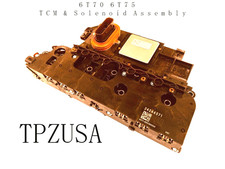
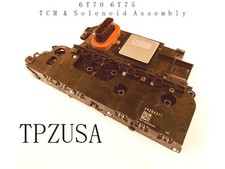
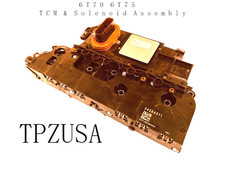
This listing covers the ten model years when the 6T70 was in its widest use: 2008 through 2017 GM crossovers and sedans such as the GMC Acadia and Terrain, Chevrolet Traverse, Equinox, Malibu and Impala, Buick Enclave and LaCrosse, and Cadillac SRX. Owners usually land here after a scan tool comes back with solenoid performance or pressure control codes, the transmission has locked itself in one gear, or shifts have turned harsh and unpredictable. What you receive is the remanufactured TEHCM: the plastic-and-aluminum control solenoid body carrying all eight solenoids, with the transmission control module and its sealed harness connector built in.
What the solenoid kit does in a 6T70
Every shift in this transaxle is electro-hydraulic. The module decides which clutches should be applied, and the solenoids on this body convert that decision into oil pressure on the valves below. GM's service manual describes the line pressure control solenoid as normally high and inversely proportional: more current means less pressure. So when the circuit fails open, line pressure goes to its maximum and the transmission shifts hard instead of slipping. The remaining pressure control solenoids each feed a single clutch circuit, while two simple on/off solenoids move the clutch select valves that decide which circuit a pressure solenoid is talking to. A sticking solenoid in that group shows up as a specific wrong gear, which is why the code tells you more than the symptom does.
Symptoms on 2008-2017 units
- Stored line pressure solenoid codes P0961, P0962 or P0963, or other pressure control solenoid performance codes
- Default gear or limp mode with the check engine light on
- Harsh engagement into Drive or Reverse even with fresh fluid at the correct level
- 2-3 upshift or 3-2 downshift shudder; GM bulletin 18-NA-358 covers this on 6T70, 6T75 and 6T80 and traces it to debris and scored valves
- 2008-2012 only: pressure switch codes P0752, P0872, P0877 or P0989 that set limp mode, from the four normally closed switches built into first-generation assemblies
How to confirm before you buy
The assembly is expensive, so prove it is the fault. Pull every code, not just the first one, and check the fluid hot. If there is no reverse, third or fifth along with P0776, the cause is the 3-5-Reverse wave plate inside the case, not this part. GM publishes a line pressure check with a gauge in Park and Neutral, plus a bench test for this exact assembly using shop air and a test block, to confirm each solenoid opens and closes. Our pressure control solenoid symptoms guide covers the gauge test, and the Acadia shift problems guide walks the same diagnosis on the most common vehicle in this range.
Fitment: one listing, two generations
2008-2017 spans a major split. GM introduced the second-generation 6T70 control system for 2013, removing the pressure switches and revising the valve body and solenoid damping. A first-generation TEHCM and a second-generation one are not interchangeable, and Sonnax warns that a Gen 2 module will not work properly in a Gen 1 transmission even if it appears to program. So within this year span, the assembly you need depends on whether your vehicle is a 2008-2012 or a 2013-2017 build. Read the M-series transmission RPO code from the Service Parts Identification label in the glove box and send it with your year and VIN, and we will confirm the generation before shipping. If you have a 2008 model, the dedicated 2008 6T70 solenoid kit is listed on its own. All 6T70 and 6T75 parts are on the 6T70 transmission page.
Install notes
- Access is through the transaxle side cover; plan for the fluid that comes out with it.
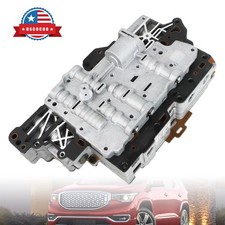
- Check the valve body below for scored bores and debris while it is exposed. If the shudder bulletin applies, the valve body is part of the repair, and a 6T70/6T75/6T80 valve body is available.
- Do not clean the new assembly in solvent.
- Torque the assembly bolts to spec in sequence so the body seals evenly.
- Fill with Dexron VI, then program the module to the VIN with a J2534 device or dealer tool and run Service Fast Learn adapts. A remanufactured module that is not programmed will not shift correctly.
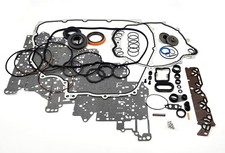
On a high-mileage unit already showing clutch slip, an overhaul kit alongside the new assembly avoids paying for the side cover job twice.