Impalas come through the door as high-mileage fleet and rental cars more often than almost anything else with a 6T70 in it, and the complaints are surprisingly predictable once you sort the car by build. The trick is that "Impala" covers two very different cars in the 6T70 years: the last of the old W-body (2012-2013) and the new full-size car that started in 2014. They run different generations of the transmission, and GM wrote different bulletins for each. This guide walks through the Impala 6T70 problems by build, with the GM bulletin numbers, build breakpoints and part numbers behind each one, so you can tell a calibration fix from a valve body from a recall before the car goes on the lift. Numbers in brackets point to the Sources list at the bottom.
First: which Impala actually has the 6T70?
The V6 car is the 6T70 car. GM's 2012 Impala owner manual lists one engine, the 3.6L V6 (engine VIN code 3), with an automatic [5], and GM's Preliminary Information PI0837 lists the 2012-2013 Impala with the 6T70 under RPO MH2 or MH4 [2]. Those are first-generation units.
The 2014-and-later Impala is where people order the wrong parts. GM bulletin PI1081 lists the 2014 Impala with the 6T70 under RPO M7W [3], and bulletin 18-NA-358 lists the Impala with RPO M7W from 2014 through the 2019 model year [1]. M7W is the second-generation unit. The four-cylinder cars are not 6T70s at all: GM PI1198 lists the 2014 Impala with the 2.5L engine and the 6T45 automatic under RPO MH7 [4]. A 6T45 and a 6T70 look alike on a parts screen and share almost nothing inside.
Pull the RPO label (in the glovebox or trunk on the 2014 car) before you order anything. MH2/MH4 means a Gen 1 kit, M7W means Gen 2, and MH7 means you are on the wrong page.
1. 2014-2019 Impala: launch shudder, flare and 2-3 / 3-2 shift (18-NA-358)
This is the hard-parts complaint on the newer Impala. GM bulletin 18-NA-358 lists the 2014-2019 Impala (RPO M7W) for a severe launch shudder in 1st from a stop, a shudder while cruising in 4th, or a shudder on the 2-3 upshift or 3-2 downshift. The same cars may also flare, slide or bump, slip, or shift harsh [1]. GM's cause statement is debris in the upper and/or lower valve bodies, or valves scratched or scored so they do not move properly [1].
The mechanism makes sense on the bench. A clutch-to-clutch six-speed depends on the regulator valves feathering one clutch off while the next comes on. A valve that hangs in a scored bore cannot track its solenoid, so the oncoming clutch sees a pressure ripple instead of a smooth ramp. On a launch that ripple shows up as a shudder through the 1-2-3-4 clutch. On a 2-3 it shows up as a flare or a bang.
Confirming it
Work it in the bulletin's order [1]:
- Rule out an engine misfire or driveability problem first. A V6 with a weak coil feels a lot like a shudder at 1,200 rpm.
- Rule out converter clutch shudder. Put TCC slip speed on the scan tool and watch it while the converter clutch is applied during the event. If the shake tracks TCC slip, it is a converter problem and belongs in a different job.
- Try to reproduce the launch shudder with a power brake in first, for 5 seconds or less, so you do not hurt the 1-2-3-4 clutch.
The repair, done right
If it reproduces, GM replaces the upper and lower valve body assemblies at the same time: upper 24281084, lower 24257450, kit 24264343, plus DEXRON VI [1]. Two notes in that bulletin save comebacks. First, TEHCM replacement has not been an effective repair for this condition, so do not hang a control module on it unless the diagnosis isolates it [1]. Second, inspect the input and output speed sensors for collected debris. Debris on the sensors means an internal failure is feeding the valve body. No debris on the sensors but scratched valves and bores means check the final drive bearing [1]. Bolting a new valve body onto a unit that is shedding bearing material just scores the new one.
2. 2014 Impala: 4-3 coastdown bump (PI1081)
A lot of 2014 Impalas get written up for a "clunk" coming to a stop. GM PI1081 describes a closed-throttle 4-3 coastdown bump on the 2014 Impala with the 6T70 (RPO M7W), built before VIN breakpoint EU125212 for Detroit-Hamtramck cars or E9163315 for Oshawa cars [3].
This is a calibration fix, not a parts job. GM's recommendation is to update the TCM through SPS with the latest software [3]. Before you reflash, check that the car is inside the VIN range and that you actually have a coast-down 4-3, not a bump on a 2-1 or a garage shift. Hold battery voltage between 12 and 15 volts on a maintainer for the whole programming event, as GM requires [3]. A reflash that drops out halfway on a weak fleet battery turns a bump complaint into a no-start.
3. 2012-2013 Impala: hesitation or "sag" after coasting (PI0837)
The W-body V6 car has its own drivability complaint. GM PI0837 covers 2012-2013 Impalas with the 6T70 (RPO MH2, MH4) that hesitate or sag on acceleration after a lift-foot or coast maneuver, typically when the driver lifts to turn a corner and then picks up moderate throttle [2]. A 5-3, 4-2 or 3-2 downshift happens, engine rpm drops for a moment and the car falls flat.
The cause is engine-side: an ECM calibration that pulls torque during downshifts to hide driveline "tip-in" clunk [2]. GM's service calibration reduces that torque reduction, and it is a sequential ECM and TCM programming event [2]. Two cautions from the bulletin are worth passing to the customer. The update only addresses the sag on those three downshifts and should not be used for other hesitation or shift-feel complaints, and it may slightly increase tip-in clunk [2]. If the customer's complaint is a slip, flare or a missing gear, this bulletin is not the answer.
The 2012-2013 car is also a first-generation 6T70, so the Gen 1 hard-parts failures still apply. When one of these comes in with no reverse plus a slip or flare in 3rd and 5th, check the 3-5-R clutch and its wave plate before anything else; our 6T70 no reverse guide walks through it.
4. 2014 Impala: shift cable adjuster recall 14V092
This one gets misdiagnosed as an internal failure. NHTSA campaign 14V092000 (GM number 14048) covers 2014 Impalas, along with several other 2014 GM cars, whose transmission shift cable adjuster may disengage from the transmission shift lever [6]. When it lets go, the driver may not be able to change gear, the indicated range may not match the gear the transmission is actually in, and the lever can reach Park while the transmission is not in Park, which is a rollaway risk [6]. The remedy is a dealer inspection and adjuster replacement, free of charge [6].
So when a 2014 Impala comes in "stuck in gear" or "won't go into Park," look under the hood at the cable end on the transmission lever before you scan for codes. Run the VIN for open recalls first. If the lever on the case does not move when the shifter does, you have found it.
5. Won't come out of Park, or the transmission is hot
Two owner-manual items explain a lot of tow-ins. The 2012 Impala manual describes torque lock: park on a hill without setting the parking brake first, and the weight of the car loads the parking pawl so hard it is difficult to shift out of Park. GM's prevention is brake first, then Park, and if it does lock, the car may need to be pushed uphill to unload the pawl [5]. That is not a transmission failure.
The same manual lists a TRANSMISSION HOT IDLE ENGINE message for fluid that is too hot: stop and let it idle until it cools, and get it serviced if the message stays on [5]. On a fleet Impala that has idled in summer traffic for 150,000 miles, treat that message as a warning about the fluid and the converter clutch, and check the cooler and its lines before blaming the unit. Our 6T70 overheating guide covers the checks.
Service and setup that keep an Impala 6T70 alive
Fluid: DEXRON-VI [5]. The 2012 Impala manual lists the automatic transmission capacity at 5.0 L (5.3 qt) [5]. That is a service refill; a rebuilt unit with an empty converter takes considerably more, so fill to level, not to a number.
Power steering is not ATF on the W-body: the 2012 Impala calls for GM Power Steering Fluid (part 89021184), not DEXRON-VI [5]. Do not top off the steering with leftover transmission fluid.
Checking level: GM's position is that you do not need to check the level routinely, that a leak is the only reason fluid is lost, and that there is a special procedure for checking and changing it [5]. That procedure is a hot check done at operating temperature per the service manual, not a quick cold look. Overfilling one of these by guesswork causes foaming and aeration complaints of its own.
Interval: change the fluid and filter at the maintenance schedule interval [5]. A rental or fleet Impala is the definition of severe service. We drain and fill those at roughly half the normal interval.
After any repair: clear adapts and run the scan tool's fast learn procedure, and program the TCM with current software. Most of the Impala complaints above were addressed by calibrations, so a unit that leaves with old software comes back with the same bump.
Quick reference
| Impala symptom | Build | Likely cause | Fix |
|---|---|---|---|
| Launch shudder, 4th-gear shudder, 2-3 / 3-2 shudder or flare | 2014-2019 (M7W) | Valve body debris or scored valves [1] | Replace upper and lower valve bodies; check sensors and final drive bearing |
| Bump on closed-throttle 4-3 coastdown | 2014 (M7W), before VIN EU125212 / E9163315 | Calibration [3] | TCM reprogram (PI1081) |
| Sag or hesitation after coasting | 2012-2013 (MH2/MH4) | ECM torque reduction on downshift [2] | ECM and TCM reprogram (PI0837) |
| Can't shift, wrong gear shown, not in Park | 2014 | Shift cable adjuster disengaged [6] | Recall 14V092000 / GM 14048 |
| Stuck in Park on a hill | All | Torque lock on the parking pawl [5] | Push uphill; brake before Park |
| Harsh step-in or step-out shift | 2014 2.5L (6T45, MH7) | Not a 6T70 [4] | ECM and TCM reprogram (PI1198) |
Shop the part for this fix: 6T70 master rebuild kit
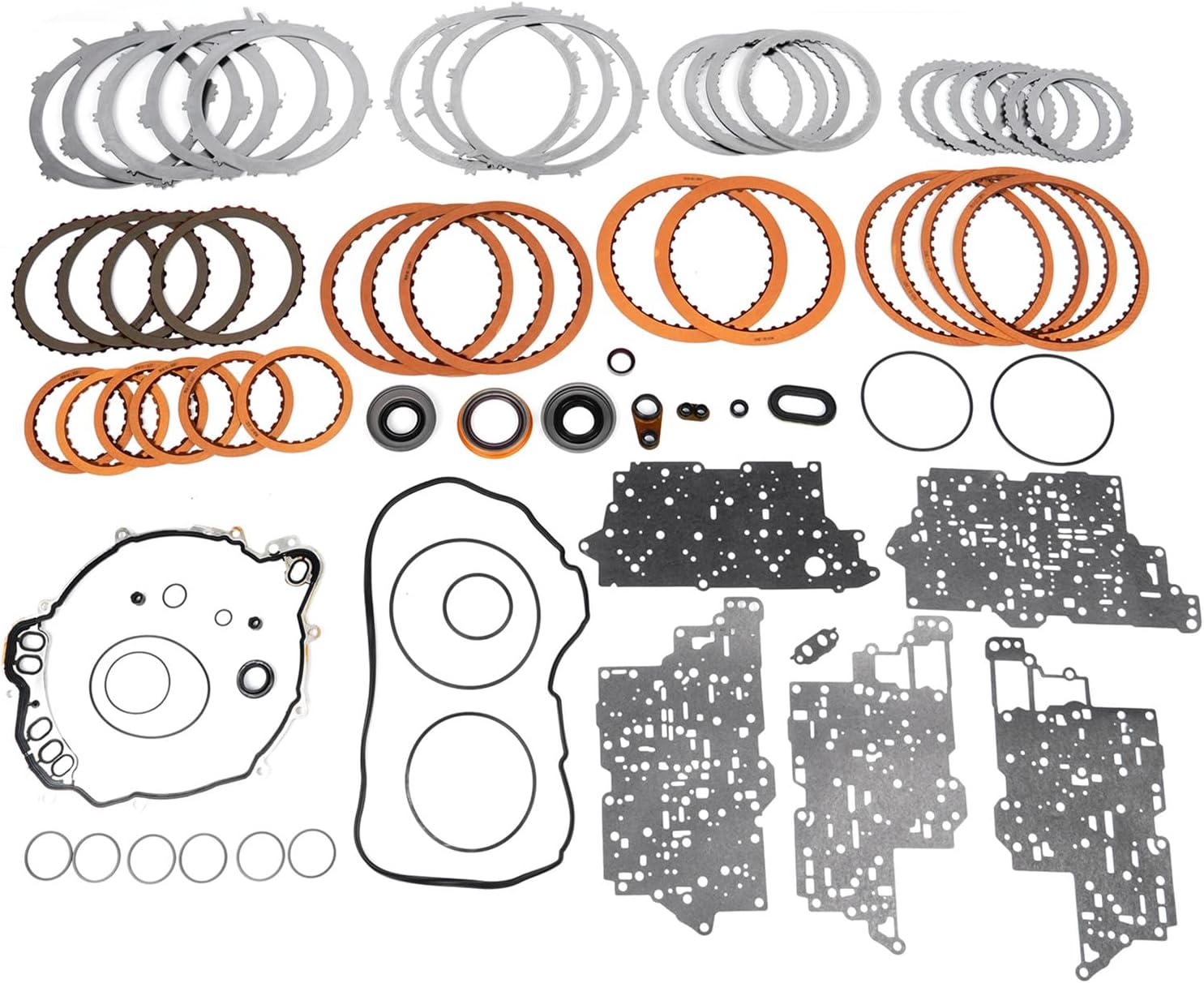
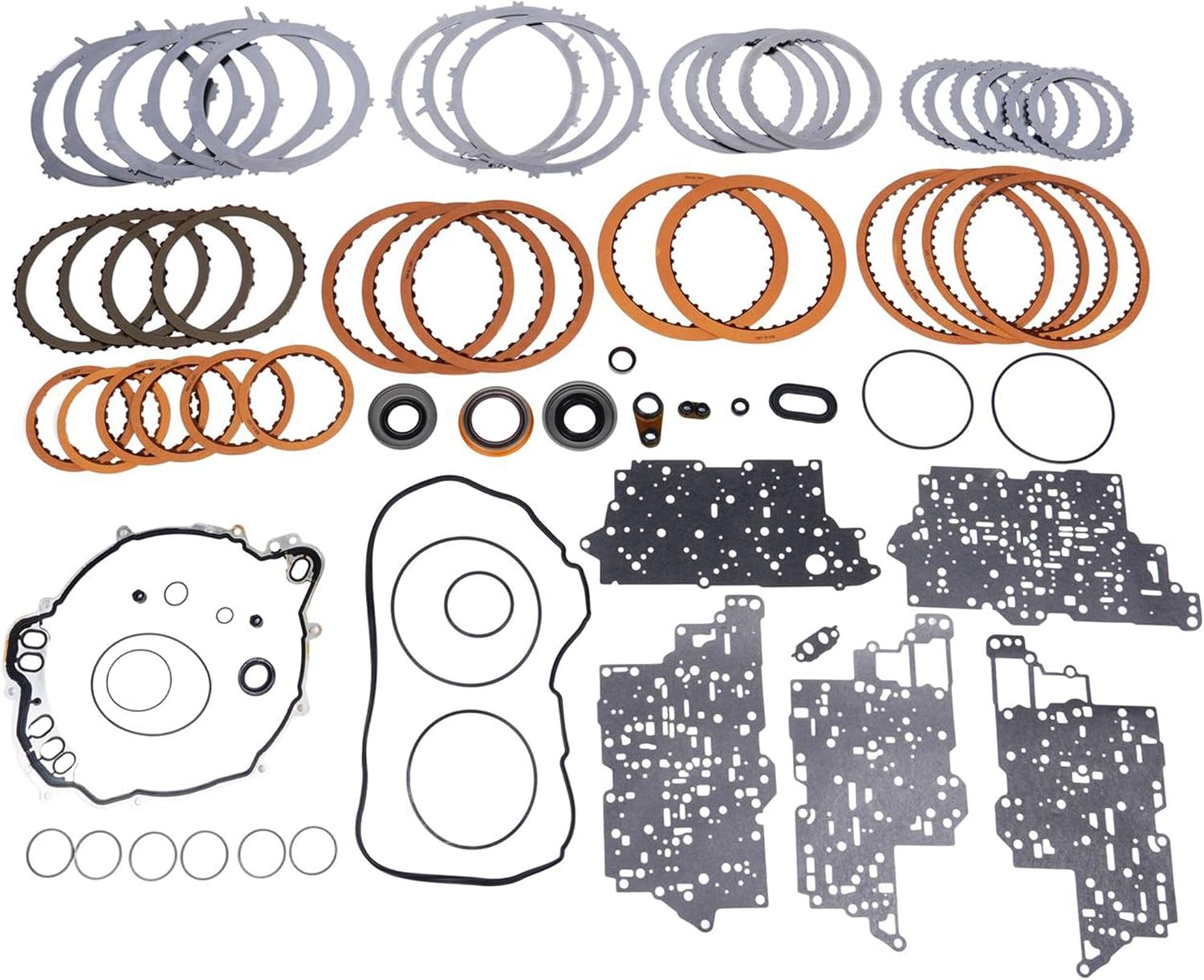
When the Impala unit has to come apart because valve body debris came from somewhere inside, this CoreTransmissionParts master kit has the frictions, steels, gaskets and seals for the overhaul. Match the generation to your RPO.
View the 6T70 master rebuild kit at CoreTransmissionPartsLooking for something else? Browse all 6T70 parts at CoreTransmissionParts.
Need parts for this job?
Our 6T70 parts page has Gen 1 and Gen 2 rebuild kits, valve bodies, solenoid kits, pumps and filter kits that fit the V6 Impala, all on our own checkout. For fluid specs across every unit, see the transmission fluid spec chart.
FAQ
Which Chevy Impala has the 6T70 transmission?
The 3.6L V6 cars. GM lists the 2012-2013 Impala with the 6T70 under RPO MH2 or MH4, and the 2014-2019 Impala under RPO M7W. A 2.5L four-cylinder 2014 Impala has the smaller 6T45 (RPO MH7), so check the RPO label before ordering parts.
Why does my 2014-2019 Impala shudder when taking off?
GM bulletin 18-NA-358 covers a severe launch shudder, a 4th-gear shudder and 2-3 or 3-2 shift shudder on 2014-2019 Impalas with the 6T70 (RPO M7W). GM traces it to debris or scored valves in the upper and lower valve bodies and replaces both together, after ruling out misfire and converter clutch shudder. GM says replacing the TEHCM has not fixed it.
What causes a bump when my 2014 Impala slows down?
A closed-throttle 4-3 coastdown bump on a 2014 Impala 6T70 is covered by GM PI1081. It applies to cars built before VIN breakpoint EU125212 (Detroit-Hamtramck) or E9163315 (Oshawa), and the fix is a TCM reprogram with the latest calibration, not hard parts.
Was there a transmission recall on the 2014 Impala?
Yes. NHTSA campaign 14V092000 (GM 14048) covers 2014 Impala and other GM models whose transmission shift cable adjuster can disengage from the shift lever. The driver may not be able to change gears, the indicator may show the wrong position, and the car may not be in Park when the lever says it is. Dealers inspect and replace the adjuster free of charge.
What transmission fluid does a 6T70 Impala use and how much?
DEXRON-VI. GM's 2012 Impala manual lists the automatic transmission capacity as 5.0 L (5.3 qt), which is a service refill, not a dry fill after a rebuild. GM says the level check uses a special hot-check procedure, and that a leak is the only reason the level should drop.
Related guides
Sources
- General Motors, Service Bulletin 18-NA-358, "Shudder, 2-3 Upshift or 3-2 Downshift Concern," December 2021. Backs the 2014-2019 Impala RPO M7W listing, the launch, 4th-gear and 2-3/3-2 shudder plus flare, slip and harsh shift symptoms, the valve body debris cause, the 5-second power brake test, the TCC slip check, the TEHCM caution, the speed sensor debris and final drive bearing check, and valve body parts 24281084, 24257450 and 24264343. static.nhtsa.gov (PDF)
- General Motors, Preliminary Information PI0837, "Hesitation or 'Sag' on Acceleration After Coast (Reprogram TCM and ECM)," October 2012. Backs the 2012-2013 Impala 6T70 RPO MH2/MH4 listing, the 5-3, 4-2 and 3-2 downshift sag, the torque-reduction cause, the sequential ECM/TCM reprogram, and the scope and tip-in clunk cautions. static.nhtsa.gov (PDF)
- General Motors, Preliminary Information PI1081, "4-3 Coastdown Bump," October 2013. Backs the 2014 Impala 6T70 RPO M7W listing, VIN breakpoints EU125212 (Detroit-Hamtramck) and E9163315 (Oshawa), the TCM reprogram fix and the 12-15 volt programming requirement. static.nhtsa.gov (PDF)
- General Motors, Preliminary Information PI1198, "Harsh Shift During Step-In or Step-Out at Low to Moderate Throttle," March 2014. Backs the 2014 Impala 2.5L engine with the 6T45 automatic (RPO MH7), used here to separate the four-cylinder cars from the 6T70. static.nhtsa.gov (PDF)
- Chevrolet, 2012 Impala Owner Manual. Backs the 3.6L V6 (VIN code 3) engine, DEXRON-VI, the 5.0 L (5.3 qt) automatic transmission capacity, GM Power Steering Fluid 89021184, the special level-check procedure and leak-only fluid loss note, torque lock, and the TRANSMISSION HOT IDLE ENGINE message. assets.gm.com (PDF)
- NHTSA, Recall 14V092000 (GM 14048), transmission shift cable adjuster. Backs the 2014 Impala coverage, the adjuster disengaging from the shift lever, the wrong-gear indication and not-in-Park rollaway risk, and the free inspection and replacement remedy. api.nhtsa.gov (recall record)