The 6T70 and its heavy-duty twin the 6T75 went into production for 2007 behind the 3.6L V6 in the GMC Acadia, Saturn Outlook, Saturn Aura and Pontiac G6, and from there into the Enclave, Traverse, Equinox, Malibu, Vue and a long list of later GM crossovers and sedans. It is a clutch-to-clutch six-speed with five clutches, one low one-way clutch, no shift valves, a single accumulator and the TCM bolted inside the case on top of the valve body. That design packs a lot of control into a small space, and it also means most of the unit's pattern failures show up as codes that point at the electronics when the root cause is mechanical.
This is the short list of problems that actually fill bays with 6T70s, in rough order of how often they show up, with the code patterns, the checks and the fix for each. The facts come from GM service bulletins filed with NHTSA, ATRA's 6T70 introduction and product-issues seminars, Sonnax technical articles and Transmission Digest. If you are chasing one specific code, our P0776 guide and limp mode guide go deeper.

Know Which 6T70 You Have First
Nearly every repair decision on this unit depends on the build. Per ATRA, the 6T70 carries RPO MH2 (FWD) or MH4 (AWD), and the 6T75 carries MY9 (FWD) or MH6 (AWD). The 6T75 is the heavy-duty version with a shot-peened output carrier, a five-pinion carrier, a wider transfer gear, a heavier differential carrier and a ribbed case. ATRA lists the 6T70 at 280 lb-ft maximum engine torque and 1,000 lb towing, and the 6T75 at 299 lb-ft and 4,500 lb.
The bigger split is by generation. ATRA's product-issues seminar explains that the 6T70 (RPO M7W or M7U) and 6T75 (M7V or M7X) received a major controls update for 2013, but because of parts availability the other RPO codes did not get it until 2014 production. That means both Gen 1 and Gen 2 units were built in 2013. Transmission Digest puts it simply: Gen 2 parts were used selectively starting in 2013, and all 2014 and later units should be Gen 2. Within Gen 1, Sonnax's identification chart shows 2007-2008 valve bodies use a 1.35 ratio 3-5-R clutch regulator valve and 2009-later use a 1.83 ratio valve, and warns that early and late Gen 1 valve bodies look nearly identical but do not interchange. Our 6T70 vs 6T75 guide covers the ID tells in more detail.
1. Broken 3-5-Reverse Wave Plate: No 3rd, 5th or Reverse
This is the failure the 6T70 is known for. GM bulletin 09-07-30-012F describes the complaint: check engine light, no reverse, and a slip, flare or harsh shift in 3rd and/or 5th, usually with P0776 (Clutch Pressure Control Solenoid 2 Stuck Off). Because the failure throws debris, GM notes that P0777, P2723, P0717, P0716, P2715 and P2714 can set independently along with it. The cause is a broken 3-5-R clutch waved plate that lets the apply piston over-stroke, which makes the piston leak and lose apply. GM says it normally does not happen before about 20,000 miles.
GM took it seriously. Special Coverage 14404B extends coverage on 2007-2009 Enclave, Acadia, G6, Aura and Outlook, 2008-2009 Equinox, Malibu, Torrent and Vue, and 2009 Traverse (RPO MH2, MH4, MH6 or MY9) to 10 years or 120,000 miles from the in-service date. At this point most of those vehicles are past that window, so the repair lands on independent shops.
How to confirm it
ATRA's advice is to keep the diagnosis simple: unplug the transmission and see whether reverse is being prevented electrically. If reverse engages with the unit unplugged, the input sun shell weld break (also an early-unit failure that causes no reverse, 3rd or 5th, and is fixed with an updated shell that includes the #3 thrust bearing) is not your problem, and the 3-5-R clutch is the suspect. A pan drop showing steel fragments in the magnet tells you the rest.
The repair
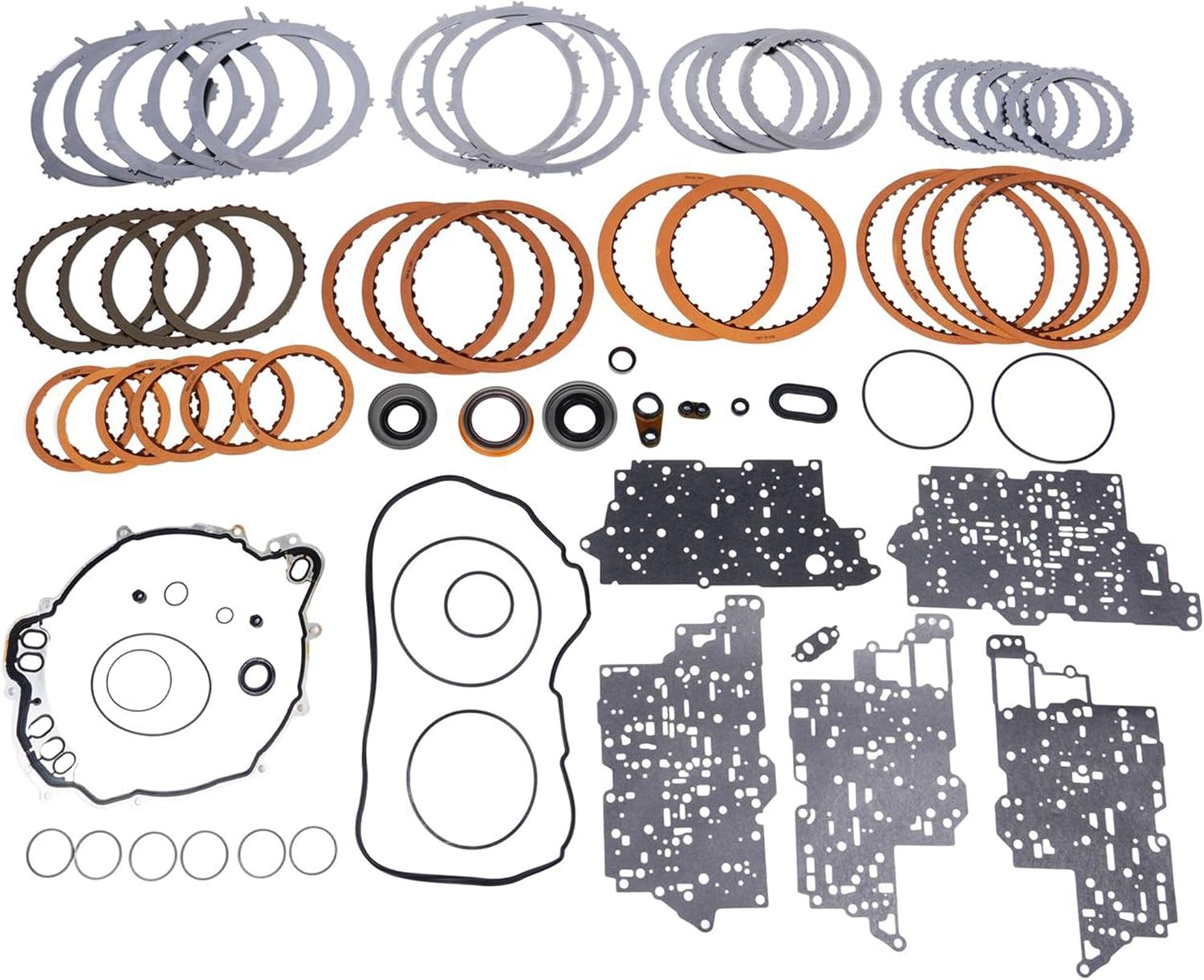
GM released updated plate P/N 24254103 and recommends installing it any time the transmission is apart for any reason. The bulletin is explicit about the debris: separate the case halves, clean the entire unit, and replace the pump fluid filter and the control solenoid filter plate, or you risk repeat damage. It also warns not to wash the control solenoid valve body and TCM assembly in a parts cleaner. ATRA's seminar goes further and recommends updated wave plates in every clutch to protect a new gear set: 1-2-3-4 (24259063), 2-6 (24259816), 3-5-R (24254103) and low-reverse (24259817), noting the 3-5-R is the one that breaks most.
Expect collateral damage. GM's coverage bulletin estimates that about 25 percent of repairs also need parts like the reaction sun gear and carrier, and Sonnax notes that a broken plate usually chews up the drum splines, which means a new housing. Sonnax also points out that even the shot-peened OE replacement plate still fails in the field, including in Gen 2 units, because every broken plate it studied separated at a tooth corner. Its drum saver kits (124555K for the 6T70/75) use a toothless waved plate guided by a billet cupped steel plate and can salvage a damaged drum.
6T70 Bonded Piston Set 2007-Up → or browse all 6T70 parts
The no-move comeback after the repair
ATRA flags a no-movement complaint with P2723 after a wave plate repair that included a new reaction carrier. Parts catalogs often show the reaction carrier and input ring gear as one piece, but they are serviced as three separate parts: carrier, ring gear and ring gear snap ring. Leave the ring gear off and the unit will not move. Check it before the case halves go together.
2. Pressure Switch Failures in the TEHCM
Gen 1 6T70/75 units have four normally closed pressure switches in the TEHCM (transmission electro-hydraulic control module). Per ATRA, switch 1 monitors the 1-2-3-4 clutch regulator valve, switch 2 the 3-5-R, switch 3 the 2-6 and switch 4 the R1/4-5-6 regulator. They open at about 8 psi, so on the scan tool a pressurized switch reads low and an unpressurized one reads high. The TCM uses them to confirm gear state and to time clutch fill for adaptive learning.
Sonnax reports these switches have a significant failure rate. When one fails, expect P0752, P0872, P0877 and/or P0989, sometimes with limp mode. On the bench the giveaway is a waffled or delaminated switch film, caused by high pressure or debris, which lets contamination reach the contacts. That is the main reason a wave plate failure so often takes the switches with it.
The fix used to be a new TEHCM. Sonnax now sells film and seal kits for the Gen 1 6T70 switches (124740-28K, 124740-30K and installer tool 124740-TL30), so the switches can be rebuilt. If you do replace the TEHCM, ATRA reminds you that the TCM is inside the transaxle and must be programmed any time the transaxle or TCM is replaced, and that a spring-loaded bracket presses the TCM against a heat sink on the valve body. Leave that bracket out and the TCM goes into thermal shutdown.
3. Slips and Delayed Engagement From Mixed Gen 1 and Gen 2 Parts
A Transmission Digest case study covers a 2015 Equinox 3.6L with a 6T75 that had delayed engagement into drive and slipped in first. The cause was a Gen 1 1-2-3-4 clutch apply piston installed in a Gen 2 transmission. The Gen 1 piston's apply fingers measure 0.638 in, the Gen 2 fingers 0.785 in, a difference of 0.147 in that leaves far too much clutch clearance. Gen 2 also went to thinner 1-2-3-4 frictions, 0.058 in versus 0.061 in on Gen 1.
This one is almost always a rebuild or used-parts problem, and it is completely avoidable: identify the generation before ordering a master kit, pistons or frictions, and measure finger height on any piston that goes in. If you are fighting a slip that only shows up under throttle on a unit that has not been apart, our slipping under load guide covers the hydraulic causes.
4. 3-4 and 4-3 Bind With P0797
ATRA's product-issues seminar describes a tie-up on the 3-4 or 4-3 shift, with P0797 possible, on both the 6T70 and 6T75. A worn ring groove on the case cover hub sleeve lets fluid leak between the 3-5-R and 4-5-6 clutch circuits, so both clutches see pressure during the shift. Pull the hub from the rear case cover and check ring-to-groove clearance with a feeler gauge. The maximum is 0.007 in. Over that, the case cover gets replaced.
5. Converter Pilot, Flex Plate and Discoloration
The 6T70/75 converter is a four-element unit built by ZF Sachs for the joint GM-Ford program. Per Transmission Digest, most of these converters that reach rebuilders arrive with vibration or leak complaints, and the reason is the welded-on pilot, which creates a weak point. When the pilot cracks or breaks, the flex plate is usually cracked too, and that is easy to miss: the flex plate has a thin 0.035 to 0.040 in shim permanently attached at the bolt area that hides cracks until the plate breaks in two. The only proper inspection is with the flex plate removed, viewed from the engine side.
Two more converter notes from ATRA. There is no seal on the turbine shaft; the lip seal is inside the converter, so it must be removed and installed vertically (GM tool J-46409) or the seal gets damaged. And some units show a dark or blue discoloration on the hub side of the converter. If the whole converter is not discolored and there is no other evidence of overheating, GM's guidance is do not replace it. For TCC shudder on these units see our 6T75 converter shudder guide.
6. Invalid Range Signal After a Rebuild (P1825)
The internal mode switch (IMS) is a sliding contact switch tied to the manual valve. It sends four inputs to the TCM (Signal A, B, C and parity P), and a fifth, P/N start, goes straight to the ECM, which is why the engine can crank even with a dead TCM. Transmission Digest reports that P1825 (invalid range signal) often sets immediately after a rebuild because the switch's retention tabs pop off during disassembly, letting the housing spread and relieving pressure on the contact fingers. The fix is to dress the tabs, clean and reassemble the switch with the tension plate flat, and secure it, rather than buying a new assembly.
7. Smaller Items That Still Cost You Time
- Low line pressure at idle: ATRA says to inspect the pump outlet seal. The pump is a remote-mounted, chain-driven vane pump, off axis from the input.
- Cooler line leaks: GM released cooler lines with longer snouts and a modified case for 2008-later. They do not back-service into earlier cases.
- Carrier bearing updates: for 2009 the output carrier bearing pocket was machined 0.01 in deeper and the reaction carrier pocket 0.009 in deeper for heavier sun gear bearings. Updated carriers back-service only with the updated bearings.
- Harsh shifts, flares and shudder from valve body debris: GM bulletin 18-NA-358 ties a 1st-gear launch shudder, 4th-gear or 2-3/3-2 shudder, and harsh shifts, flares or slide-bumps on 2014-2019 6T70/6T75/6T80 applications to debris or scored valves in the upper and lower valve bodies. GM replaces both bodies together, says TEHCM replacement has not been an effective repair, and says to inspect the speed sensors for debris and the final drive bearing when valves are scored. Our 6T70 harsh shift guide walks through the full diagnosis.
- Side cover studs: ATRA notes the studded side cover bolts must be re-torqued whenever the cooler lines are removed, and the gasket is not reusable.
Fluid and Service: The Cheapest Prevention
The 6T70 uses DEXRON VI. ATRA's seminar lists a fluid-only service at 100,000 miles for regular service and 50,000 miles for severe service, and the filter is non-serviceable: it is only replaced after an internal repair because it sits inside the case. To check level, park level with the brake set, run the engine, move through the gears, idle for one minute, and read the dipstick with transmission fluid temperature between 180 and 200 degrees F on the scan tool. After a fluid change, reset the transmission oil life monitor.
If you tow or run the vehicle hard, treat it as severe service. The unit runs a small sump with high fluid turnover, which is part of why ATRA stresses DEXRON VI's film strength. After any internal repair or valve body or TEHCM replacement, run the Service Fast Learn Adapts procedure with the scan tool, then shut the engine off and let the TCM power down to complete it. Skipping the relearn is one of the most common reasons a freshly repaired 6T70 shifts badly and comes back.
The Order I Work a 6T70
- Pull codes and note the RPO and build year to fix the generation.
- Check fluid level at 180-200 degrees F and look at the pan magnet for steel.
- No 3rd, 5th or reverse with P0776: unplug the unit and check reverse, then plan on the wave plate repair with full debris cleanup.
- Pressure switch codes (P0752, P0872, P0877, P0989): watch the switch PIDs, then rebuild the switches or replace and program the TEHCM.
- After any repair: verify parts are generation-correct, then run Fast Learn Adapts.
Need parts for this job?
Generation-correct 6T70 master rebuild kits, clutch drums, valve bodies, TCMs and solenoid kits, shipped from the USA.
Shop 6T70 parts →FAQ
What is the most common problem with the 6T70 transmission?
A broken 3-5-Reverse clutch wave plate, mostly on 2007-2009 units. It causes a loss of 3rd, 5th and reverse, usually with DTC P0776, and the debris can take out the pressure switches, speed sensors and other clutches. GM released updated plate P/N 24254103 and recommends installing it whenever the unit is apart.
Is the 6T70 wave plate covered by a GM warranty extension?
GM Special Coverage 14404B covered 2007-2009 Enclave, Acadia, G6, Aura and Outlook, 2008-2009 Equinox, Malibu, Torrent and Vue, and 2009 Traverse for 10 years or 120,000 miles from the in-service date. Most of those vehicles are now outside that window, but a dealer can still check eligibility by VIN.
What causes P0752, P0872, P0877 or P0989 on a 6T70?
Those are pressure switch codes. The Gen 1 TEHCM has four normally closed pressure switches, and Sonnax reports they fail at a significant rate from delaminated films caused by high pressure or debris. The switches can be rebuilt with a film and seal kit, or the TEHCM can be replaced and programmed.
How often should 6T70 fluid be changed?
ATRA's 6T70 seminar lists a fluid-only DEXRON VI service at 100,000 miles for regular service and 50,000 miles for severe service such as towing. The internal filter is only replaced during an internal repair. Check the level with fluid temperature between 180 and 200 degrees F.
Can Gen 1 and Gen 2 6T70 parts be mixed?
Not safely. Transmission Digest documents a Gen 1 1-2-3-4 apply piston in a Gen 2 unit causing delayed engagement and a first-gear slip, because the Gen 2 apply fingers are 0.147 in taller. Gen 2 parts started in 2013 and all 2014-later units should be Gen 2, so confirm the generation before ordering.
Sources
- General Motors — Service Bulletin 09-07-30-012F, "No Reverse, 3rd or 5th, Check Engine Light Illuminated, DTC P0776," October 2012 (via NHTSA). Backs the affected models and RPOs, the P0776 complaint and the related P0777, P2723, P0717, P0716, P2715 and P2714 codes, the broken 3-5-R waved plate and piston over-stroke cause, the roughly 20,000-mile onset, updated plate P/N 24254103, and the debris cleanup, filter and filter plate replacement requirements. static.nhtsa.gov (PDF)
- General Motors — Special Coverage Adjustment 14404B, "Transmission Clutch Wave Plate," August 2016 (via NHTSA). Backs the 10-year/120,000-mile coverage, the covered 2007-2009 models, and the estimate that about 25 percent of repairs need additional parts such as the reaction sun gear and carrier. static.nhtsa.gov (PDF)
- ATRA — "6T70 Product Issues and Updates," Steve Garrett. Backs TCM programming, Service Fast Learn Adapts, the fluid check procedure and 180-200 F window, the non-serviceable filter and 100,000/50,000-mile service intervals, vertical converter removal with J-46409, converter discoloration guidance, the P0797 hub ring groove 0.007 in limit, the sun shell weld break and unplug test, the wave plate part numbers for every clutch, the missing reaction ring gear no-move, the pump outlet seal, and the 2008-2009 cooler line and carrier updates and the 2013-2014 Gen 2 rollout by RPO. atracom.blob.core.windows.net (PDF)
- ATRA — "6T70 Introduction," Steve Garrett. Backs the 2007 launch applications, RPO codes, 6T75 heavy-duty parts, torque and towing ratings, clutch-to-clutch design with one accumulator and no shift valves, DEXRON VI, side cover re-torque, the TCM heat sink bracket, the chain-driven vane pump, and pressure switch assignments and 8 psi opening pressure. atracom.blob.core.windows.net (PDF)
- Sonnax — "Under Pressure: Shift Quality and Pressure Switches in TEHCM Applications" and "GM 6T40 and 6T70 Drum Saver Kits." Backs the pressure switch failure rate, codes P0752, P0872, P0877 and P0989, delaminated switch films, switch rebuild kits 124740-28K/30K/TL30, drum spline damage from broken plates, failures of the shot-peened OE plate, and drum saver kit 124555K. sonnax.com (pressure switches) and sonnax.com (drum saver)
- Sonnax — Remanufactured Valve Body GM6T70-1E and Gen 1 6T70/6T75 Identification Chart. Backs the 1.35 ratio (2007-2008) versus 1.83 ratio (2009-later) 3-5-R clutch regulator valve split and the warning that early and late Gen 1 valve bodies do not interchange. sonnax.com
- Transmission Digest — "GM 6T70/75 Slips and Delays in First," Wayne Colonna, November 2023. Backs the Gen 1 piston in a Gen 2 unit, the 0.638 in and 0.785 in apply finger heights, the 0.058 in and 0.061 in friction thicknesses, and Gen 2 use from 2013 and in all 2014-later units. transmissiondigest.com
- Transmission Digest — "6T70/75 Converter-Pilot Issues," Ed Lee (Sonnax), and "A 6T70 IMS Invalid Range Signal." Backs the ZF Sachs four-element converter, the welded pilot weak point, hidden flex plate cracks under the 0.035-0.040 in shim, the IMS signal layout, and P1825 after a rebuild from popped retention tabs. transmissiondigest.com (converter) and transmissiondigest.com (IMS)
- General Motors — Service Bulletin 18-NA-358, "Shudder, 2-3 Upshift or 3-2 Downshift Concern," October 2020 (via NHTSA). Backs the covered 6T70/6T75/6T80 vehicles, the shudder, flare, slide/bump and harsh shift complaints, debris or scored valves as the cause, replacement of both upper and lower valve bodies, the note that TEHCM replacement has not been effective, and the speed sensor and final drive bearing inspection. static.nhtsa.gov (PDF)