The 6T75 is the heavier-duty version of GM's transverse six-speed, the one behind the 3.6 in Acadia, Enclave, Traverse and the AWD car applications. ATRA rates it at 299 lb-ft maximum engine torque and 4,500 lb towing, against 280 lb-ft and 1,000 lb for the 6T70. Same architecture: five clutches, one diode one-way, clutch-to-clutch shifting, no shift valves, and a Bosch 32-bit TCM inside the case bolted to the valve body.
Shudder complaints on this unit get expensive fast, because the obvious answer is a converter and the converter is behind a transaxle that has to come out of a front-drive car. Half the time the converter is fine. This is the order I work it in, with the numbers that tell you when to stop guessing.
What TCC Shudder Actually Is
The torque converter clutch is a friction disc that clamps the turbine to the cover so the engine and input shaft turn together. On the 6T75 it is never fully on or fully off in normal driving. The TCC solenoid is a variable bleed solenoid, and the TCM commands a controlled amount of slip across the clutch so the driveline gets damping without the fuel-economy penalty of an open converter.
Shudder is that controlled slip going unstable. The friction material and the cover surface are supposed to have a friction coefficient that drops as slip speed increases, which is self-damping. Additive-depleted fluid flips that curve. Friction rises as slip increases, the clutch grabs, slip collapses, it releases, slip rises, and you get a stick-slip oscillation the driver feels as a rumble strip. That is why shudder shows up at light throttle in a locked or partly locked gear and disappears the second you get on it hard enough to unlock the converter.
GM finally said this out loud in bulletin 20-NA-142: the condition "may be caused by additives in the transmission fluid may have been depleted during vehicle operation" and "some of these additives assisted with regulating a consistent slip rate of the clutches." That bulletin was written for the 8L90 trucks, not the 6T75, but the cause statement is the mechanism, and it applies to any clutch that runs in controlled slip.
Step 1: Prove It Is the Transmission Before You Touch It
GM's own 6T70/6T75/6T80 shudder bulletin, 18-NA-358, opens with two instructions before any transmission diagnosis: "Validate that the concern is not an engine misfire or engine driveability concern," and "Confirm the shudder is not a torque converter clutch (TCC) shudder by monitoring TCC slip when TCC is engaged during the event."
Take that seriously. Wayne Colonna's write-up in Transmission Digest walks through how often collapsed engine mounts get sold as converter clutch jobs, particularly on vehicles running cylinder deactivation. Those liquid-filled mounts exist to absorb the roughness of an engine running on half its cylinders; when they lose their fluid and collapse, that roughness goes straight into the body, near the same road speed the converter clutch applies. His tell: if the shudder occurs at exactly the moment deactivation engages, look at the mounts, not the converter.
Do these three before you plug anything in:
- Misfire check. Pull fuel trims and misfire counters. A lazy coil on the 3.6 at light cruise reads exactly like TCC shudder from the driver's seat.
- Mounts, by hand. Look for a wet mount, a collapsed mount, or one that lets the engine move more than it should on a torque load.
- Tires and driveshafts. A tire with a shifted belt shudders at road speed regardless of gear. TCC shudder is gear-dependent and throttle-dependent.
The 18-NA-358 induce test is worth knowing: you can duplicate a valve-body launch shudder by power braking in first gear, but the bulletin caps it at five seconds or less so you do not cook the 1-2-3-4 clutch pack. If the shudder shows up power braking in first, that is not TCC shudder at all — the converter clutch is not applied in first under power. That points at the valve bodies.
Step 2: Put a Number on It With the Scan Tool
This is the part most shops skip, and it is the part that decides whether you sell a fluid service or a converter. GM's method, published in bulletin 23-NA-072 for the later transaxles, uses PIDs the 6T75 also broadcasts, and the signature is identical because the failure is identical.
Set up a graphing session log off the TCM with four channels:
- Engine Speed (RPM)
- TCC Slip Speed (RPM) — engine speed minus turbine speed
- Engine Torque (Nm or lb-ft)
- ISS / Turbine Speed (RPM) — this is the channel that shows the oscillation
Test A, the launch test. Launch from 0 mph at 15-20 percent pedal and hold it to 30 mph. The condition is present when TCC slip is under 150 RPM maximum and you can see the ISS trace ringing. Read the ISS oscillation peak to peak:
| ISS peak-to-peak | State | Action |
|---|---|---|
| Under 50 RPM | Normal | Not a converter or fluid issue. Look elsewhere. |
| 50 to 200 RPM | Degraded | Fluid degradation. Drain and refill, check fluid condition. |
| Over 200 RPM | Damaged | Hardware damage. Replace the converter. |
Test B, the steady-state slip control test. Collect data at 30-50 mph steady throttle for a minimum of 15 seconds and read TCC slip peak to peak:
| TCC slip peak-to-peak, steady throttle | State | Action |
|---|---|---|
| Below 20 RPM | Normal | Do nothing. |
| Near 60 RPM, repeating | Degraded | Fluid degradation. Check fluid condition. |
| Near 100 RPM, erratic | Damaged | Replace the converter. |
Degraded versus damaged is the difference between a fluid service and a transaxle-out job. Repeating and rhythmic means the fluid quit. Erratic means the lining is gone. Log it, save it, show the customer the graph.
Step 3: The Fluid, and Why the Mileage Matters
The 6T75 takes DEXRON VI. ATRA lists it in the family spec and GM's 18-NA-358 parts table lists it as the refill. There is no DEXRON HP in this unit — that is the eight- and ten-speed fluid. GM moved this family to DEXRON VI at launch for roughly a 50 percent improvement in film strength, to deal with reduced sump volume, higher fluid turnover, higher energy density and less cooling capacity than the old rear-drive four-speeds had. Less fluid working harder means the additive package gets consumed faster, which is the whole shudder story.
If your scan data says degraded, the fix is to get the depleted fluid out — not one drain and fill. GM's 20-NA-142 procedure is a triple: drop the pan, fill six quarts of DEXRON VI, cycle all six forward ranges plus reverse and neutral, drop and drain, six more quarts, cycle the ranges again, drop and drain a third time, clean the pan and replace the filter, six more quarts, then set the level per SI. The reason is dilution math — a single pan drop leaves most of the charge in the converter, cooler and circuits, so one service barely moves the additive concentration.
Two hard rules out of that same bulletin, and they are the ones that save you a comeback:
- Metallic debris in the pan changes the answer. If there is glitter, you are not doing a fluid service. Converter and filter come out. Fluid does not fix worn hardware.
- Mileage is a gate. GM only authorizes the flush approach at 30,000 miles or less; above that they go straight to converter and filter. On a 130,000-mile Traverse a triple flush is a reasonable attempt with the customer's informed consent — not a repair you should warranty.
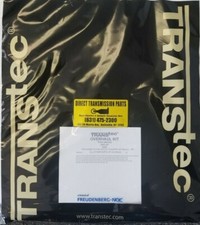
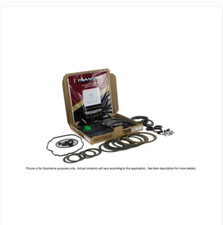
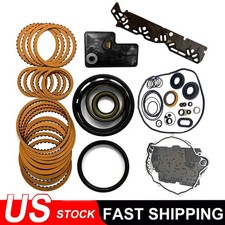
6T70/6T75 Filter and Pan Gasket Kit, GM 24223670
You are dropping this pan at least once and probably three times. Do not reuse the gasket and do not reuse the filter on the final drop — a partly loaded filter is a pressure problem waiting to become a TCC apply problem.
See it in the shop →Step 4: When Fluid Does Not Fix It, Go Hydraulic
If the fluid is fresh and correct and the shudder is still there, the next stop is the valve body — two valves in the upper body, both mapped in Sonnax's Gen. 1 6T70/6T75 vacuum test guide.
TCC Regulator Apply Valve
This valve regulates the pressure that clamps the clutch. Sonnax lists its wear symptoms as codes P0741 and P0742, harsh TCC apply, TCC slip, loss of fuel economy, low TCC apply pressure, and overheated fluid and TCC lining. The mechanism is simple: bore wear lets apply oil leak past the lands, apply pressure never gets high enough to hold the clutch, and the clutch runs in more slip than the TCM commanded. That extra slip makes heat, the heat cooks the fluid, and the cooked fluid makes shudder. The loop feeds itself.
The fix depends on how far gone the bore is. Drop-in kit 124740-31K uses lengthened spools that ride in unworn casting and a modified shuttle valve that engages the regulator directly to keep the train from cocking. For a bore too worn for a drop-in, oversized kit 124740-24K requires reaming with tool kit F-124740-TL24 and the VB-FIX fixture. Both cover Gen. 1 and Gen. 2 6T70/6T75 and the 6T80.
TCC Control Valve
The other one to vacuum test. Sonnax lists its wear symptoms as excess TCC slip, low cooler flow, overheating, low converter and lube flow, TCC apply and release concerns, TCC apply codes and TCC lining failure, with kit 124740-14K as the repair. Note "low cooler flow" in that list — a worn TCC control valve starves the cooler circuit, which is why some of these arrive with a shudder complaint and a heat complaint that the owner thinks are two problems.
Vacuum test both bores before you decide. A low reading means wear; you are not guessing from the outside of an aluminum casting.
Step 5: The Converter, and What Sits Behind It
The 6T75 converter is an EC3 246 mm furnace-brazed unit. Two things about it that will bite you on reassembly:
- It contains a lip seal that is damaged if the converter is removed or installed in any position other than vertical. ATRA calls this out specifically. Carry it flat, hang it off the input shaft at an angle, and you have installed a leak. GM tool J46409 exists for this.
- Check the flex plate from the engine side. Per Ed Lee's converter write-up in Transmission Digest, the pilot is welded to the cover in a way that creates a weak point, and most 6T70/6T75 converters arriving at reman facilities came in with vibration or leak complaints tied to it. When the pilot is cracked, the flex plate usually is too — and on this unit the flex plate carries a thin shim, 0.035 to 0.040 inch, permanently attached at the bolt area that hides cracks until the plate breaks in two. Pull it and look from the engine side.
A cracked pilot reads as a shudder or vibration that no amount of fluid or valve work will touch. It is one of the few times the answer really is "the converter."
Step 6: The Electrical Side, in Two Minutes
Before you condemn hydraulics, confirm the TCC solenoid is capable. It is one of six variable bleed solenoids in the TEHCM, and ATRA publishes the spec: VBS solenoids are positive-duty-cycle controlled at 3000 Hz, 5.5 ohms at 70°F, current limited to 0.9 A, with feed voltage regulated by the TCM at 8.3 to 9.3 volts. The TCC solenoid is normally low: solenoid off, no pressure to the clutch.
Two more things worth knowing on the TEHCM. First, a spring-loaded bracket forces the module against a heat sink on the valve body; leave that bracket out on reassembly and you get TCM thermal shutdown. Second, the module runs a solenoid cleaning cycle every 30 seconds in Park or Neutral, and you can command it with a scan tool — worth running before you tear into a debris complaint.
Debris is the theme here. 18-NA-358 tells you to inspect the ISS and OSS sensors for collected debris, because that is a sign of internal component failure upstream. If the sensors are clean but the valves and bores are scratched, GM says check for final drive bearing failure.
Debris can also hold the converter clutch on instead of making it shudder. GM service update 13120C covers 2013 Enclave, SRX, XTS, Equinox, Malibu, Traverse, Acadia and Terrain with the 6T70/6T75: the TCC solenoid in the TEHCM can stick from debris, fail to release the clutch at the end of a coast-down, pull engine speed below idle and stall the engine. GM's fix was a TCM reprogram with a revised calibration, so on a 2013 with a stall-at-stop complaint, check the calibration before you buy a TEHCM.
How to Keep It From Coming Back
- Service the fluid by condition, not by "lifetime." There is no fill-for-life fluid. On a 6T75 that tows or lives in traffic, 45,000 to 60,000 miles on a pan-and-filter is realistic. The additive package dies long before the base oil looks bad.
- Do not overfill. Set the level per the procedure at the specified fluid temperature. Cold-checking a transverse unit is how you end up half a quart over, aerating fluid, and back to shudder complaints.
- Fix heat. Low cooler flow from a worn TCC control valve, a restricted cooler or a kinked line cooks the additive package on a schedule. If the customer tows, the cooler circuit is part of the repair, not an upsell.
- Replace the filter every time you are in the pan. A loaded filter drops line pressure, and low line pressure shows up first at the TCC circuit.
One tool note: the fill is through a plug low on the case with the vehicle in the air. A hand transfer pump with a long hose turns this into a one-person job..
Filters, pan gaskets, solenoids, valve body kits, DEXRON VI and the tools to do a 6T75 TCC job right — shipped fast from the USA.
Shop 6T75 parts →Sources
- General Motors — Service Bulletin 18-NA-358, "Shudder, 2-3 Upshift or 3-2 Downshift Concern," August 2022 (6T70, 6T75, 6T80). Backs the instruction to validate the concern is not an engine misfire or driveability concern before transmission diagnosis, the instruction to confirm the shudder is not TCC shudder by monitoring TCC slip when TCC is engaged, the first-gear power-brake induce test and its five-second limit to avoid distress to the 1-2-3-4 clutch assembly, the direction not to replace the TEHCM for this condition, the ISS and OSS debris inspection and the final-drive-bearing check when bores are scratched but sensors are clean, and DEXRON VI as the specified refill along with valve body part numbers 24281084 (upper) and 24257450 (lower). nhtsa.gov (PDF)
- General Motors — Service Bulletin 23-NA-072, "Shudders or Shakes at Low Speeds," May 2023. Backs the TCC shudder graphing procedure and its four channels (engine speed, TCC slip speed, engine torque and ISS/turbine speed), the launch test from 0 mph at 15-20 percent pedal up to 30 mph with the condition present at TCC slip under 150 RPM maximum, the ISS peak-to-peak thresholds of under 50 RPM normal, 50-200 RPM degraded and over 200 RPM damaged, and the steady-state TCC slip control test at 30-50 mph for a minimum of 15 seconds with thresholds of below 20 RPM normal, near 60 RPM repeating for degraded and near 100 RPM erratic for damaged. Written for GM's M3W/M3V nine-speed transaxles; the PIDs and the failure signature are the same on the 6T75. nhtsa.gov (PDF)
- General Motors — Service Bulletin 20-NA-142, "Shudder/Surging While Driving," May 2022. Backs GM's own cause statement that the condition may be caused by additives in the transmission fluid having been depleted during vehicle operation and that some of those additives assisted with regulating a consistent slip rate of the clutches, the three-pass drain-and-refill procedure of six quarts of DEXRON VI per pass with the transmission cycled through all six forward ranges plus reverse and neutral between passes, the filter replacement on the final pass, the rule that metallic debris in the pan means converter and filter replacement rather than a fluid service, and the 50,000 km (30,000 mile) ceiling on the flush approach. Written for GM's eight-speed truck applications; the cause statement is the shared mechanism. nhtsa.gov (PDF)
- ATRA — "Introduction to the GM 6T70," ATRA technical seminar material (covers 6T70 and 6T75). Backs the 6T75 rating of 299 lb-ft maximum engine torque and 4,500 lb towing against the 6T70's 280 lb-ft and 1,000 lb, the architecture (five clutches, one diode one-way, clutch-to-clutch shifting, no shift valves, single 456 accumulator, Bosch 32-bit TEHCM inside the case), DEXRON VI as the fill and the design reasons GM moved the family to it (reduced sump volumes, higher fluid turnover rates, increased energy densities, reduced cooling capacity, clutch-to-clutch shifting, roughly 50 percent improvement in film strength), the two on/off shift solenoids and six variable bleed solenoids including TCC, the VBS electrical spec of 3000 Hz positive duty cycle, 5.5 ohms at 70°F, 0.9 A current limit and 8.3-9.3 volt regulated feed, the TCC solenoid being normally low, the EC3 246 mm furnace-brazed converter and its lip seal that is damaged if the converter is handled in any position other than vertical along with tool J46409, the spring-loaded TEHCM heat sink bracket and the thermal shutdown that follows if it is omitted, and the 30-second solenoid cleaning cycle in Park and Neutral. atra.com (PDF)
- Sonnax — "GM 6T70, 6T75 (Gen. 1) Vacuum Test Guide" and the TCC Regulator Valve Kit part pages (124740-31K, 124740-24K). Backs the location of the TCC Regulator Apply Valve and TCC Control Valve in the upper valve body, the TCC Regulator Apply Valve wear symptoms (codes P0741 and P0742, harsh TCC apply, TCC slip, loss of fuel economy, low TCC apply pressure, overheated fluid and TCC lining) and the mechanism of bore wear reducing TCC apply and converter charge pressure, the TCC Control Valve wear symptoms (excess TCC slip, low cooler flow, overheating, low converter and lube flow, TCC apply and release concerns, TCC apply codes, TCC lining failure) and repair kit 124740-14K, the drop-in kit 124740-31K with lengthened spools and modified shuttle valve for moderately worn bores, and the oversized kit 124740-24K with required tooling F-124740-TL24 and VB-FIX, covering Gen. 1 and Gen. 2 6T70/6T75, the 6T80 and Ford 6F50/6F55. sonnax.com
- Transmission Digest — Wayne Colonna, "TCC Vibration, Judder or Shudder Misdiagnosed," June 1, 2017. Backs the point that malfunctioning engine mounts are a common misdiagnosis of converter clutch shudder, the role of liquid-filled electrically or vacuum-controlled mounts in damping cylinder deactivation, the failure mode where a softened or collapsed mount transmits deactivation roughness into the vehicle near the road speed the converter clutch applies, and the diagnostic tell that the shudder occurs at the same moment deactivation engages. transmissiondigest.com
- Transmission Digest — Ed Lee (Sonnax TASC Force), "6T70/75 Converter-Pilot Issues," November 1, 2010. Backs the 6T70/6T75 converter description and its history, the weak point created by how the pilot is welded to the cover, the observation that most of these converters arriving at reman facilities came in with vibration and/or leak complaints, the correlation between a cracked or broken pilot and a cracked or broken flex plate, the 0.035 to 0.040 inch shim permanently attached at the flex plate mounting-bolt area that hides cracks until the plate breaks in two, and the requirement to remove the flex plate and inspect it from the engine side. transmissiondigest.com
- General Motors — Service Update Bulletin 13120C, "Torque Converter Clutch Sticking," May 2014 (via NHTSA). Backs the 2013 Enclave, SRX, XTS, Equinox, Malibu, Traverse, Acadia and Terrain 6T70/6T75 coverage, the TCC solenoid in the TEHCM sticking because of debris, the failure to release the converter clutch at the end of a coast-down with engine speed pulled below idle and a possible stall, and the TCM reprogram with a revised calibration as the correction. static.nhtsa.gov (PDF)