This comparison trips people up because they expect the answer to look like 4L60E versus 4L80E, where you are looking at two genuinely different transmissions. That is not what is going on here. The 6T70 and the 6T75 are the same transmission with different duty gearing behind it, and if you order parts as though they are separate units you will waste money and time.
The question that actually matters on the bench is not 70 versus 75. It is Gen. 1 versus Gen. 2. Get that wrong and nothing fits, no matter which number is on the tag.


The short version
Same gear train, same clutch names, same pump, same TEHCM architecture, same fluid. The 6T75 is the higher-duty application tier of the 6T70, put behind heavier crossovers with different final drive gearing and calibration. Sonnax covers both under a single Gen. 1 identification chart, with the same year-by-year valve body changes applying to each, which tells you most of what you need to know about how closely related they are.
The real dividing line runs across both models: GM rolled a major controls package into the 6T70 and 6T75 for the 2013 model year and phased it in over two years, so 2013 and 2014 units exist as both Gen. 1 and Gen. 2. Sonnax is blunt about it: most of those updates are not designed to back-service previous Gen. 1 applications.
What is identical
Per the Sonnax service handout for this family, both units share:
- Six forward speeds, five clutches (three stationary, two rotating) with compensator pistons on the two rotating clutches, plus a diode-style one-way clutch.
- A remote-mounted, off-axis, chain-driven vane-type oil pump. This is why chain stretch and pump feed problems show up on both.
- The TEHCM mounted inside the transaxle, carrying eight solenoids, the transmission fluid temperature sensor, and on Gen. 1 four pressure switches.
- DEXRON-VI fluid. The Ford cousins, the 6F50 and 6F55, take Mercon V instead, which is a real trap when you are pulling parts across the two families.
- The same clutch nomenclature: 1-2-3-4, 2-6, 3-5-Reverse, 4-5-6 and Low/Reverse. Ford calls the same clutches Forward, Intermediate, Direct, Overdrive and Low/Reverse.
Gear ratios and final drive
The ratio set is common to the family. These are GM's own launch numbers for the Hydra-Matic six-speed:
| Gear | Ratio |
|---|---|
| 1st | 4.48 |
| 2nd | 2.87 |
| 3rd | 1.84 |
| 4th | 1.41 |
| 5th | 1.00 |
| 6th | 0.74 |
| Reverse | 2.88 |
Since the ratios are shared, the gearing difference between a 6T70 car and a 6T75 crossover lives in the final drive. Sonnax lists the effective 6T final drive ratios as GW5 at 3.16, F07 at 3.39, D70 at 2.77 and F71 at 2.44 to 1. That spread is what changes launch feel, cruise rpm and speedometer calibration when somebody drops a donor unit into a car it did not come in.
GM's launch material rates the transmission at 380 lb-ft of maximum gearbox torque, with 258 mm of torque converter and a wet weight of 102 kg, roughly 273 lb. Fluid is DEXRON-VI at 9.0 liters, about 9.5 quarts, for a dry overhaul fill.
GM's own service data carries the ratios to three places: 4.484, 2.872, 1.842, 1.414, 1.000 and 0.742, with 2.88 reverse, and lists effective final drives of 2.77, 3.16 and 3.39 (per GM service information, Transmission General Specifications). The same page lists a 246 mm converter turbine diameter, which is a different measurement from the overall converter size above. On capacity, ATRA's 6T70 introduction rates the 6T70 at 280 lb-ft and the 6T75 at 299 lb-ft of engine torque, both at 300 hp, with towing ratings of 1,000 lb and 4,500 lb. The full ratio, final drive and apply-chart breakdown is in our 6T70 gear ratios and specs guide.
How to actually tell them apart
Do not go by the casting. Go by the RPO code on the Service Parts Identification placard, which sits in the glove box, and sometimes in the trunk or door jamb. Sonnax publishes the mapping:
| Unit | AWD RPO | FWD RPO |
|---|---|---|
| 6T70 | MH4, M7U | MH2, M7W |
| 6T75 | MH6, M7X | MY9, M7V |
| 6T80 | MHM | |
M7U, M7W, M7X, M7V and MHM are the Gen. 2 codes. Sonnax notes they are not designed to be interchanged with Gen. 1 applications. All transmission RPO codes start with M, but not every M code is a transmission code, so match it against the engine and year range before you order anything.
GM's own paperwork lines up with that split. Bulletin 18-NA-358 (August 2022), which covers 2-3 and 3-2 shudder on the 6T70, 6T75 and 6T80, lists M7V/M7X on the 2014-2017 Enclave and Traverse, M7U/M7W on the LaCrosse, Regal, SRX, Equinox, Terrain, Impala and Malibu, and both pairs on the 2014-2019 Acadia. Its parts list is a good reminder that the RPO drives the part number: the valve body kit is 24264343 for M7V, M7U, M7X and M7W, but 24268463 for the MHM 6T80 in the XTS. Earlier units show up the same way in GM bulletin 09-07-30-012F, which covers 2007-2009 applications "equipped with 6T70/75 6-Speed Automatic Transmission (RPOs MH2, MH4, MH6 or MY9)."
You can also read the unit itself. The code below the bar code decodes in order: transmission code, model year digit, transmission model, family, plant source, calendar year, Julian date, assembly shift and build time. Position five is the plant: 4 is Ramos, Mexico; H is Ypsilanti; J is Windsor; W is Warren; Y is Toledo; S is Strasbourg; R is Boryeong, Korea.
Gen. 1 versus Gen. 2, the difference that costs money
Inside the valve body, the generations are not close. Sonnax's teardown comparison lays out what changed in 2013:
- Pressure switches gone. Gen. 1 TEHCMs carry four; Gen. 2 has none and uses clutch pulse learn instead.
- Solenoid type changed from variable bleed on Gen. 1 to variable feed on Gen. 2.
- Pressure regulator valve rebored. The Gen. 1 valve is bored down the center, the Gen. 2 valve is not, to suit a new balance orifice in the separator plate. That single change is why Gen. 1 and Gen. 2 separator plates are not interchangeable.
- Six solenoid dampers instead of three. Gen. 1 damped actuator feed pressure into the solenoids; Gen. 2 damps the output of each linear pressure control solenoid.
- A tenth checkball. Gen. 1 has nine. The Gen. 2 No. 10 checkball meters the compensator feed circuit, which on Gen. 2 is fed off the converter feed circuit through an orifice rather than off orificed line pressure.
- Clutch pack changes. The Gen. 2 1-2-3-4 pack went from seven plates to nine thinner plates with more wave, identified by half-moon teeth. The 3-5-R snap ring groove moved 0.25 mm and the drum holes were reoriented 30 degrees.
Even within Gen. 1 the valve bodies changed by year, and this is the chart worth taping to the bench. Sonnax's Gen. 1 6T70 and 6T75 identification chart calls it by the 3-5-R clutch regulator valve ratio and the plate features: 2007 and 2008 use a 1.35 ratio valve with a cut-out lower plate, no notch upper, closed exhaust port; 2009 uses a 1.83 ratio valve with a notched lower plate and closed exhaust port; 2010 and 2011 use 1.83 with a circle-hole lower plate and open exhaust port; 2012 and 2013 add a raised notch above the valve body on the control valve channel plate.
Building either one? Start with the clutch pack
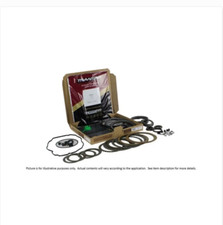
On a 2007 to 2012 core the friction module is where the money goes, because the 3-5-R plate takes the drum splines with it when it lets go. Both of these ship through our sister store, Core Transmission Parts.
6T70 friction clutch kit, 2007-2012 →The failure that defines both units
The 3-5-Reverse waved plate breaks. Sonnax describes it as a problem anyone who has worked on Gen. 1 6T40/45/50 and 6T70/75 units already knows, chronic on 2007 to 2009 builds and not uncommon after that. When the plate comes apart it usually damages the drum splines, and now you are buying a housing instead of a plate.
The mechanism is fatigue at a stress riser. Every broken original plate Sonnax studied separated at exactly a tooth corner. GM's read was that the plates were insufficiently stress relieved and shot-peened them in response, releasing updated part numbers for the 2012 model year: 1-2-3-4 waved plate 24259063, 2-6 waved plate 24259816, 3-5-Reverse waved plate 24254103 and Low/Reverse waved plate 24259817. Those plates back-service earlier years and the same parts cover all models in the family.
Sonnax's own guidance on scope is worth following: on a 2011 or earlier unit, update all of the waved plates; on a 2012 or later unit, replace the 3-5-R plate. And be aware that shot-peening did not close the case. Sonnax reports both stock and rebuilt units running the updated plate still failing in the field, which is why the toothless drum saver design exists.
One more detail that explains why this is a GM problem and not a Ford one: asked directly why waved plates break in the GM applications but not the Ford ones, Sonnax answered that Ford's waved plates, clutch packs and drums are designed differently for the 3-5-R clutch.
Diagnosing a Gen. 1 unit on the scan tool
Gen. 1 gives you something Gen. 2 does not: four hydraulic pressure switches you can watch. Sonnax documents what they monitor and how they read. Switch 1 watches the 1-2-3-4 clutch regulator valve, switch 2 the 3-5 and Reverse regulator, switch 3 the 2-6 regulator, and switch 4 the R1/4-5-6 regulator. All are normally closed. They open at about 8 psi (55 kPa) and close at about 12 psi (82 kPa), so pressure present reads low on the scan tool and no pressure reads high.
That is a genuine diagnostic asset and also a common failure point. The films delaminate and waffle, debris gets past the seal, and you end up with P0752, P0872, P0877 and P0989, often with a trip to limp mode. Before you condemn a TEHCM, work out whether the codes are tracking the pressure switch films or the clutch itself. A broken 3-5-R plate sets clutch pressure control performance codes and speed sensor codes at the same time, because the debris travels.
Solenoid to valve mapping on this family, again from Sonnax: shift solenoid 1 works clutch select valve 2; shift solenoid 2, which Sonnax lists as 6T70 only, works clutch select valve 3; PCS1 is line pressure; PCS2 is the 3-5-Reverse clutch regulator; PCS3 is R1/4-5-6; PCS4 is 2-6; PCS5 is 1-2-3-4.
Assembly note that bites people: the TEHCM uses a spring-loaded bracket to force the module against a heat sink on the valve body. Leave it out and the module goes into thermal shutdown. That is a comeback you will not find electrically.
The converter and flex plate, on both units
Ed Lee, writing for Transmission Digest, documents a converter issue that applies across the 6T70/75 family. The converter is a four-element unit built by ZF Sachs as a joint GM and Ford effort, which is why you can find a GM vehicle with a four-mounting-pad converter. The way the pilot is welded to the cover creates a weak point, and most of these converters arriving at reman facilities carry vibration or leak complaints traced there.
The part that costs shops warranty work: when the converter pilot is cracked or broken, the flex plate usually is too, and it is hard to see. The flex plate carries a thin shim, 0.035 to 0.040 in., permanently attached at the mounting bolt area, and it hides cracks until the plate breaks into two pieces. You cannot inspect it properly from the transmission side. Pull it and look at both faces.
Fluid
DEXRON-VI, and only DEXRON-VI. The specification is licensed by GM, and licensed DEXRON-VI is backward compatible into transmissions that called for earlier DEXRON grades, but the reverse is not true. A representative licensed DEXRON-VI runs about 5.95 cSt at 100 degrees C and 29.0 cSt at 40 degrees C with a viscosity index around 155. Putting a thicker legacy DEXRON III into one of these units changes clutch fill behavior and TCC apply on a transmission calibrated around the thinner fluid.
Interchange, honestly
Between a 6T70 and a 6T75 of the same generation, most of the gear train, valve body and control parts are shared, and the parts catalogs reflect that. What does not casually swap is the final drive and the module. Order the TEHCM by VIN. Sonnax's Jim Mobley describes what he calls follower syndrome, where a shop matches the part number on the module it pulled out and simply repeats somebody else's earlier mistake. A module built for the wrong generation can program like nothing is wrong and then behave like a haunted transmission.
Across to Ford, the 6F50 and 6F55 share the architecture but differ in case, final drive, TCM location and design, converter, one-way clutch, solenoid pack design and solenoid count, clutch packs and waved plates, the 3-5-R and 4-5-6 drum, and fluid. Some hard parts cross. Controls do not.
So which is stronger?
The 6T75, but the honest answer is that it is stronger by application rather than by architecture. Same ratios, same clutch layout, same failure mode, same rebuild. If you are picking a core to build, sort by generation and year first and by RPO code second, because a clean 2014 Gen. 2 core is worth more to you than either model number on its own.
Master rebuild kits, friction and steel packs, valve bodies, TEHCMs, solenoid kits, pumps and filters for the 6T70. Working the heavier side instead? Start at the 6T75 parts page.
Shop 6T70 parts →Shop 6T70 clutch parts → or browse all shift kits
FAQ
Is the 6T75 just a stronger 6T70?
It is the higher-duty member of the same family, not a different design. Sonnax documents both under one Gen. 1 identification chart, with the same year-by-year valve body and separator plate changes, the same clutch names, the same TEHCM architecture and the same chain-driven off-axis vane pump. What changes between them is duty: final drive, converter, differential and calibration for the heavier crossovers the 6T75 was put behind. Treat them as one unit with two application tiers, and let the RPO code tell you which one you actually have.
How do I tell a 6T70 from a 6T75 without pulling the pan?
Use the RPO code off the Service Parts Identification placard, which lives in the glove box and sometimes the trunk or door jamb. Per the Sonnax service handout, a 6T70 is MH4 or M7U in all-wheel drive and MH2 or M7W in front-wheel drive, while a 6T75 is MH6 or M7X in all-wheel drive and MY9 or M7V in front-wheel drive. The 6T80 is MHM. Transmission RPO codes all begin with M, but not every M code is a transmission code, so match it against the engine and year range.
Which matters more, 6T70 versus 6T75 or Gen. 1 versus Gen. 2?
Generation, by a wide margin. GM rolled the controls package into the 6T70 and 6T75 for 2013 and phased it in over two model years, so 2013 and 2014 units exist in both flavors. Gen. 2 deleted the four TEHCM pressure switches, changed the solenoids from variable bleed to variable feed, added a tenth checkball, rebored the pressure regulator valve and moved to an incompatible separator plate. Sonnax states most of those updates are not designed to back-service Gen. 1. Order by the wrong generation and the parts will not work even if the model number on the invoice is right.
Will a 6T75 bolt into a car that came with a 6T70?
Mechanically it is the same case family, but the swap is a control and gearing problem, not a bolt-up problem. Final drive is the variable: Sonnax lists 6T effective final drives of 2.44, 2.77, 3.16 and 3.39 to 1 across the family, so a donor unit can change your speedometer calibration, shift points and cruise rpm. The TEHCM also has to match the generation and the VIN. Order the module by VIN rather than by the part number stamped on the one you pulled out.
What breaks first in a 6T70 or 6T75?
The 3-5-Reverse waved plate. Sonnax found that every broken original plate it studied separated at a tooth corner, and when the plate lets go it usually takes the drum splines with it. GM shot-peened the plate and released new part numbers for 2012, but Sonnax reports both stock and rebuilt units with the updated plate still failing in the field. On a 2011 or earlier unit, update all four waved plates. On a 2012 or later unit, the 3-5-R plate is the one to replace.
Related guides
- GM 6T70/6T75 Service Guide: Chain Wear, Valve Body Issues, and What Shops Need to Know
- 6T70 Limp Mode: Causes and How to Diagnose It
- 6T70 Slipping Under Load: Root Causes and Fixes
- 6T75 Torque Converter Shudder: Diagnosis and Fix
- GM 6T40 / 6T45 Wave Plate Failure: Why P0776 Is Not Just a Solenoid
- 62TE vs 6T70: Differences, Interchange and Which Is Stronger
Sources
- Sonnax — "GM Gen. 1 6T70/75/80, Ford 6F50/55 Concerns & Repair Techniques," technical webinar handout. Backs the RPO code table (6T70 MH4/M7U AWD, MH2/M7W FWD; 6T75 MH6/M7X AWD, MY9/M7V FWD; 6T80 MHM) and the note that M7U, M7W, M7X, M7V and MHM are Gen. 2 and not designed to interchange with Gen. 1; the 6T effective final drive ratios of 3.16, 3.39, 2.77 and 2.44; the five-clutch, one-diode layout and the remote off-axis chain-driven vane pump; the Gen. 1 pressure switch assignments with 8 psi open and 12 psi closed thresholds and DTCs P0752, P0872, P0877 and P0989; the solenoid-to-valve map; the TEHCM heat sink bracket and thermal shutdown warning; the 2012 waved plate part numbers 24259063, 24259816, 24254103 and 24259817; the 2013 Gen. 2 controls package and its two-year phase-in; the ID code and plant source decoding; and the Ford 6F50 differences including Mercon V fluid. Sonnax webinar handout, PDF
- Sonnax — "GM Gen. 1 6T70 & 6T75 Identification Guide." Backs the year-by-year Gen. 1 chart: a 1.35 ratio 3-5-R clutch regulator valve for 2007 and 2008, 1.83 ratio from 2009 on, and the lower and upper separator plate, exhaust port and control valve channel plate features that identify 2007-08, 2009, 2010-11 and 2012-13 units. Also confirms Gen. 1 6T70 and 6T75 units share one identification chart. sonnax.com
- Sonnax — "The Greatest Generation: How Small Changes Led to the New Form & Function of Gen. 2 6T70/75 Valve Bodies." Backs the Gen. 1 to Gen. 2 valve body changes: pressure switch removal, the center-bored versus solid pressure regulator valve and the resulting separator plate incompatibility, three solenoid dampers becoming six, and the addition of the No. 10 checkball metering the compensator feed circuit. sonnax.com
- Sonnax — "GM 6T40 & 6T70 Drum Saver Kits: Unbeatable Protection Against 3-5-R Failures & Comebacks." Backs the 3-5-R waved plate failure mechanism: chronic on 2007-09 units and present later, drum spline damage on failure, every studied original plate separating at a tooth corner, GM's shot-peening response, and continued field failures on stock and rebuilt units using the updated plate. sonnax.com
- Sonnax — "Under Pressure: Shift Quality & Pressure Switches in TEHCM Applications." Backs the four Gen. 1 pressure switches, their normally-closed operation and role in gear selection and clutch timing, the film delamination and contamination failure mode, and the DTC set that results. sonnax.com
- Sonnax — Jim Mobley, "Identifying GM 6T70 Series TEHCM Generations Using VIN & RPO Codes." Backs the RPO placard locations, the warning that a module designed for Gen. 2 will not work properly in a Gen. 1 build, and the practice of ordering the module by VIN rather than by the part number on the removed unit. sonnax.com
- Transmission Digest — Ed Lee, "6T70/75 Converter-Pilot Issues." Backs the 2007 introduction of the 6T70/75, the four-element ZF Sachs converter built as a joint Ford and GM effort with three, four or six mounting pads, the pilot-to-cover weld as a weak point causing vibration and leaks, and the flex plate crack detection problem including the 0.035 to 0.040 in. shim that hides cracks. transmissiondigest.com
- General Motors — Hydra-Matic 6T70 six-speed launch specifications. Backs the gear ratios 4.48 / 2.87 / 1.84 / 1.41 / 1.00 / 0.74 with 2.88 reverse, 380 lb-ft maximum gearbox torque, the 258 mm torque converter, 102 kg wet weight, and DEXRON-VI fluid at 9.0 liters. GM release text
- Lubrication Engineers — DEXRON-VI Automatic Transmission Fluid (1136) product data sheet. Backs the DEXRON-VI licensing arrangement, backward compatibility into transmissions specified for earlier DEXRON grades, and the representative licensed viscosity figures of 5.95 cSt at 100 degrees C, 29.0 cSt at 40 degrees C and a viscosity index of 155. lelubricants.com, PDF
- General Motors — Service Bulletin 18-NA-358, "Shudder, 2-3 Upshift or 3-2 Downshift Concern," August 2022 (6T70, 6T75, 6T80, via NHTSA). Backs the 2014-2019 RPO-by-vehicle list (M7V/M7X on Enclave, Traverse and Acadia; M7U/M7W on LaCrosse, Regal, SRX, Equinox, Terrain, Impala, Malibu and Acadia; MHM on XTS) and valve body kits 24264343 (M7V, M7U, M7X, M7W) and 24268463 (MHM). static.nhtsa.gov (PDF)
- General Motors — Service Bulletin 09-07-30-012F, October 2012 (via NHTSA). Backs the 2007-2009 application list for 6T70/75 units with RPOs MH2, MH4, MH6 or MY9. static.nhtsa.gov (PDF)
- GM service information (Saab 9-4X, Automatic Transmission 6T70/6T75) — Transmission General Specifications. Backs the three-decimal gear ratios, the 2.77 / 3.16 / 3.39 effective final drives, the 246 mm converter turbine diameter and the RPO codes. saabwisonline.com
- ATRA — "6T70 Introduction" technical seminar. Backs the 280 lb-ft (6T70) and 299 lb-ft (6T75) torque ratings, the 300 hp limit, and the 1,000 lb and 4,500 lb towing ratings. atracom.blob.core.windows.net (PDF)