Most "6T70 specs" pages give you six ratios rounded to two places and stop there. That is fine for a spec sheet. It is not enough when you are sitting in a Traverse with a scan tool trying to decide whether the unit is slipping, or when somebody hands you a donor transmission from an Impala for an Acadia and asks if it will bolt in and read right.
This is the full reference set for the GM Hydra-Matic 6T70 and 6T75: the exact ratios from GM service information, what the final drive numbers mean, which clutches and solenoids make each gear, GM's calibrated shift points with the output speed sensor RPM at each one, torque ratings, fluid capacities, and the fastener torques you actually need on a valve body or R&R job. Every number comes from GM service information or ATRA training material, listed in the Sources at the end.


The 6T70/6T75 at a glance
The 6T70 is GM's six-speed, transverse, front-drive and all-wheel-drive automatic, co-developed with Ford (Ford's version is the 6F50/6F55). GM's general description calls it a 4-element torque converter, a compound planetary gear set, five multiple-disc clutches plus one one-way clutch, and an internal transmission control module packaged with all the solenoids in one control solenoid valve assembly (the TEHCM). The 6T75 is the same architecture sized up for more torque; GM notes the component differences between the two are "primarily related to size."
| Item | 6T70 | 6T75 |
|---|---|---|
| RPO code, 2WD | MH2 | MY9 |
| RPO code, AWD | MH4 | MH6 |
| Maximum engine torque (ATRA) | 280 lb-ft | 299 lb-ft |
| Maximum horsepower (ATRA) | 300 hp | 300 hp |
| Rated towing (ATRA) | 1,000 lb (454 kg) | 4,500 lb (2,041 kg) |
| Converter turbine diameter | 246 mm | |
| Case | Die-cast aluminum | |
| Fluid | DEXRON-VI | |
| Total (overhaul) fill | 9.0 L / 9.5 qt nominal; 7.0-9.0 L approximate | |
| Built | Warren, Michigan and Ramos, Mexico | |
The ATRA 6T70 introduction lists what makes a 6T75 the heavy-duty version: a shot-peened output carrier, a 5-pinion carrier, a wider transfer gear, a heavier differential carrier and a more heavily ribbed case. The ratios do not change. That is why you cannot identify a 6T75 by gearing; you identify it by RPO code and hard parts.
Generation matters as much as model. Sonnax's 6T70/75/80 identification guide splits these units into Gen 1 (6T70, 6T75) and Gen 2 (6T70, 6T75, 6T80), with different separator plates and castings, and notes the 6T80 exists only as a Gen 2 unit. Sonnax also warns in its TEHCM identification article that going only by the serial ID on the TEHCM you pull is not always reliable, that RPO codes are not always distinct per generation or year, and that a Gen 2 module will not work properly in a Gen 1 build. Read the Service Parts Identification label in the glove box, trunk or door jamb before you order a valve body or TEHCM.
Exact gear ratios
GM's Transmission General Specifications and its Shift Solenoid Valve State and Gear Ratio chart both carry the ratios to three decimal places. Use these, not the rounded launch numbers, when you are doing ratio math off scan data.
| Gear | Ratio | Step to next gear |
|---|---|---|
| 1st | 4.484 | 1.56 |
| 2nd | 2.872 | 1.56 |
| 3rd | 1.842 | 1.30 |
| 4th | 1.414 | 1.41 |
| 5th | 1.000 | 1.35 |
| 6th | 0.742 | — |
| Reverse | 2.88 | — |
Divide 1st by 6th and you get a 6.04 overall spread. For comparison, the ATRA training deck lines the 6T70 up against the 4T65-E it replaced in many of these vehicles: 2.92 first, 1.57 second, 1.00 third, 0.70 fourth and 2.39 reverse. The 6T70 starts 54 percent deeper in 1st and still has a taller top gear than the old 4-speed's 3rd. Fifth is direct drive at 1.000, which matters for diagnosis, as you will see below.
Final drive: what "effective" means
A transverse 6T70 does not have a single ring-and-pinion ratio you can count teeth on. Output from the planetary set goes through a transfer drive gear, a transfer driven gear and then the differential. GM rolls those into one number it calls the effective final drive ratio. The general specifications list three: 2.77, 3.16 and 3.39. The Saab 9-4X shift-speed data is calibrated to 3.16.
Multiply through and the overall ratios look like this:
| Gear | x 2.77 | x 3.16 | x 3.39 |
|---|---|---|---|
| 1st | 12.42 | 14.17 | 15.20 |
| 2nd | 7.96 | 9.08 | 9.74 |
| 3rd | 5.10 | 5.82 | 6.24 |
| 4th | 3.92 | 4.47 | 4.79 |
| 5th | 2.77 | 3.16 | 3.39 |
| 6th | 2.06 | 2.34 | 2.52 |
| Reverse | 7.98 | 9.10 | 9.76 |
This is the number that bites people on used-unit swaps. Two 6T70s with the same RPO can carry different transfer gear sets. Put a 2.77 unit in a vehicle calibrated for 3.16 and the TCM's expected output speed no longer matches wheel speed from the ABS module. You get a speedometer that reads 12 to 14 percent off, shift points in the wrong place, and on some platforms speed-sensor correlation codes. Match the final drive on the donor before it goes in, not after the customer complains.
What applies in each gear
The 6T70 is clutch-to-clutch on every shift except 1-2, where the low one-way clutch overruns. ATRA lists five clutches: 1-2-3-4, 2-6, 3-5-Reverse, 4-5-6 and Low and Reverse, plus the low one-way clutch. GM's solenoid state chart shows which pressure control solenoid is pressurized in each range, which tells you exactly which clutch is doing the work:
| Range | SS1 | SS2 | PCS5 (1-2-3-4) | PCS4 (2-6) | PCS2 (3-5-R) | PCS3 (LR / 4-5-6) | Holding |
|---|---|---|---|---|---|---|---|
| Park / Neutral | ON | ON | OFF | OFF | OFF | ON | Low and Reverse |
| Reverse | ON | OFF | OFF | OFF | ON | ON | 3-5-R + Low and Reverse |
| 1st (braking) | ON | ON | ON | OFF | OFF | ON | 1-2-3-4 + Low and Reverse |
| 1st | OFF | ON | ON | OFF | OFF | OFF | 1-2-3-4 + low one-way clutch |
| 2nd | OFF | ON | ON | ON | OFF | OFF | 1-2-3-4 + 2-6 |
| 3rd | OFF | ON | ON | OFF | ON | OFF | 1-2-3-4 + 3-5-R |
| 4th | OFF | ON | ON | OFF | OFF | ON | 1-2-3-4 + 4-5-6 |
| 5th | OFF | ON | OFF | OFF | ON | ON | 3-5-R + 4-5-6 |
| 6th | OFF | ON | OFF | ON | OFF | ON | 2-6 + 4-5-6 |
Two details from the chart are worth knowing cold. First, PCS3 feeds either the Low and Reverse clutch or the 4-5-6 clutch; the ATRA deck explains that shift solenoid 1 controls clutch select valve 2 and shift solenoid 2 controls clutch select valve 3, and those select valves decide where PCS3 oil goes. Second, "ON" and "OFF" on this chart describe hydraulic state, not the electrical command. PCS2 and PCS3 are normally high, so "OFF" in hydraulic terms is the solenoid being driven electrically. Read the chart that way or your electrical testing will not make sense.
The chart is also a diagnostic shortcut. The 1-2-3-4 clutch carries 1st through 4th, so a worn 1-2-3-4 pack slips in the lower four gears and is fine in 5th and 6th. The 3-5-Reverse clutch shows up in 3rd, 5th and Reverse together, which is why a 3-5-R failure usually arrives as "no reverse and it flares on 2-3." The 4-5-6 clutch shows up only from 4th up.
Shift points and output speed, from GM's table
GM publishes calibrated shift points with the output speed sensor RPM at each, based on the 3.16 effective final drive and a production tire. At 12.5 percent throttle:
| Upshift | mph | OSS RPM | Downshift | mph | OSS RPM |
|---|---|---|---|---|---|
| 1-2 | 9.9 | 345 | 2-1 | 6.8 | 237 |
| 2-3 | 16.2 | 561 | 3-2 | 14.3 | 496 |
| 3-4 | 24.5 | 852 | 4-3 | 22.4 | 776 |
| 4-5 | 33.6 | 1,164 | 5-4 | 31.7 | 1,100 |
| 5-6 | 44.1 | 1,531 | 6-5 | 42.6 | 1,477 |
At 25 percent throttle the 1-2 moves to 13.4 mph (464 OSS RPM), the 4-5 to 39.8 mph and the 5-6 all the way to 71.5 mph (2,479 OSS RPM). GM is explicit that these move with throttle position, engine coolant temperature, transmission fluid temperature, cruise, hot mode and engine torque, so use them as a sanity check, not a pass-fail line. A unit that will not upshift until 20 mph at light throttle with warm fluid is worth a closer look; one that shifts a couple of mph off the table is not.
The table gives you a handy constant: on a 3.16 vehicle, OSS runs about 34.7 RPM per mph (1,531 divided by 44.1). That lets you do real ratio math on the road.
Using the ratios on the scan tool
Divide Transmission ISS by Transmission OSS with the torque converter locked and steady throttle, and you should land on the gear ratio. At 60 mph in 6th on a 3.16 vehicle, OSS is about 2,080 RPM, so ISS should be about 1,545 RPM (2,080 x 0.742), and with TCC slip near zero, engine RPM should match it. In 5th, ISS and OSS should read the same, because 5th is 1.000. That makes 5th the quickest check there is: if ISS is running above OSS in 5th with the converter locked, something is slipping.
Pair the calculated ratio with the chart above. Ratio high in 1st through 4th but correct in 5th and 6th points at the 1-2-3-4 clutch. Ratio drifting in 3rd and 5th points at 3-5-R. Ratio correct everywhere but engine RPM above ISS points at the converter clutch, not the gear train. Always set the fluid level hot at the check plug, per GM's procedure, before you condemn a clutch.
Fluid capacities
| Service | Metric | US |
|---|---|---|
| Drain plug fluid change | 4.0-6.0 L | 4.2-6.3 qt |
| Valve body cover removal | 5.0-7.0 L | 5.3-7.4 qt |
| Overhaul (dry) | 7.0-9.0 L | 7.4-9.5 qt |
DEXRON-VI only. These are approximate fill amounts to get you close; the level is always set hot at the check plug, not by pouring in a number. A drain-and-fill replaces well under half the fluid in the unit, so a badly degraded fill needs more than one exchange.
Fastener torque specs you actually need
| Fastener | Torque |
|---|---|
| Control valve body cover bolts and studs | 12 N·m (106 lb-in) |
| Control valve body to case, and control valve assembly (with TCM) to case | 12 N·m (106 lb-in) |
| Case cover bolts | 12 N·m (106 lb-in) |
| Fluid level hole plug and pressure test hole plug | 12 N·m (106 lb-in) |
| Input speed sensor bolt | 9 N·m (80 lb-in) |
| Output speed sensor bolt | 12 N·m (106 lb-in) |
| Transfer drive gear support bolts | 10 N·m (89 lb-in) plus 50 degrees |
| Converter and differential housing bolts | 36 N·m (27 lb-ft), 3 bolts at 30 N·m (22 lb-ft) |
| Torque converter to flywheel | 62 N·m (46 lb-ft) |
| Transaxle to engine | 75 N·m (55 lb-ft) |
| Cooler fitting at radiator / quick-connect | 38 N·m (28 lb-ft) |
| Cooler pipe nut | 22 N·m (16 lb-ft) |
Almost everything inside the side cover is an M6 bolt at 12 N·m, but the valve body and control valve assembly bolts come in at least six lengths from 30 mm to 95 mm. Lay them out in the cover as they come off. A 95 mm bolt in a 55 mm hole will bottom out and read as torqued while leaving the body loose, and a loose TEHCM is a leak-down and pressure-switch complaint waiting to happen. The ISS bolt is the one exception at 9 N·m. One note on the source: GM's table prints the cooler pipe nut as "228 Nm" next to 16 lb-ft. That is a typo; 16 lb-ft is 22 N·m.
The transfer drive gear support bolts are torque-plus-angle. Treat them like any torque-to-yield fastener and do not reuse stretched bolts.
Need parts for this job?
6T70/6T75 filter and pan gasket kits, magnetic drain plugs, valve bodies and Gen 1 and Gen 2 master rebuild kits, shipped from the USA.
Shop 6T70 parts →6T70 Gen 2 master rebuild kit at Core Transmission Parts →
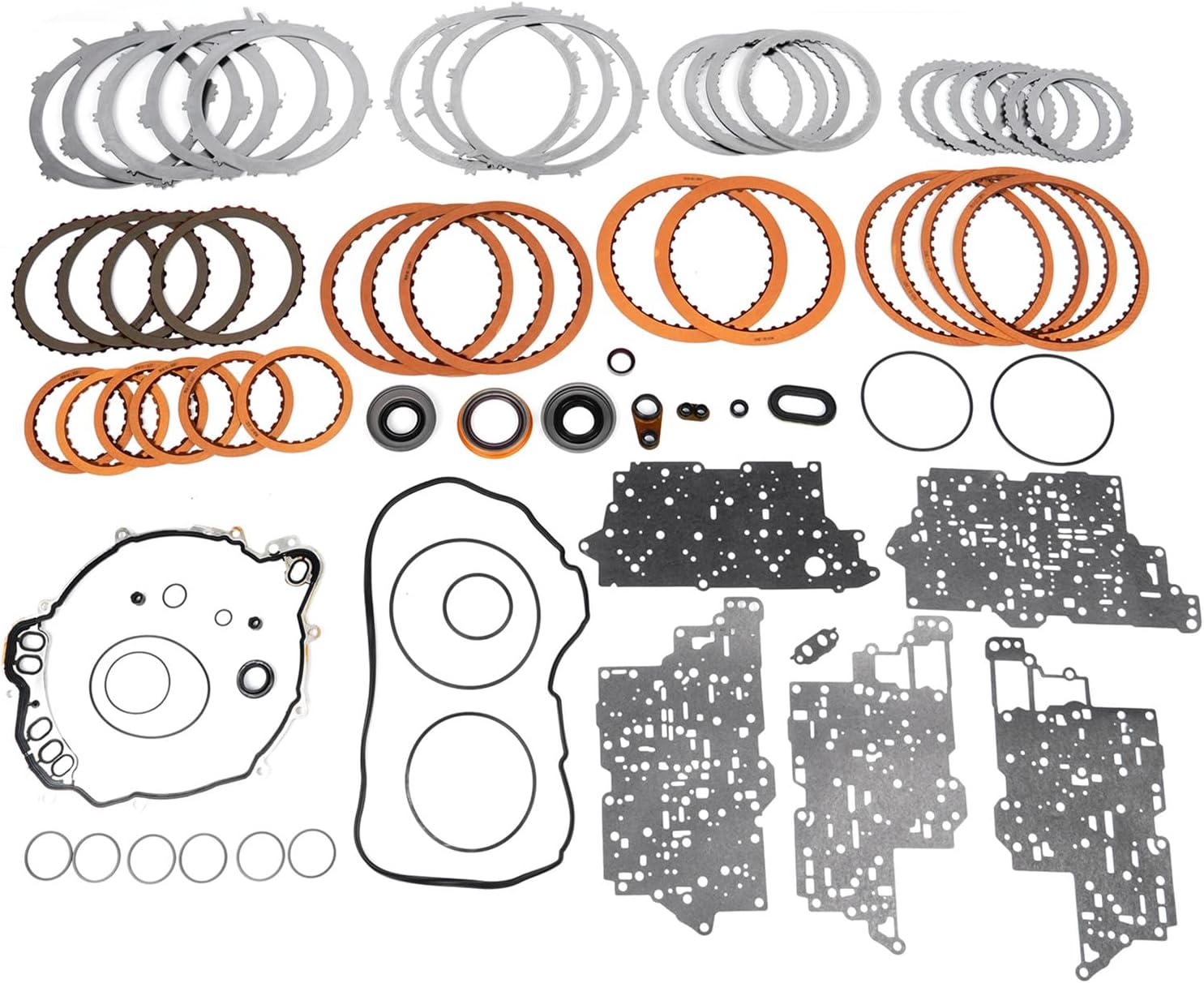
6T70 Gen 1 Master Rebuild Kit
For 2007-2012 units: Gen 1 frictions, seals and gaskets matched to Gen 1 hardware so clutch clearances come out right. Looking for something else? Browse all 6T70 parts.
View the Gen 1 kit →FAQ
What are the 6T70 gear ratios?
Per GM service information, the 6T70 and 6T75 share the same ratios: 4.484 first, 2.872 second, 1.842 third, 1.414 fourth, 1.000 fifth, 0.742 sixth and 2.88 reverse. That is a 6.04 overall spread. Fifth is direct drive, which makes it the easiest gear to check for slip on a scan tool.
Do the 6T70 and 6T75 have different gear ratios?
No. The ratios are identical. The 6T75 is the heavy-duty version with a shot-peened output carrier, a 5-pinion carrier, a wider transfer gear, a heavier differential carrier and a more heavily ribbed case. Gearing differences between vehicles come from the effective final drive, not the gear set.
What final drive ratios does the 6T70 use?
GM lists effective final drive ratios of 2.77, 3.16 and 3.39. The number combines the transfer drive gear, transfer driven gear and differential. Match it when swapping a used unit, or the speedometer and shift points will be off.
How much torque can a 6T70 handle?
ATRA's 6T70 training material rates the 6T70 at 280 lb-ft of engine torque and the 6T75 at 299 lb-ft, both at 300 hp. Rated towing is 1,000 lb for the 6T70 and 4,500 lb for the 6T75.
How much fluid does a 6T70 hold?
GM lists about 9.0 L (9.5 qt) of DEXRON-VI for a dry overhaul, 4.0-6.0 L for a drain plug fluid change and 5.0-7.0 L when the valve body cover is removed. Those are approximate; set the final level hot at the check plug.
Sources
- GM service information (Saab 9-4X, Automatic Transmission 6T70/6T75) — Transmission General Specifications. Backs the RPO codes (MH2, MH4, MY9, MH6), production locations, the 4.484 / 2.872 / 1.842 / 1.414 / 1.000 / 0.742 and 2.88 reverse ratios, the 2.77 / 3.16 / 3.39 effective final drives, the 246 mm converter turbine, DEXRON-VI and the 9.0 L fill. saabwisonline.com
- GM service information (6T70/6T75) — Shift Solenoid Valve State and Gear Ratio. Backs the SS1, SS2 and PCS2-PCS5 state for every range, the clutch each pressure control solenoid feeds, the normally-high/normally-low designations, and the note that ON/OFF describes hydraulic state. saabwisonline.com
- GM service information (6T70/6T75) — Shift Speed. Backs the 12.5 and 25 percent throttle shift points in mph and OSS RPM, the 3.16 final drive and production tire basis, and the list of variables (TP, ECT, TFT, hot mode, cruise, engine torque) that move them. saabwisonline.com
- GM service information (6T70/6T75) — Fluid Capacity Specifications. Backs the 4.0-6.0 L drain plug, 5.0-7.0 L valve body cover and 7.0-9.0 L overhaul capacities. saabwisonline.com
- GM service information (6T70/6T75) — Fastener Tightening Specifications. Backs every torque value in the fastener table, the M6 bolt lengths from 30 to 95 mm, the torque-plus-50-degree transfer drive gear support bolts, and the misprinted 228 N·m cooler pipe nut value. saabwisonline.com
- ATRA — "6T70 Introduction" technical seminar. Backs the 280 lb-ft and 299 lb-ft torque ratings, 300 hp limit, 1,000 lb and 4,500 lb towing ratings, the 6T75 heavy-duty parts list, the five clutches plus one one-way clutch, clutch-to-clutch shifting, the shift solenoid to clutch select valve relationships, and the 4T65-E ratio comparison. atracom.blob.core.windows.net (PDF)
- Sonnax — "GM 6T70/75/80 (Gen. 1 & 2) Identification Guide." Backs the Gen 1 (6T70/6T75) and Gen 2 (6T70/6T75/6T80) split, the separator plate and casting differences, and the 6T80 being Gen 2 only. sonnax.com
- Sonnax — "Identifying GM 6T70 Series TEHCM Generations Using VIN & RPO Codes." Backs the warning against identifying by TEHCM serial alone, RPO codes not being distinct per generation, the Service Parts Identification label locations, and Gen 2 TEHCMs not working in Gen 1 builds. sonnax.com