P0742 on a GM 6T70 or 6T75 is "Torque Converter Clutch System Stuck On," and the word doing the work is system. Nothing in this test looks at a wire. The module compares engine speed against input shaft speed to calculate converter slip, and sets the code when it sees almost no slip in a window where it is commanding the clutch off. The clutch is applied and the module did not ask for it.
That distinction matters, because shops chase P0742 as a solenoid circuit fault and get nowhere. Sonnax technical specialist Gregg Nader splits GM's converter codes into two families. On 4T40-E and 4T65-E units a TCC release pressure switch sits in the fluid pressure switch assembly, and P0742 sets when that switch says release pressure never showed up — an electrical diagnosis. Everything else, the 6T70 included since it has no release pressure switch, sets P0742 the other way: "when the PCM detects low slip speed with TCC commanded off." Nader lists exactly two known causes for that version: a sticking TCC apply valve, and a defective TCC PWM or TCC apply solenoid.
So on a 6T70, P0742 is a hydraulic story until proven otherwise — the opposite of P0748 on the same unit, which is purely a circuit test.
What the driver is complaining about
The signature complaint is an engine that stalls or nearly stalls coming to a stop, especially the first stop after a highway run, when the fluid is hot and the valve is at its stickiest. Under that sits a chug or shudder at low speed and a transmission that feels like it is in too high a gear all the time.
The heat side is what destroys the unit. A clutch that will not release carries load through every low-speed maneuver, and converter charge and cooler flow run through the same circuit. Sonnax lists overheated fluid and overheated TCC lining alongside P0741 and P0742 in the symptom set for the TCC regulator apply valve. By the time the code stores, the lining is usually already cooked.
Step zero: which generation is on the bench
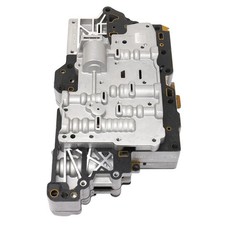
The 6T70 got a full valve body redesign in 2013, and the parts do not cross. Sonnax's teardown of the change is the clearest write-up of it:
- TEHCM. Gen. 1 carries internal fluid pressure switch assemblies. Gen. 2 does not — GM deleted them after the pressure switch films distorted and set codes on their own.
- Lower valve body casting. Gen. 1 has contours over an empty bore in the casting; Gen. 2 is flat there. That is the fastest external ID.
- Separator plate. Gen. 1 has no notch or a U notch; Gen. 2 has a V or double-V notch. The plates are not interchangeable: Gen. 2 added a balance orifice, and the pressure regulator valve changed with it — Gen. 1's is bored down the center, Gen. 2's is not.
- Solenoid dampers. Three in Gen. 1, damping actuator feed to the solenoids. Six in Gen. 2, damping the output of each linear pressure control solenoid for smoother control pressure on the regulating valves.
- Checkballs. Nine in Gen. 1, ten in Gen. 2. The added No. 10 ball meters compensator feed, which Gen. 2 tied to torque converter feed through an orifice instead of Gen. 1's orificed line pressure.
Identify by VIN and RPO before ordering anything. A Gen. 2 plate in a Gen. 1 body makes hydraulic problems you did not have.
Diagnosing it in an order that converges
1. Fluid, then scan data, then the pan
Check level and condition at the temperature the service procedure specifies. This unit takes DEXRON-VI; Mobil's data sheet for its DEXRON-VI ATF states the fluid meets GM's DEXRON-VI specification and carries warranty protection for 2006-and-newer GM vehicles. Dark, varnished fluid is why a TCC valve stops moving freely in its bore, so fluid condition here is evidence, not a preliminary.
2. Watch slip speed, not the code
On a bidirectional tool with GM transmission coverage the PIDs that decide this are TCC slip speed (or engine RPM against input shaft speed, if your tool does not calculate it), TCC commanded state or duty cycle, fluid temperature, and line pressure desired versus actual.
The test that proves it takes one drive. Get the unit fully hot, then coast to a stop on the brake and watch slip speed while the tool shows the clutch commanded off. On a healthy unit slip climbs back toward converter-stall numbers as road speed falls. On a stuck clutch it stays flat near zero until the engine stalls or drags itself down. Do it hot — a valve that moves freely cold will hand you a clean drive and a comeback.
Then read the whole code set before clearing anything. The pattern tells you which of the causes you have.
| What you see | What it usually means | Where to go next |
|---|---|---|
| P0742 alone, hot only | TCC regulator apply valve sticking in the applied position | Vacuum test the TCC valves before ordering anything |
| P0742 and P0741 both stored | The valve is hanging in both directions — classic bore wear | Oversized valve kit or valve body replacement |
| P0742 with shudder on the 2-3 or 3-2 and a launch shudder in 1st | Debris or scored valves through the body, per GM 18-NA-358 | Both valve bodies, and find where the debris came from |
| P0742 with a scattered set including P0776, P0796, P2714, P0965 | Suspect the TEHCM itself on 2018 builds | Read the TEHCM build date before you condemn hardware |
| P0742 plus metal on the magnet and ISS/OSS debris | Something upstream is coming apart | Internal inspection — the code is downstream of the real failure |
3. The bench test that names the part
Once the pan is off, stop guessing and vacuum test. Sonnax's GM 6T70/6T75 (Gen. 1) Vacuum Test Guide maps the critical wear areas on both halves of the body and states the rule plainly: test OE valves in their rest position unless noted otherwise, and a low vacuum reading indicates wear. Two locations decide a P0742:
- TCC regulator apply valve. Sonnax lists its symptom set as codes P0741 and P0742, harsh TCC apply, TCC slip, loss of fuel economy, low TCC apply pressure, and overheated fluid and TCC lining. Bore wear here reduces TCC apply and converter charge pressure; if the valve hangs in the apply position you get harsh apply and a clutch that will not let go, and if it hangs released you get the no-apply version instead.
- TCC control valve. Excess TCC slip, low cooler flow, low converter and lube flow, overheating, TCC apply and release concerns, apply codes, lining failure. Test it on the same trip through the body — the symptom overlap is nearly total.
Parts follow the test result. For the regulator apply valve, Sonnax lists oversized kit 124740-24K — hardcoat anodized aluminum valves, lengthened spools for extra bore contact and sealing, annular grooves to center the valve and cut future side-load wear — requiring tooling F-124740-TL24 and the VB-FIX fixture, or 124740-31K where the bore is still serviceable. The 24K covers Gen. 1 and Gen. 2 6T70/6T75 plus the 6T80 and the Ford 6F50/6F55 cousins. For the TCC control valve it is 124740-14K with tooling F-124740-TL14. None are drop-in: the bore gets reamed to size on a fixture, and without the tooling you are buying a valve body instead.
6T70 shift kit — the valve body side of this repair
Recalibrated valve body springs and valves, checkballs and separator plate components, with instructions. If the vacuum test says the TCC circuit is soft and you are already in the body, this goes back in with it. Pick by generation: the 2013-Up kit is the Gen. 2 calibration.
6T70 Shift Kit 2013-Up at Core Transmission Parts →Earlier unit? The base 6T70 shift kit covers 2007–2012, and the full shift kit shelf covers the rest.
When GM says replace the valve bodies
GM service bulletin 18-NA-358 covers shudder and 2-3 upshift or 3-2 downshift complaints on 2014–2019 6T70, 6T75 and 6T80 applications, from the Equinox and Terrain up through Acadia, Traverse, Enclave, XTS and SRX. The stated cause is debris in the upper and/or lower valve bodies, or valves scratched or scored, causing them not to move properly — the same mechanism that hangs a TCC valve. Four things in it carry into a P0742 job:
- Confirm the shudder is not TCC shudder by monitoring TCC slip when the clutch is engaged. Separating a converter complaint from a valve body complaint is step one.
- You can induce the launch shudder by power braking in first gear, but GM caps that at five seconds or less so you do not distress the 1-2-3-4 clutch assembly.
- GM states flatly that TEHCM replacement has not been an effective repair for this condition. Do not throw a module at it.
- If the condition is confirmed, both valve body assemblies get replaced together — upper body 24281084, lower body 24257450, or valve body kit 24264343 (24268463 for RPO MHM). Labor operation 8463870.
The bulletin adds the note that saves you the second job: inspect the input and output speed sensors for collected debris, because debris there means an internal component is failing. Clean sensors with scratched valves and bores means checking for a final drive bearing failure feeding the body.
The 2018 module that fakes this code
One exception is worth knowing before you spend a day in the valve body. Writing in ATRA's Gears magazine, Steve Garrett documented an internal capacitor defect in the Bosch-built TEHCM shared by the 6T70, 6T75 and 6T80, affecting 2018 model year units with TEHCM build dates 7209 (July 28, 2017) through 7262 (September 19, 2017). A capacitor having a bad day disrupts microprocessor operation, and the resulting code set includes P0742 along with P0562, P0776, P0796, P0965, P0969, P2714, P2715, P2719 and P2762, plus propulsion failures and harsh shifting that come and go with temperature.
The build date is readable on the module: the 13-digit number inked below the QR code carries it in positions 5 through 8. A 2018 unit in that window with a code list sprawling across unrelated circuits gets the module read before the valve body. TEHCM part numbers also vary by application and do not interchange within the family.
Need parts for this job?
Valve bodies, shift kits, filter and pan gasket kits, friction modules, seal kits and DEXRON-VI — the 6T70 and 6T75 shelf in one place, shipped from the USA.
Shop 6T70 parts →Doing the repair so it stays fixed
- Decide the cause before you buy. The vacuum test names the valve. A sprawling code list on a 2018 unit names the module. Debris on the ISS/OSS names something upstream.
- Replace the converter if the clutch has been dragging. The lining does not recover, and the debris it sheds goes straight back into the body you just cleaned.
- Clean everything the debris touched. New filter, clean pan and magnet, cooler and lines flushed or replaced.
- Match generation on every part. Separator plate, valve body, TEHCM. Order by VIN and RPO.
- Verify hot, with data. Coast to a stop at full operating temperature and watch slip speed climb the way it should. A cold verification drive proves nothing on this unit.
Keeping it from coming back
- Service the fluid on a real interval with DEXRON-VI. Varnish is what sticks an aluminum valve in an aluminum bore, and fluid service is the part of that you control.
- Vacuum test the TCC circuit any time the pan is off for something else. It costs minutes, and it is the difference between a repair and a return visit.
- Fix cooling, not just the clutch. A dragging TCC overheats fluid, and overheated fluid varnishes the next valve.
FAQ
Can you drive a 6T70 with P0742?
Only carefully, and not far. A converter clutch that will not release ties the engine to the drivetrain, so the engine can stall as you come to a stop the same way a manual does when you forget the clutch pedal. It also cooks the fluid and the lining, because the clutch is taking load it was never scheduled to take. Stalling at intersections makes this a park-it code, not a wait-and-see one.
Does P0742 on a 6T70 mean the torque converter is bad?
Usually not. Sonnax lists the two known causes of P0742 across GM units without a TCC release pressure switch as a sticking TCC apply valve and a defective TCC PWM or TCC apply solenoid. The 6T70 has no release pressure switch, so it falls in that group. The converter itself is normally a victim: it gets replaced because the lining is already overheated by the time the code shows up, not because it caused the code.
Is the TCC solenoid on a 6T70 replaceable by itself?
No. Every solenoid on this transmission lives inside the TEHCM along with the transmission control module, and there is no individual connector or serviceable solenoid. If the electrical side is the fault, the module is replaced or remanufactured as an assembly, then programmed on the vehicle.
What fluid does a 6T70 take, and does the wrong fluid cause P0742?
DEXRON-VI. Mobil's product data sheet for its DEXRON-VI ATF states it meets GM's DEXRON-VI specification and provides warranty protection for 2006 and newer GM vehicles. Wrong or worn-out fluid does not directly set P0742, but varnish and debris are what make the TCC valves stick in their bores, and that does.
Sources
- Sonnax — "Beyond 1870: GM Converter Codes P0741, P0742 and 1887," Gregg Nader. Backs the split between units with and without a TCC release pressure switch, the statement that GM uses P0742 when the computer detects the TCC has not released, the all-GM-units definition ("when the PCM detects low slip speed with TCC commanded off") and its two listed causes — sticking TCC apply valve and defective TCC PWM or TCC apply solenoid — plus the P0741 causes including worn TCC valve bores. sonnax.com
- Sonnax — Oversized TCC Regulator Valve Kit 124740-24K product page. Backs the symptom list (codes P0741 and P0742, harsh TCC apply, TCC slip, loss of fuel economy, low TCC apply pressure, overheated fluid and TCC lining), the cause statement that bore wear at the TCC regulator valve reduces TCC apply and converter charge pressure, the stuck-in-apply versus stuck-in-release behavior, the kit contents and construction (lengthened spools, hardcoat anodized aluminum valves, annular grooves), the required tooling F-124740-TL24 and VB-FIX, and coverage of Gen. 1 and Gen. 2 6T70/6T75, 6T80 and Ford 6F50/6F55. sonnax.com
- Sonnax — "GM 6T70, 6T75 (Gen. 1) Vacuum Test Guide," December 2, 2014. Backs the vacuum test method (valves tested in rest position unless otherwise indicated, low vacuum reading indicates wear), the mapped critical wear areas and test locations on the upper and lower valve body, the TCC regulator apply valve entry naming codes P0741 and P0742 with parts 124740-31K or 124740-24K, and the TCC control valve entry (excess TCC slip, low cooler flow, low converter and lube flow, overheating, TCC apply codes, TCC lining failure) with part 124740-14K. sonnax.com
- Sonnax — "The Greatest Generation: How Small Changes Led to the New Form & Function of Gen. 2 6T70/75 Valve Bodies," February 12, 2018. Backs every Gen. 1 versus Gen. 2 identification point: pressure switches deleted from the Gen. 2 TEHCM after switch films distorted and set codes, the lower valve body casting contours, the separator plate notch identification and plate incompatibility, the bored versus solid pressure regulator valve and the added balance orifice, three versus six solenoid dampers and what each damps, and the nine versus ten checkballs with the No. 10 ball metering compensator feed. sonnax.com
- General Motors — Service Bulletin 18-NA-358, "Shudder, 2-3 Upshift or 3-2 Downshift Concern," August 2022 revision (hosted by NHTSA). Backs the model and year coverage for 6T70, 6T75 and 6T80 applications, the stated cause of debris in the upper and/or lower valve bodies or valves scratched or scored, the instruction to confirm the concern is not TCC shudder by monitoring TCC slip, the five-second limit on power braking in first gear, the statement that TEHCM replacement has not been an effective repair, the direction to replace both upper and lower valve body assemblies together, the part numbers 24281084, 24257450, 24264343 and 24268463, labor operation 8463870, and the ISS/OSS debris and final drive bearing inspection notes. static.nhtsa.gov
- Gears Magazine (ATRA) — "Now, What Do I Do? 6L50/80/90, 6T70/75/80, Propulsion Issues," Steve Garrett, April 5, 2022. Backs the shared Bosch-built TEHCM design across 6T70, 6T75 and 6T80 with non-interchangeable part numbers by application, the internal capacitor defect and its effect on microprocessor operation, the affected 2018 model year build dates 7209 through 7262, the code set including P0742, P0562, P0776, P0796, P0965, P0969, P2714, P2715, P2719 and P2762 with propulsion failures and temperature-sensitive symptoms, and the 13-digit number below the QR code carrying the build date in positions 5 through 8. gearsmagazine.com
- ExxonMobil — Mobil DEXRON-VI ATF product data sheet. Backs the fluid specification: the fluid meets or exceeds the requirements of GM's DEXRON-VI specification and provides warranty protection for 2006 and newer GM vehicles where DEXRON is specified. exxonmobil.com