Generic scan tools print P0776 as "Pressure Control Solenoid B Performance or Stuck Off." That label sends people shopping for a solenoid. GM's own wording is more useful: Clutch Pressure Control (PC) Solenoid 2 — Stuck Off, and on a 6T70 or 6T75 that solenoid has exactly one job. Per the Sonnax solenoid function table for the Gen. 1 unit, pressure control solenoid 2 controls the 3-5-Reverse clutch regulator valve. Nothing else.
So P0776 is not a vague pressure complaint. It is the module saying: I commanded the 3-5-R circuit to apply and the confirmation never showed up. Which is why the customer complaint that rides along with it is so consistent — no reverse, no third, no fifth, or a slip and flare into all three. Those are the only three gears that use that clutch.
And on the Gen. 1 6T70, most of the time, the part that failed is not electrical at all. It is a stamped steel plate about the size of a coffee can lid.
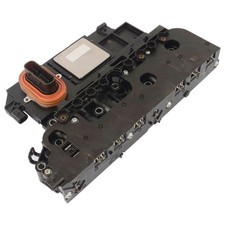
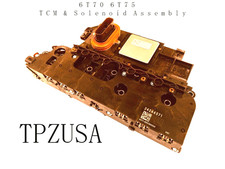
How the module decides the solenoid is "stuck off"
This is the part worth understanding before you touch anything, because it explains why a mechanical failure sets a solenoid code.
Sonnax lays out the general mechanism in its Hydraulics Fundamentals series: a pulse-width-modulated solenoid sends control pressure to a clutch regulator valve, which strokes against spring force and opens a passage so clutch feed pressure from the manual valve can reach the clutch. A portion of that apply oil is routed back to the balance side of the valve so the pressure regulates to a specific value. Then comes the part that matters here — "Fluid pressure is sent through the clutch regulator valve when in the released position to apply a pressure switch so that the TCM has confirmation of the valve, and presumably clutch, position."
On a Gen. 1 6T70/6T75, that confirmation hardware is real and specific. The TEHCM carries four fluid pressure switches, all normally closed. Switch 2 monitors the 3-5 and Reverse clutch regulator valve. It opens at 8 psi (55 kPa) and closes at 12 psi (82 kPa). Pressure present means the switch is open, which reads low on the scan tool. No pressure means closed.
Now the failure logic falls out on its own. The TCM commands PC solenoid 2 on for a 2-3 shift, expects switch 2 to report pressure, and does not get it within the allowed window. It has no way to know whether the solenoid stuck, the valve stuck, the circuit leaked, or the clutch is lying on the floor of the pan in pieces. It sets P0776 and calls the solenoid stuck off, because that is the only name the code table gives it.
Gen. 2 units are a different animal on this point. The Gen. 2 controls package deleted the pressure switches entirely and uses clutch pulse learn instead, and the solenoids changed from variable bleed to variable feed. Same code, different detection strategy, and different diagnostic tooling — more on that split below.
The cause that accounts for most of them: the 3-5-R waved plate
GM published this one repeatedly. Corporate bulletin 09-07-30-012F (October 2012), covering 2008-2009 Enclave, 2008-2009 Equinox and Malibu, 2009 Traverse, 2007-2009 Acadia, 2007-2009 G6, 2008-2009 Torrent, 2007-2009 AURA and OUTLOOK and 2008-2009 VUE with the 6T70/75 (RPO MH2, MH4, MH6 or MY9), is titled "No Reverse, 3rd or 5th, Check Engine Light Illuminated, DTC P0776 (Replace 3-5 Reverse Clutch Plate (Waved))."
The mechanism, in GM's words: the condition "may be caused by a broken 35R clutch wave plate allowing the apply piston to over-stroke the piston to leak and causing loss of apply." The waved plate is the cushion at the bottom of the 3-5-R clutch pack. When it cracks and comes apart, the pack loses its stack height, the apply piston travels past its intended stroke, and the piston seal walks out of its sealing surface. The circuit will not build pressure. Switch 2 never opens. P0776 sets.
Two details from that bulletin change how you plan the job:
- Mileage. GM states this "normally will not occur before approximately 32,000 km (20,000 mi)." A unit with 18,000 miles and a P0776 is probably telling you something else. A unit at 90,000 is textbook.
- Companion codes. GM lists the codes that may set independently as a result of the plate breaking: P0777, P2723, P0717, P0716, P2715, P2714. The speed sensor codes are there because the debris is ferrous and the ISS and OSS sensors are magnetic. Do not chase P0716 as a separate problem when P0776 is in the set.
Sonnax puts the same failure in engineering terms on its 3-5-R drum saver kit page: the OE waved plate "commonly fails and breaks into pieces, resulting in code P0776, harsh and flare shifts or complete loss of 3-5-R," the broken pieces then damage the 3-5-R clutch housing splines, and "the teeth on the OE plate are high-stress points that cannot stand up to long-term fatigue." The point that should make you inspect rather than assume: "Even plates that haven't broken can have micro-fractures at the tooth corners and be on the verge of failure."
GM's own updated plate is P/N 24254103, shot-peened, and it back-services earlier years. Sonnax notes the shot-peened OE update still fails in some units. Their replacement plate is shot-peened and toothless, which removes the stress risers at the tooth corners, and it rides on a cupped billet steel plate that sets clutch clearance and lets it run in a drum whose splines are already chewed.
If you are in there anyway on a 2011-or-earlier unit, Sonnax's guidance from their 6T70 webinar Q&A is to update all of the wave plates; on 2012-and-later, just the 3-5-R. The 2012 updated numbers are 1-2-3-4 24259063, 2-6 24259816, 3-5-R 24254103, and Low-Reverse 24259817.
The other real cause: a worn 3-5-R clutch regulator bore
Not every P0776 is a broken plate, and this is the one that gets missed because the plate looks fine.
PC solenoid 2 is PWM-controlled, so the 3-5-R clutch regulator valve oscillates constantly in an aluminum bore. Sonnax technical support specialist Tory Royce, writing on the GM 6T70/75 and Ford 6F50/55 pair: "One area in the valve body that is frequently found to be worn is the 3-5-Reverse regulator bore, which often causes flaring on the 2-3 and 4-5 shifts, as well as delayed engagements or slipping in Reverse." Sonnax's stated cause for its oversized replacement is that "oscillation of the 3-5-R clutch regulator valve causes bore wear that allows crucial pressure loss and prevents proper hydraulic actuation of 3-5-R clutches."
A leaking bore can bleed enough of the apply circuit that switch 2 never sees its 8 psi threshold on a marginal shift. Same code, different repair.
The valve ratio trap on a valve body swap
This one costs people a second teardown. Around 2009 GM changed the 3-5-R regulator valve to raise clutch apply pressure. The inner spool went from .390" diameter (1.35 ratio) to .335" diameter (1.83 ratio) on the spring end. Royce reports the change "increased maximum pressure by over 20 psi on the high end of the pressure curve." Casting and plate venting changes went with it.
Measure the small spool on the OE valve before you order anything. Get it backwards and the symptoms are predictable: a 1.35 valve body in a 1.83 application gives 2-3 and 4-5 flare; a 1.83 valve body in a 1.35 application gives harsh and binding 2-3 and 4-5 shifts. Sonnax's oversized kits split the same way — 124740-21K for the 1.83 ratio, 124740-26K for the 1.35.
Diagnosing it without guessing
1. Read the full code set, then the fluid
Record every current and history code before clearing anything. P0776 with P0716/P0717 and metal on the magnet is a broken plate with debris circulating, not a solenoid. P0776 alone on a unit with clean fluid and a flare-only complaint points harder at the valve body. Check level and condition at operating temperature per the service procedure; the 6T70 family runs DEXRON-VI.
1b. Rule out the input sun shell with the unplug test
On early units there is a second failure that throws the same complaint. ATRA's "6T70 Product Issues and Updates" seminar lists a broken weld on the input sun shell as a cause of no Reverse, 3rd or 5th with P0776, P2723 or P2715 possible, primarily on transmissions built before the 2010 model year. The updated shell comes with the #3 thrust bearing. ATRA's test is quick: unplug the transmission and see whether Reverse is being prevented electrically. If Reverse engages with it unplugged, the shell is not the problem and the 3-5-R clutch is your suspect. On the 2007-2009 units, GM's Special Coverage 14404B estimated that about 25 percent of wave plate repairs also needed parts such as the reaction sun gear, so price the job with that in mind.
2. Watch pressure switch 2 in live data (Gen. 1)
This is the highest-value PID on a Gen. 1 unit and it costs nothing. Drive it and watch switch 2 state through 2-3 and 4-5 and into Reverse. If the switch never changes state when PC solenoid 2 is commanded, the circuit is not making pressure. If it toggles correctly but the vehicle still flares, you are looking at apply rate and pressure quality, which points at the regulator bore or the boost valve rather than a dead circuit. Watch commanded versus actual current on PCS 2 at the same time.
3. Do not trust an air check through the case
GM is unusually blunt about this in Preliminary Information PI0670A, written for the smaller 6T30/40/45/50 family that shares the same 3-5-R failure: "do not rely on an air check of the 3-5-R clutch through the case oil feed ports as a reliable diagnostic test. Air testing through the case has been found to frequently lead to incorrect diagnosis of the 3-5-R clutch piston condition. The only reliable method of diagnosing the condition of the 3-5-R clutch piston is transmission disassembly and visual inspection of the piston." Carry that caution to the 6T70 — a broken plate with an over-stroked piston can still hold air well enough to fool you.
That same PI also draws the Gen. 1 / Gen. 2 line for diagnostics: the TEHCM Solenoid Performance Test is not functional on Gen 1 controls, and is functional and required on Gen 2. If you are running that test on a Gen. 1 unit and getting nothing back, the tool is not broken.
4. Vacuum test the valve body before you reuse it
Sonnax's Gen. 1 6T70/75 vacuum test guide maps the critical wear areas: test valves in the rest position unless the instructions say otherwise, and a low reading means wear. The 3-5 Reverse clutch regulator valve sits in the upper body; the 3-5-R clutch boost valve is in the lower body, and its wear signature is "shift quality is not load sensitive," plus harsh shifts, slips and flares, delayed engagement and burnt clutches. If the boost valve bore is worn, replacing the regulator alone will not give you back shift feel.
Doing the repair so it does not come back
GM's bulletin is explicit that this is not a plate-swap job. Debris generated by the broken plate "must be cleaned from the entire transmission," the pump fluid filter and the control solenoid filter plate must be replaced, and "failure to separate the case halves, disassemble the transmission, clean the debris and replace the pump fluid filter and the control solenoid filter plate could lead to repeat transmission damage and repairs."
The rest of GM's sequence, condensed:
- Pull the case cover and the 35R/456 clutch housing and confirm the broken plate.
- Inspect the case. Peening or wear on the face or edge of the case lugs that engage the steel plates is normal and not cause for case replacement. Some degradation of the 2-6 backing plate shelf is acceptable as long as the plate lies flat; knock a raised burr down with a file or de-burring tool.
- Pull the valve body cover, the TEHCM and the filter plate assembly, and read the filter plate screens. No debris on the screens means the pump filter did its job and the pump, converter and valve body do not need replacement. Debris on the screens means inspect the pump and converter per the SI procedures.
- Fine metal you cannot feel, or a gray tint to the fluid, is not by itself a reason to replace the converter. Chips you can feel, or debris found when flushing the cooler and lines, is.
- Inspect the TEHCM pressure switches. Deformed O-ring seals that are still attached do not affect switch performance and the module gets reused. Damaged switch membranes mean the module gets replaced.
- Separate the case halves, clean everything, and clean both speed sensors. They are magnetic and will hold ferrous debris; skipping them sets new codes on a good repair.
Add the steps GM does not cover: measure the 3-5-R regulator small spool to establish your ratio, vacuum test the 3-5-R regulator and boost bores, and replace the 3-5-R clutch pack rather than reusing frictions that have been slipping against a broken plate.
The parts that actually fix a P0776
The 3-5-R clutch pack takes the damage when the waved plate lets go, and frictions that have been slipping against a broken plate do not go back in. This friction kit covers the 07-12 Gen. 1 units the GM bulletin lists.
6T70 Friction Clutch Kit 07-12 →If the apply piston over-stroked and the lip seal is cut or rolled — the exact condition GM says can only be confirmed by disassembly and visual inspection — the piston goes with it. Core Transmission Parts lists a 6T70 bonded piston set for 07-Up, and their full 6T70 parts listing covers the master and overhaul kits if the debris took the unit further than the clutch.
FAQ
Does P0776 on a 6T70 always mean a broken wave plate?
No, but it is the leading cause on Gen. 1 units past about 20,000 miles, which is the threshold GM gives in bulletin 09-07-30-012F. The other real cause is wear in the 3-5-R clutch regulator bore bleeding off apply pressure. The tell is the fluid: a broken plate makes ferrous debris and usually drags speed sensor codes like P0716 or P0717 along with it, while a worn bore leaves the fluid clean and produces flare-only complaints.
Can I just replace the TEHCM to fix P0776?
Almost never, and GM warns against it directly. The bulletin states the control solenoid valve assembly should not be replaced for any DTC unless SI diagnostics instruct you to. The related PI adds that on Gen. 1 units you should not replace the TEHCM before visually inspecting the 3-5-R clutch and piston. Modules do fail, but replacing one to chase a mechanical 3-5-R failure buys an expensive comeback.
Which gears does the 3-5-R clutch affect?
Third, fifth and Reverse, applied with other clutches in each case. That is why the complaint pattern is so specific: slip or no engagement in Reverse, slip or flare into 3rd, slip or flare into 5th, in any combination. If a customer describes losing exactly those three, you can predict the code before you plug in.
Do I have to drop the transmission, or can I do this in the vehicle?
It comes out. The repair requires removing the case cover and the 35R/456 clutch housing, and GM's procedure goes further — separating the case halves, removing internal components, cleaning all of the debris and replacing the pump fluid filter and control solenoid filter plate. That is a bench job, not a pan-off job.
Is the updated GM wave plate enough, or do I need the aftermarket one?
GM's shot-peened plate, P/N 24254103, is a genuine improvement and back-services earlier years. Sonnax's position is that it still fails in some units because the teeth remain high-stress points, which is why their drum saver plate is toothless. If the drum splines are already damaged, the toothless plate is the practical choice because it will not hang up on chewed splines.
Get the 6T70 friction clutch kit →
Need parts for this job?
Friction module kits, filter and pan gasket kits, valve bodies, seal kits and DEXRON-VI for the 6T70 and 6T75, all in one place.
Shop 6T70 parts →Sources
- General Motors — Service Bulletin 09-07-30-012F, "No Reverse, 3rd or 5th, Check Engine Light Illuminated, DTC P0776 (Replace 3-5 Reverse Clutch Plate (Waved))," October 2012, hosted by NHTSA. Backs the GM DTC definition "Clutch Pressure Control (PC) Solenoid 2 - Stuck Off," the covered models and RPOs MH2/MH4/MH6/MY9, the cause statement that a broken 35R wave plate allows the apply piston to over-stroke and leak, the approximately 32,000 km (20,000 mi) onset, the companion codes P0777/P2723/P0717/P0716/P2715/P2714, plate P/N 24254103, the debris cleaning and pump fluid filter plus control solenoid filter plate replacement requirement, the case lug peening and 2-6 backing plate shelf inspection criteria, the filter plate screen decision rule for the pump and converter, the pressure switch O-ring versus membrane call, and the speed sensor cleaning warning. static.nhtsa.gov
- General Motors — Preliminary Information PI0670A, "Diagnostic Tips for DTC P0776, Slips in or No Reverse, Third, Fifth," February 2012, hosted by NHTSA. Written for the 6T30/40/45/50 family that shares the 3-5-R failure. Backs the warning not to rely on an air check of the 3-5-R clutch through the case oil feed ports, the statement that disassembly and visual inspection of the piston is the only reliable diagnosis, the instruction not to replace the TEHCM before visually inspecting the 3-5-R clutch and piston, and the note that the TEHCM Solenoid Performance Test is not functional on Gen 1 controls but is functional and required on Gen 2. static.nhtsa.gov
- Sonnax — "GM Gen. 1 6T70/75/80, Ford 6F50/55 Concerns & Repair Techniques" webinar. Backs the 6T70 solenoid function table showing pressure control solenoid 2 controls the 3-5-Reverse clutch regulator valve, the Gen. 1 TEHCM configuration (two shift solenoids, six variable bleed solenoids PCS1-PCS5 and TCC, four pressure switches on Gen. 1 and none on Gen. 2 with clutch pulse learn used instead), the normally closed pressure switch operation with switch 2 monitoring the 3-5 and Reverse clutch regulator valve and opening at 8 psi (55 kPa) and closing at 12 psi (82 kPa), the 2012 updated wave plate part numbers 24259063, 24259816, 24254103 and 24259817, and the Q&A guidance to update all wave plates on 2011-and-earlier units and only the 35R plate on 2012-and-later. sonnax.com
- Sonnax — 3-5-R Drum Saver Kit 124555K product page. Backs the statement that the OE 3-5-R waved plate in Gen. 1 and Gen. 2 6T70/6T75 units commonly breaks into pieces resulting in code P0776, harsh and flare shifts or complete loss of 3-5-R, that the broken pieces damage the 3-5-R clutch housing splines, that the OE plate teeth are high-stress points that cannot stand long-term fatigue, that unbroken plates can carry micro-fractures at the tooth corners, that the OE shot-peened update still fails in some units, and the toothless shot-peened replacement plate with cupped billet steel plate that sets clutch clearance and salvages a damaged drum. sonnax.com
- Sonnax — "Trading Places: Avoiding Valve Body Pitfalls with GM/Ford 6-Speed Automatic Transaxles," Tory Royce, August 29, 2018. Backs the PWM-driven valve oscillation wearing the casting, the 3-5-Reverse regulator bore as a frequently worn area causing 2-3 and 4-5 flare plus delayed engagement and Reverse slip, the circa-2009 GM change of the inner spool from .390" (1.35 ratio) to .335" (1.83 ratio) to increase clutch apply pressure, the resulting increase of over 20 psi at the high end of the pressure curve, and the mismatch symptoms in each direction. sonnax.com
- Sonnax — Oversized 3-5-R Clutch Regulator Valve Kit 124740-21K product page. Backs the cause statement that oscillation of the 3-5-R clutch regulator valve causes bore wear allowing pressure loss and preventing proper hydraulic actuation of the 3-5-R clutches, the symptom list (2-3 flare, 4-5 flare, delayed Reverse, Reverse slip, burnt 3-5-R clutch, ratio codes, bind-up), the fact that the 3-5-R clutch is applied in 3rd, 5th and Reverse in GM Gen. 1 6T70/6T75 and Ford 6F50/6F55, and the ratio split between kit 124740-21K (1.83 ratio, .335" spool) and 124740-26K (1.35 ratio, .390" spool). sonnax.com
- Sonnax — "GM 6T70, 6T75 (Gen. 1) Vacuum Test Guide," December 2, 2014. Backs the vacuum test method (valves tested in rest position unless otherwise indicated, low reading indicates wear), the location of the 3-5 Reverse clutch regulator valve in the upper valve body and the 3-5-R clutch boost valve in the lower valve body, and the boost valve wear signature of shift quality that is not load sensitive, harsh shifts, slips and flares, delayed engagement and burnt clutches. sonnax.com
- Sonnax — "Hydraulics Fundamentals Part IX: Clutch Regulator Valves — Controlling Shift Apply & Feel," November 20, 2020. Backs the mechanism description of a solenoid stroking a clutch regulator valve against spring force to open the clutch feed passage, the balance-side feedback that regulates apply pressure, the effect of bore wear making that pressure higher or lower than required, and the quoted statement that fluid pressure is sent through the clutch regulator valve in the released position to apply a pressure switch so the TCM has confirmation of valve and clutch position. sonnax.com
- ATRA — Steve Garrett, "6T70 Product Issues and Updates," ATRA technical seminar. Backs the input sun shell weld break as a cause of no Reverse, 3rd or 5th with P0776, P2723 or P2715, its concentration in pre-2010 builds, the updated shell supplied with the #3 thrust bearing, and the unplug test to see whether Reverse is being prevented electrically. atra.com (PDF)
- General Motors — Special Coverage Adjustment 14404B, "Transmission Clutch Wave Plate," August 2016 (via NHTSA). Backs the 10-year/120,000-mile coverage on 2007-2009 6T70/6T75 applications for a cracked or fractured wave plate causing loss of 3rd, 5th and Reverse, and GM's estimate that about 25 percent of repairs also require parts such as the reaction sun gear. nhtsa.gov (PDF)