"It needs a valve body" gets said about a lot of 6T70s that do not. It also gets missed on a lot of 6T70s that do, because the part everyone reaches for first is the TEHCM, the black module with the solenoids and the TCM on it. On the Traverse, Acadia, Enclave, Equinox, Terrain, SRX, XTS, Impala and LaCrosse, the aluminum upper and lower valve bodies behind that module wear out on their own schedule, and GM has a bulletin that says outright that swapping the TEHCM does not fix the valve body problem.
This guide covers what the valve body actually does on a 6T70/6T75/6T80, which symptoms point to which valve, how to test it in the car and on the bench, and how to buy the right replacement for a Gen. 1 or Gen. 2 unit. The bulletin numbers, part numbers and valve-by-valve symptoms come from GM, Sonnax and ATRA, listed in the Sources at the end.


What the 6T70 valve body is (and is not)
The 6T70 control system sits under the side cover and comes apart in two layers. The outer layer is the TEHCM (transmission electro-hydraulic control module): the TCM, the shift and pressure control solenoids and, on Gen. 1 units, the pressure switches. The inner layer is the control valve body itself, an upper and a lower aluminum casting with separator plates, check balls and a channel plate between them and the case. The solenoids only produce signal pressure. The valves in the upper and lower bodies turn that signal into line pressure, clutch apply pressure, converter feed and lube. When a solenoid fails, you usually get a code for that circuit. When a valve bore wears, you usually get a feel complaint and, later, a ratio or slip code for whatever clutch the valve feeds.
Before you order anything, know which generation you have. ATRA's 6T70 notes explain that the 6T70 (RPO M7W or M7U) and 6T75 (RPO M7V and M7X) got a major control system update for the 2013 model year, and that applications with other RPO codes did not get it until 2014 production. So 2013 exists as both Gen. 1 and Gen. 2, and the two control systems do not interchange. Check the RPO on the glovebox or door label, not just the model year.
Symptoms, valve by valve
Sonnax's vacuum test guides for the Gen. 1 and Gen. 2 units map each wear point to the complaint it causes. That map is the most useful thing you can have on the bench, because it lets you work backward from the customer's words to one or two bores. Here is the Gen. 2 layout grouped by circuit.
Line pressure: pressure regulator and isolator valves
A worn pressure regulator valve gives erratic line pressure, poor shift quality, burnt clutches, low converter and lube flow, overheating, and TCC apply and release problems. The isolator valve next to it causes low line pressure, line pressure instability, no line rise, burnt clutches and harsh shifts. These are the "everything is a little wrong" valve bodies: soft engagements when hot, clutches that burn under load, and a TCC that never feels right. A line pressure check at idle is worth doing, but ATRA notes that low line at idle on a 6T70 can also be a damaged pump outlet seal, so do not condemn the valve body on that number alone.
Converter circuit: TCC regulator apply and TCC control valves
The TCC regulator apply valve is the classic 6T70 wear point. Sonnax lists P0741 and P0742, TCC slip, harsh TCC apply, loss of fuel economy, low TCC apply pressure and overheated fluid and TCC lining. The TCC control valve in the same body adds excess TCC slip, low cooler flow, low converter and lube flow, and TCC lining failure. If a replacement converter starts shuddering again after a few thousand miles, this is where it came from.
Clutch regulator valves: one per clutch
- 1-2-3-4 clutch regulator: burnt 1-2-3-4 clutch, delayed forward engagement, 1-2-3-4 shift concerns.
- 3-5-Reverse clutch regulator: burnt 3-5-R clutch, delayed reverse, 3rd and 5th shift concerns, 2-3 and 4-5 flare. Sonnax traces the wear to oscillation of this valve cutting its own bore, which lets critical pressure bleed off. It also lists reverse slip, ratio codes and bind-up.
- 2-6 clutch regulator and gain valve: 1-2 and 5-6 flare, slipping or no 2nd and 6th, ratio codes, burnt 2-6 clutch and erratic shift timing.
- Low/Reverse and 4-5-6 clutch regulator: burnt low/reverse or 4-5-6 clutch, 4-5-6 shift concerns, delayed reverse and 3-4 flare.
Boost valves and the 4-5-6 accumulator
The 1-2-3-4, 3-5-R and 4-5-6 clutch boost valves in the lower body all produce the same complaint list: shift quality is not load sensitive, harsh shifts, slips and flares, delayed engagement, slide shifts, burnt clutches and slip codes. "Not load sensitive" is the tell. A light-throttle shift and a heavy-throttle shift feel the same, and usually both feel wrong. The 4-5-6 clutch accumulator piston in the same body causes a 3-4 flare or a harsh 3-4, ratio codes and a burnt 4-5-6 clutch.
Actuator feed limit valve
AFL pressure is the regulated supply that feeds every solenoid. When the actuator feed limit valve wears, Sonnax lists solenoid performance codes, wrong gear starts and clutch failure. This is the valve that makes a good TEHCM look bad: the solenoids set performance codes because their supply is low, a tech replaces the TEHCM, and the codes come back.
End plugs
Leaking bore end plugs cause pressure loss, shift concerns, burnt clutches and TCC apply concerns. There are several of them and they are easy to skip.
GM's own valve body bulletin: 18-NA-358
GM service bulletin 18-NA-358 covers the 6T70, 6T75 and 6T80 in the 2014-2017 Enclave, Equinox, Terrain and Traverse, the 2014-2019 Acadia, the 2014-2016 SRX, the 2014-2019 XTS, the 2014-2019 Impala, the 2016 LaCrosse, the 2017 Regal and the 2015 Malibu. The complaint is a severe launch shudder in 1st, a shudder cruising in 4th, or a shudder on the 2-3 upshift or 3-2 downshift, sometimes with a flare, slide-bump, slip or harsh shift. GM's cause is debris in the upper and/or lower valve bodies, or valves that are scratched or scored and do not move properly.
The bulletin's diagnostic rules are worth following word for word:
- Rule out an engine misfire or driveability problem first.
- Confirm it is not TCC shudder by monitoring TCC slip while the event happens.
- The launch shudder can be reproduced by power braking in first gear, but for five seconds or less so the 1-2-3-4 clutch is not damaged.
- TEHCM replacement has not been an effective repair. Performance test the TEHCM and clean or replace it only as needed.
- If the power brake test reproduces the shudder, replace the upper and lower valve bodies at the same time.
- Inspect the input and output speed sensors for collected debris, which points to an internal component failure. If the sensors are clean but valves or bores are scratched, check for a final drive bearing failure.
The parts list calls out upper body 24281084 (without manual valve), lower body 24257450, valve body kit 24264343 for RPO M7V, M7U, M7X and M7W or 24268463 for MHM, and DEXRON VI fluid. That last note about the sensors and the final drive bearing matters: a valve body scored by bearing debris will be scored again unless the source is fixed.
Testing it in the car
- Pull codes and freeze frame. A single solenoid circuit code points at the TEHCM. Solenoid performance codes plus ratio or slip codes across more than one clutch point upstream, at AFL or line pressure.
- Check the level the way GM specifies. ATRA's procedure: level ground, parking brake set, engine running, move the selector through the ranges, idle one minute, and read the dipstick with transmission fluid temperature between 180 and 200 degrees F. A low 6T70 imitates a worn valve body perfectly.
- Look at the fluid. Debris is what scores 6T70 bores. Dark fluid with a burnt smell, or metal in the pan, means the valve body is a casualty and not the cause.
- Make sure it has learned. ATRA explains that the TCM runs its clutch pressure (CP) learn during steady conditions: the 4-5-6 clutch in 3rd gear, the 1-2-3-4 and 2-6 clutches in 5th, and the 3-5-R clutch in 6th, and it aborts the learn on rough roads. A unit that never gets steady time in those gears can shift badly with a healthy valve body. Run Service Fast Learn Adapts before you condemn anything.
- Log it during the complaint. Record TCC slip, input speed, output speed and commanded gear. A flare or slip on one specific shift, repeatable after a fresh learn, sends you to that clutch's regulator valve in the map above. A shudder with the TCC released sends you to 18-NA-358.
Testing it on the bench
Once the valve body is out, vacuum testing is how you find wear you cannot see. Sonnax's guides specify testing OE valves in their rest position unless noted, at the ports marked on the guide, and state that a low vacuum reading indicates wear. Several locations are marked "test together," meaning you seal and test two ports as one circuit. For the end plugs, test at the outboard port while sealing the bore opening with your thumb. Individual pass/fail values ship with each Sonnax kit's instructions.
While it is apart, look for scored valves and bores (the 18-NA-358 condition), check ball position against the service information, and compare the separator plates to the correct year. Clean every passage. A valve body that looks fine but vacuum tests low at two clutch regulator bores will keep burning those clutches after a rebuild.
Gen. 1 valve bodies are not all the same
The Sonnax Gen. 1 identification guide splits the 2007-2013 Gen. 1 units into four versions:
- 2007-2008: 1.35 ratio 3-5-R clutch regulator valve, cut-out style lower separator plate, no notch on the upper plate, closed exhaust port.
- 2009: 1.83 ratio 3-5-R regulator valve, notched upper and lower plates, closed exhaust port.
- 2010-2011: 1.83 ratio, circle hole in the lower plate, notched upper plate, open exhaust port.
- 2012-2013: same as 2010-2011 plus a raised notch above the valve body on the channel plate.
Sonnax states that the early and late styles cannot be interchanged even though they look very similar, and sells separate remanufactured units for them (GM6T70-1E for 2007-2008, GM6T70-1L for 2009-2013). If you are repairing the 3-5-R bore instead, measure the small spool of the OE valve before ordering: the 124740-21K kit replaces the 1.83 ratio valve with a .335 in. small spool, and 124740-26K replaces the 1.35 ratio valve with a .390 in. spool.
Repair options
Replace upper and lower together
For the 18-NA-358 shudder, GM's answer is new upper and lower valve bodies at the same time. Do not replace one half. The bores that scored in one body saw the same debris as the other.
Remanufactured valve body
A good reman is more than a cleaned casting. Sonnax's GM6T70 units have bores, check balls, seals and casting reviewed and refreshed, new separator plates and gaskets, and are tested for main line pressure, actuator feed limit pressure, clutch pressures and torque converter pressure against OE specifications. Their listed fixes include P0741 and P0742, harsh TCC apply, TCC slip, solenoid performance codes, wrong gear starts, slips and flares, delayed engagements, burnt clutches, low converter and lube flow and erratic line pressure, which is close to the whole symptom map above. The TEHCM is not included and moves over from the old unit.
Ream and oversize the worn bores
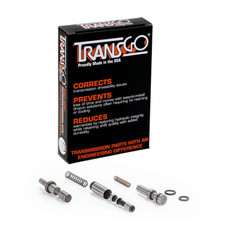
If vacuum testing isolates one or two bores, oversized valve kits restore them for less than a complete unit. Common 6T70 kits are the TCC regulator valve (124740-31K, or 124740-24K with F-124740-TL24), the pressure regulator valve (124740-60K), the 2-6 clutch regulator (124740-66K), the actuator feed limit valve (124740-33K or 124740-48K), and the isolator valve (124740-03K). Each reamed kit requires its specific tool and a fixture. A shift kit that corrects the known wear points, like the TransGo SK 6T70 kits, is a good add while the valve body is on the bench.
After the repair
If the TEHCM was replaced, ATRA reminds you the TCM is internal to the transaxle and has to be programmed. Then run Service Fast Learn Adapts, shut the engine off and let the TCM power down until the scan tool loses communication, and restart to complete it. Refill with DEXRON VI and recheck the level hot at 180-200 degrees F TFT. ATRA also notes the filter is only replaced after internal repair, so if the valve body came out because of debris, this is the time to put one in. Road test the exact shift that started the job and save the log.
Sonnax 124740-31K TCC regulator valve kit for the 6T70
If vacuum testing shows the TCC regulator bore is worn (P0741, P0742, TCC slip, hot fluid), this kit restores converter apply pressure without a whole valve body.
View at Core Transmission Parts →Browse 6T70 parts at Core Transmission Parts →
Need parts for this job?
6T70/6T75 valve bodies, TransGo shift kits, filter kits and master rebuild kits, shipped from the USA. Confirm Gen. 1 or Gen. 2 by RPO before you order.
Shop 6T70 parts →FAQ
What are the symptoms of a bad 6T70 valve body?
The most common are slips and flares on specific shifts (2-3, 3-4 or 4-5), delayed forward or reverse engagement, harsh or slide shifts that feel the same at any throttle, TCC slip or codes P0741 and P0742, overheated fluid, and ratio codes. Solenoid performance codes can also come from a worn actuator feed limit valve rather than a bad TEHCM.
Is the 6T70 valve body the same as the TEHCM?
No. The TEHCM holds the TCM and solenoids and bolts onto the upper and lower aluminum valve bodies. GM bulletin 18-NA-358 states that TEHCM replacement has not been an effective repair for the valve body shudder condition, and it calls for replacing the upper and lower valve bodies together.
How do you test a 6T70 valve body?
In the car, check fluid level at 180-200 degrees F, run Service Fast Learn Adapts, and log TCC slip and input and output speed during the complaint. On the bench, vacuum test each marked bore with the valve in its rest position. A low vacuum reading indicates bore wear at that valve.
Can I put a 2009-2013 6T70 valve body on a 2007-2008 transmission?
No. Sonnax states that early and late Gen. 1 valve bodies cannot be interchanged even though they look very similar. The 2007-2008 units use a 1.35 ratio 3-5-R clutch regulator valve and different separator plates, while 2009-2013 units use a 1.83 ratio valve.
Sources
- General Motors — Service Bulletin 18-NA-358, "Shudder, 2-3 Upshift or 3-2 Downshift Concern," August 2022 (6T70, 6T75, 6T80, via NHTSA). Backs the covered models, years and RPOs, the launch, 4th gear and 2-3/3-2 shudder with flare, slide-bump, slip or harsh shift, the valve body debris and scored valve cause, the misfire and TCC slip checks, the five-second power brake limit, TEHCM replacement not being effective, replacing upper 24281084 and lower 24257450 together, kits 24264343 and 24268463, the ISS/OSS debris and final drive bearing check, and DEXRON VI. static.nhtsa.gov (PDF)
- Sonnax — GM 6T70/75/80 (Gen. 2) Vacuum Test Guide. Backs the valve-by-valve symptom map (pressure regulator, isolator, TCC regulator apply, TCC control, 1-2-3-4, 3-5-R, 2-6, L/R and 4-5-6 clutch regulators, the three boost valves, the 4-5-6 accumulator, the actuator feed limit valve and end plugs), testing at rest position, "test together" locations, the thumb-sealed end plug test, low vacuum indicating wear, and the oversized kit part numbers. sonnax.com
- Sonnax — GM Gen. 1 6T70 & 6T75 Identification Guide. Backs the four Gen. 1 versions (2007-2008, 2009, 2010-2011, 2012-2013), the 1.35 versus 1.83 ratio 3-5-R regulator valve, separator plate, exhaust port and channel plate differences, and the GM6T70-1E and GM6T70-1L reman fitments. sonnax.com
- Sonnax — Oversized 3-5-R Clutch Regulator Valve Kit 124740-21K. Backs the 3-5-R regulator valve oscillation causing bore wear and pressure loss, the 2-3 and 4-5 flare, delayed reverse, reverse slip, burnt 3-5-R clutch, ratio code and bind-up symptoms, the .335 in. and .390 in. spool kits (124740-21K and 124740-26K), and measuring the OE valve before ordering. sonnax.com
- Sonnax — Remanufactured Valve Body GM6T70-1E. Backs the problems a remanufactured valve body addresses, the refreshed bores, check balls, seals, separator plates and gaskets, testing of main line, AFL, clutch and converter pressures, the TEHCM not being included, and early and late units not interchanging. sonnax.com
- ATRA — "6T70 Product Issues and Updates," Steve Garrett. Backs the 2013 Gen. 1/Gen. 2 control system split by RPO, the fluid check at 180-200 degrees F, the CP learn gears and rough road abort, Service Fast Learn Adapts and power-down, TCM programming, low idle line pressure from a damaged pump outlet seal, and replacing the filter only after internal repair. atracom.blob.core.windows.net (PDF)