Search "6T70 shift solenoid" and you will find a lot of advice written for older GM units, where a shift solenoid is a screw-in part you swap in the pan for forty bucks. The 6T70 and 6T75 do not work that way. Every solenoid in this transaxle lives on one assembly behind the side cover, bolted to the valve body with the transmission control module on top of it. GM calls it the control solenoid (with body and TCM) valve assembly; everyone in the trade calls it the TEHCM. Once you understand what each solenoid on that assembly does, the symptoms line up with the right solenoid, and you stop replacing the whole assembly for problems it did not cause.
This guide covers what each 6T70 solenoid controls, the symptoms and codes that point at each one, how to check them, and what replacement really involves, including the programming step that catches people out. Facts come from ATRA's 6T70 seminars, Sonnax technical articles, and a GM service bulletin filed with NHTSA, all listed at the end.


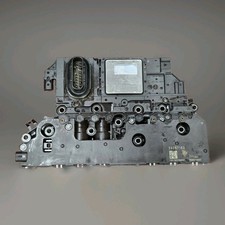
What Is Actually on a 6T70 Solenoid Body
Per ATRA's 6T70 introduction, the unit uses two on/off shift solenoids (SS1 and SS2) and six variable bleed solenoids: pressure control solenoids PCS1 through PCS5 plus the TCC solenoid. They are driven by a Bosch-built 32-bit TCM that is part of the same assembly. The job of each one, from ATRA's solenoid function chart:
| Solenoid | Controls | Type |
|---|---|---|
| Shift Solenoid 1 (SS1) | Clutch Select Valve 2 | On/off, normally closed |
| Shift Solenoid 2 (SS2) | Clutch Select Valve 3 | On/off, normally closed |
| PCS1 | Line pressure | Variable bleed, normally high |
| PCS2 | 3-5-Reverse clutch regulator valve | Variable bleed, normally high |
| PCS3 | R1/4-5-6 clutch regulator valve | Variable bleed, normally high |
| PCS4 | 2-6 clutch regulator valve | Variable bleed, normally low |
| PCS5 | 1-2-3-4 clutch regulator valve | Variable bleed, normally low |
| TCC solenoid | Converter clutch apply | Variable bleed, normally low |
"Normally high" means that with the solenoid off, pressure is allowed through to the clutch; "normally low" means that with it off, no pressure goes through. ATRA gives the electrical specs for the variable bleed solenoids: positive duty cycle control at 3,000 Hz, about 5.5 ohms at 70 degrees F, current limited to 0.9 A, with solenoid feed voltage regulated by the TCM at 8.3-9.3 volts. The two shift solenoids are ground-side controlled.
The part most people get wrong: on this transaxle the "shift solenoids" do not pick the gear. ATRA's seminar is direct about it. SS1 and SS2 decide whether the transmission is in reverse or forward, by positioning the clutch select valves. Solenoids 2 through 5 (the pressure control solenoids for the four clutch regulator valves) decide when each shift happens and how hard it is. So when a customer says "it shifts badly," the solenoid you are hunting is usually a PCS, not SS1 or SS2.
Symptoms by Solenoid
SS1 and SS2: reverse and forward problems
ATRA's solenoid application chart shows SS1 commanded on in park, reverse, neutral and 1st-gear engine braking, and off through drive 1st to 6th. SS2 is commanded on everywhere except reverse. A clutch select valve that will not move, or a shift solenoid that will not open, shows up as a delayed or missing reverse, a harsh or wrong engagement coming out of park, or problems specifically when 1st-gear engine braking is commanded. The performance codes are P0751 (SS1) and P0756 (SS2). Electrical faults on the solenoid circuits set the SAE circuit codes P0973/P0974 (SS1 low/high) and P0976/P0977 (SS2 low/high).
PCS1: everything shifts wrong
Because PCS1 sets line pressure, a fault here does not pick on one shift. Expect every shift to feel off, soft and slipping if line is low, harsh if it is high, along with engagement complaints. ATRA's product-issues seminar adds a useful note for pressure complaints on this family: check line pressure at idle, and if it is low, inspect the pump outlet seal for damage before blaming the solenoid.
PCS2 through PCS5: one clutch at a time
These are where most "shift solenoid" complaints live. Match the symptom to the clutch using the clutch application chart in ATRA's seminar: 1st uses the 1-2-3-4 clutch and the one-way clutch, 2nd adds 2-6, 3rd adds 3-5-R, 4th adds 4-5-6, 5th is 3-5-R plus 4-5-6, 6th is 2-6 plus 4-5-6, and reverse is 3-5-R plus low/reverse.
- PCS2 (3-5-R): no reverse, slip or flare on 3rd and 5th, harsh 3rd and 5th. The performance codes are P0776 and P0777.
- PCS3 (R1/4-5-6): problems into 4th, 5th and 6th, plus reverse and low/reverse behavior.
- PCS4 (2-6): 1-2 and 5-6 shift complaints, and anything that involves 2nd or 6th.
- PCS5 (1-2-3-4): launch and 1st through 4th complaints, and the 4-5 shift where this clutch releases.
A warning on PCS2 in particular. GM bulletin 09-07-30-012F lists no reverse, slip or flare in 3rd and 5th, and P0776 as the signature of a broken 3-5-Reverse wave plate, not a bad solenoid. ATRA's product-issues seminar repeats the bulletin, including that P0777, P2723, P0717, P0716, P2715 and P2714 can each set on their own from the debris. That is a mechanical failure setting a solenoid code, and a new TEHCM will not fix it.
TCC solenoid
Converter clutch symptoms: shudder at light throttle cruise, no lockup, or RPM that climbs and drops on the highway. The usual codes are P0741 (TCC stuck off) and P0742 (stuck on). As with PCS2, confirm fluid condition and converter health before condemning the solenoid.
Pressure switches (Gen 1 only)
These are not solenoids, but they sit on the same assembly and cause some of the same complaints. Per Sonnax, Gen 1 6T70/6T75 units have four normally-closed pressure switches in the TEHCM, one hydraulically tied to each clutch regulator valve, which tell the TCM which gear it is in and time each clutch apply. When one fails, one or more of P0752, P0872, P0877 and P0989 set, and the vehicle may go into limp mode. Note that P0752 reads as a shift solenoid code on a generic scan tool, and ATRA's product-issues seminar lists exactly that group as a known fluid pressure switch problem. Sonnax notes these switches were eliminated starting with 2013 model year 6T70 Gen 2 units, which use clutch pulse learning instead.
How to Diagnose It Before Buying Anything
- Pull every code, stored and history. A single performance code on one clutch points at that PCS and its regulator valve. A cluster of solenoid and speed sensor codes, especially with P0776, points at wave plate debris. Pressure switch codes on a Gen 1 unit point at the switches.
- Check fluid level hot. ATRA's procedure: level surface, parking brake on, start and move the selector through the ranges, idle one minute, and read the dipstick with transmission fluid temperature at 180-200 degrees F on the scan tool. Low fluid starves every solenoid at once and looks like several failures.
- Look at the fluid and the magnet. Steel chunks or broken plate material send you to the wave plate bulletin, not the solenoid body.
- Watch commanded versus actual in live data. Compare commanded gear to the gear ratio calculated from input and output speed. A shift that flares on the same clutch every time is your PCS or its regulator valve.
- Run the solenoid cleaning procedure. ATRA notes the TCM runs a solenoid cleaning cycle every 30 seconds in park or neutral, and it can also be commanded from the scan tool. On a unit with contaminated fluid it is worth doing before you condemn a solenoid.
- Check resistance at the solenoid body. With the side cover off, the variable bleed solenoids should read close to 5.5 ohms at 70 degrees F per ATRA. An open or shorted solenoid is a clear electrical failure. A solenoid that reads correctly can still stick hydraulically, so resistance only rules out the electrical side.
GM's own guidance belongs on the wall of every shop doing these. The bulletin says the control solenoid (with body and TCM) valve assembly should not be washed in a parts cleaner, and should not be replaced for any DTC unless the service information diagnostics for that code have been completed and tell you to replace it. It also says to reuse the TEHCM if the pressure switch O-ring seals are only deformed but still attached, and to replace it only if a switch membrane is damaged.
The same caution shows up in a later bulletin. For the 2014-2019 Traverse, Acadia, Enclave, Equinox, Terrain, SRX, XTS, Impala and other 6T70/6T75/6T80 applications with a launch shudder, a 4th gear shudder or a shudder on the 2-3 or 3-2 shift, GM bulletin 18-NA-358 puts the cause in debris or scored valves in the upper and lower valve bodies and states that TEHCM replacement has not been an effective repair. GM's instruction is to performance test the TEHCM and clean or replace it only as needed, and to replace both valve bodies together if the shudder can be reproduced by power braking in first for five seconds or less. A worn actuator feed limit valve in the valve body can also set solenoid performance codes on a good TEHCM, so if the complaint is a feel problem rather than a circuit code, read our 6T70 valve body symptoms and testing guide before you order a module.
Replacement: What the Job Really Involves
GM's service part for a failed solenoid is the complete control solenoid (with body and TCM) valve assembly, and Sonnax notes that component failures and circuit faults in the TEHCM can only be remedied with a replacement unit. That makes the replacement more of a module job than a solenoid job, and it has four steps people skip.
1. Match the generation, not just the part number
Sonnax's TEHCM identification article makes the point that you should not identify the correct module only by reading the part number off the one you pulled out, because a previous shop may already have installed the wrong one. A module designed for a Gen 2 6T70/6T75/6T80 will not work properly in a Gen 1 build. Use the VIN and the transmission RPO code from the Service Parts Identification label to confirm what the vehicle should have.
2. Install the heat sink bracket
ATRA's introduction calls out a spring-loaded bracket that forces the TCM against a heat sink on the valve body. Leave it out and the TCM goes into thermal shutdown. The side cover gasket is not reusable, and if the cooler lines were removed, the studded side cover bolts need to be re-torqued.
3. Program it
The TCM is part of the assembly you are replacing, so the new one has to be programmed to the vehicle. ATRA states that any time you replace the transaxle you must reprogram the TCM because it is internal to the unit, and the same applies when you replace the TEHCM itself. Sonnax's remanufactured Gen 2 TEHCM (GM6T70-G2-TEHCM, covering OE numbers including 24257300 and 24264346) ships with the old VIN still in it and must be reprogrammed on the vehicle with a J2534 device before it works correctly. Budget for that tool or for a shop that has it.
4. Run Service Fast Learn Adapts
After programming, the TCM has to learn the clutches. ATRA describes Service Fast Learn Adapts as a scan tool procedure that runs a series of tests so the TCM learns each clutch's characteristics and stores them in the adaptive cells used during shifts. When it finishes, shut the engine off and power down the TCM (you will lose scan tool communication), then restart to complete it. Skip this and a good new TEHCM will shift badly.
Repair Instead of Replace?
On Gen 1 units with pressure switch codes, Sonnax sells pressure switch film and seal kits for the 6T70 family (124740-28K and 124740-30K, with installer tool 124740-TL30) so the switches can be repaired instead of buying a new TEHCM. On units with solenoid performance codes across several clutches, the cause is often in the valve body rather than the solenoids; our P0751 guide covers the actuator feed limit valve wear that starves every solenoid at once. A solenoid body that tests open or shorted, or has internal module faults, is a replacement.
Browse 6T70 parts at Core Transmission Parts →
Need parts for this job?
6T70/6T75 TCM and solenoid assemblies, valve bodies and rebuild kits — shipped from the USA. Confirm Gen 1 or Gen 2 by VIN and RPO before you order.
Shop 6T70 parts →FAQ
What are the symptoms of a bad shift solenoid on a 6T70?
It depends on which solenoid. SS1 and SS2 control the clutch select valves, so faults show up as delayed or missing reverse and bad engagements. The pressure control solenoids PCS2 through PCS5 each run one clutch regulator valve, so their faults show up as a flare, slip or harsh shift on the specific gears that use that clutch. PCS1 controls line pressure and affects every shift.
How many solenoids does a 6T70 have?
Eight, per ATRA: two on/off shift solenoids (SS1 and SS2) and six variable bleed solenoids (PCS1 through PCS5 and the TCC solenoid). All of them are on the control solenoid valve assembly with the TCM, known as the TEHCM, behind the side cover.
Can you replace just one solenoid on a 6T70?
GM's service part is the complete control solenoid (with body and TCM) valve assembly, and Sonnax notes TEHCM component failures can only be remedied with a replacement unit. On Gen 1 units with pressure switch codes, Sonnax sells switch film and seal kits so the switches can be repaired instead.
Does a new 6T70 TEHCM need to be programmed?
Yes. The TCM is part of the assembly, so a replacement must be programmed to the vehicle; Sonnax specifies a J2534 device for its remanufactured unit. Afterward, run Service Fast Learn Adapts with a scan tool so the TCM relearns each clutch.
Is P0776 on a 6T70 a bad solenoid?
Often not. GM bulletin 09-07-30-012F ties P0776 with no reverse and 3rd/5th slip to a broken 3-5-Reverse wave plate, a mechanical failure. Replacing the solenoid body will not fix it, and GM says not to replace that assembly unless the service diagnostics direct it.
Sources
- ATRA — "6T70 Introduction," Steve Garrett. Backs the two on/off shift solenoids and six variable bleed solenoids, the solenoid function chart (SS1 to Clutch Select Valve 2, SS2 to Clutch Select Valve 3, PCS1 line pressure, PCS2 3-5-R, PCS3 R1/4-5-6, PCS4 2-6, PCS5 1-2-3-4), the solenoid application chart, normally high/low assignments, 3,000 Hz / 5.5 ohm / 0.9 A / 8.3-9.3 V specs, the solenoid cleaning cycle, the TCM heat sink bracket and thermal shutdown warning, the non-reusable side cover gasket and stud re-torque. atracom.blob.core.windows.net (PDF)
- ATRA — "6T70 Product Issues and Updates," Steve Garrett. Backs the requirement to reprogram the internal TCM, the Service Fast Learn Adapts procedure, the hot fluid check at 180-200 degrees F, the low line pressure pump outlet seal check, the P0752/P0872/P0877/P0989 pressure switch issue, and the codes that set from the broken wave plate. atracom.blob.core.windows.net (PDF)
- General Motors — Service Bulletin 09-07-30-012F, "No Reverse, 3rd or 5th, Check Engine Light Illuminated, DTC P0776" (via NHTSA). Backs the broken 3-5-Reverse wave plate as the cause of P0776 with no reverse and 3rd/5th slip, and the instructions not to wash the control solenoid (with body and TCM) valve assembly in a parts cleaner, not to replace it for any DTC unless SI diagnostics direct it, and to reuse it unless a pressure switch membrane is damaged. static.nhtsa.gov (PDF)
- Sonnax — "Under Pressure: Shift Quality & Pressure Switches in TEHCM Applications." Backs the four normally-closed Gen 1 pressure switches and their function, DTCs P0752/P0872/P0877/P0989 and limp mode, the 124740-28K / 124740-30K / 124740-TL30 repair kits, and the elimination of the switches on 2013 and later Gen 2 6T70 units with clutch pulse learning. sonnax.com
- Sonnax — "Identifying GM 6T70 Series TEHCM Generations Using VIN & RPO Codes," Jim Mobley. Backs the warning against identifying the TEHCM only by the old module's part number, that a Gen 2 module will not work properly in a Gen 1 unit, and the use of VIN and RPO codes from the Service Parts Identification label. sonnax.com
- Sonnax — Remanufactured TEHCM GM6T70-G2-TEHCM product and instruction page. Backs the TEHCM housing the TCM and solenoids, the symptom list (solenoid circuit and performance codes, gear ratio codes, TCC codes), the OE part numbers covered, and the requirement to reprogram with a J2534 device after installation. sonnax.com
- General Motors — Service Bulletin 18-NA-358, "Shudder, 2-3 Upshift or 3-2 Downshift Concern," August 2022 (6T70, 6T75, 6T80, via NHTSA). Backs the covered models, the launch, 4th gear and 2-3/3-2 shudder symptoms, the upper and lower valve body debris and scored valve cause, TEHCM replacement not being an effective repair, performance testing the TEHCM and cleaning or replacing it only as needed, and replacing both valve bodies when the shudder reproduces on a five-second power brake. static.nhtsa.gov (PDF)