P0751 comes up on a scan tool as "Shift Solenoid A Performance or Stuck Off." That is generic OBD-II language. On a GM 6T70 or 6T75, GM calls it Shift Solenoid Valve 1 Performance — Stuck Off, and the difference matters, because on this transaxle shift solenoid 1 does not run a shift valve the way a 4L60E shift solenoid does. It runs a clutch select valve, and the clutch select valves are what decide which clutch a shared regulator circuit is feeding at any given moment.
Get that one idea straight and the code makes sense. Miss it, and you end up buying a TEHCM for a problem that was living in a valve bore two inches away.
How the 6T70 actually picks a gear
The 6T70 is a clutch-to-clutch six-speed with five friction elements plus a low/reverse one-way clutch. Sonnax publishes the apply chart with its remanufactured valve bodies, and the pattern is worth memorizing:
| Range | Elements applied |
|---|---|
| Reverse | 3-5-R clutch + low/reverse clutch |
| 1st (drive) | 1-2-3-4 clutch, low/reverse one-way clutch holding |
| 2nd | 1-2-3-4 + 2-6 |
| 3rd | 1-2-3-4 + 3-5-R |
| 4th | 1-2-3-4 + 4-5-6 |
| 5th | 3-5-R + 4-5-6 |
| 6th | 2-6 + 4-5-6 |
Notice that reverse and 4th through 6th both need a clutch fed off the same regulator. Sonnax identifies that valve in the Gen. 1 upper valve body as the L/R 4-5-6 clutch regulator valve (I.D. 107). One regulator, two very different jobs. Something has to point it at the right clutch, and that something is the pair of clutch select valves sitting right next to it: clutch select solenoid valve #2 (I.D. 105) and #3 (I.D. 104).
The shift solenoids are the actuators for those valves. Per ATRA's teardown of this solenoid family, the shift solenoid is an on/off, normally closed device whose only job is to send signal oil to the clutch select valve. Signal pressure works against valve spring force; when it wins, the valve strokes and the circuit is redirected. There is no modulation, no duty cycle, no current ramp. It is on or it is off.
One more piece of context that shapes the symptoms: GM's description of this transaxle notes that shifts from 2nd through 6th are clutch-to-clutch, but the 1-2 upshift is a freewheeling action handled by the low/reverse one-way clutch. That is why a clutch select fault rarely shows up as a 1-2 complaint. It shows up as a 3-4 flare, a delayed or missing reverse, or a wrong-gear start.
What the TCM measures before it sets P0751
The module has no pressure sensor watching that clutch select valve. What it has is input (turbine) speed and output speed. It commands shift solenoid 1 on, waits, then divides input speed by output speed and compares the result against the ratio the commanded gear should produce. If the measured ratio says the transmission is still in the gear it was supposed to leave — the clutch select valve never moved — that is "stuck off," and P0751 sets.
Two consequences follow from that, and both save you time:
- P0751 is a mechanical and hydraulic code, not an electrical one. The electrical circuit tests set their own codes. P0751 means the module could talk to the solenoid and the transmission still did not do what it was told.
- It needs a valid speed signal to run at all. If you also have P0716, P0717, P2714 or P2715 stored, the ratio math those tests depend on may already be corrupt. Sort the speed-signal and pressure-control faults first, then see whether P0751 survives.
The three things that actually cause it
1. Debris from a broken 3-5-R wave plate
This is the one to rule out first on a 2007-2009 unit, and it is documented all the way up at GM. Corporate bulletin 09-07-30-012F covers 2007-2009 Acadia, Outlook, Enclave, Traverse, AURA, VUE, Malibu, Equinox, G6 and Torrent with RPO MH2, MH4, MH6 or MY9. The condition is no reverse, slip or flare, or harsh shifts in 3rd and 5th, with P0776 set. The cause, in GM's words, is a broken 35R clutch wave plate letting the apply piston over-stroke, and GM notes it normally will not occur before approximately 20,000 miles.
The line that matters for P0751 is this one: debris generated by the condition can affect the operation of the speed sensors and other clutches. GM lists P0777, P2723, P0717, P0716, P2715 and P2714 as codes that can set independently as a result of that wave plate breaking. Metallic debris circulating through the control solenoid filter plate is exactly what parks a clutch select valve in its bore.
The replacement waved plate is P/N 24254103. GM's cleanup instruction is not optional: separate the case halves, clean the debris out of the entire transmission, and replace both the pump fluid filter (201) and the control solenoid filter plate (16). GM states that failing to do all of that leads to repeat damage and repairs. GM also warns specifically that the control solenoid assembly (with body and TCM) must not be washed in a parts cleaner, and should not be replaced for any DTC unless the service diagnostics tell you to.
The useful triage detail from the same bulletin: pull the filter plate and look at the screens. No debris on the screens means the pump filter did its job and the pump, converter and valve body do not need replacing. Fine gray metal flake you cannot feel is not a reason to replace the converter. Chips you can feel are.
2. Actuator feed limit pressure too low to stroke the valve
Every solenoid in this unit is fed through the actuator feed limit circuit, and the AFL valve's job is to cap solenoid feed pressure at a fixed value regardless of what line pressure is doing. TransGo's writeup of the Gen. 1 failure is direct: complaints of erratic shifts, TCC slip and assorted solenoid performance and gear ratio codes on 2007-2013 6T70 and 6T75 units are often the result of wear at the actuator feed limit valve bore. If solenoid feed pressure is too low, solenoid output is too low — and an on/off shift solenoid with weak signal oil behind it cannot overcome the clutch select valve spring. The valve does not stroke. The ratio does not change. P0751.
TransGo lists P0751 and P0752 explicitly among the codes its SK 6T70-A Gen. 1 kit addresses, alongside P0756, P0757, P0776, P0777, P0796, P0797 and the P2714/P2715/P2723 group. Sonnax attacks the same circuit from the parts side: the Gen. 1 AFL/solenoid pressure regulator valve kit 124740-32K is listed against solenoid performance codes, wrong gear starts and clutch failure, and on Gen. 2 units the equivalents are the actuator feed limit valve kit 124740-33K and oversized kit 124740-48K, carrying that same symptom list.
3. A worn clutch select valve bore
The valve itself wears. Sonnax's Gen. 1 vacuum test guide marks test locations on both clutch select solenoid valves and lists their symptoms: clutch select solenoid valve #2 — various shift concerns, delayed reverse, 3-4 flare, shift codes; clutch select solenoid valve #3 — various shift concerns, shift codes. Read that list against the apply chart above and the P0751 story writes itself.
Sonnax's test rule for this valve body is that OE valves are tested in their rest position unless the guide says otherwise, and a low vacuum reading indicates wear. Note what Sonnax does not publish: a drop-in oversized clutch select valve. If those bores test low, you are looking at a sleeve repair or a remanufactured valve body, not a small kit.
A diagnostic order that converges
- Read and record every code, stored and history, before clearing anything. P0751 alone points at the clutch select circuit. P0751 with P0776 points at the wave plate. P0751 with a spread of solenoid performance codes points at AFL pressure starving all of them at once.
- Check fluid level and condition at temperature, and look at the pan. Level is a hot check: Sonnax's procedure is engine idling at 500-800 rpm with transmission fluid temperature between 180 and 200°F, read on the driver information center or a scan tool, taking the lower level on the dipstick and confirming with a second reading. Gray fluid, a loaded magnet or chips on the pan floor sends you straight back to the wave plate section above.
- Watch live data through a full warm-up. The PIDs that earn their keep are input speed sensor, output speed sensor, calculated gear ratio, commanded gear versus attained gear, transmission fluid temperature, and shift solenoid 1 commanded state. What you want is the ratio at each commanded gear. If commanded 4th holds the 3rd-gear ratio while SS1 shows commanded on, you have found your stuck clutch select valve.
- Do not sign off on a cold drive. ATRA's bench guidance on this exact unit is that shift quality problems usually do not appear until full operating temperature, and that after clearing adaptives the TCM relearns most of the shift timing within 3 to 5 complete shift cycles once it is hot.
- Test the solenoid electrically, then functionally. ATRA's published resistance values for this solenoid family are 16-20 ohms for the on/off shift solenoids and 3-5 ohms for the pressure control solenoids, measured with the solenoid removed from the TEHCM. You may apply 12 volts to the shift solenoid to actuate it; never apply 12 volts to a pressure control solenoid. For the functional check, pull the solenoid block, cover the fluid entry port with a plastic test plate, apply about 45 psi of regulated air and watch the exit ports. All of these variable-bleed solenoids leak a little air by design, so learn the normal pattern before you condemn one.
- Air check the case circuits while the valve body is out. Sonnax maps the 6T70/6T75E air test ports for the low/reverse clutch, compensator feed, 3-5 reverse direct clutch, 4-5-6 overdrive clutch, 2-6 intermediate clutch and 1-2-3-4 forward clutch. Low regulated pressure only. This catches a leaking clutch before you install parts on top of it.
- Vacuum test the valve body, clutch select bores included, before you decide the module is the problem.
TransGo SK 6T70-A shift kit
The kit that goes after the actual cause on most of these: a drop-in AFL valve and bushing that restores solenoid feed pressure in a worn bore, plus a hardened pressure regulator valve and TCC regulator valve. TransGo lists P0751 and P0752 among the codes it corrects. Gen. 1 units 2007-2013 with pressure switches — check your generation before ordering, since the Gen. 2 kit is a different part.
View the 6T70 shift kit at Core Transmission Parts →Different generation, or a different job? The full shift kit shelf at Core Transmission Parts covers Gen. 1 and Gen. 2.
Putting it back together so it stays fixed
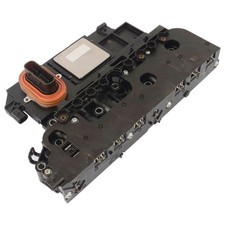
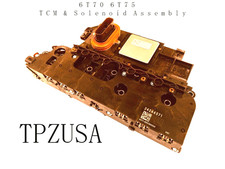
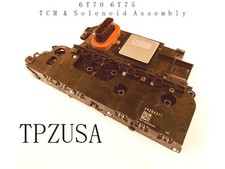
Sonnax publishes the reassembly numbers with its remanufactured Gen. 1 valve bodies, and they are the numbers you want for any valve body or TEHCM job on this unit:
- Valve body to case: 10 bolts, hand tight first, then torqued in the published sequence to 106 in-lb. Align the manual valve with the detent lever and seat the detent spring.
- TEHCM and TCU spring retainer to valve body: 11 bolts, hand tight, then 106 in-lb in sequence. Install a new solenoid filter plate first.
- Main control cover to case: 20 bolts and stud bolts, 106 in-lb in sequence. Inspect the 20-pin TEHCM connector seal and make sure it sits on the inside of the cover, or it leaks.
- Verify the 1-2-3-4 clutch seal is in place before the valve body goes on.
- Generation identification is not optional. Gen. 1 valve bodies split further by 3-5-R clutch regulator ratio — 2007-2008 units use the 1.35 ratio, 2009 and later Gen. 1 units use 1.83 — and the castings look nearly identical. Sonnax identifies them by the notch, cut-out or circle-hole pattern at the lower and upper separator plates.
- Fluid: DEXRON-VI only. Fill enough to start the engine safely, then run the range sweep — brake applied, roughly three seconds in each range, back to Park — idle at 500-800 rpm for at least a minute, and set the level at 180-200°F. Add no more than one pint at a time without rechecking.
- Program the module. A replacement or reused TEHCM must be loaded with the correct current calibration per the OE procedure. If you are reusing a Gen. 1 module, Sonnax recommends replacing all fluid pressure switch seals and laminated discs while it is out; they are contamination-prone and cause pressure switch codes plus a spread of shift complaints.
Need parts for this job?
Shift kits, valve bodies, filter and pan gasket kits, friction modules, overhaul kits and DEXRON-VI — the 6T70 and 6T75 shelf in one place, shipped from the USA.
Shop 6T70 parts →Keeping it from coming back
- Never reuse the control solenoid filter plate. It is cheap, it is the last line between debris and your clutch select valves, and GM calls out replacing it by name.
- Service the fluid with DEXRON-VI on a real interval. Debris is the mechanism behind most stuck-valve codes on this family, and fluid condition is the part of that you control.
- If it is an 07-09 unit and the wave plate has never been replaced, replace it. GM's own instruction is that a new plate should be installed any time the transmission is disassembled for any reason.
- Vacuum test before you buy a module. A TEHCM is the most expensive guess in the bay.
- Relearn hot, verify hot. Watch ratio versus commanded gear through a full warm-up cycle before you hand the keys back.
FAQ
Is P0751 on a 6T70 a bad solenoid or a bad valve body?
More often the valve body or the fluid than the solenoid winding. The shift solenoid is a simple on/off device; what usually fails is the clutch select valve it feeds, either because the bore is worn, because debris is holding the valve, or because actuator feed limit pressure has dropped too low to stroke it. Check the pan and vacuum test the clutch select bores before you condemn the TEHCM.
Can I replace just shift solenoid 1 on a 6T70?
Not through GM. The shift solenoids, the pressure control solenoids, the Gen. 1 pressure switches and the transmission control module are one assembly, the TEHCM. Rebuilders do swap individual solenoids off donor modules, and ATRA has published that approach, but there is no OE service part for a single solenoid.
What should shift solenoid 1 measure on a meter?
ATRA's published figures for this solenoid family are 16 to 20 ohms for the on/off shift solenoids and 3 to 5 ohms for the pressure control solenoids. Remove the solenoid from the TEHCM before you test it. A shift solenoid that reads in spec still tells you nothing about whether the valve it feeds is actually stroking.
Does a broken 3-5-R wave plate cause P0751?
It causes the debris that causes P0751. GM bulletin 09-07-30-012F identifies the broken 35R clutch wave plate as the source of P0776 and states that debris generated by the failure can affect the speed sensors and other clutches. That debris is what sticks a clutch select valve. If P0751 shows up alongside P0776, P0717 or P2714, look for the wave plate.
Do I have to program a replacement TEHCM on a 6T70?
Yes. Sonnax states in its own valve body instructions that the original or replacement TEHCM must be programmed with the proper and latest software and calibrations, following the OE procedure. Skip it and the module behaves like a hardware failure the moment you drive the vehicle.
Related reading: our 6T70 P0741 TCC diagnosis, 6T70 limp mode causes, and the GM 6T70/6T75 service guide.
Sources
- General Motors Corporate Bulletin 09-07-30-012F, "No Reverse, 3rd or 5th, Check Engine Light Illuminated, DTC P0776 (Replace 3-5 Reverse Clutch Plate (Waved))", October 2012, hosted by NHTSA. Backs the model and RPO coverage (MH2, MH4, MH6, MY9), the broken 35R clutch wave plate allowing apply-piston over-stroke as the cause, the approximately 20,000-mile onset, the statement that debris generated by the condition can affect the speed sensors and other clutches, the associated codes P0777, P2723, P0717, P0716, P2715 and P2714, replacement plate P/N 24254103, the requirement to clean the entire transmission and replace the pump fluid filter (201) and control solenoid filter plate (16), the warning not to wash the control solenoid assembly in a parts cleaner, the filter-plate screen triage rule, and the instruction to install a new plate any time the unit is disassembled. static.nhtsa.gov (PDF)
- Sonnax, "GM 6T70, 6T75 (Gen. 1) Vacuum Test Guide." Backs the Gen. 1 upper valve body identification of clutch select solenoid valve #3 (I.D. 104), clutch select solenoid valve #2 (I.D. 105) and the L/R 4-5-6 clutch regulator valve (I.D. 107), the actuator feed limit valve (I.D. 205) in the lower body, the symptom lists for both clutch select valves (various shift concerns, delayed reverse, 3-4 flare, shift codes), and the test rule that OE valves are tested in rest position and a low vacuum reading indicates wear. sonnax.com
- Sonnax, GM 6T70/75 (Gen. 1) and GM 6T70/75/80 (Gen. 2) Valve Body Layouts. Back the Gen. 1 AFL/solenoid pressure regulator valve kit 124740-32K being listed against solenoid performance codes, wrong gear starts and clutch failure, and the Gen. 2 actuator feed limit valve kit 124740-33K and oversized actuator feed limit valve kit 124740-48K carrying the same symptom list. sonnax.com (Gen. 1 layout) • sonnax.com (Gen. 2 layout)
- Sonnax, "6T70 (Gen. 1), 6T75 (Gen. 1) Remanufactured Valve Body" tech and install instructions (GM6T70-1E, GM6T70-1L). Backs the clutch apply chart used above, the 6T70/6T75E air test port list (low/reverse clutch, compensator feed, 3-5 reverse direct clutch, 4-5-6 overdrive clutch, 2-6 intermediate clutch, 1-2-3-4 forward clutch), the 106 in-lb torque in sequence for the 10 valve body bolts, the 11 TEHCM and TCU spring retainer bolts and the 20 main control cover bolts and stud bolts, the 20-pin connector seal orientation, the 1-2-3-4 clutch seal check, the 1.35 versus 1.83 ratio Gen. 1 identification by separator plate notch and cut-out, the DEXRON-VI-only requirement, the fluid level procedure at 500-800 rpm idle and 180-200 degrees F with no more than one pint added at a time, and the TEHCM programming and pressure switch seal and laminated disc recommendations. sonnax.com (PDF)
- GEARS Magazine (ATRA), "Understanding GM 6T40 Solenoids," Jarad Warren, June 2017. Backs the description of the shift solenoid as an on/off, normally closed solenoid that controls oil to the clutch select valve, the resistance specifications of 3-5 ohms for the pressure control solenoids and 16-20 ohms for the shift solenoid, the instruction to remove the solenoid from the TEHCM before resistance testing, the caution never to apply 12 volts to a pressure control solenoid while the shift solenoid may be actuated with 12 volts, the 45 psi air test method using a plastic test plate over the fluid entry port, and the note that individual solenoids can be swapped rather than replacing the whole TEHCM. gearsmagazine.com
- GEARS Magazine (ATRA), "Things That Go Bump - 6T70 Transmission Shift Quality Issues," Keith Clark, April 2022. Backs the statement that 6T70 shift quality problems typically do not appear until the unit reaches full operating temperature and that a short post-rebuild test drive is misleading, and that after adaptives are cleared the TCM relearns most shift timing within 3 to 5 complete shift cycles once hot. gearsmagazine.com
- TransGo, "GM 6T70, 6T75 GEN1 SHIFT KIT Valve Body Repair Kit" (SK 6T70-A) product documentation. Backs the statement that 2007-2013 Gen. 1 6T70/6T75 units commonly present with erratic shifts, TCC slip and assorted solenoid performance and gear ratio codes as a result of wear at the actuator feed limit valve bore, the explanation of the AFL valve's function in capping solenoid feed pressure independent of main line pressure, the consequence that out-of-spec solenoid feed pressure produces out-of-spec solenoid output, and the corrected-code list including P0751 and P0752. transgo.com