Plug a generic reader into a Chevrolet Traverse with a stored P0756 and it will tell you the 2-3 shift solenoid failed. On a GM 6T70 or 6T75 that description is simply wrong, and chasing it costs you a day.
This transaxle does not have a 2-3 shift solenoid. It is a clutch-to-clutch six-speed with eight solenoids in the TEHCM, and only two of them are on/off shift solenoids. Transmission Digest's teardown comparison of the GM 6T70 against its Ford 6F50 cousin spells out what the second one does: SS2 is a normally closed on/off solenoid used in Reverse to control the position of clutch select valve 3. When Reverse is selected, SS2 is turned off, which exhausts solenoid signal pressure from the outboard end of that valve. Reverse pressure from the manual valve plus spring force on the inboard end holds the valve released, and reverse pressure passes through clutch select valve 3 into the 3-5-R clutch feed circuit.
So P0756 on this unit is a Reverse and 3-5-R circuit story. Read it that way and the diagnosis narrows fast.
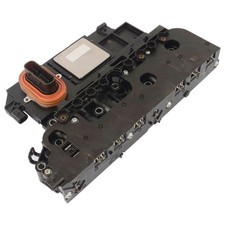
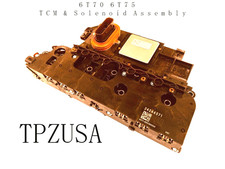
How the module decides the solenoid is not performing
There is no pressure transducer watching that circuit. The 6T70 uses four transmission fluid pressure switches inside the TEHCM to report the position of the four clutch regulator valves: TFP #1 monitors the 1-2-3-4 clutch regulator valve, #2 the 3-5-Reverse, #3 the 2-6, and #4 the 4-5-6. All four are normally closed and pass current when no fluid pressure is present. When the regulator valve strokes and routes pressure to the switch, the switch opens and the current stops. By reading the combination of open and closed switches, the control module infers which gear the transaxle is actually in.
That is the whole mechanism behind a "performance" code. The module commanded SS2 to a state, waited for the switch pattern that state should produce, and did not get it inside the monitor's time window. Nothing in that test proves the solenoid is bad. It proves the hydraulic result never showed up. The solenoid, the feed pressure behind it, the valve it moves, and the switch that reports back are all inside the loop.
Step zero: identify the generation before you order anything
The 6T70 family split into two generations and the valve body parts do not cross. Sonnax's Gen. 1 identification chart sorts them by the 3-5-R clutch regulator valve ratio and by marks on the separator plates:
| Model year | 3-5-R reg. valve | Lower separator plate | Upper separator plate | Exhaust port | Channel plate |
|---|---|---|---|---|---|
| 2007 – 2008 | 1.35 ratio | Cut out | No notch | Closed | Level with valve body |
| 2009 | 1.83 ratio | Notch | Notch | Closed | Level with valve body |
| 2010 – 2011 | 1.83 ratio | Circle hole | Notch | Open | Level with valve body |
| 2012 – 2013 | 1.83 ratio | Circle hole | Notch | Open | Raised notch above valve body |
Gen. 2 castings drop the contours that Gen. 1 bodies carry. This matters more than it sounds, because the single most common real fix for P0756 is a valve repair that is generation-specific: Sonnax warns outright that if the valve is Gen. 2, stop, and use 124740-48K with tooling F-124740-TL48 instead of the Gen. 1 parts.
The cause that actually repeats: actuator feed limit bore wear
Every solenoid in this unit is fed through the actuator feed limit valve, which GM calls AFL and Ford calls the solenoid pressure regulator on the closely related 6F50 and 6F55. Sonnax's engineering note on the circuit is the clearest statement of the failure I have seen in print: in Ford 6F50/6F55 and GM Gen. 1 6T70/6T75 units, AFL bore wear results in low pressure at the shift and control solenoid valve assembly. The OE valve has a large reaction area and is heavily side-loaded, which wears the aluminum bore. As bore wear increases, oil pressure to the shift solenoids drops, and that causes solenoid and ratio codes, along with lower line pressure overall.
Read that against the P0756 monitor and it lines up exactly. SS2 is a small on/off valve. Starve its feed and it will not stroke clutch select valve 3 quickly or completely, the TFP pattern does not arrive, and the module sets a solenoid performance code on a solenoid that is electrically perfect. Sonnax's own symptom list for the AFL repair is short and familiar: solenoid performance codes, wrong gear starts, clutch failure.
You verify it with a vacuum test, not a guess. Sonnax's Gen. 1 6T70/6T75 vacuum test guide maps the AFL valve on the lower valve body and lists its wear symptoms as harsh shifts, low clutch pressure, no or slipping shifts, and solenoid cores. Test the valve in its rest position unless the instruction sheet says otherwise; a low vacuum reading means the bore has worn and is leaking. There are two repair paths for a Gen. 1 body:
- 124740-32K — the drop-in sleeve and valve kit. A hardcoat anodized aluminum valve inside a billet sleeve gives the valve a new unworn bore while the sleeve seals off the existing moderate wear. A correct-rate spring and a .062" drill with plugs and rivets for rerouting balance oil at the separator plate are in the kit. No reaming. Note Sonnax's caveat: because of the sleeve design, post-install vacuum testing at the inboard port is not a valid sealing test.
- 124740-01 — the oversized valve. Cheaper part, more work: it requires reaming the bore with F-104740-TL12 and the VB-FIX fixture. Use this when you already own the tooling and the bore is beyond what a sleeve should cover.
The debris path: a broken 3-5-R wave plate
If the vehicle also has a Reverse complaint, stop and read GM bulletin 09-07-30-012F before you touch the valve body. It covers 2007–2009 Saturn AURA, OUTLOOK and VUE, 2008–2009 Buick Enclave, Chevrolet Equinox and Malibu, 2009 Traverse, 2007–2009 GMC Acadia and Pontiac G6, and 2008–2009 Pontiac Torrent with RPO MH2, MH4, MH6 or MY9.
The condition is no Reverse plus slip, flare or harsh shifts in 3rd or 5th, caused by a broken 35R clutch wave plate allowing the apply piston to over-stroke, which lets the piston leak and loses the apply. GM says this normally does not occur before roughly 32,000 km (20,000 mi), and that the old design plates were not stress relieved. The replacement plate is P/N 24254103. The line that matters for a solenoid code: debris generated by the condition can affect the operation of the speed sensors and other clutches. The bulletin's headline code is P0776, but it lists P0777, P2723, P0717, P0716, P2715 and P2714 as codes that may set independently as a result of the plate breaking. A shift solenoid valve hung up on that same debris is the same story one circuit over.
GM's triage for the debris is worth stealing whether or not you are doing a warranty repair. Pull the control valve body cover, the control solenoid valve assembly and the filter plate assembly, and inspect the filter plate screens. No debris on the screens means the pump filter did its job and the pump, converter and valve body do not need replacing. Debris on the screens means you inspect further. Fine metal you cannot feel, a gray tint to the fluid, is not by itself a reason to replace the converter; chips you can feel, or debris found when flushing the cooler and lines, is. GM also says plainly that the control solenoid assembly should not be washed in a parts cleaner, and should not be replaced for any DTC until the service information diagnostics for that DTC have been completed and call for it.
Working the code in an order that converges
1. Fluid and voltage, first, every time
DEXRON-VI only in this family. Check level with the engine idling at 500–800 rpm and the transmission fluid temperature PID between 180–200°F, after cycling the shifter through every range with a three-second pause in each, then reading the lower level on the dipstick and confirming it with a second insertion. Adjust no more than a pint at a time. Then put a meter on the charging system and the transmission ground. Marginal supply voltage produces solenoid faults on healthy hardware.
2. Read the whole code set before clearing anything
| What you see | What it usually means | Next move |
|---|---|---|
| P0756 alone, shifts otherwise normal | SS2 or clutch select valve 3 circuit only | Vacuum test the AFL and 3-5-R circuits |
| P0756 with P0751 | Both shift solenoids affected — a shared feed problem | AFL bore wear is the prime suspect |
| P0756 plus P0776 and no Reverse | 3-5-R clutch apply lost | Wave plate per bulletin 09-07-30-012F |
| P0756 with P0716, P0717, P2714, P2715 or P2723 | Debris moving through the unit | Filter plate screen inspection, then internal |
| P0756 with an assortment of pressure switch codes | TEHCM laminate disc failure faking a pattern | Switch repair, not a solenoid chase |
3. Air check what you can reach
With the valve body out, air check the circuits with low regulated shop air before anything goes back together. The 6T70 test port map covers low/reverse clutch, compensator feed, 3-5 reverse direct clutch, 4-5-6 overdrive clutch, 2-6 intermediate clutch and 1-2-3-4 forward clutch. A dull or leaky 3-5-R response with a good low/reverse response tells you where to look next.
4. Vacuum test the two valves that matter here
The AFL valve on the lower body is the feed side. On the upper body, the 3-5 Reverse clutch regulator valve is the one whose wear produces burnt 3-5-R clutch, delayed Reverse, 3rd and 5th shift complaints and 2-3 or 4-5 flare. The Gen. 1 repair is ratio-specific: 124740-26K for the 1.35 ratio, 124740-21K for the 1.83, each with its own reaming tool and the VB-FIX fixture.
5. Live data worth watching
On a bidirectional scan tool with GM transmission coverage, log transmission fluid temperature, the four TFP switch states, commanded versus actual line pressure, and input and output shaft speed. Command SS2 on and off with the vehicle in Park and watch whether the switch pattern responds. Then drive it hot. A 6T70 that behaves for the first ten minutes and misbehaves at full operating temperature is the normal presentation, not the exception — aluminum bores leak more as the fluid thins.
Know what the command should look like before you judge it. ATRA's 6T70 solenoid application chart shows SS2 commanded on in Park, Neutral and every forward gear, and off only in Reverse, while SS1 is on in Park, Reverse, Neutral and 1st-gear engine braking and off in drive 1st through 6th. ATRA also notes that SS1 and SS2 are normally closed, ground-side controlled on/off solenoids, and that the TCM runs a solenoid cleaning cycle every 30 seconds in Park or Neutral, which you can also trigger from the scan tool. Run that cleaning cycle on a unit with dirty fluid before you condemn SS2; our 6T70 shift solenoid symptoms guide maps every solenoid on the TEHCM to the clutch it controls.
Putting it back together
These numbers come from the Sonnax remanufactured valve body install sheet for the Gen. 1 units and they are worth writing on the bench:
- Verify the 1-2-3-4 clutch seal is in place before the valve body goes on, and align the manual valve with the detent lever as you set it down.
- Valve body: 10 bolts, hand tight first, then torqued in the marked sequence to 106 in-lb. Align the detent spring into the detent lever.
- New solenoid filter plate onto the solenoid body. Do not reuse it.
- TEHCM and TCU spring retainer: 11 bolts, hand tight, then 106 in-lb in sequence.
- Main control cover bolts and studbolts: 106 in-lb in sequence. On a 6T70, make sure the 20-pin TEHCM connector seal sits on the inside of the cover or it will leak.
- Reconnect the shift position switch, output speed sensor and turbine shaft speed sensor.
- If you reuse the original TEHCM, replace all fluid pressure switch seals and laminated discs while it is off. They are prone to contamination failure, and they cause pressure switch codes and a long list of shift complaints.
- A replacement TEHCM has to be programmed with current calibrations before it will run correctly.
6T70 shift kit — CoreTransmissionParts
Recalibrated valve body springs, valves and checkball/separator-plate components for the 6T70. This is the right buy when your vacuum testing shows general valve body wear rather than one bad bore, and it goes in while the pan is already off for the AFL repair. Confirm your year and generation before ordering. Browse the rest of the shift kit collection if your unit is a 2013-up.
View the 6T70 shift kit →Keeping it from coming back
- Vacuum test the AFL circuit any time the pan is off on this family. It is the feed for every solenoid in the unit and it is the cheapest thing you will ever fix on a 6T70.
- Do not put a new solenoid assembly behind a dirty cooler. If debris put the code there, the cooler and lines get flushed or replaced and the pan and magnet get cleaned, or you are installing a countdown.
- Service the fluid with DEXRON-VI on schedule. Contamination is what hangs these valves, and fluid service is the part of that you control.
- Replace the 3-5-R wave plate any time the unit is apart, which is GM's own recommendation in the bulletin, not just ours.
Need parts for this job?
Valve bodies, TEHCM units, filter and pan gasket kits, master rebuild kits, pressure switch seal tooling and DEXRON-VI — the 6T70 and 6T75 shelf in one place, shipped from the USA.
Shop 6T70 parts →FAQ
Is P0756 on a 6T70 really the 2-3 shift solenoid?
No. That definition comes from the generic OBD-II description of P0756 and it does not describe this transaxle. GM's shift solenoid 2 in the 6T70 and 6T75 is a normally closed on/off solenoid used to position clutch select valve 3, and it is switched off when Reverse is selected. Treat P0756 on this unit as a Reverse and 3-5-R circuit fault, not a 2-3 upshift fault.
Can you replace shift solenoid 2 by itself on a 6T70?
Not as an individual part. The eight solenoids, the fluid pressure switches on Gen. 1 units and the transmission control module are one assembly, the TEHCM. If the solenoid winding or its driver is genuinely bad, the module is replaced or remanufactured whole. That is exactly why you want to rule out the hydraulic causes first.
Why does P0756 come back after a new valve body or TEHCM?
Usually because the actual restriction was never in the part that got replaced. Actuator feed limit bore wear starves the shift solenoid feed circuit, so a new solenoid assembly gets the same low pressure the old one had. Debris left in the pan, cooler and converter after a broken 3-5-R wave plate does the same thing a second time.
What does a broken 3-5-R wave plate have to do with a shift solenoid code?
GM bulletin 09-07-30-012F documents the 35R clutch wave plate breaking and letting the apply piston over-stroke, and says debris generated by that condition can affect the operation of the speed sensors and other clutches. That debris is what lodges a shift solenoid valve or a clutch select valve. The bulletin's primary code is P0776, but P0716, P0717, P2714, P2715 and P2723 are listed as codes that can set independently as a result.
How do I know if my 6T70 is Gen. 1 or Gen. 2 before ordering parts?
Sonnax's identification chart splits Gen. 1 by year using the 3-5-R clutch regulator valve ratio and the separator plate marks: 2007 and 2008 units use the 1.35 ratio with a cut out in the lower separator plate and no notch in the upper, 2009 units use the 1.83 ratio with a notch in both, and 2010 to 2013 units use the 1.83 ratio with a circle hole in the lower plate, a notch in the upper and an open exhaust port. Gen. 2 valve bodies drop the contours on the casting. Order the AFL valve for the wrong generation and it will not fit.
Related reading: our 6T70 P0748 pressure control solenoid guide, 6T70 P0751 shift solenoid A, and 6T70 limp mode causes.
Sources
- Transmission Digest — "Ford 6F50 and GM 6T70: Similar but Different," Steve Garrett. Backs the solenoid count and layout (GM uses eight solenoids where Ford uses seven, with the TCM built into the GM solenoid body), the function of SS1 and SS2, the specific statement that SS2 is a normally closed on/off solenoid used in Reverse to control the position of clutch select valve 3 by exhausting solenoid signal pressure from its outboard end, and the four transmission fluid pressure switches monitoring the 1-2-3-4, 3-5-Reverse, 2-6 and 4-5-6 clutch regulator valves as normally closed switches that open under pressure. transmissiondigest.com
- General Motors Service Bulletin 09-07-30-012F, October 2012 (hosted by NHTSA). Backs the affected model and RPO list, the condition (no Reverse, slip/flare or harsh 3rd and 5th, SES light), the cause as a broken 35R clutch wave plate allowing the apply piston to over-stroke, the roughly 32,000 km (20,000 mi) onset, replacement wave plate P/N 24254103, the statement that debris generated by the condition can affect speed sensor and other clutch operation, the companion codes P0777, P2723, P0717, P0716, P2715 and P2714, the filter plate screen inspection rule for deciding whether the pump and converter need attention, and the instructions not to wash the control solenoid assembly in a parts cleaner and not to replace it for any DTC until SI diagnostics call for it. static.nhtsa.gov
- Sonnax — AFL/Solenoid Pressure Regulator Valve Kit 124740-32K. Backs the mechanism at the center of this article: that AFL bore wear in Ford 6F50/6F55 and GM Gen. 1 6T70/6T75 units results in low pressure at the shift and control solenoid valve assembly, that the OE valve has a large reaction area and is highly affected by side-loading, that increasing bore wear reduces oil pressure to the shift solenoids and causes solenoid and ratio codes plus low line pressure, the symptom list (solenoid performance codes, wrong gear starts, clutch failure), the kit contents including the hardcoat anodized valve, billet sleeve, new spring and the .062" drill with plugs and rivets, and the note that post-install vacuum testing at the inboard port is not a valid sealing test. sonnax.com
- Sonnax — Oversized AFL/Solenoid Pressure Regulator Valve 124740-01. Backs the second repair path for a worn AFL bore, its required tooling F-104740-TL12 and VB-FIX, the hardcoat anodizing, and the explicit warning that a Gen. 2 valve must instead be repaired with 124740-48K and F-124740-TL48. sonnax.com
- Sonnax — "GM 6T70, 6T75 (Gen. 1) Vacuum Test Guide," December 2, 2014. Backs the vacuum test method (valves tested in rest position unless otherwise indicated, a low reading indicates wear), the actuator feed limit valve location on the lower valve body with its symptom list of harsh shifts, low clutch pressure, no or slipping shifts and solenoid cores, and the 3-5 Reverse clutch regulator valve on the upper body with its symptoms of burnt 3-5 Reverse clutch, delayed Reverse, 3rd and 5th shift complaints and 2-3 and 4-5 shift flare, repaired with 124740-26K for the 1.35 ratio or 124740-21K for the 1.83 ratio. sonnax.com
- Sonnax — GM Gen. 1 6T70 & 6T75 Identification Guide. Backs the year-by-year identification table: 3-5-R clutch regulator valve ratio, lower and upper separator plate marks, exhaust port state and control valve channel plate height for 2007–2008, 2009, 2010–2011 and 2012–2013 units. sonnax.com
- Sonnax — 6T70/6T75 (Gen. 1) Remanufactured Valve Body GM6T70-1E / GM6T70-1L Tech & Install Tips (PDF). Backs the reassembly specifications: air check port identification for the low/reverse, compensator feed, 3-5 reverse direct, 4-5-6 overdrive, 2-6 intermediate and 1-2-3-4 forward circuits; 10 valve body bolts torqued in sequence to 106 in-lb; 11 TEHCM and TCU spring retainer bolts to 106 in-lb; main control cover bolts and studbolts to 106 in-lb; the 20-pin TEHCM connector seal placement on the inside of the cover; DEXRON-VI only; the fluid level procedure at 180–200°F with the engine idling 500–800 rpm and no more than a pint added at a time; the recommendation to replace all pressure switch seals and laminated discs when reusing a TEHCM; and the requirement to program a replacement TEHCM with current calibrations. cdn.transend.us
- ATRA — "6T70 Introduction," Steve Garrett. Backs the SS1/SS2 commanded states in the solenoid application chart (SS2 on in every range except Reverse; SS1 on in Park, Reverse, Neutral and 1st-gear engine braking), the normally closed, ground-side controlled on/off shift solenoid design, and the 30-second solenoid cleaning cycle in Park or Neutral that can also be run from the scan tool. atracom.blob.core.windows.net (PDF)