On a GM 6T70 or 6T75, the part most people call the "EPC solenoid" is listed in GM service information as the line pressure control (PC) solenoid. It sets main line pressure for the whole unit, which means when it misbehaves the complaint is rarely one bad shift. It is every engagement, every shift and sometimes the whole gear range, all at once. That breadth is the first clue that you are looking at a pressure problem and not a single clutch or shift valve.
The second clue is how it fails. The 6T70 line PC solenoid is a normally-high design, so a dead circuit does not give you soft, slipping shifts. It gives you maximum line pressure and hard shifts. This guide covers how the solenoid works, the symptoms each failure mode produces, the codes GM attaches to it, how to prove it with a gauge and the factory pressure chart, and the valve body wear that looks exactly like a bad solenoid. The specs come from GM service information for the 6T70/6T75 and Sonnax technical data, listed in the Sources at the end.
What the line pressure control solenoid actually does
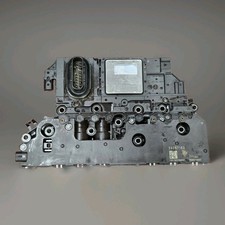
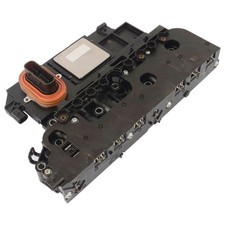
GM describes the line PC solenoid as part of the control solenoid valve assembly, the TEHCM that bolts to the valve body and carries the TCM and every solenoid in one housing. GM lists that assembly as having no serviceable components. The solenoid regulates PC solenoid oil and sends it to the pressure regulator valve and isolator valve. More PC solenoid pressure at the regulator means more line pressure.
The control logic is inverse, and it is worth getting straight before you read any data. Per GM's P0961-P0963 description, the TCM controls the solenoid through a low side driver and feeds it power through a high side driver (HSD). Less current means more pressure, because the solenoid closes its exhaust port. More current opens the exhaust and drops pressure. So when the circuit opens, current goes to zero and the solenoid goes to full pressure. That is the fail-safe: a unit with no pressure control defaults to squeezing every clutch as hard as it can instead of burning them up slipping.
The HSD also protects the circuit. If it sees excessive current it shuts off, and it resets once the fault is gone. That is why a chafed wire that touches ground only over bumps can produce an intermittent that clears itself.
Symptoms of a failing 6T70 EPC (line PC) solenoid
1. Harsh engagements and harsh shifts in every gear
The most common complaint. A solenoid that is electrically open, or stuck toward its high side, sends line pressure to the top of the range. Park to Drive bangs, Park to Reverse bangs, and every upshift is firm. GM's own response to most line PC faults is to command maximum line pressure, so even after the TCM catches the problem, the ride will not get softer. If the harshness is limited to one or two shifts, look at the clutch-specific PC solenoids and the shift valve pair for that clutch instead.
2. Soft shifts, flare, slip or delayed engagement
The opposite failure: a solenoid stuck toward low, or one that is starved of feed oil, lets line pressure sag. Engagements are slow, the engine flares between gears, and a hot unit can slip under load. GM's "Fluid Pressure High or Low" checklist specifically calls for verifying that the variable bleed solenoid (VBS) is not stuck high or low, alongside pump, filter and regulator valve checks. Low pressure is the more dangerous of the two, because it burns clutches while the driver keeps going.
3. Stuck in 5th and Reverse only
If the line PC control circuit shorts to ground, GM sets P0962 as a Type A code (lights the MIL on the first failure). The TCM turns off the high side driver, limits the transmission to Reverse and 5th gear, inhibits the torque converter clutch, disables tap up/down and manual shifting of forward gears, enables torque management and commands maximum line pressure. The customer describes it as "no power from a stop" and "stuck in one gear." That is the default gear, not a broken clutch.
4. Shift quality that never adapts
On P0961 and P0963, both Type B codes, the TCM freezes transmission adaptive functions and commands maximum line pressure. A unit that was shifting a little firm and never improves over a week of driving, with a history code for P0961 or P0963, is a line PC solenoid case until proven otherwise.
5. Codes that ride along
Because line pressure feeds everything, a weak line PC circuit can drag in ratio and clutch-slip codes as secondary faults. Read the whole code list before you clear anything, and fix the pressure code first.
The codes GM ties to the line PC solenoid
These come straight from GM service information for DTC P0961-P0963 on the 6T70/6T75. The code only runs with the engine at 400 RPM or more for 5 seconds and ignition voltage at 8.6 volts or higher, so a weak battery during cranking will not set it, but a failing charging system can confuse everything else.
- P0961 - Line Pressure Control Solenoid Valve Performance. The measured solenoid current does not equal the commanded current for 5 seconds. GM classes it as an internal electrical malfunction. Type B. Adapts frozen, maximum line pressure.
- P0962 - Control Circuit Low Voltage. Short to ground on the control circuit for 2 seconds. Type A. Reverse and 5th only, no TCC, maximum line pressure, HSD off.
- P0963 - Control Circuit High Voltage. An open or a short to voltage for 5 seconds. Type B. Adapts frozen, maximum line pressure.
If you want the electrical side of the clutch pressure control circuits in more depth, our 6T70 P0748 guide walks through testing solenoids you cannot reach with a meter.
How to prove it: the GM diagnostic path
Step 1: fluid, voltage and engine codes first
Check level and condition with DEXRON-VI at operating temperature, and check charging voltage. Then read engine codes. GM's "Harsh Garage Shift" chart makes a point that catches people: if the engine controller tells the transmission that engine torque is inaccurate, the transmission will command high line pressure on purpose. A MAF or throttle fault can produce harsh engagements on a perfectly good solenoid.
Step 2: run the circuit verification
GM's verification for P0961-P0963 is simple. Engine running in Park, move the shifter through each position and back to Park, and watch three scan tool test status parameters: Line Pressure Control Solenoid Valve Performance, Control Circuit High Voltage, and Control Circuit Low Voltage. All three should read OK. Then drive under the conditions in Freeze Frame. If it passes, GM says stop and treat it as an intermittent, because going further risks unnecessary parts.
Step 3: put a gauge on it and compare to the chart
This is the test that separates a bad solenoid from a hydraulic problem. GM's Line Pressure Check uses a DT 21867-A gauge (any quality 300 psi gauge does the job) in the line pressure test port. With the scan tool's output controls, command the Line PC solenoid up and down. The TCM only allows this in Park or Neutral below 1500 RPM, to protect the clutches, and it steps pressure in roughly 200 kPa (29 psi) increments. Let each step stabilize and run the sweep at least three times.
GM's Solenoid Valve Pressure chart gives the expected actual pressure for each requested value:
- Requested 0 kPa: 345-900 kPa (50-130 psi)
- Requested 200 kPa: 690-900 kPa (100-130 psi)
- Requested 400 kPa: 1100-1310 kPa (160-190 psi)
- Requested 600 kPa: 1520-1725 kPa (220-250 psi)
- Requested 800 and 1000 kPa: 1860-2070 kPa (270-300 psi)
GM's harsh garage shift checklist also gives a quick sanity number: line pressure at idle should be below 800 kPa (about 116 psi). Reinstall the test port plug at 12 N·m (106 lb-in).
How to read the result:
- Pressure pinned high and does not move with commands: solenoid stuck high or open circuit, or a stuck pressure regulator valve.
- Pressure follows commands but low at every step: usually a supply problem, not the solenoid. Pump, filter, seals, or regulator bore wear.
- Pressure erratic between sweeps: contamination at the solenoid or a worn regulator bore letting the valve hunt.
- Pressure tracks the chart but the unit still shifts hard: the line PC solenoid is doing its job. Look at the clutch PC solenoids, wave plates and boost valves.
Step 4: bench-test the solenoid
If the circuit test status reads a fault with the harness verified good, GM's procedure is to pull the control solenoid valve assembly, inspect it, connect it to the vehicle harness with the DT-47825-20 adapter harness on the bench, and recheck the three test status parameters. Any fault means replacing the assembly.
For a stuck-valve question, GM's Solenoid Performance Test uses the DT-47825-100 test block bolted to the valve body face of the TEHCM at 5 N·m (44 lb-in) in a center-out pattern, with 90-100 psi of shop air. You command each solenoid on and off with the scan tool and watch the gauge. On GM's port chart, PC solenoid 1 shows "regulated PSI flow" key on, engine off. Two cautions from GM: do not energize solenoids for more than two minutes, and expect the gauge to flicker at key-on, because the TCM dithers some solenoids to keep them clean.
Before you condemn a module, do GM's inspection: look for bent pins, debris and contamination on the connectors, metallic debris near the terminals and on the solenoid leads, and cracked filter plate retaining tabs. Metal on the solenoids means something upstream is coming apart, and a new TEHCM will not fix that.
The look-alike: pressure regulator bore wear
A lot of 6T70 units that "need an EPC solenoid" actually have a worn valve body. Sonnax documents two versions of the problem, split by generation:
- Gen. 1 6T70/6T75: the AFL/solenoid pressure regulator valve has a large reaction area and gets side-loaded, which wears its bore. As wear increases, oil pressure to the solenoids drops, and the unit starts setting solenoid and ratio codes. Sonnax's fix is the 124740-32K AFL/solenoid pressure regulator valve kit.
- Gen. 2 6T70, 6T75 and 6T80: wear in the main pressure regulator bore causes multiple line pressure and converter-related problems, including harsh shifts and overheating from reduced cooler and converter flow. Sonnax's fix is the 124740-60K oversized pressure regulator valve kit, which requires reaming the bore.
The reason the Gen. 1 bore matters so much to line pressure control: per ATRA's Gears Magazine write-up on the solenoid regulator valve, that valve limits feed oil to every solenoid, the line PC solenoid included, to about 130 psi, while line pressure itself runs from roughly 60 psi to over 200 psi. The TCM assumes that 130 psi feed is steady when it picks a current. First-generation 6L/6T/6F units have no exhaust circuit on the solenoid regulator, so cross-leakage lets line pressure sneak into solenoid feed oil and build above 130 psi with nowhere to go. High feed gives harsh engagements and binds; low feed gives slips and flares. Either way the EPC solenoid gets blamed for a valve body problem.
GM addressed this in the Gen. 2 valve body, introduced for 2013. Sonnax's Gen. 2 6T70/75 valve body guide lists the changes: pressure switches eliminated, a balance orifice added to the separator plate with a matching change to the pressure regulator valve, six solenoid output dampers instead of three, and a tenth checkball. Gen. 2 separator plates carry a V or double-V notch where Gen. 1 has no notch or a U notch, which is the quick way to know which regulator failure you are chasing.
This is why the gauge test matters. A new solenoid on a worn regulator bore gives you the same complaint back in a few weeks. If the pressure is wrong and the solenoid passes the air test, vacuum-test the valve body before you order anything. For more on this, see our 6T70 valve body symptoms guide.
The repair, and the step people skip
At the dealer level, a failed line PC solenoid means a control solenoid valve assembly, which then has to be programmed. On the bench, rebuilders replace the individual solenoid or the full solenoid set when the module and housing are in good shape. Either way:
- Fix the source of any debris first. Replace the filter and flush the cooler.
- Refill with DEXRON-VI only. A drain-plug service takes approximately 4.0-6.0 liters (4.2-6.3 quarts) per GM.
- Reset the transmission adapts. GM requires an adapt reset after control solenoid valve assembly replacement, valve body work, any internal repair, and all shift quality work. With the engine running, reset adapts with the scan tool, do the road test so the TCM relearns, then key off for two minutes. Skip this and the old learned values for a unit with bad pressure control will make the new part shift badly.
Browse 6T70 parts at Core Transmission Parts →
Need parts for this job?
6T70 pressure control solenoids, full solenoid kits, valve bodies and filter kits, shipped from the USA.
Shop 6T70 parts →FAQ
What does the EPC solenoid do on a 6T70?
GM calls it the line pressure control solenoid. It is built into the control solenoid valve assembly (TEHCM) and sends regulated oil to the pressure regulator valve to set main line pressure. It is a normally-high solenoid, so less current from the TCM means more line pressure.
What are the symptoms of a bad 6T70 pressure control solenoid?
Harsh engagements and harsh shifts in every gear are the most common, because an open circuit sends the solenoid to maximum pressure. A solenoid stuck low causes soft shifts, flare and slipping. A short to ground sets P0962 and limits the transmission to Reverse and 5th gear with no converter clutch.
What do codes P0961, P0962 and P0963 mean on a 6T70?
P0961 is line pressure control solenoid performance, set when measured current does not match commanded current for 5 seconds. P0962 is a short to ground on the control circuit and P0963 is an open or short to voltage. All three make the TCM command maximum line pressure.
What should 6T70 line pressure be?
GM's chart shows 345-900 kPa (50-130 psi) with 0 kPa requested, rising to 1860-2070 kPa (270-300 psi) at 800 kPa requested and above. GM's harsh garage shift check calls for line pressure at idle below 800 kPa, about 116 psi.
Can I replace just the pressure control solenoid on a 6T70?
GM lists the control solenoid valve assembly as having no serviceable components and replaces the whole assembly. Rebuilders do replace individual solenoids on the bench when the housing and module are good. Either way, reset the transmission adapts afterward, which GM requires after solenoid assembly replacement.
Sources
- GM service information (Saab 9-4X, Automatic Transmission 6T70/6T75) — DTC P0961-P0963. Backs the line PC solenoid description (part of the control solenoid valve assembly, no serviceable components, normally high, feeds the pressure regulator and isolator valves), the inverse current-to-pressure logic, low side and high side drivers, the run conditions (400 RPM for 5 seconds, 8.6 V), the P0961/P0962/P0963 set conditions and actions (maximum line pressure, frozen adapts, P0962 Reverse and 5th only with TCC inhibited), the test status verification, and the DT-47825-20 bench check. saabwisonline.com
- GM service information (6T70/6T75) — Solenoid Valve Pressure chart. Backs the requested vs actual line pressure values from 0 to 1000 kPa requested. saabwisonline.com
- GM service information (6T70/6T75) — Line Pressure Check. Backs the DT 21867-A gauge procedure, Park/Neutral below 1500 RPM limit, 200 kPa (29 psi) increments, three repeat sweeps, and the 12 N·m (106 lb-in) test plug torque. saabwisonline.com
- GM service information (6T70/6T75) — Control Solenoid Valve and TCM Assembly Solenoid Performance Test and Inspection. Backs the DT-47825-100 test block, 90-100 psi shop air, 5 N·m (44 lb-in) block torque, the two-minute energize limit, key-on dither, the PC solenoid 1 port state, and the connector/debris/filter plate inspection. Performance test · Inspection
- GM service information (6T70/6T75) — Harsh Garage Shift; Fluid Pressure High or Low; Resetting of the Transmission's Adaption; Fluid Capacity Specifications. Backs the engine-torque-inaccurate high line pressure note, the below-800 kPa idle line pressure check, boost valve and wave plate causes, the VBS stuck high/low and pump/regulator checks, the adapt reset requirements and steps, and the 4.0-6.0 L drain refill capacity. Harsh garage shift · Pressure high or low · Adapt reset · Capacities
- Sonnax — Oversized Pressure Regulator Valve Kit 124740-60K and AFL/Solenoid Pressure Regulator Valve Kit 124740-32K. Backs the Gen. 2 main pressure regulator bore wear causing line pressure and converter-related problems, and the Gen. 1 AFL/solenoid regulator bore wear causing low solenoid feed pressure and solenoid/ratio codes. 124740-60K · 124740-32K
- ATRA / Gears Magazine — "The Solenoid Regulator Valve: Too Important to Overlook!" Backs the roughly 130 psi solenoid feed limit on the 6L80/6T70/6F50, the 60 to 200-plus psi line pressure range, the missing exhaust circuit on first-generation units letting cross-leakage build feed pressure above 130 psi, the high-feed harsh/bind and low-feed slip/flare symptoms, and vacuum testing the reaction end of the valve to measure bore wear. gearsmagazine.com
- Sonnax — "The Greatest Generation: How Small Changes Led to the New Form & Function of Gen. 2 6T70/75 Valve Bodies." Backs the 2013 Gen. 2 introduction, pressure switch elimination, the separator plate balance orifice and revised pressure regulator valve, six versus three solenoid dampers, the tenth checkball, and the U-notch versus V/double-V separator plate identification. sonnax.com