A Traverse that slips is usually telling you exactly which clutch is giving up, if you know how to listen. The 2009-2017 Traverse runs the heavy-duty 6T75 version of GM's six-speed front-drive automatic behind a 3.6L V6, and it moves a three-row crossover that is rated to tow 5,200 lb with the V92 package [6]. That load is why Traverse units slip earlier and burn more friction material than the same family in a Malibu. Numbers in brackets point to the Sources list at the bottom.
Start with the gear: the clutch apply chart does the diagnosis
The 6T70/6T75 has five clutches (three stationary, two rotating) and one low one-way clutch [5]. Every forward gear uses two of them, so the gear (or gears) where the slip shows up points at one clutch. Sonnax's apply chart lays it out [5]:
| Range | Clutches applied |
|---|---|
| 1st (Drive) | 1-2-3-4 + low one-way clutch holding (low/reverse added for engine braking) |
| 2nd | 1-2-3-4 + 2-6 |
| 3rd | 1-2-3-4 + 3-5-R |
| 4th | 1-2-3-4 + 4-5-6 |
| 5th | 3-5-R + 4-5-6 |
| 6th | 2-6 + 4-5-6 |
| Reverse | 3-5-R + low/reverse |
Read it backward from the complaint:
- Slips in 1st through 4th, fine in 5th and 6th: 1-2-3-4 clutch.
- Slips or flares into 3rd and 5th, weak or no reverse: 3-5-R clutch.
- Slips in 2nd and 6th only: 2-6 clutch, which lives in the case cover.
- Slips in 4th, 5th and 6th: 4-5-6 clutch.
- Slips everywhere, including reverse: not a clutch. That is pressure, fluid, filter or pump.
Before you blame the transmission
GM's road test procedure has three preconditions before any shift is judged: the engine has to be running properly, the fluid level has to be correct, and tire pressure has to be right [3]. On a Traverse the fluid level is where most bad diagnoses start. The owner manual warns that the fluid will not reach the end of the dipstick unless the transmission is at operating temperature [6], and ATRA's level check calls for a level surface, the engine idling for one minute, and fluid temperature between 180 and 200 degrees F [4]. A unit checked cold reads low, gets topped off, and then foams once it is hot. Overfilled fluid aerates, and aerated fluid slips.
Check the drain-and-refill history too. The 2012 manual specifies DEXRON-VI only, at 5.0 L (5.3 qt) for a drain-and-refill [6]. A Traverse that has seen a universal or multi-vehicle ATF can have friction behavior that looks like a mechanical slip.
Prove it on the scan tool
GM's 6T70/6T75 road test lists the data to watch: Engine Speed, Transmission ISS, Transmission OSS, Commanded Gear, Gear Ratio, Line PC Sol. Pressure Cmd., the PC Sol. 2 through 5 pressure commands, TCC PC Sol. Pressure Cmd., TCC Slip Speed, and TFT [3]. Here is how to use them on a slip complaint.
Upshifts at steady throttle
Drive at a steady 15 to 20 percent throttle. GM expects a noticeable shift feel or engine speed change within 1 to 2 seconds of the commanded gear change, with the PC solenoid command going to YES for the oncoming clutch and NO for the off-going clutch [3]. A real slip shows as Gear Ratio wandering off the commanded gear while ISS climbs without OSS following. Note which gear it happens in and go back to the apply chart.
Step-in downshifts
From 3rd at light throttle (5 to 15 percent), step into the pedal until a 3-2 downshift is commanded. GM wants the downshift within 2 seconds of throttle movement, repeated for 4-3, 5-4 and 6-5 [3]. A slow downshift with a flare (RPM jumps, then the gear catches) under load is the classic Traverse complaint when the trailer is hooked up.
Torque converter slip vs clutch slip
Do not let converter slip get booked as a clutch slip. The 6T70/6T75 uses an electronically controlled capacity clutch (ECCC) that deliberately runs about 20 RPM of slip in 2nd through 6th, depending on the application. When the TCC is commanded on, GM says slip speed should stay below 100 RPM with steady throttle and no shift in progress. If it stays above that for more than 6 seconds after the command, check codes and go to torque converter diagnosis [3]. If TCC Slip Speed is high but Gear Ratio is correct, the problem is in the converter or its feed, not the clutch packs.
Cause 1: early units and the 3-5-R wave plate (2009 Traverse)
GM bulletin 09-07-30-012F covers the 2009 Traverse for no reverse, a check engine light, and a slip, flare or harsh shift in 3rd and/or 5th. P0776 usually sets, and P0777, P2723, P0717, P0716, P2715 or P2714 can set on their own [1]. The 3-5-R wave plate breaks, the apply piston over-strokes and leaks, and the clutch loses apply. GM notes it normally does not happen before about 20,000 miles, and the debris can damage the speed sensors and other clutches [1].
That last point is why a Traverse with this failure often slips in more than just 3rd and 5th by the time it reaches you. The broken plate's steel shards travel. GM's repair calls for separating the case halves, cleaning the debris out of the entire unit, and replacing the pump fluid filter and the control solenoid filter plate, and it warns that skipping that clean-out can cause repeat damage [1]. Sonnax's answer on wave plates is direct: on a 2011 or earlier unit, update all of the wave plates; on 2012 and later, replace just the 3-5-R plate [5]. ATRA lists the updated plates as 1-2-3-4 24259063, 2-6 24259816, 3-5-R 24254103 and low/reverse 24259817 [4].
Cause 2: low or erratic line pressure
If the slip is in every range, put a gauge on it. GM's line pressure check uses the DT 21867-A gauge at the line pressure test hole. The scan tool commands the Line PC solenoid in steps of about 200 kPa (29 psi), only in Park or Neutral below 1,500 RPM, and GM says to run the sequence at least three times for consistent readings. The test hole plug goes back in at 12 Nm (106 lb-in) [3].
When the readings are off, GM's "Fluid Pressure High or Low" list is the checklist [3]:
- Loose fluid pump bolts, leaking or damaged pump outlet seals and filter seal, a damaged or mis-installed filter, and a sticking line pressure blow-off valve.
- A leaking drive gear support converter seal or fluid passage tube gasket.
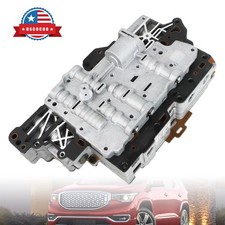
- A worn, sticking or damaged pressure regulator valve or spring in the upper valve body, and leaking upper or lower valve body gaskets.
- Leaking filter plate seals on the control valve body (TEHCM), and a VBS stuck high or low.
- A missing lube oil circuit orifice or baffle in the case.
ATRA adds a specific shortcut: when pressure switch codes P0752, P0872, P0877 or P0989 show up, check line pressure at idle, and if it is low, inspect the pump outlet seal [4]. Sonnax ties a worn pressure regulator valve to erratic line pressure, burnt clutches, low converter and lube flow, TCC concerns, overheating and poor shift quality [5]. On a high-mileage Traverse, that regulator bore is a prime suspect. Sonnax explains that valve bores in these units wear from the scrubbing action of solenoid frequency and duty cycle, the valve body material, and valve designs that allow side-loading [5]. Vacuum testing the valve body finds the worn bores before you reassemble.
Cause 3: 2017 Traverse valve body debris (18-NA-358)
GM bulletin 18-NA-358 lists the 2017 Traverse (RPO M7V, M7X) for a severe launch shudder in 1st, a shudder in 4th, or a shudder on the 2-3 upshift or 3-2 downshift, with some owners also reporting flare, slide/bump, slip or harsh shifts. The cause is debris in the upper and/or lower valve bodies, or scratched and scored valves that do not move properly [2].
Follow the bulletin's order. Rule out an engine misfire or driveability problem. Confirm it is not TCC shudder by watching TCC slip while the converter is applied during the event. A launch shudder can be reproduced by power-braking in first, but GM limits that to 5 seconds or less to avoid distressing the 1-2-3-4 clutch [2]. If it reproduces, GM replaces the upper and lower valve bodies together and says TEHCM replacement has not been an effective repair for this concern [2].
The note that saves comebacks: inspect the ISS and OSS for collected debris. Debris on the sensors means an internal component failure. If the sensors are clean but the valves or bores are scratched, check for a final drive bearing failure [2]. A new valve body on top of a failing bearing just gets scored again.
Cause 4: burned frictions from heat and towing
The Traverse owner manual tells drivers to shift down and slow to about 55 mph on a long uphill grade to reduce the chance of engine and transmission overheating, and to use a lower gear if the transmission shifts too often while towing [6]. It also has a TRANSMISSION HOT IDLE ENGINE message [6]. Customers who ignore both bring in units where the 1-2-3-4 and 3-5-R frictions are glazed or burned. Once the friction material is gone, no calibration or fluid change brings the shift back. That is a rebuild.
The rebuild: get the generation right
ATRA and Sonnax both document the 2013 controls update. The 6T70 (M7W, M7U) and 6T75 (M7V, M7X) got it for 2013, other RPO codes in 2014 production, so two versions existed in 2013-14: Gen 1 and Gen 2 [4][5]. Sonnax lists what changed in Gen 2: a new TEHCM with no pressure switches and VFS instead of VBS solenoids, a new valve body and spacer plate, a new 1-2-3-4 piston (notched legs for ID) with nine thinner frictions instead of seven, new 2-6 and 3-5-R wave plates and frictions, and a redesigned 3-5-R/4-5-6 housing. Most of those updates do not back-service Gen 1 [5].
That is why a Traverse rebuild that slips again right away is often a mixed-generation build: Gen 1 frictions in a Gen 2 drum, or the wrong 1-2-3-4 piston. Transmission Digest documented exactly that on a 6T75: a delayed engagement and slip in 1st traced to a Gen 1 1-2-3-4 apply piston in a Gen 2 unit. The Gen 2 piston's apply fingers measure .785 in. against .638 in. on Gen 1, and Gen 2 frictions are .058 in. thick against .061 in., so the mixed build leaves too much clearance for the pack to hold [7]. Measure the piston fingers before you blame anything else on a rebuilt unit that slips in 1st through 4th. Read the RPO code off the glovebox label, confirm it against the unit, and order the kit for the hardware on the bench.
After the build, ATRA calls for Service Fast Learn Adapts on the scan tool, then shutting the engine off and letting the TCM power down before restarting [4]. ATRA also explains how the TCM learns clutch fill volume (CP Learn) on the road: 4-5-6 in 3rd gear, 1-2-3-4 and 2-6 in 5th, and 3-5-R in 6th, with learning aborted on rough roads [4]. A short test drive on a bad road will not finish the learn. Give it steady highway time in 5th and 6th before you judge the shift.
Shop the part for this fix: 6T75 HT friction clutch pack
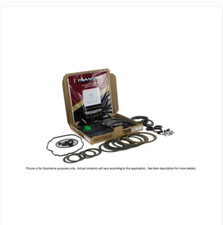
When a 2009-2012 Traverse unit slips because the frictions are burned, this Raybestos 6T75 high-temp friction pack from CoreTransmissionParts replaces the clutch material. For 2013-up Gen 2 units, use the 2013-up friction kit instead.
View the 6T75 friction clutch pack at CoreTransmissionPartsGen 2 unit or need a full kit? See the 6T75 friction clutch kit 2013-up or all 6T75 parts at CoreTransmissionParts.
Need parts for this job?
Our 6T75 parts page has rebuild and overhaul kits, valve bodies, pumps, clutch drums and solenoid kits for the Traverse, all on our own checkout. For fluid specs across every unit, see the transmission fluid spec chart.
FAQ
Why is my Chevy Traverse transmission slipping?
The most common causes are a broken 3-5-R wave plate on early units, low line pressure from pump seals, the filter or a worn pressure regulator valve, valve body debris on 2017 models, and burned frictions from heat and towing. Which gears slip tells you which clutch is involved, so note the gear before anything else.
What transmission does a Traverse have?
The 2009-2017 Traverse uses the 6T75, the heavy-duty member of GM's 6T70/6T75 six-speed family, behind the 3.6L V6. GM's 18-NA-358 bulletin lists the 2017 Traverse under RPO M7V and M7X, which are 6T75 codes. Units from 2013-14 can be Gen 1 or Gen 2, and the parts are not interchangeable.
Can low fluid make a Traverse slip?
Yes, and so can overfilling. The 6T75 fluid will not reach the dipstick until it is at operating temperature, so a cold check reads low and often gets topped off too much. Check it hot, at 180 to 200 degrees F on a level surface with the engine idling, using DEXRON-VI only.
Is it the torque converter or the transmission slipping?
Watch TCC Slip Speed and Gear Ratio on a scan tool. GM says slip should stay below 100 RPM once the converter clutch is commanded on; if it is higher but the gear ratio is correct, look at the converter. If the gear ratio drifts off the commanded gear, a clutch pack inside the transmission is slipping.
Related guides
Sources
- General Motors, Service Bulletin 09-07-30-012F, "No Reverse, 3rd or 5th, Check Engine Light Illuminated, DTC P0776" (2009 Traverse and other 6T70/75 models). Backs the 3rd/5th slip and flare symptoms, P0776 and companion codes, the broken 3-5-R wave plate and piston over-stroke cause, the 20,000-mile note, debris damage to sensors and clutches, and the case-split clean-out with new pump filter and solenoid filter plate. static.nhtsa.gov (PDF)
- General Motors, Service Bulletin 18-NA-358, "Shudder, 2-3 Upshift or 3-2 Downshift Concern," October 2020. Backs the 2017 Traverse RPO M7V/M7X listing, the shudder, flare and slip symptoms, the valve body debris cause, the 5-second power brake limit, the TCC slip check, the TEHCM caution, and the ISS/OSS debris and final drive bearing checks. static.nhtsa.gov (PDF)
- General Motors 6T70/6T75 service information (fault diagnosis section, as mirrored on SAAB WIS Online): Road Test (preconditions, scan tool PIDs, 15-20 percent throttle upshifts within 1-2 s, step-in downshifts within 2 s, ECCC about 20 RPM, TCC slip under 100 RPM / 6 s rule); Line Pressure Check (DT 21867-A, 200 kPa steps, Park/Neutral below 1,500 RPM, three runs, plug 12 Nm); Fluid Pressure High or Low (pump, seal, filter, blow-off valve, regulator, VBS checklist). Road Test · Line Pressure Check · Fluid Pressure High or Low
- ATRA, "6T70 Product Issues and Updates" seminar. Backs the updated wave plate part numbers, the 2013 Gen 1 / Gen 2 controls update by RPO, the pressure switch codes and pump outlet seal check, the 180-200 degree F level check, Service Fast Learn, and the CP Learn gears (4-5-6 in 3rd, 1-2-3-4 and 2-6 in 5th, 3-5-R in 6th, aborted on rough roads). atracom (PDF)
- Sonnax, "6T70/6F50 Transaxle" technical webinar. Backs the five-clutch layout and clutch apply chart, the Gen 2 change list (no pressure switches, VFS solenoids, nine-plate 1-2-3-4 pack, new wave plates, non-back-serviceable), the wave plate replacement guidance by model year, the pressure regulator symptom list, and the causes of valve bore wear. sonnax (PDF)
- Chevrolet, 2012 Traverse Owner Manual. Backs the 3.6L V6 with automatic, the 5,200 lb V92 tow rating, the grade-towing advice (shift down, about 55 mph), the TRANSMISSION HOT IDLE ENGINE message, DEXRON-VI, the 5.0 L (5.3 qt) drain-and-refill, and the dipstick-at-operating-temperature note. assets.gm.com (PDF)
- Transmission Digest, Wayne Colonna, "GM 6T70/75 slips and delays in first," November 1, 2023. Backs the Gen 1 1-2-3-4 piston in a Gen 2 unit cause, the .638 in. / .785 in. apply finger heights, the .061 in. / .058 in. friction thicknesses, and the 2013 selective / 2014-up Gen 2 phase-in. transmissiondigest.com