The 722.9, Mercedes' 7G-Tronic and 7G-Tronic Plus seven-speed, has no dipstick, no simple drain plug and refill, and two fluid specs that aren't interchangeable. That combination is exactly why one shop quotes $350 for a "fluid change" and another quotes $600 for what sounds like the same job. Both numbers can be correct, because they're pricing different amounts of fluid and different procedures. Here's what the transmission actually requires, what Mercedes' own bulletins say about shift complaints that get blamed on fluid service, and what you should expect to pay whether you're booking a shop or doing it yourself.

Two Fluid Specs, And They Don't Mix
The 722.9 came in two chemically different fluid generations. Transmissions built from August 2003 through roughly June 2010 (the original NAG2, internally NAT2) use red ATF 134 under Mercedes-Benz specification 236.14. Transmissions built after that cutoff, commonly called the "722.9 Plus" (NAT2i), switched to blue ATF 134 FE under specification 236.15, and the option code A89 on the vehicle's data card confirms which one a given car left the factory with.
These aren't the same fluid with different dye. Motul's own technical data sheet for its 236.15-approved product lists a visibly thinner formulation than the 236.14 generation: density of 0.837 at 20°C, viscosity of 17.4 mm²/s at 40°C and 4.3 mm²/s at 100°C, a viscosity index of 163, a pour point of -45°C, and a flash point of 192°C, built to exceed GM Dexron and Ford Mercon requirements rather than just meet them. That lower viscosity is the blue fluid's whole purpose, improving cold-shift speed and fuel economy, and it's exactly why Mercedes documentation treats 236.15 as not back-compatible with the older 236.14 red fluid. Buying the wrong color because it was cheaper or already on the shelf is the single most common way a 722.9 fluid change goes wrong before the pan even comes off.
Two Different Jobs Both Get Called "Fluid Change"
A pan-drop service pulls the pan, drains and refills roughly 6 liters, and swaps the integrated filter housing that snaps into the control valve body. That's the fluid sitting in the pan and the lower case; it leaves the torque converter, which independent technical references put at holding close to 4 liters on its own, nearly half the transmission's total volume, completely untouched.
A full exchange adds a torque converter drain on top of the pan service, pushing total fluid used to roughly 9 liters. There's no dipstick and no gravity-fill tube on this transmission: fluid goes in through the drain plug with a pump and a pan adapter, and the correct level is set by watching fluid barely drip from an overflow pipe while a scan tool confirms the transmission has reached 45°C. That procedure takes real shop time regardless of which fluid method you choose, which is part of why 722.9 labor rates run higher than a transmission with a normal dipstick and fill tube.
| Service type | Fluid used | What's included |
|---|---|---|
| Pan-drop and filter | ~6 liters | Integrated filter, pan gasket, fluid in the pan and lower case |
| Full exchange (adds converter drain) | ~9 liters | Filter, pan gasket, plus the ~4 liters held in the torque converter |
Parts Cost Breakdown
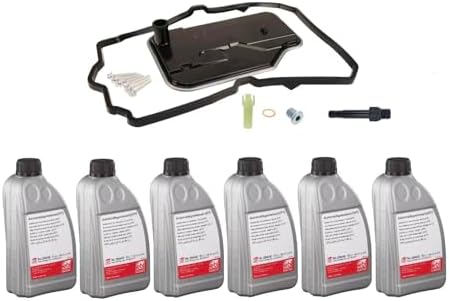
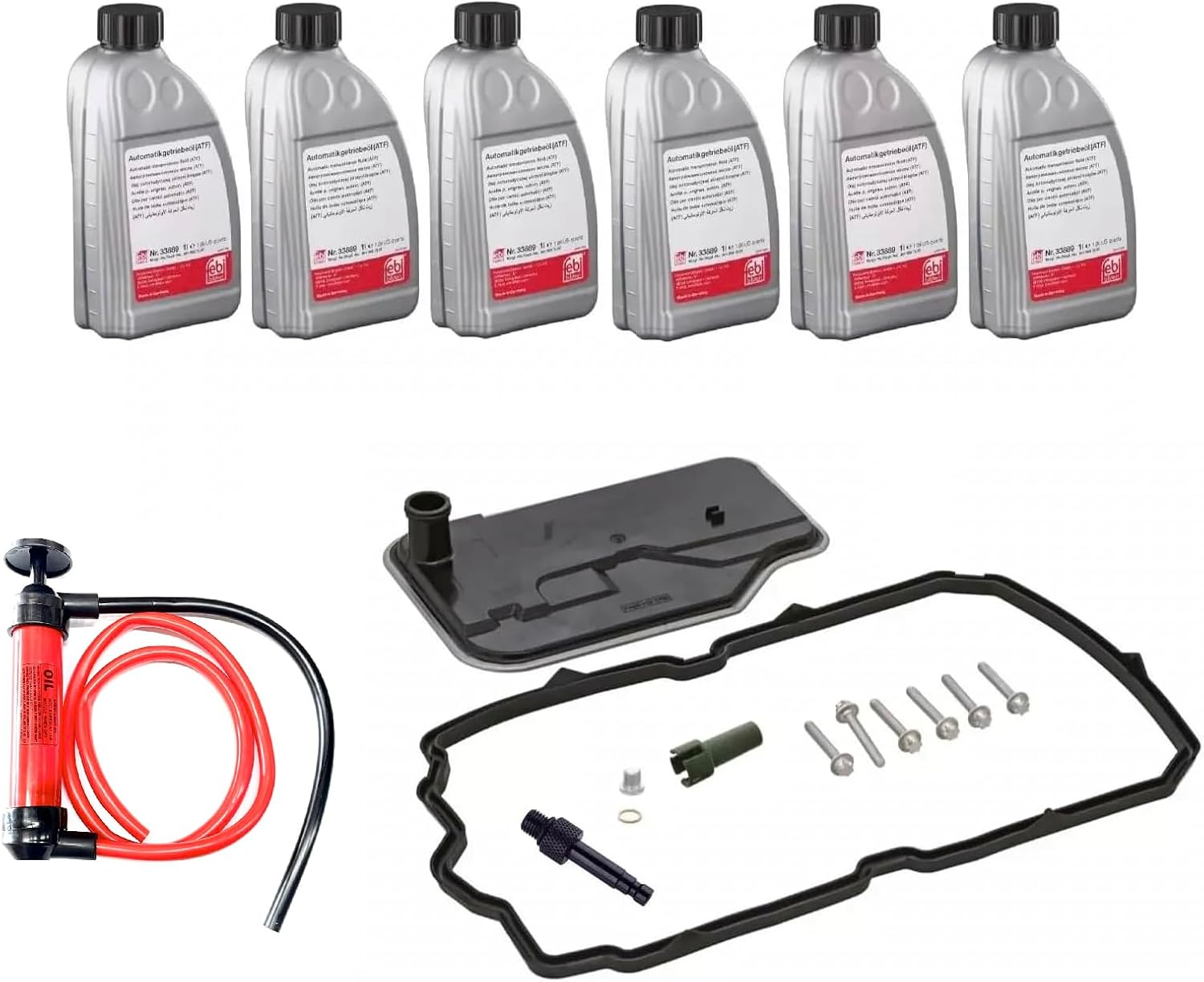
The integrated filter housing is a modest cost on its own, typically in the $25-50 range depending on whether it's sold bare or bundled with a fill adapter for the drain-plug filling procedure. The fluid is the bigger line item: at roughly $12-20 per liter for correctly spec'd 236.14 or 236.15 ATF, 6 liters for a pan-drop or 9 for a full exchange adds up fast, and it's the one part of the job you can't substitute your way around without risking shift quality. A bundled kit that pairs the filter with the full fluid charge in the correct spec removes the guesswork on both color and quantity, which matters on a transmission where buying the wrong shade of ATF is a real and common mistake, not a hypothetical one.
Labor and Shop Pricing
Owners comparing invoices for this exact service report a wide spread: independent and Euro specialist shops using OEM-spec parts have quoted in the $350-400 range for a standard service, while dealer quotes commonly land between $500 and $600, with parts running roughly $200 of that total and the remainder being labor for the drain-plug fill procedure and temperature verification. The size of that gap is less about one shop overcharging and more about dealer labor rates plus the extra time most dealers spend on the Star Diagnosis-monitored fill versus an independent shop that's done enough of these to move faster. A quote at either extreme is worth a direct question about which fluid spec they're using and whether the quote covers a pan-drop or a full exchange.
Why Shift Complaints After a Service Aren't Always the Fluid's Fault
Mercedes has published several factory bulletins on 722.9 shift quality that have nothing to do with fluid condition, and they matter here because a fluid service resets the transmission control unit's adaptive values, which can surface these exact symptoms right after a service that was done correctly. One bulletin documents harsh engagement when shifting from Park to Drive, caused by friction coefficient fluctuations in the B2 clutch pack, with the remedy being a specific relearn sequence: cycling N-R and N-D five times each at both 40°C and 70°C operating temperature, not another fluid change. A separate bulletin covers a 5-to-4 coasting downshift quality concern specific to cold transmission oil between 20°C and 40°C, fixed with a transmission control unit software update rather than a parts replacement. If your 722.9 shifts rough in the week after a fluid service, especially cold or right after a Park-to-Drive shift, that adaptation and software history is worth checking before you assume the shop used the wrong fluid.
There's also a mechanical reason to stay on top of this fluid on schedule rather than stretching intervals: Sonnax's oversized supply pressure regulator valve, a documented fix for the 722.9, exists because wear in that valve's bore lets supply pressure to the control solenoids go erratic, which Sonnax ties directly to burnt clutches and harsh or soft shifts. Degraded fluid accelerates that kind of wear. Regular service at the correct spec is cheap insurance against ending up as a Sonnax repair instead of a fluid-change invoice.
Is DIY Actually Cheaper?
For a pan-drop and filter service, yes, usually by a meaningful margin, since you're paying for the filter and roughly 6 liters of correctly spec'd fluid plus your own time instead of shop labor. The catch is the fill procedure itself: without a way to read transmission oil temperature, either a scan tool or an IR thermometer on the case, you can't reliably hit the 45°C level-check target, and overfilling or underfilling this transmission causes real shift problems. A full exchange is a tougher DIY case because you also need a pump and pan adapter to push fluid in through the drain plug, which is a one-time tool cost that only pays off if you're planning to service the car again yourself down the line.
Frequently Asked Questions
How do I know if my 722.9 takes red 236.14 or blue 236.15 fluid?
Transmissions built from roughly August 2003 through June 2010 use red ATF 134, Mercedes specification 236.14 (the original NAG2 unit). Transmissions built after that cutoff, the "722.9 Plus" version, use blue ATF 134 FE under specification 236.15, and the option code A89 on the vehicle's data card confirms it. The two fluids are not back-compatible: the 236.15 blue fluid is a lower-viscosity formulation and mixing it with 236.14 is explicitly against Mercedes' own guidance. If you don't know which one your car takes, the transmission's build date or the A89 option code settles it before you buy a drop of fluid.
Why does a 722.9 fluid change cost so much more than a normal car?
Two reasons stack on top of each other. First, the 722.9 has no dipstick and no simple drain-and-fill point; it fills through the drain plug with a pump and adapter while a scan tool monitors fluid temperature through an overflow pipe, which takes more shop time than topping off a dipstick. Second, the fluid itself is expensive: correctly spec'd 236.14 or 236.15 ATF runs well above generic Dexron pricing, and a full exchange that pushes fluid through the torque converter uses close to the transmission's full capacity rather than the roughly 60 percent a pan-drop replaces.
How much fluid does a 722.9 actually hold?
A pan-drop only service empties and refills about 6 liters, since that is all that drains through the pan opening. A full exchange that also drains the torque converter uses roughly 9 liters total. The torque converter alone holds close to 4 liters, nearly half the transmission's total fluid volume, which is why skipping the converter on a pan-drop leaves a large share of old fluid still in the system.
My shift quality got worse after a 722.9 fluid service, is the shop to blame?
Not necessarily. Mercedes has documented factory bulletins describing 722.9 shift complaints that are calibration issues rather than fluid problems, including a harsh Park-to-Drive engagement caused by friction coefficient drift in the B2 clutch pack, fixed by a specific N-D and N-R relearn sequence rather than another fluid change, and a cold 5-to-4 coasting downshift tied to oil temperature between 20 and 40 degrees Celsius, fixed with a software update. A shop that just refills fluid without letting the transmission control unit relearn its adaptive values can leave you with a harsh-feeling transmission that has nothing wrong with the fluid at all.
Is it worth doing a 722.9 fluid change yourself?
For a pan-drop and filter service, yes, if you already have a way to monitor transmission temperature, since the parts cost (filter and roughly 6 liters of correctly spec'd fluid) is the bulk of the bill either way and you're mainly paying for a tech's time and tooling. A full exchange is a harder sell without the right equipment, since you need a pump and fill adapter to push fluid in through the drain plug and a scan tool or IR thermometer to hit the 45 degree Celsius level-check target, both of which add real cost if you're buying them for a one-time job.
722.9 Transmission Filter with Gaskets
CoreTransmissionParts carries the direct-fit filter and gasket set for the 722.9 pan-drop service, the part that's being replaced regardless of which fluid spec your car takes.
View the filter →Shop 722.9 parts →
Sources
- Mercedes-Benz AG / Daimler AG, Xentry Tips bulletin LI27.50-P-049281, "Harsh engagement when changing gear range from P to D," valid for transmission 722.9, hosted via NHTSA. Backs the B2 clutch pack friction coefficient cause and the exact N-D/N-R relearn sequence at 40°C and 70°C. static.nhtsa.gov (PDF)
- Mercedes-Benz AG, Xentry Tips bulletin LI27.60-P-071237, "5 to 4 coasting downshift - shift quality concern with cold transmission oil," transmission 722.9, hosted via NHTSA. Backs the cold-oil shift quality cause (20-40°C range) and the software-update remedy. static.nhtsa.gov (PDF)
- Sonnax, part 88740-02 product page, oversized supply pressure regulator valve for the 722.9. Backs the valve bore wear mechanism and its link to burnt clutches and harsh/soft shifts. sonnax.com
- Motul, ATF 236.15 technical data sheet. Backs the blue fluid's MB-Approval 236.15 certification and physical properties: density, viscosity at 40°C/100°C, viscosity index, pour point and flash point. motul.com (PDF)
- Youcanic, "Mercedes-Benz 7-Speed Transmission Fluid and Filter Change Instructions." Practical reference for the pan-drop (~6L) versus full-exchange (~9L) fluid volumes, the drain-plug fill procedure, and the 45°C level-check target. youcanic.com
- W220.wiki, "WIS 27.00 Transmission - General." Corroborates the torque converter's roughly 4-liter fluid volume and the 236.14/236.15 fluid-spec cutover around June 2010. w220.wiki
Shop filter kits, fluid service kits in both fluid specs, and fill adapters for the 722.9, shipped fast from the USA.
Shop 722.9 parts →