The 8L90 is GM's 8-speed behind the 6.2L trucks and SUVs, the Corvette, and the Camaro, built since 2015 under RPO codes M5U and M5X (the lighter-duty 8L45 shares the same case family under M5N and M5T). It has earned a reputation for two very different noise complaints that customers often describe the same way -- "it's making a weird sound" -- but that come from almost unrelated parts of the transmission. A whine is a pump or converter problem. A clunk is a clutch-clearance or shift-timing problem. Treating one like the other wastes a teardown or a part swap that never had a chance of fixing the actual complaint.
This is a diagnosis-first write-up pulled directly from GM's own service bulletins for this unit, not guesswork. Four separate bulletins cover four separate noise conditions on the 8L90/8L45 platform, and knowing which one you're dealing with before you touch a wrench saves hours.
Step One: Separate Whine From Clunk by When It Happens
Before opening a bulletin, nail down the exact conditions under which the noise occurs. These two complaints have different signatures:
- Whine is continuous, rises and falls with engine RPM, and is present whether or not the vehicle is moving. It's a pump or converter-bearing condition. As a rule of thumb that holds across most GM transmissions: a whine present in Park or Neutral points toward the pump itself, while a whine heard only while stopped in Drive or Reverse -- that fades once the vehicle starts moving or the torque converter clutch applies -- points toward the converter, because there's no more slip speed across the converter's internal bearings once it locks up or the vehicle is rolling.
- Clunk is a single, sharp noise tied to an event -- a launch from a stop, the first shift after startup, or a specific gear change. It is not RPM-dependent the way whine is. It happens once per event, not continuously.
Once you know which category you're in, GM's bulletins for this platform split cleanly into two tracks.
Diagnosing Whine: Rule Out the Easy Stuff First
GM's TechLink guidance for 8-speed noise concerns lays out a specific order of operations before anyone pulls a transmission pan, and it's worth following in sequence because each step is cheaper than the next:
- Correct every engine and transmission DTC first. Many trouble codes command elevated line pressure, and elevated line pressure produces a pump whine that GM's guidance explicitly calls "characteristic" -- in other words, not a defect, just a side effect of the code. Chasing the noise before addressing the code wastes time.
- Remove the accessory drive belt to rule out a belt-driven component mimicking a transmission noise.
- Check the starter. GM's current 8-speed noise bulletin (24-NA-078, referenced for the 2.7L turbo L3B applications) notes that a failing starter can sound like it's coming from the front of the transmission, and the noise can be intermittent or only show up after the engine has been running a while or after a remote start.
- Check the engine for a damaged thrust bearing on 4.3L, 5.3L, 6.2L and 6.6L applications (bulletin 23-NA-170). GM notes some transmissions have been needlessly replaced for a noise that actually came from the engine.
- Never unbolt the torque converter from the flexplate to "check" it. GM's guidance is explicit that doing this risks damaging the engine and transmission and can produce an incorrect diagnosis in the process.
If none of that clears the complaint and the noise is coming from the front of the transmission, GM's next step before any disassembly is measuring transmission endplay with the specified tools, per bulletin PIP5996A. That measurement is described as critical to a correct diagnosis -- a worn, damaged, or missing thrust bearing or other internal part can be easy to miss on endplay alone, but skipping the check entirely means you're disassembling blind.
Pump Whine vs. Converter Whine
Pump whine tends to show up across every gear range and changes noticeably with line pressure -- it gets louder under load or when a code is commanding higher pressure. Converter-bearing whine is more specific: it's loudest with the vehicle stationary in Drive or Reverse, climbs with RPM, and goes quiet once the vehicle moves or the TCC locks up, because the slip speed across the converter's bearings drops to zero. If you can make the whine disappear just by letting off the brake and rolling forward a few feet, you're likely listening to the converter, not the pump.
Diagnosing Clunk: Three Different Bulletins, Three Different Fixes
Clunk on Launch After a Stop — PI1450A
This is the bulletin to check first if the complaint is a snap, pop, click, tick or clunk specifically on a launch after coming to a stop. GM bulletin PI1450A covers 2015 Cadillac Escalade and Escalade ESV, Chevrolet Silverado, and GMC Sierra and Yukon/Yukon XL models with the 8L90 (RPO M5U) built before January 15, 2015. GM's stated cause is clearance between the C1 and C2 clutch reaction plates (steels) and the case -- the plates striking the case on launch is what produces the noise. GM revised those reaction plates in transmissions built November 5, 2014 or later specifically to stop this from happening, so a later-build unit shouldn't need this procedure at all.
The confirmation test: warm the transmission to at least 40°C (104°F) sump temperature, put the transfer case in 2WD, drive up to about 40 mph, release the throttle and come to a stop, then launch and listen. Repeat several times. If the noise is confirmed, GM's fix is not a repair at the dealer level -- it's a full transmission replacement, followed by solenoid characterization reprogramming through the Service Programming System and a Transmission Service Fast Learn. There's no bench fix for worn reaction plate clearance in this bulletin; the whole unit gets swapped.
Clunk at Startup, Firm Garage Shifts — 15-NA-007
Don't confuse the above with a clunk that happens right at or immediately after engine startup, especially paired with firm Park-to-Drive or Park-to-Reverse engagement after the truck has sat for several hours. GM bulletin 15-NA-007 covers that specific combination -- plus an illuminated MIL with DTC P16F3 present or in history -- on 2015-2016 Escalade, Corvette/Silverado, Sierra and Yukon models with the 8L90/M5U. This one has a much cheaper fix: a revised TCM calibration loaded through the Service Programming System, followed by a Service Fast Learn and clearing all DTCs. No parts, no teardown. If your startup clunk comes with P16F3, check for the latest calibration before you assume you're looking at hard parts.
Clunk Tied to a Specific Shift — PIP5437A
If the noise or harshness happens during a specific shift rather than on launch or at startup, GM's diagnostic bulletin PIP5437A for 8L45/8L90 shift concerns applies. GM's stated cause is one or more clutch fill times not being completely learned in the TCM. The diagnostic path: clear DTCs in all modules, confirm the latest TCM calibration is installed, then road test with GDS2 logging and set a bookmark the moment the complaint occurs. Reviewing that session log identifies exactly which clutch's shift is involved, and the fix is running the drive learn procedure for that specific clutch -- not every clutch needs to be relearned.
GM ties this bulletin to mileage windows by model year (7,500 miles for 2015, 5,000 for 2016, 2,500 for 2017, measured from the in-service date, a calibration update, or the last Fast Learn). Past that mileage without a prior complaint, GM says the drive-learn procedure has limited success -- a transmission that's been running fine for 10,000 miles and only just started clunking on a shift is less likely to be a simple learn issue. In that case, GM's own next step is to pull the pan and check for excessive clutch debris: if it's clean, replace the valve body; if there's debris, the unit needs to come apart for a root-cause repair.
How the Drive Learn Procedure Actually Works
Since several of these fixes depend on the TCM's adaptive learning completing correctly, it's worth knowing what that process actually requires. Per ATRA's technical breakdown of 8L90 diagnostic strategy, a Fast Learn needs the transmission fluid between 131°F and 198°F (55°C to 96°C) or the procedure will abort outright. Each clutch has its own learn condition: C1 learns during slow accelerations between roughly 1,000-1,650 RPM in 4th gear in Manual mode; C2 learns between roughly 1,000-2,500 RPM in 3rd gear in Manual mode; C3, C4 and C5 each need sustained cruising between 1,000-1,750 RPM in 7th, 6th and 8th gear respectively, held for about five miles -- cruise control makes this easier to hold steady. A coast-down from 65 mph to 25 mph, repeated ten times, is also a required prerequisite once per drive cycle before C2 and C3 learning will complete at all. Skipping that coast-down is a common reason a drive-learn procedure seems to not be taking.
Two identification numbers matter if you're troubleshooting a used or previously-serviced unit: the Transmission Unique Number (TUN), stamped on the rear of the case on the passenger side, and the Part Unique Number (PUN), on the valve body. If the PUN doesn't match what the TCM is currently programmed for, the transmission has likely been serviced or swapped before you got to it -- worth knowing before you assume you're dealing with a factory-original unit.
The Vibration That Gets Mistaken for Noise: TCC Shudder
A shake or shudder during light, steady throttle between about 25 and 80 mph -- often described as driving over rumble strips -- is a separate complaint from whine or clunk, but it shows up in the same service bays enough to be worth covering here. GM bulletin 18-NA-355 covers this on 8L45/8L90-equipped Cadillac, Chevrolet and GMC models, and it gives a clean way to confirm the diagnosis before doing anything to the vehicle: a three-mode test using a scan tool.
- Mode A: Normal operation, GDS2 for viewing only. Reproduce the complaint as the customer experiences it.
- Mode B: Command the torque converter clutch disabled (TCC open) with GDS2.
- Mode C: Command the TCC enabled and locked (slip speed at zero).
If the shudder goes away in both Mode B and Mode C, it is confirmed TCC shudder. If it's still present in either mode, GM is explicit that the root cause is not TCC shudder, and the vibration needs to go through general vehicle vibration diagnosis instead -- meaning engine mounts, tires, or driveline components, not the transmission. GM's recommended confirmation tool is a PicoScope running NVH software to measure the actual vibration frequency rather than relying on feel alone.
Once TCC shudder is confirmed, the fix is a full fluid exchange -- not a pan drop -- using a TransFlow machine to flush in new blue-label Mobil 1 Synthetic LV ATF HP fluid (GM part number 19417577, US, 1 quart container). GM states the condition should start improving immediately after the exchange and may take up to 200 miles of driving to fully resolve. Mixing other fluid types or aftermarket additive packages into the system dilutes the new fluid below the concentration needed to work, so the exchange procedure has to be followed as published rather than just adding fresh fluid on top of what's already in the pan.
Quick Reference: Which Bulletin Applies
- Whine, RPM-dependent, any gear: clear DTCs first, check belt/starter/engine per GM TechLink noise guidance, then measure endplay (PIP5996A) before teardown.
- Clunk on launch after a stop, early-build 2015 trucks: PI1450A — C1/C2 clutch reaction plate clearance, fix is transmission replacement.
- Clunk at startup with firm garage shifts and P16F3: 15-NA-007 — TCM reprogram and Fast Learn, no parts.
- Clunk or harshness on a specific shift: PIP5437A — clutch fill time learning, GDS2-logged drive learn for the affected clutch.
- Shudder at steady light throttle, 25-80 mph: 18-NA-355 — confirm with the 3-mode TCC test, then fluid exchange to Mobil 1 Synthetic LV ATF HP.
For fluid type and the exact drain-and-refill capacity for your specific application, see our separate 8L90 fluid type and capacity guide -- GM's published capacity figures vary meaningfully by vehicle platform, so don't guess from a generic number.
FAQ
Is a clunk on launch always a bad transmission on an 8L90?
Not always, but on the specific vehicles covered by GM bulletin PI1450A it usually is. That bulletin covers 2015 Escalade, Escalade ESV, Silverado, Sierra and Yukon/Yukon XL with the 8L90 (RPO M5U) built before January 15, 2015, and the fix GM lists is transmission replacement, not a repair, because the C1 and C2 clutch reaction plates are hitting the case due to clearance built into that early production run. A clunk right at startup after the truck has sat for hours is a different bulletin (15-NA-007) with a much cheaper fix: a TCM reprogram.
Why does my 8L90 whine louder when it's cold or at idle?
Before chasing a mechanical cause, pull codes. GM's own noise-diagnosis guidance for the 8-speed family notes that active DTCs commanding high line pressure will produce a pump whine that is considered characteristic of the unit, not a defect. Clear or address the codes first, then re-evaluate the noise. If it's still there with no codes present, move on to isolating whether the whine is coming from the pump or the torque converter.
Can a TCM reprogram really fix a clunk noise?
Yes, for the specific condition it targets. GM bulletin 15-NA-007 covers firm Park-to-Drive or Park-to-Reverse garage shifts plus a clunk at or right after engine start, tied to DTC P16F3, on 2015-2016 8L90-equipped Escalade, Corvette, Silverado, Sierra and Yukon models. The fix is a Service Programming System update to the latest TCM calibration followed by a Service Fast Learn, with no parts replaced. It will not touch a launch-clunk complaint caused by worn clutch reaction plate clearance -- that is a different bulletin with a different fix.
How do I know if a vibration is TCC shudder and not a bad motor mount or tire?
GM's bulletin 18-NA-355 gives a three-mode test: reproduce the concern in normal operation (Mode A), then disable the torque converter clutch with a scan tool (Mode B), then force it locked (Mode C). If the shudder disappears in both Mode B and Mode C, it is not TCC shudder and you're looking at an engine, tire, or driveline vibration instead. Only a shudder that goes away in both modes confirms TCC shudder, and GM recommends a PicoScope with NVH software to measure it rather than relying on feel alone.
What fluid does GM use to fix 8L90 torque converter shudder?
Mobil 1 Synthetic LV ATF HP, GM part number 19417577 (US, 1 quart), applied through a full fluid exchange with a TransFlow machine per bulletin 18-NA-355 -- not a simple pan drop. GM states the shudder should start improving immediately after the exchange and may take up to 200 miles to fully resolve. Mixing in other fluid types or aftermarket additives dilutes the new fluid's concentration and will not give the same result.
Related 8L90 guides
Need parts for this job?
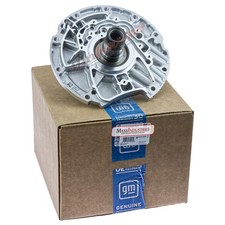
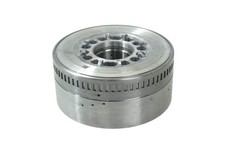
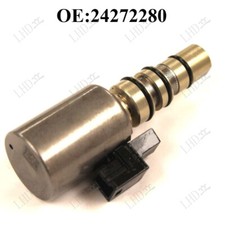
Pumps, clutch drums, TCC solenoids, valve bodies, and the fluid to get the job done right — shipped fast from the USA.
Shop 8L90 parts →Sources
- General Motors Service Bulletin PI1450A, "Snap, Pop, Click, Tick or Clunk Noise on a Launch" (March 2016). Backs the 2015 Escalade/Escalade ESV, Silverado, Sierra and Yukon/Yukon XL (8L90, RPO M5U, built before January 15, 2015) application, the C1/C2 clutch reaction plate-to-case clearance cause, the confirmation road test procedure, the November 5, 2014 production fix date, and transmission replacement as the only listed corrective action. static.nhtsa.gov (PDF, hosted by NHTSA)
- General Motors Service Bulletin 15-NA-007, "Firm Garage Shifts, Start Up Clunk, DTC P16F3 (Reprogram TCM)" (January 2016). Backs the 2015-2016 Escalade, Corvette/Silverado, Sierra and Yukon (8L90/M5U) application, the firm garage shift and startup clunk condition tied to DTC P16F3, and the TCM reprogram-and-Fast-Learn fix with no parts replacement. static.nhtsa.gov (PDF, hosted by NHTSA)
- General Motors Service Bulletin PIP5437A, "8L45 8L90 Diagnostic Tips for Harsh Shifts" (November 2016). Backs the clutch-fill-time-not-learned cause, the GDS2 session-log diagnostic method with bookmarking, the per-model-year mileage windows (7,500/5,000/2,500 miles), and the clutch-debris pan check as the next step when the learn procedure doesn't resolve the complaint. static.nhtsa.gov (PDF, hosted by NHTSA)
- General Motors Service Bulletin 18-NA-355, "Shake and/or Shudder During Light Throttle Acceleration Between 25 and 80 MPH" (March 2019). Backs the TCC shudder symptom description, the three-mode (A/B/C) confirmation test, the PicoScope NVH measurement method, and the Mobil 1 Synthetic LV ATF HP fluid exchange fix (GM part number 19417577) with its stated up-to-200-mile resolution window. static.nhtsa.gov (PDF, hosted by NHTSA)
- GM TechLink, "8-Speed Transmission Noise Concerns." Backs the diagnostic order for whine/noise complaints: correcting DTCs before chasing "characteristic" pump whine, ruling out the accessory belt and starter (bulletin 24-NA-078) and engine thrust bearing (bulletin 23-NA-170), the warning against unbolting the torque converter from the flexplate, and the endplay measurement requirement (bulletin PIP5996A) before disassembly. gm-techlink.com
- ATRA / GEARS Magazine, "8L90: Diagnosing Strategies, A Look at Diagnosing New Technology." Backs the TUN/PUN identification method, the Fast Learn fluid-temperature requirement (131-198°F), the per-clutch Drive Learn RPM and gear conditions, the required 65-25 mph coast-down prerequisite for C2/C3 learning, and the reference to bulletin 18-NA-355 and Mobil 1 ATF HP as the TCC shudder fix. gearsmagazine.com