Techs keep searching for "the 8L90 3-4 clutch" because the complaint sounds like it should point to one dedicated part. It doesn't. GM's own shift-adaptive-learning bulletin lists the applying clutch for the 3-4 upshift as C5, and GM's own delayed-engagement bulletin names that same C5 clutch as the 4-5-6-7-8-Reverse clutch. There is no part built just to handle gear three to gear four. The clutch doing that job also carries 4th, 5th, 6th, 7th, 8th, and Reverse — which is exactly why a real C5 problem rarely stays confined to one shift.
What Actually Applies on the 3-4 Shift
GM bulletin 16-NA-019 ("Information on Transmission Adaptive Functions and Correcting Low Mileage Harsh Shifts, Slips, or Flares," August 2016) exists to tell technicians which of the transmission's five clutches to relearn for each specific shift complaint. The 8-speed uses C1 through C5 to produce all eight forward ratios plus reverse, and the bulletin's own table removes any guesswork about which clutch does what:
| Shift | Applying Clutch | Releasing Clutch |
|---|---|---|
| 1–2 | C4 | C3 |
| 2–3 | C3 | C1 |
| 3–4 | C5 | C3 |
| 4–5 | C3 | C4 |
| 5–6 | C4 | C2 |
| 6–7 | C1 | C4 |
| 7–8 | C4 | C3 |
| N–D | C3 (garage shift learn) | — |
| N–R | C5 (garage shift learn) | — |
C5 is the clutch that applies for the 3-4 upshift. It's also the clutch GM commands for the N-R garage shift into Reverse. That's not a coincidence of naming — it's the same physical clutch pack doing both jobs. GM bulletin 20-NA-187 confirms this directly, referring to it in plain language as the "4-5-6-7-8 Reverse Clutch (C5)." C3, the clutch that releases on the 3-4 shift, is labeled in the same bulletin as the "1-3-5-6-7 Clutch (C3)" and is also the clutch commanded for the N-D garage shift into Drive.
Why a "3-4 Problem" Shows Up Everywhere Else Too
Because C5 covers 4th, 5th, 6th, 7th, 8th, and Reverse in addition to the 3-4 upshift, a genuinely worn or damaged C5 clutch pack does not politely confine itself to one complaint. A customer might describe a flare or neutral condition going from 3rd to 4th, a slow or harsh engagement into Reverse after the vehicle sits, or just generally soft, slipping shifts anywhere above 3rd gear — and all three can trace back to the same clutch. If you're chasing a 3-4 complaint and the customer also mentions anything odd about backing out of the driveway in the morning, that's not two separate problems. Check C5 once and you've covered both.
Two Very Different Failure Pictures
Before any parts come off, it's worth separating two failure modes that produce a similar-sounding complaint but have nothing in common mechanically.
1. Worn clutch control valve bores (hydraulic, no mechanical damage required)
Sonnax's documentation on the 8L45/8L90 platform identifies a specific wear pattern in the clutch control valve bores that handle C1 and C5 apply pressure. As the bore wears, clutch apply fluid pressure leaks past the valve instead of building force against the clutch pack, which reduces the apply force available. The result is pressure loss, burnt clutches, and poor shift quality — and because this is a bore-wear problem rather than a clutch-material problem, it can develop on a unit with otherwise healthy friction plates. Sonnax's fix is a drop-in replacement valve (part 154740-13K) with a lengthened spool that rides on an unworn section of the bore and a scarf-cut seal at the signal apply end, sold as a kit that fits either the S1 or S5 location.
2. A solenoid wiring mix-up (electrical, zero clutch wear)
Sonnax also documents a completely different cause that produces a hard 3-4-to-neutral complaint with no clutch damage at all. The S8 default control solenoid and the S9 1-2-3-4-5-Reverse boost solenoid are physically identical and use the same connector type, so it's easy to plug them in swapped after valve body or harness service — Sonnax notes this frequently turns up on vehicles that just had a P0711 transmission fluid temperature sensor replaced along with an updated wiring harness. When S8 and S9 get crossed, the default override valve fails to latch in 2nd gear, which exhausts the C5 (4-5-6-7-8-Reverse) clutch apply oil, and the 3-4 shift drops straight to neutral. Sonnax's own correct-wiring reference: S8 (default control) lands on terminal 1 with a green wire carrying a blue tracer and about 3.75 inches of conduit; S9 (1-2-3-4-5-Reverse boost) lands on terminal 7 with a yellow wire carrying a red tracer and about 1.75 inches of conduit. A faulty solenoid or a missing #3 checkball can produce the same complaint, so confirm wiring before condemning either part.
The practical takeaway: if the 3-4 neutral condition showed up right after valve body, harness, or sensor work, check wiring before you check clutches. If it developed gradually with no recent service, pressure loss from worn control valve bores or genuine clutch wear is the more likely culprit.
GM's Delayed-Engagement Test (the Real Threshold)
When the complaint leans toward a slow or harsh engagement into Reverse or Drive after the vehicle sits, GM bulletin 20-NA-187 ("Delayed and/or Harsh Engagement of Transmission Shift After Vehicle Sitting with Engine Off," September 2020) gives an exact, testable threshold instead of relying on driver impression. Evaluate the vehicle after it's sat for a minimum of 8 hours but less than 24 hours, at 50°F (10°C) or above. With the brake held, start the engine in Park, then shift to Drive or Reverse while watching the transmission Input Speed Sensor (ISS) on a scan tool.
- ISS drops to 0 RPM within 3 seconds: GM calls this acceptable engagement time. No repair should be attempted — this is normal operation, not a fault.
- ISS takes longer than 3 seconds to reach 0 RPM: this is a real delayed-engagement condition worth chasing.
- Under 2,500 miles with a recent transmission, valve body, or clutch replacement: go straight to the C3/C5 learn procedure in bulletin 16-NA-019 before assuming a hardware fault.
If engagement exceeds 3 seconds, GM's procedure is to attempt a C3-Drive and C5-Reverse clutch learn: let the transmission sump temperature rise to 20–30°C (68–86°F), don't touch the accelerator, then perform 20 Park-to-Reverse shifts or 20 Park-to-Drive shifts, releasing the brake on each one and letting the vehicle roll 5 to 10 feet (1.5–3.0 m) into gear each time. Only if that learn procedure fails to correct the condition does the bulletin call for disassembly: inspect the 1-3-5-6-7 Clutch (C3) for a delay into Drive and the 4-5-6-7-8 Reverse Clutch (C5) for a delay into Reverse, checking both the clutch plates and seals for wear or damage.
For a 3-4-specific complaint rather than a garage-shift complaint, bulletin 16-NA-019 gives a separate C5 learn procedure: find a low-traffic road (GM specifically suggests a business park) where you can hold 5–25 mph safely, shift to 3rd gear in manual mode, and slowly accelerate from about 1,000 rpm up to 2,500 rpm, then back down, repeating the cycle 10 times. Follow that with 15 light-throttle 3-4 upshifts at roughly 15% throttle. None of this works outside the transmission fluid temperature window GM specifies for any adaptive learn on this platform: 35–95°C (95–203°F).
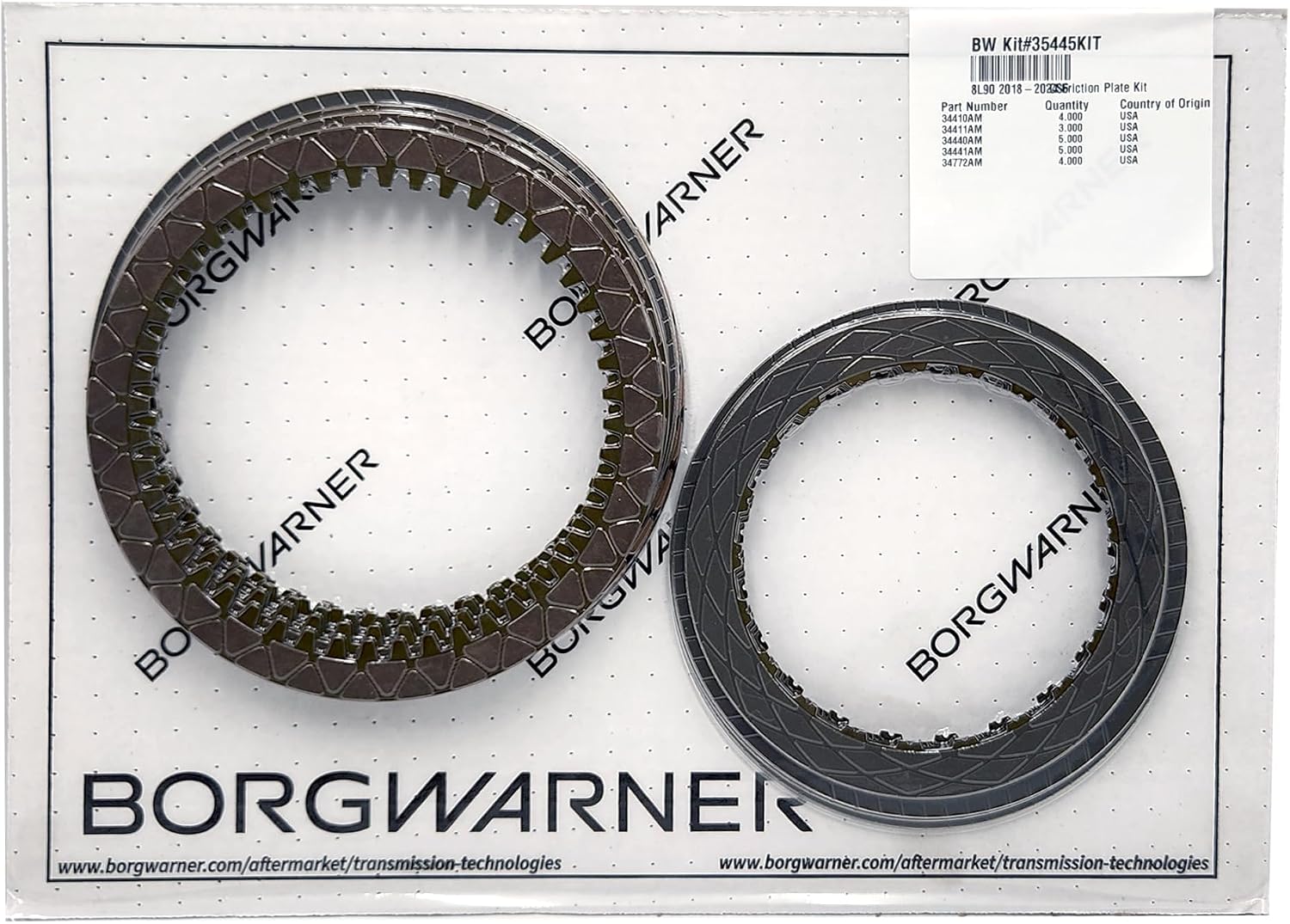
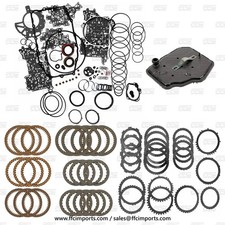
8L90 Friction Clutch Plate Kit (BorgWarner 35445KIT)
When teardown confirms worn or burnt friction material in the C5 pack per GM's own inspection step in 20-NA-187, this is the replacement friction kit — BorgWarner-sourced plates sized for the 8L90's clutch drums.
View the friction clutch plate kit →GM Changed the C5 Friction Material in 2019 — for This Exact Shift
Gears Magazine's reporting on 8L90 clutch revisions documents a 2019 update made specifically to the C5 clutch disk: GM changed the friction material pattern from radial grooves to a spiral-groove design, paired with a calibration change, with the stated purpose of improving the 3-4 shift. The update applies to both the 8L90 and the lighter-duty 8L45 that shares the platform. Like the other hard-part revisions on this transmission, it is not designed for back-service onto earlier-build units, since the new friction material is calibrated against updated TCM software rather than being a drop-in swap. If you're rebuilding a pre-2019 unit with a persistent 3-4 shift-feel complaint that survives a proper clutch learn, confirming which C5 disk generation is actually installed is worth the five minutes it takes.
Diagnostic Order That Doesn't Waste a Teardown
- Pull codes and recent service history first. A 3-4 neutral that appeared right after valve body, harness, or TFT sensor work points straight at the S8/S9 connector swap — check wiring before anything else.
- Run GM's delayed-engagement test (ISS to 0 RPM within 3 seconds, per 20-NA-187) if Reverse or Drive engagement feels slow or harsh after the vehicle sits. Don't skip this just because the complaint was phrased as a 3-4 problem — both ride on C5.
- If under 2,500 miles since a transmission, valve body, or clutch repair, go directly to the C3/C5 learn procedure in 16-NA-019 before suspecting a hardware fault.
- If engagement exceeds 3 seconds, perform the full C3-Drive/C5-Reverse learn (20 Park-to-Reverse or Park-to-Drive shifts at the specified sump temperature) before anything comes apart.
- For a pure 3-4 shift-quality complaint, run the dedicated C5 learn procedure from 16-NA-019 (the slow 1,000–2,500 rpm cycling in 3rd gear, then 15 light-throttle 3-4 upshifts) within the 35–95°C fluid temperature window.
- If the learn procedures don't resolve it, drop the pan and check for debris, then disassemble and inspect the C5 (4-5-6-7-8-Reverse) clutch plates and seals per 20-NA-187, along with the C3 pack while it's apart.
- If the pack looks clean but pressure is still weak, vacuum-test the S1/S5 clutch control valve bores for wear before condemning the clutch material itself — a leaking bore can mimic a worn clutch pack.
FAQ
Does the 8L90 have a dedicated 3-4 clutch?
No. GM's own shift-adaptive-learning bulletin 16-NA-019 lists C5 as the applying clutch and C3 as the releasing clutch for the 3-4 upshift. C5 is not a part built just for that shift — GM's own bulletin 20-NA-187 identifies it as the 4-5-6-7-8-Reverse clutch, meaning the same clutch pack also carries 4th through 8th gear and Reverse.
Why would a 3-4 shift problem also affect Reverse?
Because both rely on the same C5 clutch pack. GM's bulletin 20-NA-187 tells technicians to inspect the same 4-5-6-7-8 Reverse Clutch (C5) for wear when delayed engagement into Reverse doesn't clear after a clutch learn, and the C5 clutch is also the one that applies on the 3-4 upshift per the 16-NA-019 clutch chart. A worn or damaged C5 pack does not limit itself to one gear or one direction.
Can a wiring mistake cause a 3-4 shift to drop to neutral?
Yes. Sonnax documents a specific case where the S8 default control solenoid and S9 1-2-3-4-5-Reverse boost solenoid connectors get swapped during valve body or harness reinstallation, since the two solenoids are identical and share the same connector type. When that happens, the default override valve fails to latch in 2nd gear, 4-5-6-7-8-Reverse (C5) clutch apply oil gets exhausted, and the 3-4 shift drops to neutral — with no clutch damage involved at all.
How does GM test for a real delayed-engagement clutch problem versus normal operation?
Per GM bulletin 20-NA-187, after the vehicle sits 8 to 24 hours at 50°F (10°C) or above, shift from Park to Drive or Reverse with the brake held and watch the input speed sensor (ISS) on a scan tool. If the ISS drops to 0 RPM within 3 seconds, that is acceptable engagement and no repair should be attempted. Exceeding 3 seconds is the threshold for a real delayed-engagement condition worth chasing.
Did GM change the C5 clutch material on the 8L90?
Yes. Gears Magazine's reporting on 8L90 clutch changes documents a 2019 update to the C5 (4-5-6-7-8-Reverse) clutch disk that switched the friction material from a radial groove pattern to a spiral groove design specifically to improve the 3-4 shift, paired with a calibration change. GM does not design this update for back-service onto earlier-build transmissions because the hard-part change is tied to the new calibration.
Related 8L90 guides
Sources
- General Motors Service Bulletin 16-NA-019, "Information on Transmission Adaptive Functions and Correcting Low Mileage Harsh Shifts, Slips, or Flares" (August 2016). Backs the full clutch apply/release chart for every shift including 3-4 (C5 applying, C3 releasing), the C5-specific adaptive learn procedure (3rd gear, 1,000-2,500 rpm cycling, 15 light-throttle 3-4 upshifts), and the 35-95°C fluid temperature window required for any clutch learn. static.nhtsa.gov (PDF, hosted by NHTSA)
- General Motors Service Bulletin 20-NA-187, "Delayed and/or Harsh Engagement of Transmission Shift After Vehicle Sitting with Engine Off" (September 2020). Backs the naming of C5 as the "4-5-6-7-8 Reverse Clutch" and C3 as the "1-3-5-6-7 Clutch," the 3-second delayed-engagement test threshold, the C3/C5 relearn procedure (20 Park-to-Reverse/Drive shifts), and the disassembly/inspection step when the learn doesn't resolve the complaint. static.nhtsa.gov (PDF, hosted by NHTSA)
- Gears Magazine, "A Clutch Performer – 8L90 Clutch Changes" (January/February 2023). Backs the 2019 C5 (4-5-6-7-8-R) clutch disk friction material update from radial to spiral-groove design specifically to improve the 3-4 shift, and confirms the update is not designed for back-service due to tied calibration changes. gearsmagazine.com
- Sonnax Technical Resource, "Diagnosing the Infamous GM 8L45, 8L90 3-4 Neutral: Check Your Solenoid Wiring Harness Assembly." Backs the S8/S9 solenoid connector swap failure mode, the exact terminal/wire-color reference for correct wiring, and the mechanism by which the mix-up exhausts C5 clutch apply oil and drops the 3-4 shift to neutral. sonnax.com
- Sonnax S1/S5 Clutch Control Valve Kit (Part No. 154740-13K) product documentation. Backs the worn clutch control valve bore failure mode on the S1/S5 circuit, its effect on clutch apply pressure, and the drop-in valve fix design. sonnax.com