Two numbers put an 8L90 in trouble more often than any hard part does: the fluid spec and the capacity. Both are easy to get wrong. GM publishes two very different capacity figures for this transmission, and the 8-speed and 10-speed families that sit next to each other on the same truck assembly line take fluids that are not interchangeable.
What follows is the fluid and capacity data for the GM 8L90, pulled from GM's own published transmission specification sheet, GM's 2025 service capacity chart, the fluid manufacturer's product data sheet, and GM Service Bulletin 18-NA-355. Every figure is cited at the bottom of the page.
The short version: the 8L90 takes DEXRON HP, which in practice means blue-label Mobil 1 Synthetic LV ATF HP, GM part 19417577 in the U.S. Service fluid-change capacity is 7.0 liters / 7.4 quarts. Dry capacity is 10.3 liters excluding cooler volume, roughly 10.9 quarts. It is not DEXRON VI and it is not DEXRON ULV. There is no dipstick — the level is set at a stand pipe in the pan with fluid temperature between 95 and 113°F and the engine running.
The Fluid Spec: DEXRON HP, and Why the Letters Matter
GM's published specification sheet for the 8L90 Hydra-Matic lists the fluid type in one line: DEXRON High Performance ATF. [1] GM's 2025 Transmission Capacities & Fluids chart backs it up for every listed 8L90 application — Express, Savana and Low Cab Forward under RPO N8X all show DEXRON HP. [2]
That sounds simple until you look at what sits around it in the same GM lineup. On one truck line GM builds three transmissions with three different fluids:
| Transmission | Fluid | Service capacity |
|---|---|---|
| 6L80 / 6L90 | DEXRON VI | 5.7 L / 6.0 qt (6L90, Low Cab Forward) |
| 8L45 / 8L80 / 8L90 | DEXRON HP | 7.0 L / 7.4 qt |
| 10L60 / 10L80 / 10L90 | DEXRON ULV | 7.7 L / 8.1 qt |
| 10L1000 | DEXRON ULV | 13.6 L / 14.4 qt |
All four of those numbers come off the same GM chart. [2] Three different specifications, three different viscosities, and a parts counter that will happily hand you whichever one is closest. ULV in particular gets mixed up with HP constantly, because both are "the new low-viscosity GM fluid" in casual shop talk. They are not the same fluid and they are not approved against each other. If you are working on a 2015-2024 Silverado, Sierra, Escalade, Yukon, Camaro, Corvette, ATS, CTS, CT6, Colorado or Canyon with an 8-speed, the answer is HP.
What DEXRON HP actually is
DEXRON HP is a GM licensed specification, and the fluid that carries it in North America is Mobil 1 Synthetic LV ATF HP under GM license code J-62120. [3] The published typical properties tell you why GM went there:
| Property | Mobil 1 Synthetic LV ATF HP |
|---|---|
| Kinematic viscosity @ 40°C | 27 mm²/s |
| Kinematic viscosity @ 100°C | 5.7 mm²/s |
| Viscosity index | 152 |
| Pour point | -54°C |
| Flash point | 233°C |
| Density @ 15°C | 835 kg/m³ |
A viscosity index of 152 with a 5.7 cSt hot number is the whole point. [3] The 8L90 runs six variable force solenoids — one for each of its five clutches plus one for the converter clutch — plus two on-off solenoids, and it controls converter clutch apply through an electronically controlled capacity clutch that runs a small, deliberate amount of slip to damp engine pulses. [1] Every one of those functions is a pressure-regulation job through a small aluminum bore. A fluid whose viscosity swings hard between a cold morning and a loaded tow grade makes those regulators behave differently at each end, and the ECCC slip band is narrow enough that it shows up in the seat as shudder.
Capacity: The Two Numbers, and When to Use Each
This is where most of the confusion lives, and it is not a mistake on anyone's part — GM publishes both figures, for two different jobs.
Dry fill: 10.3 liters
GM's 8L90 specification sheet lists fluid capacity as 10.3 L (Excluding Cooler Volume). [1] That is about 10.9 U.S. quarts, and it is the number for a bare unit going back together on the bench — empty converter, empty pump, empty cooler. Add the cooler and the lines and the real-world total lands around 11.5 quarts depending on application, which is the figure Transmission Digest quotes for a full fill on this unit. [4]
Fluid change: 7.0 liters / 7.4 quarts
GM's 2025 capacities chart lists the 8L90 fluid change capacity at 7.0 liters or 7.4 quarts. [2] That is what comes out and goes back in on a pan-and-filter service with the converter left full. Buy 8 quarts for a pan drop and you will have enough to set the level and a little left to top off.
Buy for the job, not for the transmission. Pan and filter service: about 8 quarts. Rebuild or R&R with a drained converter: 11 to 12 quarts. Full exchange per GM's shudder bulletin: GM specifies filling the machine with 20 quarts and running until 16 quarts of old fluid have been collected. [5]
Part numbers
| Item | GM part number |
|---|---|
| Mobil 1 Synthetic LV ATF HP, 1 quart (U.S.) | 19417577 |
| Mobil 1 Synthetic LV ATF HP, 1 qt / 0.946 L (Canada) | 19418066 |
| Mobil 1 Synthetic LV ATF HP, 55-gallon drum (U.S.) | 19417904 |
| Transmission fluid cooler pipe retainer | 24205103 |
| Transmission fluid cooler pipe seal | 23135703 |
All five come out of the parts table in GM bulletin 18-NA-355. [5] The bulletin notes the fluid is available through local GM oil distributors rather than through the normal parts pipeline, which is why some dealers quote long lead times on it.
Setting the Level With No Dipstick
The 8L90 has no fill tube and no factory dipstick on most applications. GM's own language is direct about it: "Because the transmission on this vehicle is not equipped with a fill tube and dipstick, a tube in the bottom pan is used to set the fluid level." [5] The push-lock fill plug is on the passenger side of the case, and the pan carries the stand pipe. [4] Everything happens from underneath, with a scan tool connected so you can watch transmission fluid temperature.
The temperature window is the whole procedure
GM's warning is worth reading in full, because it is the single most-skipped step on this unit:
"The transmission fluid level must be checked when the transmission fluid temperature (TFT) is between 35–45°C (95–113°F)... Setting the fluid level with a TFT outside this range will result in either an under or over-filled transmission. TFT>45°C = under-filled, TFT<35°C = over-filled." [5]
Read the direction of that carefully, because it runs opposite to intuition. Fluid expands as it heats, so a hot unit reads full sooner and you stop short — that is the under-filled case. A cold unit reads low, you keep adding, and you end up over. GM spells out what each does: an under-filled unit causes premature component wear or damage, and an over-filled unit discharges fluid out the vent tube, which GM warns can cause a fire, along with foaming and pump cavitation. [5]
The thermal bypass trap
Silverado, Sierra, Yukon and Escalade models with a thermal bypass valve need an extra step, and getting it wrong sends a truck out the door low on fluid. GM specifies bringing TFT to or past 90°C (194°F) first, which opens the bypass valve and lets the cooler fill, then shutting the vehicle off and letting the fluid cool back down into the 35–45°C window before checking. [5] Skip the heat cycle and you set the level with an empty cooler circuit. The cooler fills on the customer's first real drive and the unit is now down a quart or more.
The level check, step by step
- Watch TFT on the driver information center or a scan tool. On thermal-bypass trucks, heat past 194°F first, then let it cool back to the window.
- Start and idle the engine. Foot on the brake, move the shift lever through every range, pausing at least 3 seconds in each, then back to Park.
- Confirm idle is in the 500–800 rpm range and let it idle at least 1 minute.
- Raise the vehicle level, engine still running, lever in Park. The engine must be running when the level check plug comes out or you will lose excess fluid and end up under-filled. [5]
- Pull the level check plug from the pan. If fluid runs as a steady stream, wait for it to drop to a drip. If nothing comes out, add fluid at the fill port until it drips.
- Reinstall the plug and torque it to 9 N·m (80 lb-in). That is inch-pounds, not foot-pounds — it is a small plug in an aluminum pan.
- Inspect for external leaks before you drop the hoist.
| Fastener | Torque |
|---|---|
| Transmission oil level check / level set plug | 9 N·m (80 lb-in) |
| Cooler line adapter block bolt (service procedure) | 22 N·m (16 lb-ft) |
| Fluid fill adapter, maximum | 9 N·m (80 lb-in), hand tight |
Those come from the same bulletin. [5] If you are renting or borrowing the GM fill adapter, note the "do not exceed" wording — the adapter is the part that breaks, not the case.
Why a Pan Drop Is Not a Fluid Change on This Unit
If the reason you are under the truck is shudder, a drain and fill will disappoint you, and GM's own bulletin explains why. Bulletin 18-NA-355 addresses "Shake and/or Shudder During Light Throttle Acceleration Between 25 and 80 MPH... at Steady Speed" on 8L45 and 8L90 units, and the stated cause is torque converter clutch shudder. [5] The correction is not a converter. It is a complete fluid exchange to HP fluid.
The volume is the point. GM specifies a machine filled with 20 quarts, expelled and replaced in staged 4-quart and 5-quart increments until 16 quarts of old fluid sit in the bucket. [5] A pan drop moves roughly 7 quarts of a unit that holds close to 11 with the converter, so more than a third of the old fluid stays put, most of it inside the converter where the shudder lives.
GM is blunt about what dilution does: "Intermixing of other types of transmission fluid or aftermarket additive packages will result in a low concentration level of new fluid and will not provide satisfactory results." [5] That sentence covers both halves of the mistake — leftover DEXRON VI, and the bottle of shudder-fix additive somebody poured in before you got there.
Two more cautions from the procedure that are worth memorizing. First: "DO NOT REMOVE MORE THAN 3 QUARTS OF FLUID AS IT COULD CAUSE FLUID PUMP CAVITATION AND POSSIBLY DAMAGE THE TRANSMISSION" during the initial expel step. [5] Second: GM states the procedure should only be completed once per vehicle, and that a unit that comes back shuddering needs real diagnosis, since "sometimes shudder is not caused by the torque converter clutch. In some instances, shudder is fish bite, chuggle, surge or vibration." [5]
When the exchange does work, it is not instant. GM tells dealers to advise the customer that full effect takes up to 320 km (200 miles) and a minimum of two cold-to-operating-temperature drive cycles. [5] Do not let a customer pull back in at 20 miles and call it a failure.
What the Wrong Fluid Costs You Downstream
The fluid argument stops being academic once you look at what this transmission asks its hydraulics to do. Commanded line pressure on an 8L90 can approach 300 psi in normal operation, and there are test plugs on the extension housing — line pressure on the left, the 1-2-3-4-5/R circuit on the right — so you can compare actual to commanded with a scan tool. [4] Sonnax puts the normal peak at roughly 315 psi and reports field measurements above 415 psi on units with worn pressure regulator lineups, where the regulator bore and shuttle valve sleeve leak while the OE blow-off spring sits calibrated too high to catch the overshoot. Their published consequence list includes cracked valve body castings and shattered drums. [6]
That is the environment the fluid works in: 300-plus psi across small aluminum bores, regulated by low-flow variable force solenoids, with a converter clutch deliberately slipping. Viscosity that drifts with temperature changes how every one of those bores leaks. It is why GM did not simply publish a service bulletin telling shops to use more DEXRON VI.
Change the filter while you are in there
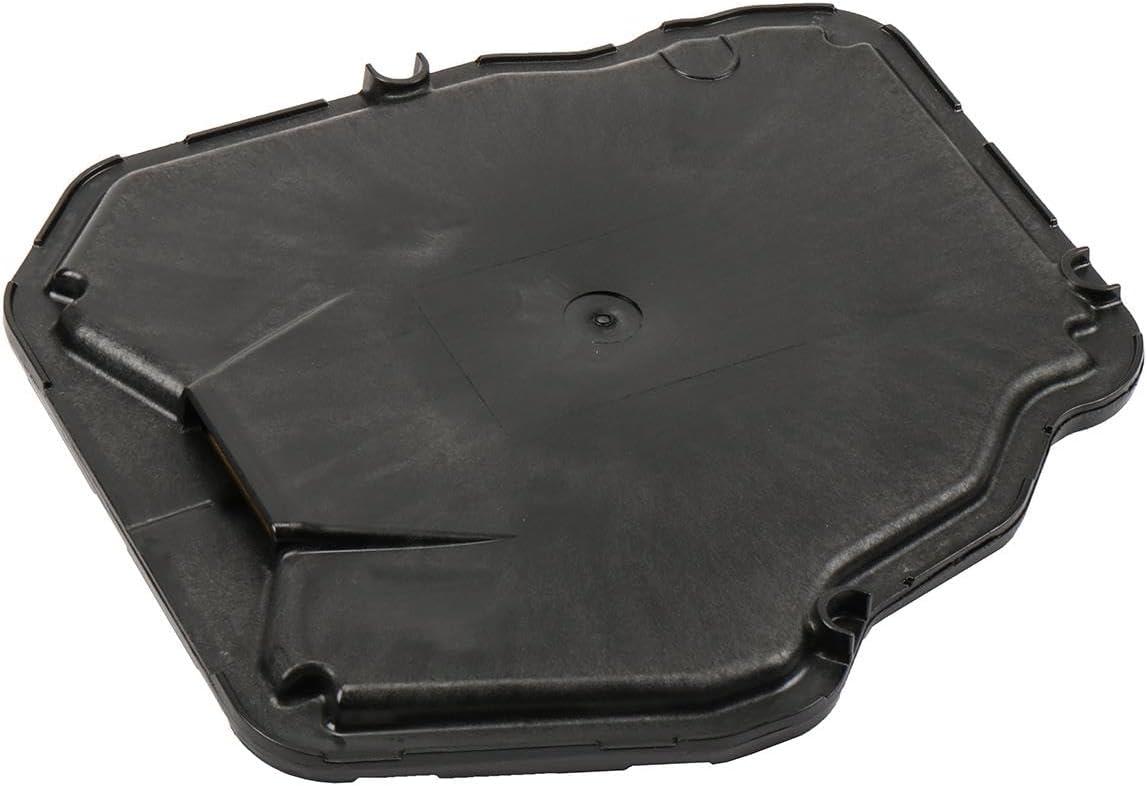
The 8L90 and 8L45 share filter GM 24274402, sold in the aftermarket as TF922. The pan gasket is a one-time-use part — buy the filter and gasket together rather than reusing a gasket that has been torqued once. If the pan is off for a rebuild rather than a service, clean the pan and the magnet before it goes back on; GM's own triple drain-and-fill procedure for Corvette and CT6 specifically calls for cleaning the pan and magnet between fills. [5]
Need parts for this job? The 8L90 filter and pan gasket, ATF fill adapters, cooler bypass kits, solenoids, valve bodies and master rebuild kits are all on our 8L90 parts page, shipped from the USA with checkout on site.
8L90 Fluid and Capacity Reference
| Spec | Value | Source |
|---|---|---|
| Fluid type | DEXRON HP ATF (GM license J-62120) | [1] [2] [3] |
| Fluid change capacity | 7.0 L / 7.4 qt | [2] |
| Dry capacity, excluding cooler | 10.3 L (approx. 10.9 qt) | [1] |
| Approximate full fill with cooler | ~11.5 qt, varies by application | [4] |
| Level-check fluid temperature | 35–45°C (95–113°F) | [5] |
| Thermal bypass pre-heat | 90°C (194°F), then cool to window | [5] |
| Level plug torque | 9 N·m (80 lb-in) | [5] |
| Filter | GM 24274402 (TF922), 8L45 / 8L90 | — |
| Transmission RPO | M5U / M5X (light duty), N8X (Express, Savana, Low Cab Forward) | [2] [4] [5] |
| Max gearbox torque | 665 lb-ft (900 Nm) | [1] |
| Converter | 258 mm, variable force solenoid ECCC, 2-path, turbine damper | [1] |
| Solenoids | 6 variable force (5 clutch + TCC), 2 on-off | [1] |
FAQ
What kind of transmission fluid does a GM 8L90 take?
DEXRON HP. GM's published specification sheet for the 8L90 lists the fluid type as DEXRON High Performance ATF, and GM's 2025 Transmission Capacities and Fluids chart lists every 8L90 application on DEXRON HP. In the U.S. that is Mobil 1 Synthetic LV ATF HP, the blue-label fluid, GM part number 19417577 for a one-quart bottle. It is not DEXRON VI, which the 6L80 and 6L90 use, and it is not DEXRON ULV, which the 10L80 and 10L90 use.
How many quarts does an 8L90 hold?
There are two correct answers and they get confused constantly. A fluid change takes 7.0 liters or 7.4 quarts per GM's 2025 capacities chart. A completely dry unit takes 10.3 liters excluding cooler volume, about 10.9 quarts, per GM's published 8L90 specification sheet, and closer to 11.5 quarts once the cooler and lines are counted. Buy for the job: a pan-and-filter service needs roughly 8 quarts on hand, while a full exchange per GM's shudder bulletin uses 20.
Can I use DEXRON VI or DEXRON ULV in an 8L90?
No on both counts. DEXRON VI is the older, thicker specification and it is what the factory filled early 8L90 units with before GM moved to HP fluid to cure torque converter clutch shudder. DEXRON ULV is a different low-viscosity fluid for the 10-speed family. GM bulletin 18-NA-355 states that intermixing other types of transmission fluid or aftermarket additive packages will result in a low concentration level of new fluid and will not provide satisfactory results.
How do you check the fluid level on an 8L90 with no dipstick?
The level is set by a stand pipe in the bottom pan. Bring transmission fluid temperature to between 35 and 45 degrees C (95 to 113 degrees F), idle the engine at 500 to 800 rpm in Park, raise the vehicle level, and pull the level check plug with the engine still running. If fluid streams out, wait for it to drop to a drip. If nothing comes out, add fluid through the fill port until it drips. Torque the plug to 9 N·m (80 lb-in). Setting the level above 45 C leaves the unit under-filled; below 35 C leaves it over-filled.
Why does my Silverado need to reach 194 degrees before I check the 8L90 fluid level?
Because of the thermal bypass valve. On Silverado, Sierra, Yukon and Escalade applications, GM specifies bringing fluid temperature to or past 90 degrees C (194 degrees F) first, which opens the bypass and lets the cooler fill, then shutting the engine off and letting the fluid cool back to the 35 to 45 C window before setting the level. Skip that step and you set the level with an empty cooler, the cooler fills on the first hot drive cycle, and the unit runs low from then on.
Sources
- GM Powered Solutions — 8L90 Hydra-Matic Eight Speed RWD Automatic Transmission, features and specifications sheet (©2022 General Motors). Backs the fluid type line "DEXRON High Performance ATF," the fluid capacity of 10.3 L excluding cooler volume, maximum gearbox torque of 665 lb-ft (900 Nm), the 258 mm converter with variable force solenoid ECCC and turbine damper, the six variable force solenoids (one per clutch plus one for TCC) and two on-off solenoids, the four gear sets and five clutches, and the electronically controlled capacity clutch description of regulated slip used to damp engine pulses. poweredsolutions.gm.com — 8L90 Features & Specifications (PDF)
- GM TechLink — 2025 Transmission Capacities & Fluids (U.S. and Canada only), 05-2025 A. Backs the 8L90 fluid change capacity of 7.0 L / 7.4 qt on DEXRON HP under RPO N8X for Express, Savana and Low Cab Forward; the 8L80 (RPO MFC/MTH) at 7.0 L / 7.4 qt DEXRON HP; the 8L45 (RPO MHA) at 7.0 L / 7.4 qt DEXRON HP; the 6L90 (RPO MYD) at 5.7 L / 6.0 qt DEXRON VI; the 10L60/10L80/10L90 at 7.7 L / 8.1 qt DEXRON ULV; and the 10L1000 at 13.6 L / 14.4 qt DEXRON ULV. gm-techlink.com — Transmission Capacities & Fluids 2025 (PDF)
- ExxonMobil — Mobil 1 Synthetic LV ATF HP product data sheet. Backs the GM DEXRON HP approval and license code J-62120, and the typical properties: kinematic viscosity 27 mm²/s at 40°C and 5.7 mm²/s at 100°C, viscosity index 152, pour point -54°C, flash point 233°C and density 835 kg/m³ at 15°C. mobil.com — Mobil 1 Synthetic LV ATF HP product data sheet
- Transmission Digest — "GM 8L90: The Other 8 Speed Automatic, Part 1," Mike Riley, February 1, 2016. Backs the RPO M5U designation, the absence of a dipstick and the requirement to work from underneath with a scanner connected, the push-lock fill plug on the passenger side of the case and the stand pipe in the pan, the approximate 11.5-quart DEXRON HP fill depending on vehicle model, the line pressure and 1-2-3-4-5/R test plugs on the extension housing with line pressure on the left, commanded line pressure approaching 300 psi, and the remote access pump, five friction elements and four planetary gear set architecture. transmissiondigest.com — GM 8L90: The Other 8 Speed Automatic, Part 1
- GM Service Bulletin 18-NA-355 (April 2020, version 6), via NHTSA. Backs the shudder subject line and 25–80 mph condition, TCC shudder as the stated cause, the fluid exchange correction to blue-label Mobil 1 Synthetic LV ATF HP, part numbers 19417577 (U.S. 1 quart), 19418066 (Canada) and 19417904 (U.S. 55-gallon drum) plus retainer 24205103 and seal 23135703, the availability note through local GM oil distributors, the 20-quart machine fill and 16-quart exchange volume, the intermixing and aftermarket-additive warning, the "do not remove more than 3 quarts" cavitation caution, the once-per-vehicle note and the fish bite / chuggle / surge caveat, the 320 km (200 mile) and two-drive-cycle expectation, the statement that the transmission has no fill tube or dipstick and uses a tube in the bottom pan, the 35–45°C (95–113°F) TFT window with TFT>45°C = under-filled and TFT<35°C = over-filled, the over-fill vent discharge / fire / foaming / cavitation warning, the 90°C (194°F) thermal bypass pre-heat requirement for Silverado, Sierra, Yukon and Escalade, the engine-must-be-running caution at the level plug, the 3-second-per-range and 500–800 rpm / 1-minute idle steps, the 9 N·m (80 lb-in) level set plug torque, the 9 N·m fill adapter maximum, the 22 N·m (16 lb-ft) cooler line adapter block bolt, and the Corvette / CT6 triple drain-and-fill with pan and magnet cleaning. NHTSA — GM Service Bulletin 18-NA-355 (PDF)
- Sonnax — "Watch Out for High Pressure in GM 8L45, 8L90 Valve Bodies." Backs the roughly 315 psi normal peak line pressure, field measurements above 415 psi on worn units, the worn pressure regulator valve lineup and shuttle valve sleeve leak path, the OE blow-off spring calibrated too high to catch the overshoot, and the published consequences of cracked valve body castings and shattered drums. sonnax.com — High Pressure in GM 8L45, 8L90 Valve Bodies