The GM 8L90 is a good transmission that picked up a bad reputation, and most of that reputation traces to three things: a fluid that was wrong for the converter clutch, a pressure regulator circuit that wears and then lets line pressure run away, and a valve body full of small aluminum bores that leak long before anything looks worn. Sort those out and the unit is fine. Miss them and you get a rebuild that comes back.
What follows is the list of failures worth knowing on the 8L90 and its smaller sibling the 8L45, what causes each one, and the repair. Every number comes from a GM bulletin, GM's own fluid data, or published manufacturer technical material.
The short version: shudder at steady cruise is a fluid problem GM fixed with a full exchange to Mobil 1 Synthetic LV ATF HP per bulletin 18-NA-355. Harsh shifts, burnt clutches and cracked castings are a line pressure problem — the unit should peak near 315 psi, and worn units have been measured above 415 psi. Soft shifts, flares and ratio codes with clean fluid are signal accumulator bore wear, worst at S3 and S4. A no-move after install is usually a pump that never primed, not a bad build.


Problem 1: Shudder at Steady Cruise (TCC Shudder)
This is the complaint that made the 8L90 famous, and it is the one with the cleanest factory answer. GM Service Bulletin 18-NA-355, dated April 2020, is titled "Shake and/or Shudder During Light Throttle Acceleration Between 25 and 80 MPH (40 and 128 KM/H) at Steady Speed." [1] It covers 8L45 and 8L90 units across 2015-2019 Cadillac ATS, CTS, CT6 and Escalade, Chevrolet Camaro, Colorado, Corvette and Silverado, and GMC Canyon, Sierra and Yukon, with transmission RPOs M5N, M5T, M5U and M5X. [1]
The condition, in GM's own words, happens "during light throttle acceleration between 25 and 80 mph (40 and 128 km/h) steady state driving when transmission is not actively shifting gears," and "may be described as if they are driving over rumble strips or a concrete road surface with rough expansion joints." The stated cause is torque converter clutch shudder. [1]
What the bulletin does not do is condemn the converter. The correction is a complete fluid exchange to the blue-label Mobil 1 Synthetic LV ATF HP fluid, GM part 19417577 in the U.S. and 19418066 in Canada, at labor operation 8480818, 1.1 hours. [1]
Why a drain-and-fill does not fix it
Read the procedure and the reason is obvious. GM specifies filling the flush machine with 20 quarts of HP fluid and running the exchange until 16 quarts of old fluid have been collected in the graduated bucket, in staged 4-quart and 5-quart increments. [1] The bulletin is blunt about why: "Intermixing of other types of transmission fluid or aftermarket additive packages will result in a low concentration level of new fluid and will not provide satisfactory results." [1] A pan drop gets maybe five quarts out of a unit that holds far more, and the leftover DEXRON VI dilutes the friction modifier package the whole fix depends on.
One caution in that procedure is easy to miss and expensive to get wrong. GM warns in capitals: "DO NOT REMOVE MORE THAN 3 QUARTS OF FLUID AS IT COULD CAUSE FLUID PUMP CAVITATION AND POSSIBLY DAMAGE THE TRANSMISSION" during the initial expel step. [1] Torques for the level set plug and cooler line adapter block are in the spec table below.
One more caution straight from the bulletin: "This procedure should only be completed once per vehicle," and if the shudder returns, diagnose it properly — because "Sometimes shudder is not caused by the torque converter clutch (TCC). In some instances, shudder is fish bite, chuggle, surge or vibration." [1] If a unit has been shuddering for 30,000 miles, the lining is already glazed and fluid will not bring it back.
Problem 2: Runaway Line Pressure and Cracked Castings
This is the failure that kills hard parts, and the one most people write off as "it just came apart." Maximum line pressure on an 8L45 or 8L90 should peak at about 315 psi. Sonnax reports field measurements above 415 psi on units evaluated with worn valve bodies. [2] That is a hundred psi of overpressure riding on aluminum worm tracks that were never designed for it, and the published consequence is exactly what it sounds like: cracked valve body castings, with enough energy in the circuit to shatter a drum. [2]
Two things cause it together. The pressure regulator valve lineup wears at the casting bore and at the shuttle valve sleeve, so the valve can no longer stroke to the low-pressure position and the shuttle can no longer seal the leak. Behind it, the OE line pressure blow-off spring is calibrated too high — over 400 psi in some cases — so nothing catches the overshoot. [2] Neither alone would do it. Together they run the unit up until something splits.
The fix, and why it is a two-part fix
Replace the pressure regulator lineup and the blow-off spring together, targeting a peak in the 300-315 psi range. Sonnax pairs pressure regulator and O-ringed shuttle valve kit 154740-29K with pressure relief ball valve spring 154740-18 for that reason. [2] The practical shop rule is to do this every time an 8L45 or 8L90 valve body is opened, whether or not the customer's complaint pointed at pressure, because you cannot see 415 psi in a parts washer.
If you drop a pan and find aluminum, do not assume a drum failed on its own. Look at the worm tracks between pump suction and the secondary line circuit before you condemn anything downstream.
Problem 3: Signal Accumulator Bore Wear (Soft Shifts, Flares, No TCC)
This failure produces a transmission that drives badly with fluid that looks fine, which is why it gets misdiagnosed as a solenoid over and over. The 8L45 and 8L90 control solenoid valve body carries seven signal accumulator bores. The pistons in them are, as Sonnax puts it, extremely active, and they wear the cast aluminum bores they ride in — with S3 and S4 generally the worst. [3] The VFS solenoids feeding those circuits are low-flow devices, so any leak past a worn accumulator bleeds off the signal pressure the related clutch control valve needs to regulate apply. [3]
The published symptom list covers most of what shops chase on this unit: poor shift quality, low line pressure, no converter apply, burnt clutches, soft shifts, flare shifts, clutch slippage, ratio codes and hydraulic-related converter codes. [3] Notice that a bad solenoid and a worn accumulator bore produce the same scan data. Putting solenoids into a worn casting is money spent to reproduce the complaint.
How to actually test it
Vacuum test the accumulator pistons on the bench, with gauge pins as the backup. Test with the spring still in the piston, put the test port opening at the center of the spring, and block the OE piston at several positions through its stroke so you check the whole bore and not one spot. [3] Bores wear unevenly, and one that holds vacuum at rest will often fail halfway through travel — exactly where the piston lives while a clutch is regulating.
For the repair, signal accumulator piston kit 154740-06K reconditions up to four bores with no reaming. Casting wear beyond that scope takes oversized kit 154740-01K, which includes a complete set of seven pistons and uses tool kit 154740-TL. A Shift Zip Kit (8L45-8L90-SHIFT-ZIP) services all seven bores in one package. [3]
Problem 4: Clutch Control Valve and Solenoid Mix-Ups
This one is self-inflicted, and common enough to deserve its own section. It bites on assembly, not in service. The 8L45/8L90 uses clutch control valves with two different inner land diameters — .426 in and .443 in — but every one of those valves carries the same .531 in outside land at the solenoid end. [4] They look interchangeable in your hand. They are not. Put a .426 in valve in the S3 bore and you get delayed forward engagement and sloppy upshifts, usually with P0722. [4] Put one in an early-2019 S4 bore and you get a bad flare on the 1-2 shift with occasional delayed forward; in a late-2019-and-up S4 bore, a no-move-forward condition. [4] In the S7 (TCC) bore, no TCC apply or excessively high RPM slipping, with P2808. [4]
The solenoids have their own trap. The S4 and TCC solenoids sit in adjacent bores and share compatible connectors, so they can be swapped. The result is a neutral condition on the 1-2 shift. [4] If a freshly assembled unit neutralizes on 1-2, pull the solenoids and verify the ID numbers before you pull the transmission back out.
Correct valve kits by position: 154740-11K for S2/S3/S4/TCC, 154740-13K for S1/S5, 154740-24K for the early S4 and 154740-26K oversized for the late S4. [4]
Problem 5: No Move or No Pressure After Install
Sonnax's TASC Force material on this unit opens by saying no-move and no-pressure conditions after repair "have plagued this unit since its inception." [5] Before you pull a freshly installed 8L90 back out, walk this list.
- No movement right after a fast learn or J2534 programming. Remove the key, get out, shut the doors, come back 15 minutes later. It usually clears itself. [5]
- Pump prime failure. The off-axis chain-driven pump is advertised as self-priming and in the field often is not. Prime it on the bench: valve body face down in a clean drain pan, manual valve in Park with the first land flush to the casting, funnel in the pump suction, fill with ATF, then spin the pump shaft clockwise with a half-inch chuck drill. [5]
- Pressure regulator assembled backward. The inner shuttle boost valve and bushing must face inboard for boost. Installed outboard, you get a low- or no-pressure condition. [5]
- Wrong valve body. Do not put a stop-start valve body on a non-stop-start vehicle. It leaves a leak at the rear of the valve body where the stop-start accumulator would normally attach. [5]
- The test port plug. New OE valve bodies carry a plug bolted into a hole the original casting does not have. Remove it and it dumps line pressure. [5]
- The 1-2-7-8-R case seal. It goes in the case underneath the valve body, the 8L45 and 8L90 seals are different, and it gets left out. [5]
One more useful fact from that same material: if the unit has basic function, the failsafe or default gears are second and Reverse. [5] A truck that limps in second and backs up normally is in failsafe, not mechanically dead.
Fluid and Capacity: Get This Right or Repeat the Job
The 8L90 does not take DEXRON VI. GM's 2025 transmission capacities and fluids chart lists the 8L90, RPO N8X, at a fluid change capacity of 7.0 liters / 7.4 quarts on DEXRON HP. [6] The 8L45 in the CT4, RPO MHA, carries the same 7.0 L / 7.4 qt and the same DEXRON HP spec. [6]
| Spec | 8L90 | Source |
|---|---|---|
| Fluid | DEXRON HP (Mobil 1 Synthetic LV ATF HP, blue label) | GM TechLink / 18-NA-355 |
| Fluid change capacity | 7.0 L / 7.4 qt | GM TechLink 2025 |
| Shudder-fix exchange volume | 16 qt expelled, 20 qt in the machine | GM 18-NA-355 |
| Level set plug torque | 9 N·m (80 lb in) | GM 18-NA-355 |
| Cooler line adapter block bolt | 22 N·m (16 lb ft) | GM 18-NA-355 |
| Line pressure, peak | ~315 psi (worn units measured 415+ psi) | Sonnax |
Set the level at the level set plug with the fluid at the specified temperature, the way the bulletin does after its exchange. [1] There is no factory dipstick on most of these, and eyeballing the level is how units come back burnt.
Diagnosis Order That Saves Time
- Separate shudder from shift complaints. Shudder only at steady cruise, 25-80 mph, not shifting, is the 18-NA-355 path; anything that happens during a shift is not TCC shudder. [1]
- Confirm what fluid is in it. If the vehicle predates the HP breakpoint and has never been exchanged, that is your first move on a shudder, not your last.
- Pull codes before clearing. P0722 and P2808 in a unit that was recently apart point straight at a misplaced clutch control valve. [4]
- Measure line pressure hot. You are looking for a peak near 315 psi. A reading well above that is a cracked casting waiting to happen. [2]
- Inspect the pan. Aluminum means look at the valve body worm tracks and the drums together, not one or the other. [2]
- Vacuum test the signal accumulator bores before you buy solenoids, and test through the full stroke. [3]
- On a no-move after install, prime the pump and verify valve body orientation before the unit comes back out. [5]
The all-in-one valve body correction kit for this unit
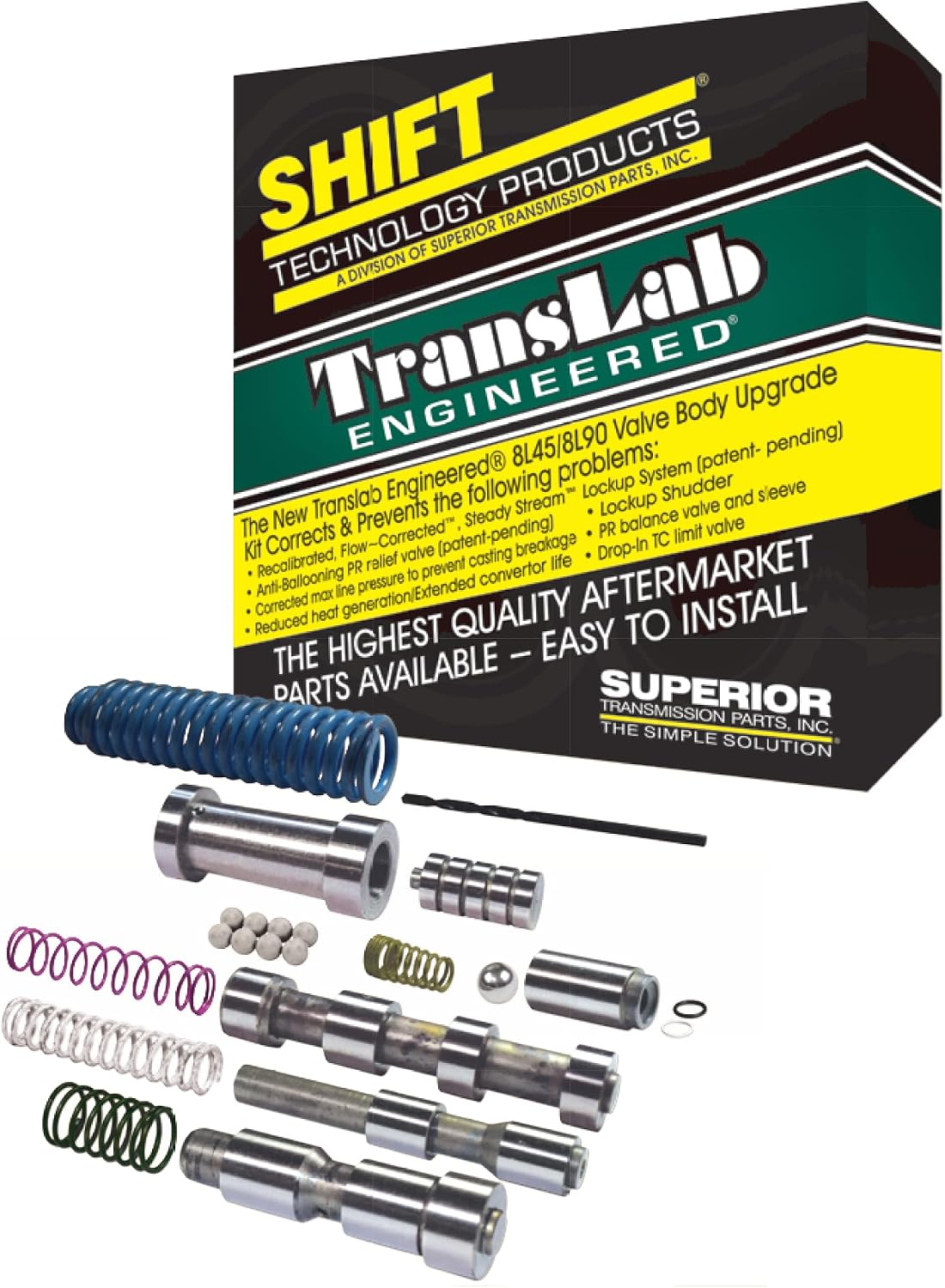
If you are going into the 8L45/8L90 valve body once, the Sonnax Sure Cure kit bundles the pressure regulator, shuttle valve, clutch control valve and accumulator corrections this article covers into one box.
Sonnax Sure Cure Kit SC-8L45-8L90 →Need something more specific? Browse the full 8L90 parts collection.
Need parts for this job? Valve body kits, solenoid sets, filters, pan gaskets, clutch packs, pumps and master rebuild kits for the 8L90 are all on our 8L90 parts page, shipped from the USA with checkout on site.
FAQ
What is the most common problem with the GM 8L90 transmission?
Torque converter clutch shudder at steady cruise is the most reported complaint, and GM addressed it in bulletin 18-NA-355 with a complete fluid exchange to Mobil 1 Synthetic LV ATF HP rather than a converter replacement. The bulletin describes it as a shake or shudder during light throttle acceleration between 25 and 80 mph at steady speed when the transmission is not actively shifting. On units that have been apart, the more damaging problem is runaway line pressure from a worn pressure regulator lineup, which cracks castings and shatters hard parts.
Will a transmission fluid change fix 8L90 shudder?
A full exchange will, if the converter lining is not already damaged. GM's procedure runs 16 quarts of old fluid out of the unit, not the five or so a pan drop gets, and the bulletin states that intermixing other fluid types or aftermarket additives leaves a low concentration of the new fluid and will not give satisfactory results. GM also specifies the procedure be done only once per vehicle, so a shudder that returns needs real diagnosis rather than a second flush.
What fluid does an 8L90 take and how much?
DEXRON HP, which is the blue-label Mobil 1 Synthetic LV ATF HP fluid, not DEXRON VI. GM's 2025 capacities chart lists the 8L90 under RPO N8X at a fluid change capacity of 7.0 liters or 7.4 quarts. Set the level at the level set plug at the specified fluid temperature, because these units have no factory dipstick on most applications.
Why does my 8L90 shift harshly and burn clutches after a rebuild?
Check line pressure before anything else. The unit should peak near 315 psi, and worn valve bodies have been measured above 415 psi in the field because the pressure regulator bore and shuttle valve sleeve wear while the OE blow-off spring is calibrated too high to catch the overshoot. The repair is the pressure regulator lineup and the blow-off spring together, targeting 300 to 315 psi. If pressure is normal, the next suspect is signal accumulator bore wear leaking off the VFS signal the clutch control valves need.
My 8L90 will not move after installation. Is the build bad?
Usually not. The off-axis chain-driven pump frequently fails to self-prime, and the cure is a bench prime: valve body face down, manual valve in Park, funnel in the pump suction filled with ATF, and the pump shaft spun clockwise with a half-inch drill. Also check that the pressure regulator inner shuttle boost valve and bushing face inboard, that a stop-start valve body was not installed on a non-stop-start vehicle, and that the 1-2-7-8-R case seal is in place. If it happened right after a fast learn or J2534 programming, key off, doors shut, 15 minutes usually clears it.
Sources
- GM Service Bulletin 18-NA-355 (April 2020), via NHTSA. Backs the subject line and the 25-80 mph / 40-128 km/h steady-speed condition, the rumble-strip description, TCC shudder as the stated cause, the affected brands, models, model years and transmission RPOs M5N/M5T/M5U/M5X, the Mobil 1 Synthetic LV ATF HP correction with part numbers 19417577 (US, 1 quart) and 19418066 (Canada), labor operation 8480818 at 1.1 hours, the 20-quart machine fill and 16-quart exchange volume in staged 4- and 5-quart increments, the "do not remove more than 3 quarts" cavitation caution, the intermixing warning, the once-per-vehicle note, the fish bite / chuggle / surge caveat, the 9 N·m (80 lb in) level set plug torque and the 22 N·m (16 lb ft) cooler line adapter block bolt. NHTSA — GM Service Bulletin 18-NA-355 (PDF)
- Sonnax — Watch Out for High Pressure in GM 8L45, 8L90 Valve Bodies. Backs the roughly 315 psi normal peak line pressure, the 415+ psi measured in field evaluations, the cracked valve body casting and shattered drum consequences, the worn pressure regulator valve lineup and shuttle valve sleeve as the leak path, the OE blow-off spring calibrated over 400 psi, the 300-315 psi repair target, and parts 154740-29K (pressure regulator and O-ringed shuttle valve kit) and 154740-18 (pressure relief ball valve spring). sonnax.com — High Pressure in GM 8L45, 8L90 Valve Bodies
- Sonnax — Tips for Tackling 8L45, 8L90 Shift Repairs With Signal Accumulator Pistons. Backs the seven signal accumulator bores, S3 and S4 as the worst-wearing positions, the low-flow VFS solenoid and signal-pressure bleed-off mechanism, the symptom list (poor shift quality, low line pressure, no converter apply, burnt clutches, soft shifts, flare shifts, clutch slippage, ratio codes, hydraulic converter codes), the vacuum test method with the spring left in the piston and the test port at the center of the spring, blocking the piston at varying positions through the stroke, gauge pins as the alternative, and kits 154740-06K (four bores, no reaming), 154740-01K (oversized, seven pistons, tool kit 154740-TL) and 8L45-8L90-SHIFT-ZIP. sonnax.com — 8L45, 8L90 Signal Accumulator Piston Repairs
- Sonnax — 8L45/90 Clutch Control Valves & Solenoid Mix Ups. Backs the .426 in and .443 in inner land diameters against the common .531 in outside land, the symptom and DTC table (.426 in valve in S3 = delayed forward engagement and sloppy upshifts with P0722; .426 in in an early-2019 S4 = 1-2 flare with occasional delayed forward; wrong valve in a late-2019-up S4 = no move forward; .426 in in S7/TCC = no TCC apply or excessively high RPM slipping with P2808), the adjacent S4 and TCC solenoid swap producing a neutral condition on the 1-2 shift, and valve kits 154740-11K, 154740-13K, 154740-24K and 154740-26K. sonnax.com — 8L45/90 Clutch Control Valves & Solenoid Mix Ups
- Transmission Digest — "How to fix GM 8L45/8L90 no-move and no-pressure conditions," Jim Mobley, Sonnax TASC Force, December 15, 2022. Backs the statement that these conditions have plagued the unit since its inception, the no-move-after-fast-learn 15-minute reset, the off-axis chain-driven pump prime failure and the bench prime procedure (valve body face down, manual valve in Park with the first land flush to the casting, funnel in the pump suction, half-inch chuck drill clockwise), the inner shuttle boost valve and bushing inboard orientation requirement, the stop-start valve body leak at the rear of the valve body, the new-OE-valve-body test port plug that dumps line pressure if removed, the omitted 1-2-7-8-R case seal, and second and Reverse as the failsafe/default gears. transmissiondigest.com — GM 8L45/8L90 No-Move, No-Pressure Conditions
- GM TechLink — 2025 Transmission Capacities & Fluids (U.S. and Canada). Backs the 8L90 fluid specification and service capacity: RPO N8X, fluid change capacity 7.0 liters / 7.4 quarts, DEXRON HP; and the 8L45 (RPO MHA) at the same 7.0 L / 7.4 qt on DEXRON HP. gm-techlink.com — Transmission Capacities & Fluids 2025 (PDF)