P0741 gets read as "the torque converter is bad," and on a GM 8L90 that reading costs somebody a transmission removal they did not need. The code does not say the clutch failed. It says the clutch is slipping more than the TCM asked it to slip — and on this unit the clutch is supposed to slip.
That distinction is the whole diagnosis. Get it right and most of these jobs are a valve body and a fluid exchange. Get it wrong and you are pulling a converter that was never the problem.
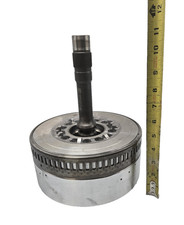
Why the 8L90 converter clutch is designed to slip
GM's own product data for the 8L90 describes the control strategy plainly: the transmission uses electronically controlled capacity clutch (ECCC) technology, which employs a small, regulated amount of slip to dampen engine pulses for a smooth-running drivetrain, especially during shifting. That is not a compromise. It is the design. The converter clutch on an 8L90 spends most of its working life partially applied, holding a commanded slip target while the TCM feeds it a modulated apply pressure through the TCC pressure control solenoid.
So the TCM is not asking a yes-or-no question. It is running a comparison: commanded slip versus actual slip, where actual slip is engine RPM minus input speed. When actual slip runs above target by more than the calibration allows, for long enough, P0741 sets. A burnt clutch will do that. So will a clutch that never got enough apply oil to hold in the first place, and on the 8L90 that second case is far more common.
Worth keeping in scale: this is a unit rated to 665 lb-ft (900 Nm) of gearbox torque, with four gear sets and five clutches packaged into the same space GM used for the 6L80. There is not much margin in the converter circuit, and it does not take a big leak to fall out of the commanded slip window.
| 8L90 reference numbers | Spec | Source |
|---|---|---|
| Fluid | DEXRON HP (not VI, not ULV) | GM TechLink 2025 capacities |
| Fluid change capacity | 7.0 L / 7.4 qt (RPO N8X) | GM TechLink 2025 capacities |
| Service fluid part no. | 19417577 (US, 1 qt) Mobil 1 Synthetic LV ATF HP | GM N192217820 |
| Normal TCC slip, peak to peak | Below 20 rpm at steady throttle | GM 21-NA-047 |
| Degraded TCC slip | Near 60 rpm, repeating | GM 21-NA-047 |
| Slip test conditions | 55–70 mph steady, sump 122–158°F, 1100–1500 rpm, 150–250 Nm | GM 21-NA-047 |
| Level set plug torque | 9 N·m (80 lb in) | GM 21-NA-047 |
| Cooler line adapter block bolt | 22 N·m (16 lb ft) | GM 21-NA-047 |
| Max gearbox torque | 665 lb-ft (900 Nm) | GM 8L90 product data |
Measure the slip properly before you decide anything
Everybody looks at TCC slip. Almost nobody looks at it under the conditions GM specifies, which is why two techs get two answers off the same truck.
Per GM bulletin 21-NA-047, the slip control test runs on a smooth road with transmission sump temperature between 122°F and 158°F (50–70°C), engine speed between 1100 and 1500 rpm, and engine torque between 150 and 250 Nm. You pull TCC data from the TCM with a factory-capable tool, collect it between 55 and 70 mph at steady throttle for a minimum of 15 seconds, then zoom into that 15-second window and evaluate it as a line graph. Not as a number box. The number box hides exactly the oscillation you are looking for.
The thresholds GM publishes for that test:
- Peak-to-peak slip below 20 rpm at steady throttle — normal. Do nothing.
- Slip repeating near 60 rpm — degraded. Shudder, surge and fish bite are likely, and the fluid exchange is the published action.
Two practical notes. A cold transmission will lie to you in both directions, so get it into that 122 to 158 degree window or the reading is noise. And if the customer's real complaint is a vibration rather than a stored code, run the picoscope side of the same bulletin: TCC shudder sits at 23 to 27 Hz and is stationary in 8th gear. If the vibration frequency tracks vehicle speed or engine speed, it is not the converter clutch, and you are about to fix the wrong thing.
Fluid first, and not because it is the easy answer
On the GM 8-speeds the fluid is a genuine mechanical cause, not a shop dodge. GM's service update N192217820 opens with the condition statement that the current transmission fluid may cause the customer to experience a shake or shudder feeling, and the correction is to drain and refill with the updated fluid. That update covers RPOs M5N, M5U, M5T, M5X and MQE across 2015–2019 Escalade, ATS, CTS, CT6, Colorado and Canyon.
The 8L90 takes DEXRON HP. GM's 2025 transmission capacities chart lists the unit under RPO N8X at 7.0 liters (7.4 quarts) fluid change capacity. Do not reach for the 10L80 bottle sitting next to it on the shelf — that unit takes DEXRON ULV at 7.7 L / 8.1 qt, and the two specifications do not cross.
The numbers that matter when you do the exchange:
- The DT-45096 machine gets filled with 20 quarts of Mobil 1 Synthetic LV ATF HP, GM part 19417577 in the US.
- Never expel more than 3 quarts at a time. GM puts that in a caution box, in capitals: pump cavitation will damage the unit.
- Cooler line adapter block bolt: 22 N·m (16 lb ft). Level set plug: 9 N·m (80 lb in), and do not exceed that on the fill adapter either.
- GM is explicit that intermixing other transmission fluid types or aftermarket additive packages results in a low concentration of new fluid and will not provide satisfactory results. No friction modifiers. No shudder-fix bottles.
- Do not judge the repair on the way back from the test drive. Full effect takes up to 320 km (200 miles) and a minimum of two cold-to-operating-temperature drive cycles.
The valve that actually sets this code
If the fluid is correct and current and the slip is still out of range, the next stop is the converter feed limit valve. This is the part of the 8L90 story most people skip.
Sonnax lists code P0741 and code P0218 directly on the application data for their converter feed limit valve kit 154740-19K, alongside overheated converter, inadequate lubrication, excess converter pressure and high TCC slip RPM. Their stated cause: converter feed limit bore wear, or a stuck converter feed limit valve, resulting in overheat, incorrect TCC apply or release, inadequate lube and cooling, and converter over-pressurization.
Follow the mechanism through and the code stops being mysterious. The converter feed limit valve regulates the oil going into the converter and back out to the cooler. Wear that bore and the regulated pressure bleeds off into the casting instead. Converter charge pressure drops, so the apply side of the clutch never sees the differential it needs to hold the commanded slip target, and actual slip climbs away from commanded until the TCM gives up and sets the code. Meanwhile the same leak has cut cooler flow and lube feed, so the fluid heats up. That is why P0218, the fluid over-temperature code, so often rides along with P0741 on these units. Two codes, one worn bore.
Sonnax's TCC Zip Kit for the 8L45 and 8L90 attacks the same failure at the circuit level, sealing losses in the lube, converter limit, line pressure and converter apply circuits. Its published symptom list reads like a P0741 work order: TCC apply and release concerns, overheated transmission and converter, loss of cooler flow, loss of lube oil, burnt converter, high TCC slip RPM, code P0218 and code P0741.
Vacuum test rather than eyeball. Note that OE vacuum testing at the inboard spool of the converter feed limit bore requires Sonnax tool 154740-TL22 — you cannot get a valid reading on that spool without it, and a bore that looks clean under a light can still fail the test.
Sonnax Converter Feed Limit Valve Kit 154740-19K
This is the specific kit Sonnax lists against code P0741 and code P0218 on the 8L45 and 8L90. Drop-in Zip Valve with a support sleeve and a hardcoat anodized valve, so it restores converter charge and cooler flow in a worn bore without reaming the casting. If your slip is out of range and the fluid is already correct, this is the repair — not another converter.
See the converter feed limit valve kit →Check the build year before you order anything
The 8L90 is not one transmission across its production run, and the change lands right in the middle of this diagnosis.
Sonnax documents that for model year 2019, GM truck and SUV applications with the 5.3L and 6.2L V-8 moved from active fuel management to dynamic fuel management. Where AFM turned a V-8 into a four-cylinder under light load, DFM lets the controls deactivate any of the eight cylinders selectively. That changed the pulse the driveline has to absorb, so the torque converter picked up a centrifugal pendulum absorber, and the valve body casting, the control solenoid and the S4 control valve all changed with it.
Two consequences on the bench. If you are ordering a converter, a 2019-and-later unit is not the same part as a 2018. And if you are in the valve body, Sonnax warns that the .443 in. diameter valve supplied in kit 154740-11K cannot be used in the '19-later S4 location or you will create shift complaints you did not walk in with. Sonnax publishes three ways to tell the designs apart, including an external ID marked by a triangle on the canister that you can see without pulling the valve body.
When it really is the converter
Sometimes it is. Here is the honest short list for condemning the converter on a P0741:
- The fluid is correct and current — DEXRON HP, exchanged per the bulletin, with at least 200 miles and two full heat cycles on it.
- Line and converter charge pressure check out on a gauge, not on a guess.
- The converter feed limit and TCC clutch control bores pass a vacuum test, using the correct test tooling for the inboard spools.
- The pan tells the story. Converter clutch lining shows up as a very fine dark powder suspended in the fluid, or as a film on the magnet that smears rather than sticking like steel fuzz — not as the chunks a clutch pack throws.
- Slip stays out of range after the valve body repair. This is the real test. If you sealed the circuits and slip still will not come down inside the 20 rpm band under GM's stated test conditions, the friction surface is gone.
Whichever way it goes, if the converter comes off or the valve body comes out, the unit needs its adaptive relearn afterward. A transmission that just had its converter circuit restored is still driving on adapts it learned around a leak, and those adapts will fight you until they are cleared and rebuilt.
FAQ
Does P0741 on an 8L90 mean I need a new torque converter?
Not on its own. The 8L90 uses an electronically controlled capacity clutch, so the TCM is comparing actual slip against commanded slip rather than checking for a hard lockup. Anything that starves converter apply pressure produces the same excess slip a worn clutch does, and on this unit that is most often a worn converter feed limit valve bore or degraded fluid. Prove charge pressure and fluid condition before you pull the transmission.
What is a normal TCC slip reading on a GM 8-speed?
GM's slip control test in bulletin 21-NA-047 calls peak-to-peak TCC slip below 20 rpm at steady throttle normal, and slip repeating near 60 rpm degraded. Log it between 55 and 70 mph at steady state for a minimum of 15 seconds, with sump temperature between 122 and 158 degrees F, engine speed 1100 to 1500 rpm and engine torque 150 to 250 Nm. Outside that window the numbers do not mean anything.
Why do P0741 and P0218 show up together on an 8L90?
Because they share a cause. Sonnax attributes both codes on the 8L45 and 8L90 to loss of oil pressure in the converter, lube and cooler circuits, and lists a worn or stuck converter feed limit valve as a specific source. The same leak that keeps the converter clutch from applying also starves cooler flow and lube, so the fluid overheats and sets P0218. Two codes, one valve.
What fluid and how much does an 8L90 take?
DEXRON HP, not DEXRON VI and not DEXRON ULV. GM's 2025 transmission capacities chart lists the 8L90 under RPO N8X at 7.0 liters or 7.4 quarts for a fluid change. The service fluid GM specifies for the shudder and TCC bulletins is Mobil 1 Synthetic LV ATF HP, part number 19417577 in the US. Intermixing other fluid types or additive packages dilutes the new fluid and will not give you the result you are after.
Did the 8L90 torque converter change during the production run?
Yes. Sonnax documents that for 2019 GM switched truck and SUV 5.3L and 6.2L applications from active fuel management to dynamic fuel management, and the torque converter picked up a centrifugal pendulum absorber to damp the extra noise and vibration. The valve body casting, the control solenoid and the S4 control valve changed at the same time. Check the build year before you order a converter or a valve for one of these.
Sources
- General Motors — Service Bulletin 21-NA-047, “Shake and/or Shudder During Light Throttle Acceleration Between 25 and 80 MPH (40 and 128 KM/H) at Steady Speed” (March 2021, NHTSA-hosted PDF). Backs the TCC slip control test thresholds of below 20 rpm peak-to-peak slip at steady throttle as normal and near 60 rpm repeating as degraded; the test window of a smooth road with transmission sump temperature between 122°F (50°C) and 158°F (70°C), engine speed 1100–1500 rpm and engine torque 150–250 Nm; the data collection between 55 and 70 mph (89–112 km/h) at steady throttle for a minimum of 15 seconds using TIS2Web / GDS2 / MDI and the TCM TCC data list; the 23 to 27 Hz shudder frequency band and the rule that a vibration frequency which follows vehicle speed or engine speed is not TCC shudder; the caution not to remove more than 3 quarts of fluid at a time due to pump cavitation risk; the 22 N·m (16 lb ft) cooler line adapter block bolt torque and the 9 N·m (80 lb in) level set plug torque; the DT-45096 machine filled with 20 quarts of Mobil 1 Synthetic LV ATF HP and the warning that intermixing other fluid types or aftermarket additive packages results in a low concentration of new fluid; and the statement that full effect takes up to 320 km (200 mi) and a minimum of two cold-to-operating-temperature drive cycles. static.nhtsa.gov (PDF)
- General Motors — Service Update N192217820, “Torque Converter Shudder/Shake” (August 2019, NHTSA-hosted PDF). Backs the 8-speed application list covering RPOs M5N, M5U, M5T, M5X and MQE across 2015–2019 Escalade, Escalade ESV, ATS, CTS, CT6, Colorado and Canyon; the condition statement that the current transmission fluid may cause the customer to experience a shake or shudder feeling described as driving over rumble strips or rough pavement, with the correction being to drain and refill with the new fluid; the Mobil 1 Synthetic LV ATF HP part numbers 19417577 (US, 1 quart) and 19418066 (Canada) with 20 quarts specified for all models except CT6 and 24 for CT6; the DT-45096 cooler flush and flow test tooling and the DT-52263 fluid exchange kit contents; and the 1.1 hour transmission fluid exchange labor operation. static.nhtsa.gov (PDF)
- General Motors Powered Solutions — “8L90 Hydra-Matic Eight Speed RWD Automatic Transmission, Features & Specifications” (OEM product data sheet). Backs the electronically controlled capacity clutch (ECCC) description stating the converter clutch employs a small, regulated amount of slip to dampen engine pulses for a smooth-running drivetrain, especially during shifting — the design intent this entire code depends on; the 665 lb-ft (900 Nm) maximum gearbox torque rating; the RPO N8X designation and the 4.56 first through 0.65 eighth gear ratios with 3.82 reverse and a 7.0 overall ratio spread; the four gear sets and five clutches architecture that fits the same space as the previous 6L80/6L90; the variable force solenoid (VFS) clutch pressure control; the 32-bit TCM that compensates for normal clutch plate wear; and the DEXRON High Performance fluid callout. poweredsolutions.gm.com (PDF)
- General Motors TechLink — “2025 Transmission Capacities & Fluids (U.S. and Canada only),” rev. 05-2025 A. Backs the 8L90 fluid specification and capacity used throughout this article: RPO N8X, 7.0 liters / 7.4 quarts fluid change capacity, DEXRON HP. Also backs the contrast drawn with the 10L80 (7.7 L / 8.1 qt, DEXRON ULV) and the 6L90 (5.7 L / 6.0 qt, DEXRON VI) that keeps the wrong bottle out of the 8-speed. gm-techlink.com (PDF)
- Sonnax — Converter Feed Limit Valve Kit, part 154740-19K (8L45, 8L90 application and symptom data). Backs the direct attribution of code P0741 and code P0218 to converter feed limit bore wear or a stuck converter feed limit valve, along with overheated converter, inadequate lubrication, excess converter pressure and high TCC slip RPM; the failure mechanism of bore wear or a stuck valve producing converter overheat, incorrect TCC apply or release, inadequate lube and cooling and converter over-pressurization; the drop-in Zip Valve design with hardcoat anodized aluminum valve, annular centering groove and support sleeve; and the note that OE vacuum testing at the inboard spool requires converter feed limit vacuum test tool 154740-TL22. sonnax.com
- Sonnax — TCC Zip Kit, part 8L45-8L90-TCC-ZIP, and “GM 8L90 Model Year 2019 S4/23468 Control Valve Changes,” Jim Mobley, August 2022. The kit page backs the 8L45 and 8L90 converter-related symptom list of TCC apply and release concerns, overheated transmission and converter, loss of cooler flow, loss of lube oil, burnt converter, high TCC slip RPM, code P0218 and code P0741, all attributed to loss of oil pressure due to worn components in critical oil circuits, and the identification of those circuits as lube, converter limit, line pressure and converter apply; it also backs the technical booklet included with the kit containing vacuum testing information and locations at key valve body areas. The 2019 article backs the model year 2019 change from active fuel management to dynamic fuel management on 5.3L and 6.2L truck and SUV applications, the resulting torque converter change to a centrifugal pendulum absorber, the accompanying change to the control solenoid, valve body casting and control valve, the three published ways to identify previous-design versus new-design units including an external triangle marking on the canister, and the warning that the .443 in. diameter valve in kit 154740-11K cannot be used in the '19-later S4 location or shift complaints will occur. sonnax.com