P0716 is Input/Turbine Speed Sensor A Circuit Range/Performance. The word that matters in that definition is performance. The transmission control module is not telling you the sensor is dead. It is telling you the sensor is reporting a number that does not make sense next to everything else the TCM knows: engine RPM, the commanded gear, and what the other two speed sensors in the case are saying. That distinction is the whole diagnosis. A dead circuit sets P0717, no signal. A signal that lies, drops out for a moment, or disagrees with the gear ratio math sets P0716.
On the GM 8L90 that difference sends you looking at wiring and assembly work rather than at a parts counter. The units that come through with this code are usually recent repair jobs, high-mileage trucks with chafed harnesses, or vans that vibrate hard enough to find the one place a wire touches metal. Below is how the 8L90 actually measures speed, the two documented assembly traps that produce speed sensor codes on this unit, and the relearn you cannot skip afterward.
How the 8L90 measures speed: three sensors, not one
The 8L90 is GM's heavy-duty eight-speed, released in the 2014 Cadillac ATS and spread across Corvette, Camaro, Silverado, Sierra, Yukon, Escalade, and the Express and Savana vans from 2015 on. It is loosely related to the ZF eight-speed family, but with one welcome departure: there is no TCM inside the transmission. The control module lives outside the case, which means the wiring between the module and the unit is a real diagnostic surface rather than a sealed assembly.
Inside the case there are three rotational speed inputs, and P0716 only makes sense once you know what each one watches:
- Input speed sensor (ISS) — reads turbine speed off a sensor ring pressed onto the housing. This is the sensor P0716 names.
- Intermediate speed sensor — points at the reaction carrier. The reaction carrier is held in first, second, seventh and eighth gear, so this sensor deliberately reads zero in those ranges.
- Output speed sensor — takes its trigger from the output carrier, with the tone teeth cut into the output planet assembly itself.
The intermediate and output sensors sit close together in the case. Remember that; it is the single most productive fact in this article.
The TCM continuously compares input speed against output speed to calculate an actual ratio, then checks that against the ratio it commanded. When input speed is implausible for the gear the unit is actually in, you get P0716. When the ratio itself is out of range you get the ratio codes, P0721 and P0722 among them.
Trap one: swapped intermediate and output speed sensors
This is the failure that catches good rebuilders, and it is documented rather than theoretical. Transmission Digest published a case on a 2019 Chevrolet Express that came back from a rebuild and would not shift out of first gear, setting P0722 (output speed sensor, no signal) and P176B (intermediate speed sensor circuit performance). Neither code existed before the repair.
The cause was that the rebuild technician had installed the output and intermediate speed sensors in each other's locations, which the article notes is easy to do because of their proximity. The consequence is pure mechanical logic: the output speed sensor, now sitting in the intermediate position, was pointing at the reaction carrier. The reaction carrier is held in first and second gear. A held carrier does not rotate, so the sensor that the TCM believes is watching output shaft speed reported nothing at all, and the unit had no reason to command an upshift. Moving both sensors back to their correct locations restored all gears and the codes did not return.
If an 8L90 sets speed sensor or ratio codes immediately after internal work and it never set them before, verify sensor placement before you touch anything else. You are not chasing a fault; you are checking your own work, and it costs ten minutes.
Working on an 8L90?
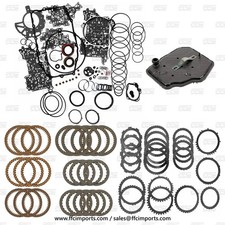
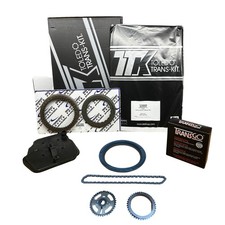
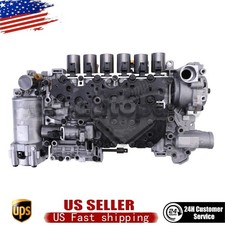
Filters, overhaul kits, valve body repair kits, and the sealing ring tools that keep an 8L90 rebuild from coming back.
Shop 8L90 parts →Trap two: the external harness, and one bolt
The 8L90's external TCM means the harness between module and transmission carries every solenoid feed and every sensor signal. It also means that harness can chafe.
Transmission Digest documented a 2018 Chevrolet Express 2500 with the 2.8L diesel that would intermittently drop into failsafe, sometimes in second gear and sometimes in eighth, but always kept reverse. A health check pulled P2670 (Actuator High Control Circuit Group 2 Low Voltage) and U0402 (invalid data received from the TCM). The service information for P2670 pointed at terminal 19 of the transmission X175 connector, a gray wire with a brown tracer that supplies voltage to six solenoids inside the unit, and specified that the code sets when the circuit shorts to ground for more than one second. Because the fault was intermittent, the procedure called for a wiggle test of the harness starting at the K71 TCM.
The technician traced the harness from the TCM, which on that van is mounted to the passenger side inner fender near the firewall, and found it running under the tip of a bolt below the battery. One wire had been rubbed through its insulation: gray with a brown tracer. Repairing that single wire cleared both codes permanently.
That case is not a P0716 case, but it is the exact mechanism that produces one. A diesel that shakes, a harness routed against a fastener, and an intermittent short or open on a signal circuit is how a healthy speed sensor ends up reported as a performance failure. On any 8L90 with an intermittent speed sensor code, wiggle-test the harness from the TCM down to the case connector before condemning anything.
Trap three: the internal harness after a temp sensor job
There is a third assembly trap worth knowing, because it lands on the same bench and it will make you doubt a perfectly good valve body.
Sonnax documented what it calls the infamous 8L45 and 8L90 3-4 neutral. The job usually starts with a P0711 transmission fluid temperature sensor code. The repair replaces the temp sensor along with an updated internal wiring harness, which requires pulling and reinstalling the valve body. On reassembly the S8 default control solenoid and the S9 1-2-3-4-5-reverse boost solenoid get plugged in backward. They are identical solenoids sharing the same connector type, so nothing feels wrong. With S8 and S9 swapped, the default override valve does not latch in second gear, which exhausts 4-5-6-7-8-R clutch apply oil and produces a neutral condition on the 3-4 shift.
Sonnax makes a point that is worth repeating: many popular tech resources have these two solenoids labeled incorrectly and show incorrect wiring diagrams, so the reference you are checking against may be validating a wrong assembly. The physical tells are the ones to trust. The S8 default control solenoid has 3.75 inches of conduit and a green wire with a blue tracer going to terminal 1. The S9 boost solenoid has 1.75 inches of conduit and a yellow wire with a red tracer going to terminal 7. Count the conduit and check the tracer colors, not the diagram.
For context on the rest of the electrical package, the 8L90 carries nine solenoids: seven variable-force pressure control solenoids plus S8 and S9, which are the only two three-port on/off, normally closed units. Per Gears Magazine, all of them measure 4.5 to 5.5 ohms, so a resistance check tells you very little on its own. Note also that the 8L90 has no 1-2 or 2-3 shift solenoid in the older sense, which is why generic code lists that describe P0751 or P0756 as "1-2 shift solenoid performance" do not map onto this transmission at all.
Diagnosing P0716 on the scan tool
Graph these PIDs together on a road test rather than reading them one at a time. A performance code is a disagreement, and you can only see a disagreement side by side.
- Engine speed and input/turbine speed — with the converter locked these should track within a few RPM. Unlocked, input speed should sit below engine speed by the converter's slip, smoothly, with no instant drops to zero.
- Input speed vs. output speed — divide one by the other and compare to the commanded gear's ratio. A ratio that is right but a code that still sets points at signal quality, not mechanics.
- Intermediate speed sensor — expect zero in first, second, seventh and eighth by design. A tech who does not know that has condemned more than one good sensor.
- Commanded gear vs. attained gear — tells you whether the TCM is acting on the bad data or just logging it.
The signature you are hunting is a momentary dropout: input speed spiking to zero or to an impossible value for a fraction of a second while engine speed stays smooth. That is electrical every time. A genuinely failed sensor typically goes and stays gone, which sets the no-signal code instead.
Then repeat the wiggle test stationary, watching the live input speed PID with the engine idling in drive. Work from the TCM connector down, checking every point the harness passes a bracket, a bolt tip, or a sharp edge on the case. Inspect the pass-through connector for spread terminals, pushed-out pins, and fluid intrusion; fluid wicking up a harness presents as intermittent nonsense on whichever circuit it reaches first.
Fluid: DEXRON HP, and the ULV mistake
Any time the pan comes off an 8L90 for sensor or internal harness access, the fluid and filter go back correct or the job is not finished. This is where a lot of shops get handed the wrong bottle.
| Item | 8L90 specification |
|---|---|
| RPO code | N8X |
| Fluid | DEXRON HP |
| Service fill (drain and refill) | 7.0 quarts (7.4 liters) |
| Filter | GM 24274402 (TF922 equivalent), 8L45/8L90 |
| Solenoid resistance | 4.5 to 5.5 ohms, all nine |
Per GM's own transmission capacities chart, the 8L90 (RPO N8X) takes DEXRON HP with a 7.0 quart service fill. DEXRON ULV is the specification for the 10-speed units such as the 10L80 and 10L90, which take 7.7 quarts. The two get confused constantly because they are both recent GM low-viscosity fluids sitting next to each other on the shelf. They are not interchangeable, and the 8L90 is the one that does not take ULV.
8L90 filter kit with gaskets (24274402)
If you drop the pan to reach the internal harness, speed sensors, or valve body, the filter and pan gasket go back new. This is the correct 8L45/8L90 filter with the gaskets included, so you are not waiting on a second order mid-job.
View the 8L90 filter kit →The relearn you cannot skip
If the P0716 repair involved the valve body, the internal harness, or TCM replacement, the adaptives have to be addressed or the customer comes back with a shift complaint that has nothing to do with the original code.
GM bulletin PIP5437, "8L45 8L90 Diagnostic Tips for Harsh Shifts" (November 2016) covers 2015-2016 Escalade and ESV, 2016 ATS, ATS-V, CTS and CTS-V, 2015-2016 Corvette and Silverado, 2016 Camaro, and 2015-2017 Sierra and Yukon. Its stated cause for shift complaints is direct: one or more clutch fill times not completely learned in the TCM. The bulletin is explicit that transmission or valve body replacement would have required a Service Fast Learn procedure to be performed.
The procedure PIP5437 lays out is worth following as written:
- Check for DTCs in all modules and address every one of them before going further.
- Road test to duplicate the concern, and capture a GDS2 session log with a bookmark set at the moment the customer's complaint occurs.
- Review the log to identify which specific shift is at each bookmark.
- Apply the adaptive bulletin for the model year: 14-07-30-001F for 2015, 16-NA-019 for 2016 and 2017.
- Complete the clutch drive learn for the suspect clutches only. The bulletin notes that every clutch may not need to be learned.
- Let the vehicle cool down for eight or more hours, then road test again to confirm cold shift quality is acceptable.
The mileage thresholds in PIP5437 are useful for triage. The adaptive path applies to 2015 vehicles with 7,500 miles or less, 2016 vehicles with 5,000 miles or less, and 2017 vehicles with 2,500 miles or less since the in-service date, a TCM calibration update, or a Service Fast Learn. Past those mileages on an otherwise untouched unit, a shift complaint is more likely hydraulic wear than unlearned adaptives, and the valve body becomes the honest suspect.
Order of operations
Put together, the efficient sequence on an 8L90 with P0716 is:
- Read all modules. Note whether the code is alone or sitting with ratio, solenoid, or communication codes, which reframes the whole diagnosis.
- If the unit was recently apart, verify intermediate and output speed sensor placement first.
- Check fluid level and condition. Aerated or low fluid makes every speed and ratio signal unstable.
- Graph input, intermediate, output and engine speed on a road test and look for dropouts rather than steady-state errors.
- Wiggle-test the external harness from the K71 TCM to the case connector, inspecting every point the harness passes a bolt or bracket.
- Inspect the pass-through connector for fluid intrusion and terminal damage.
- Only then consider the sensor itself. Rostra offers a speed sensor and harness assembly for the 8L90 as kit 50-1613, covering 2015 through 2022.
- After any internal or TCM work, perform the Service Fast Learn and the eight-hour cold soak retest per PIP5437.
That order works because P0716 is a plausibility complaint, and plausibility is broken far more often by a connection than by a sensor. Start there and the code usually resolves before you have spent a dollar on parts.
FAQ
Does the 8L90 take DEXRON ULV or DEXRON HP?
The 8L90 takes DEXRON HP, not DEXRON ULV. GM's own transmission capacity chart lists the 8L90 under RPO N8X with a 7.0 quart service fill and DEXRON HP as the specified fluid. DEXRON ULV is specified for the 10-speed units such as the 10L80 and 10L90, which take 7.7 quarts. Putting ULV in an 8L90 is a common parts-counter mistake.
Can I just replace the input speed sensor to fix P0716 on an 8L90?
Usually not. P0716 is a performance code, which means the TCM is seeing an implausible signal rather than no signal at all. On the 8L90 the documented real-world causes are far more often wiring and assembly errors than a failed sensor. Check the external harness, the pass-through connector, and sensor placement before you buy a sensor.
What causes a no-upshift with speed sensor codes right after an 8L90 rebuild?
The output and intermediate speed sensors sit close together and are easy to swap during assembly. Transmission Digest documented a 2019 Chevrolet Express that would not shift out of first gear and set P0722 and P176B because the two sensors were installed in each other's locations. The output sensor ended up pointing at the reaction carrier, which is held in first and second gear, so it reported no signal. Swapping them back cleared the codes.
Do I need to relearn anything after replacing an 8L90 speed sensor or harness?
If the repair required valve body or TCM work, yes. GM bulletin PIP5437 notes that transmission or valve body replacement requires a Service Fast Learn procedure, and that clutch fill times not fully learned in the TCM cause shift complaints. After the relearn, let the vehicle cold soak for eight or more hours and road test again to confirm cold shift quality.
Is P0716 the same as P0717 on an 8L90?
No. P0716 is a range or performance fault, meaning the input speed signal is present but does not agree with engine speed, commanded gear, or the other speed sensors. P0717 is a no-signal fault, meaning the TCM sees nothing at all. An intermittent connection often sets the performance code first and only sets the no-signal code when the circuit opens completely.
Shop 8L90 parts →
Need parts for this job?
We stock 8L90 filters, overhaul and master rebuild kits, valve body repair kits, solenoid sets, and the sealing ring resizer tools this unit requires.
Shop 8L90 parts →Related 8L90 guides
Sources
- GM TechLink, Transmission Capacities & Fluids (2025) — backs the 8L90 RPO code N8X, the 7.0 quart (7.4 liter) service fill, and DEXRON HP as the specified fluid, plus the contrasting DEXRON ULV and 7.7 quart figures for the 10L80/10L90. gm-techlink.com
- GM Bulletin PIP5437, "8L45 8L90 Diagnostic Tips for Harsh Shifts" (November 2016), via NHTSA — backs the covered models and years, the stated cause of clutch fill times not completely learned in the TCM, the Service Fast Learn requirement after transmission or valve body replacement, the GDS2 bookmark procedure, the 14-07-30-001F and 16-NA-019 adaptive bulletins, the 7,500/5,000/2,500 mile thresholds, and the eight-hour cool-down retest. static.nhtsa.gov
- Transmission Digest, "GM 8L90 no upshift after rebuild" (Wayne Colonna, August 2025) — backs the swapped intermediate and output speed sensor case on a 2019 Chevrolet Express, codes P0722 and P176B, and the reaction carrier being held in first, second, seventh and eighth gear. transmissiondigest.com
- Transmission Digest, "8L90 Intermittent Failsafe Diagnosis and Cause" (Craig Sarokoff, August 2026) — backs the 2018 Express 2500 2.8L diesel harness chafe case, codes P2670 and U0402, X175 connector terminal 19, the gray wire with brown tracer feeding six solenoids, the one-second short-to-ground set criteria, and the K71 TCM wiggle-test procedure. transmissiondigest.com
- Sonnax, "Diagnosing the Infamous GM 8L45, 8L90 3-4 Neutral" (Jim Mobley, April 2022) — backs the P0711 temp sensor and updated harness job, the S8/S9 swap causing the default override valve not to latch in second gear, the exhaust of 4-5-6-7-8-R clutch apply oil, the warning that many tech resources label these solenoids incorrectly, and the 3.75 inch green/blue to terminal 1 versus 1.75 inch yellow/red to terminal 7 identification. sonnax.com
- Gears Magazine (ATRA), "8L90 Solenoid Strategies" — backs the nine-solenoid layout of seven variable-force pressure control solenoids plus S8 and S9 as the only two three-port on/off normally closed units, and the 4.5 to 5.5 ohm resistance specification. gearsmagazine.com
- Transmission Digest, "GM 8L90 – The Other 8 Speed Automatic: Part 2" (Mike Riley, March 2016) — backs the 2014 Cadillac ATS release and model spread, the absence of an internal TCM compared to the ZF units, and the intermediate speed sensor teeth being cut into the output planet assembly. transmissiondigest.com
- Transmission Digest, "Rostra highlights GM 8L90 speed sensor, harness assembly" (June 2024) — backs the Rostra speed sensor and harness assembly kit number 50-1613 and its 2015 to 2022 model year coverage. transmissiondigest.com