An 8L90 that "slips" is almost never one problem. The word gets used for a converter doing exactly what GM designed it to do, for a clutch pack genuinely letting go under load, and for a delayed engagement that only feels like slip from the driver's seat. Those three have nothing in common under the pan, and the parts that fix one will not touch the other two. The first job is not to pick a part — it is to decide which of the three you actually have, and this unit gives you enough data to do that without splitting the case.
Start by separating converter slip from clutch slip
Before anyone condemns a clutch, understand that this unit slips on purpose. GM's own specification sheet for the 8L90 describes the torque converter clutch as an electronically controlled capacity clutch (ECCC) that "employs a small, regulated amount of slip to dampen engine pulses for a smooth-running drivetrain, especially during shifting." Slip RPM on a scan tool is a normal reading here, not a finding.
The clean way to sort it is the road test GM published in bulletin 16-NA-175, which covers 2015–2018 8L90 and 8L45 units under RPOs M5U, M5T, M5N and M5X. Run it on a smooth road with transmission sump temperature between 122°F and 158°F (50–70°C), in three modes:
- Mode A: normal operation, scan tool for viewing only.
- Mode B: command the TCC off so the converter clutch is open.
- Mode C: command the TCC on so it is fully locked, slip speed at zero.
On full-size trucks and SUVs, press and hold the tow/haul button for five seconds first to disable grade braking so the unit does not downshift mid-test. The logic is simple: if the complaint is present in Mode A but gone in both B and C, the root cause is converter clutch shudder. If the complaint survives with the clutch open or with it locked solid, it is not the converter and you should be looking at line pressure and clutch apply instead.
If you have a scope, the bulletin gives you the confirming number. TCC shudder shows up in 8th gear as a vibration peak within ±2 Hz of an application-specific frequency: roughly 26 Hz on an L86 Silverado or Sierra at 1050–1500 rpm input and 45–55 mph, 28 Hz on an LT1 Corvette or Camaro SS, and 25 Hz on a V6 Colorado or Canyon. The frequency is stationary in 8th gear. GM is explicit that if the frequency follows vehicle speed or engine speed, it is not TCC shudder and you are chasing a driveline or tire vibration.
The ratio math that proves real clutch slip
For actual clutch slip, use the speed sensors and the published ratios. Per GM, the 8L90 runs 4.56, 2.97, 2.08, 1.69, 1.27, 1.00, 0.85 and 0.65, with reverse at -3.82. Divide input shaft speed by output shaft speed in the commanded gear. Sixth is the easy one: a straight 1.00, so input and output should read the same. If the calculated ratio drifts upward as you load it, a clutch is passing. Log it under load, not at cruise — a marginal clutch will hold at part throttle and let go at torque.
The fluid, and the spec people get wrong
The 8L90 takes DEXRON HP. Not DEXRON VI, and not DEXRON ULV. GM's 2025 TechLink capacities chart lists the 8L90 under RPO N8X at 7.0 liters / 7.4 quarts for a fluid change, and GM's product spec sheet puts total capacity at 10.3 liters excluding cooler volume. The mix-up worth knowing about: the 10L80 in the same truck showroom takes DEXRON ULV at 7.7 liters / 8.1 quarts. Two GM rear-drive automatics, two different fluids, one shelf. Per GEARS, the wrong fluid here produces exactly the complaints you are chasing — harsh or slipping shifts, converter shudder and overheating. Check the bottle for the DEXRON HP license rather than the marketing name; Mobil 1 Synthetic LV ATF HP carries GM license code J-62120.
If the three-mode test pointed at converter shudder, bulletin 16-NA-175's service procedure is the fix, and the details are the part techs skip:
- Use filtered compressed air regulated to 60 psi to push old fluid out of the transmission cooler lines. A pan drop alone leaves the worst of it in the cooler circuit.
- Drop the pan, clean the pan and magnet if there are metallic particles, and replace the filter.
- Stop immediately if the fluid is cloudy or milky. GM's instruction is to abandon the flush and run the cooling system leak test and the coolant-in-transmission procedure instead. Flushing a unit full of coolant is throwing fluid at a failure you have not found.
- Refill with DEXRON HP to the correct level using the fill procedure and check plug.
Then set expectations with the customer. GM's note says shudder should improve directionally right away, but the vehicle may need 200 miles and a minimum of two cold-to-hot drive cycles before you can judge the result. Do not re-evaluate before that.
Signal accumulator bore wear: the most common real slip
This is where most genuine 8L90 slip complaints live, and it is not a part anybody sells over the counter.
Per Sonnax, the 8L90 controls its clutches through seven variable force solenoid circuits. Those solenoids are low-flow devices that apply nothing directly; they meter a small signal pressure that strokes a much larger control valve, and that valve does the work of applying the clutch. Each circuit carries a small signal accumulator piston that damps pressure and flow instability so the shift feels controlled. Those pistons ride directly in cast aluminum and are constantly active, so they wear their bores — and because the solenoid feeding the circuit is low-flow to begin with, Sonnax notes that any loss of signal fluid through that wear path has an outsized effect on the related control valve. A small leak in a small circuit is a large percentage.
The payoff is that the circuit map tells you which bore to look at before you take anything apart:
| Circuit | Clutch / function | Gears affected | Typical complaint |
|---|---|---|---|
| S1 | 1-2-7-8-Reverse | 1st, 2nd, 7th, 8th, Reverse | Slip or flare in those gears |
| S2 | 1-2-3-4-5-Reverse | 1st through 5th, Reverse | Slip or flare in those gears |
| S3 | 1-3-5-6-7 | 1st, 3rd, 5th, 6th, 7th | Shift quality, flare; a common wear bore |
| S4 | 2-3-4-6-8 | 2nd, 3rd, 4th, 6th, 8th | Shift quality, burnt clutch; the worst wear bore |
| S5 | 4-5-6-7-8-Reverse | 4th through 8th, Reverse | Slip in the upper gears and reverse |
| S6 | Line pressure control | All | Low line pressure, slipping, burnt clutches |
| S7 | Torque converter clutch | All | Converter apply and release, burnt converter |
Write down every gear the unit slips in, then find the circuit common to all of them. Slipping in 2nd, 3rd, 4th, 6th and 8th and nowhere else is an S4 story. Slipping across the board with soft engagement is an S6 story, and Sonnax lists that circuit's complaints verbatim as low line pressure, slipping and burnt clutches. In the field, Sonnax reports S3 and S4 are generally the worst of the seven.
Test them with vacuum, not by eye: leave the spring in the piston and place the test port opening in the center of the spring. When you repair the bore, use like material — aluminum pistons in an aluminum casting. Mixing materials with different thermal expansion rates opens the clearance right when the unit is hot, which is exactly when the customer says it slips. Sonnax's drop-in kit 154740-06K covers four of the seven bores; oversized kit 154740-01K covers all seven but requires reaming with tooling 154740-TL.
Clutch control valve wear, and the burnt 2-3-4-6-8
Downstream of the signal accumulator is the clutch control valve itself, and Sonnax flags the S4 (2-3-4-6-8) clutch control valve and bore specifically: wear there lets clutch apply pressure leak past, reducing the force holding the clutch and burning it. Pressure loss, a burnt 2-3-4-6-8 clutch and poor shift quality are the published complaints.
If someone else has already been in the valve body, check for a mix-up first. The S1 and S5 valves use a .426 inch small inner land; S2, S3, S4 and S7 use .443 inch. All share a .531 inch external land, so a wrong valve drops into the wrong bore and stays there. OEM valving cannot be mixed up; aftermarket valving can. Sonnax's symptom map for a misplaced S1 or S5 valve:
- In the S3 bore: P0722, delayed forward engagement, sloppy upshifts, no adaptation.
- In a 2019-or-earlier S4 bore: 1-2 shift flare, inconsistent forward delay, good reverse.
- In a 2019-or-later S4 bore: no forward movement at all, possible P0722, good reverse.
- In the S7 (TCC) bore: no converter clutch apply, excessive RPM slip, possible P2808.
That last one reads exactly like a slipping transmission to a customer and is purely an assembly error. Sonnax adds that the S4 and TCC solenoids sit close enough together with compatible wiring that swapping them produces a neutral on the 1-2 shift.
Line pressure kills clutches in both directions
Low line pressure slips clutches. High line pressure destroys hard parts. The 8L90 manages to do both.
Sonnax puts design peak line pressure for these units at roughly 315 psi, with 300–315 psi as the target range, and reports field evaluations measuring above 415 psi. The causes are a worn pressure regulator valve lineup leaking badly enough that the valve cannot stroke down, combined with a blow-off spring calibrated over 400 psi in some units. What follows is cracked worm tracks in the valve body casting and catastrophic drum failure. A cracked casting is scrap, not a repair.
ATSG, on Transmission Digest's Builder's Bench, reports these two as regular arrivals and connects them: an 8L90 that neutralizes on the shift into second, with pieces of aluminum in the pan and the 2-3-4-6-8 drum blown apart on teardown, and a unit with uncontrollable line pressure, sometimes high and sometimes low, whose valve body shows cracked worm tracks between the pump suction and secondary line circuits.
So drop the pan early. Aluminum in the pan on a slipping 8L90 means the drum is already gone and no amount of valve body work brings it back. Sonnax's rebuild advice is to replace the pressure regulator lineup and the blow-off spring every single time (kit 154740-29K, spring 154740-18) rather than reusing a marginal one.
Slip that shows up after a rebuild
Per GEARS, the 8L90 split into meaningfully different designs in 2018, and mixing the eras causes slip that no amount of relearning will fix.
- 2-3-4-6-8 piston and seals. The 2015–2017 piston is 24259281; the 2018-and-later piston is 24283348, with different seal groove wing dimensions (.080 aft / .141 rear on the early, .088 / .132 on the late). Force late seals into early grooves and the piston fights you going together and does not seal reliably after. Pre-2018 pistons were also crack-prone, which the 2018 geometry addressed.
- Trapped air in the stator cover. Early units trap air in the stator cover oil passages, producing a delayed engagement or dropout the customer will describe as slipping. The updated stator support 24277234 and cover 24277964 add a check ball and passage changes to purge it.
- The pump has to be primed. It is an off-axis binary pump with no guide ring for the vanes; it relies on scavenge oil pressure to get the vanes out. Assemble it with ATF, not assembly lube, add about a half quart of fluid to the converter and rotate it several times before final install, or you get a no-move from no pickup.
- Clutch clearance and drum capacity. Clearances outside factory spec cannot be corrected with programming or a relearn, and friction material, oil relief patterns and plate thickness need to match what came out. The 1-3-5-6-7 drum also comes in four-clutch (8L90A) and five-clutch (8L90B) versions per its QR label — more clutches is not automatically better, because changing capacity from the OEM design changes shift quality.
One more ceiling worth naming: GM rates the 8L90 at 460 lb-ft maximum engine torque and 665 lb-ft maximum gearbox torque. A tuned truck living above that is not suffering a defect when it slips. It is running out of clutch.
A diagnostic order that does not waste parts
- Check fluid level at spec temperature and look hard at the fluid. Cloudy or milky stops the job and sends you to the cooling system.
- Pull codes. Ratio codes, P0748, P0961 and P2808 all steer the next step.
- Run the GM three-mode drive test to separate converter shudder from clutch slip.
- Log input and output speed and do the ratio math in the gear that slips, under load.
- Put a gauge on line pressure. Expect a peak around 315 psi. Over 400 means the regulator lineup, not the clutches, is your problem.
- Drop the pan. Aluminum means the drum. Friction material and steel mean the clutch pack.
- Pull the valve body and vacuum test the signal accumulator bores, S3 and S4 first, then S6 if line pressure was low.
- Order parts last, when you know which circuit is leaking.
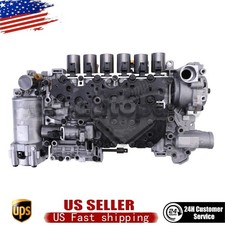
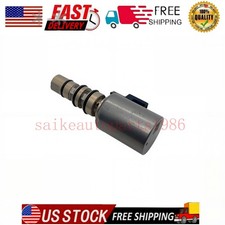
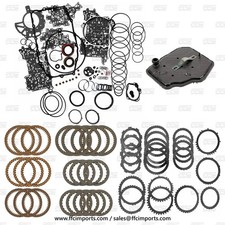
Need parts for this job? Valve bodies, pressure control solenoids, solenoid kits, clutch modules, pumps and master rebuild kits for the 8L90 are all on our 8L90 parts page, shipped from the USA with checkout on site.
Shop the part for this fix
If the vacuum test found a worn signal accumulator bore, the Sonnax 154740-06K piston kit is the repair that actually restores the signal pressure holding the clutch. CoreTransmissionParts stocks it along with the oversized kit and the pressure regulator kits for the units that came in hot.
View the Sonnax 154740-06K signal accumulator kit →Full 8L90 parts selection, including valve body kits, clutch packs and rebuild kits: CoreTransmissionParts 8L90 collection.
FAQ
Is some torque converter slip normal on an 8L90?
Yes. GM's own 8L90 specification sheet describes the electronically controlled capacity clutch as using a small, regulated amount of slip to dampen engine pulses, especially during shifting. So a scan tool showing slip RPM across the converter is not proof of a problem. What matters is whether the slip is controlled and steady or whether it climbs with load, and whether the customer feels it as a shudder rather than a slip.
How do I tell if my 8L90 is slipping a clutch or just the converter?
Run GM's three-mode test from bulletin 16-NA-175 on a smooth road with sump temperature between 122 and 158 degrees F: normal operation, then with the TCC commanded off, then with it commanded locked. If the complaint disappears both with the converter clutch open and with it fully locked, the root cause is converter clutch shudder, not a slipping clutch pack. If it is still there in either of those modes, stop chasing fluid and start chasing pressure.
What fluid does a GM 8L90 take, and how much?
DEXRON HP, not DEXRON ULV. GM's 2025 TechLink capacities chart lists the 8L90, RPO N8X, at 7.0 liters or 7.4 quarts for a fluid change, and GM's own product specification sheet lists 10.3 liters total excluding cooler volume. The trap is that the 10L80 sitting in the same truck line takes DEXRON ULV at 7.7 liters, so the two get mixed up constantly. Look for the DEXRON HP license on the bottle.
Why does my 8L90 slip only in certain gears?
Because each clutch is fed through its own solenoid and signal accumulator circuit. Sonnax maps them: S4 serves 2nd, 3rd, 4th, 6th and 8th, S3 serves 1st, 3rd, 5th, 6th and 7th, S5 serves 4th through 8th and reverse, S1 serves 1st, 2nd, 7th, 8th and reverse, and S2 serves 1st through 5th and reverse. Write down which gears slip, find the circuit common to all of them, and you have narrowed it to one bore before the pan ever comes off.
Is there aluminum in the pan of a slipping 8L90, and what does that mean?
If there is, the diagnosis is basically over. ATSG reports a common 8L90 failure where the unit neutralizes on the shift into second, the pan shows pieces of aluminum, and teardown finds the 2-3-4-6-8 drum blown apart. That is a hard-parts failure driven by pressure, not something a solenoid or a fluid service will recover. Pull the pan early in the diagnosis for exactly this reason.
Related guides
- GM 8L90 and 8L45 Shudder and Harsh Shift Fix — the fluid-service side of a converter slip complaint
- 8L90 Pressure Testing: Taps, Specs and Readings
- 8L90 Shift Solenoid Symptoms and Replacement
- 8L90 Rebuild Wear Points
- 8L90 Common Problems and Fixes
Sources
- GM Powered Solutions, 8L90 Hydra-Matic Eight Speed RWD Automatic — features and specifications sheet — backs the RPO N8X designation, the gear ratios (4.56, 2.97, 2.08, 1.69, 1.27, 1.00, 0.85, 0.65 and reverse -3.82), the 460 lb-ft maximum engine torque and 665 lb-ft maximum gearbox torque ratings, the 258 mm converter, the DEXRON High Performance ATF fluid type, the 10.3 liter fluid capacity excluding cooler volume, and the description of the electronically controlled capacity clutch using a regulated amount of slip to dampen engine pulses. poweredsolutions.gm.com (PDF)
- General Motors Service Bulletin 16-NA-175, "Shake and/or Shudder During Light Throttle Acceleration" (hosted by NHTSA) — backs the 2015-2018 model year and RPO M5U/M5T/M5N/M5X coverage, the 122–158°F sump temperature window for the road test, the three-mode diagnosis (normal, TCC commanded open, TCC commanded locked), the 8th-gear PicoScope frequencies by application, the rule that a frequency following vehicle or engine speed is not TCC shudder, the 60 psi filtered-air cooler line evacuation, the stop-work instruction on cloudy or milky fluid, the Mobil 1 Synthetic LV ATF DEXRON HP requirement, and the 200 mile / two cold-to-hot cycle re-evaluation window. static.nhtsa.gov (PDF)
- GM TechLink, 2025 Transmission Capacities & Fluids (U.S. and Canada) — backs the 8L90 (RPO N8X) fluid change capacity of 7.0 liters / 7.4 quarts with DEXRON HP, and the contrasting 10L80 figure of 7.7 liters / 8.1 quarts with DEXRON ULV that causes the fluid mix-up. gm-techlink.com (PDF)
- Sonnax, "Diagnosing 8L45 & 8L90 Shift Complaints: Always Check the VFS Solenoid Circuits" (TASC Force Tips) — backs the seven low-flow VFS circuits and the signal accumulator piston in each, the circuit-to-gear map (S1 through S7), S6 as the line pressure control circuit whose related complaints are low line pressure, slipping and burnt clutches, S3 and S4 as the worst wear locations, the vacuum test performed with the spring left in the piston, the like-material (aluminum) replacement guidance for thermal expansion, and kits 154740-06K and 154740-01K with tooling 154740-TL. sonnax.com
- Sonnax, "Watch Out for High Pressure in GM 8L45, 8L90 Valve Bodies" (TASC Force Tips) — backs the roughly 315 psi design peak line pressure and the 300–315 psi target range, the 415+ psi measured in field units, the worn pressure regulator valve lineup and the over-400 psi blow-off spring calibration as root cause, the cracked worm tracks and catastrophic drum failure that follow, and part numbers 154740-29K and 154740-18. sonnax.com
- Sonnax, "GM 8L45, 8L90 Valve Body Traps: Clutch Control Valves & Solenoid Mix-Ups" — backs the S4 (2-3-4-6-8) clutch control valve and bore wear that leaks clutch apply pressure and burns the clutch, the .426 inch versus .443 inch inner land diameters against a common .531 inch external land, the symptom map for a valve installed in the wrong bore (P0722 and delayed forward engagement in the S3 bore, 1-2 flare in the pre-2019 S4 bore, no forward movement in the 2019-and-later S4 bore, no TCC apply with excessive slip and possible P2808 in the S7 bore), the S4-to-TCC solenoid swap causing neutral on the 1-2 shift, and kits 154740-11K, 154740-13K and 154740-24K. sonnax.com
- GEARS Magazine (ATRA), Keith Clark, "8L90 Changes and Updates — They Are Not Created Equal!" — backs the 2018 design split, the 2-3-4-6-8 piston change from 24259281 to 24283348 with revised seal groove wing dimensions, the pre-2018 piston cracking resolved by the 2018 geometry, the updated stator support 24277234 and cover 24277964 adding a check ball and passages to purge trapped air, the off-axis binary pump that relies on scavenge pressure and the half-quart converter prime, the CPA versus non-CPA stator and input shaft incompatibility, the four-clutch 8L90A versus five-clutch 8L90B drums, and the requirement to hold factory clutch clearance because programming cannot correct it. gearsmagazine.com
- Transmission Digest, "Resolving Two Common GM 8L90 Issues" (The Builder's Bench, with ATSG) — backs the two field failures ATSG reports seeing regularly: a unit neutralizing on the shift into second with pieces of aluminum in the pan and the 2-3-4-6-8 drum blown apart, and uncontrollable line pressure traced to cracked worm tracks between the pump suction and secondary line circuits. transmissiondigest.com