"It won’t go into overdrive" means something specific on an 8L90, and it is worth pinning down before you start pulling codes. Per GM’s own specification sheet, this unit runs 4.56, 2.97, 2.08, 1.69, 1.27, 1.00, 0.85 and 0.65, with reverse at -3.82. Sixth is a straight 1.00 — direct drive. Only 7th (0.85) and 8th (0.65) are overdrive ratios. So a no-overdrive complaint really means the unit tops out in 6th and will not take the 6-7 upshift. The clutch apply chart narrows it further — down to exactly one element.

What actually has to happen to get 7th and 8th
The 8L90 uses four gear sets and five clutches, and three of the five are applied in every forward gear. GEARS Magazine lays out the element map, and Sonnax publishes the same groupings as solenoid circuits:
| Element | Gears it serves | Solenoid that feeds it |
|---|---|---|
| C1 | 1-2-7-8-Reverse | S1 (normally high) |
| C2 | 1-2-3-4-5-Reverse | S2 (normally low) |
| C3 | 1-3-5-6-7 | S3 (normally low) |
| C4 | 2-3-4-6-8 | S4 (normally high) |
| C5 | 4-5-6-7-8-Reverse | S5 (normally high) |
Read three gears off that chart and the whole diagnosis falls out:
- 6th gear = C3 + C4 + C5
- 7th gear = C1 + C3 + C5
- 8th gear = C1 + C4 + C5
C1 is in 7th and in 8th. C1 is not in 6th. C1, the 1-2-7-8-Reverse clutch, is the single element that has to come on to leave direct drive. If the unit holds 6th forever, either C1 did not apply, or the TCM never asked it to.
GM’s own bulletin 16-NA-019 publishes the applying and releasing clutch for every shift so techs can target adaptive relearns, and it lists the 6-7 upshift as applying C1 and releasing C4, and the 7-8 upshift as applying C4 and releasing C3. That is the factory confirming the element chart shift by shift, and the rest of GM’s table agrees with the gear map line for line.
The free test you run before you touch a scan tool
Look at the C1 row again: 1-2-7-8-Reverse. The same clutch that gives you overdrive also carries 1st, 2nd and reverse. That hands you a no-cost capacity test in the customer’s driveway.
Back the truck up a grade under load. Then take off from a dead stop and feel the 1-2. If reverse is strong and 1st and 2nd are clean and firm, C1 has holding capacity — the pack and the drum are fine, and what you are chasing is a command or control problem in the top two gears rather than a burnt clutch.
If reverse is soft or slipping and there is no 7-8, now C1 is a real suspect and the pan comes off. Check the magnet and the pan floor for friction material and aluminum before you go any further.
Confirm it with ratio math, not with feel
Get the A/T input speed sensor and A/T output speed sensor on the scan tool, along with commanded gear and attained gear. Divide input rpm by output rpm. In 6th you should read a clean 1.00 — input and output turning together. If the TCM is commanding 7th and the ratio stays at 1.00, the unit is physically still in 6th and C1 never applied. If the ratio drops toward 0.85 (output turning faster than input) and then climbs back, C1 applied and then let go, which is a pressure or capacity problem rather than a command problem. And if commanded gear itself never leaves 6th, stop looking at the transmission and start looking at why the TCM will not ask.
Cause 1: the TCM is never commanding overdrive
This is the most common version of the complaint on a vehicle that has not been apart, and it splits two ways.
Failsafe. When the TCM loses solenoid control, hydraulics take over through the default override valve, which GEARS notes is operated by the S8 fault control shift solenoid and latches hydraulically in the stroked position. The unit lands on a fixed ratio and stays there. Transmission Digest documented a clean example: a 2018 Express 2500 with the 2.8L diesel that intermittently dropped to failsafe, sometimes in 2nd and sometimes in 8th, and always kept reverse. The codes were P2670 (Actuator High Control Circuit Group 2 Low Voltage) and U0402. GM’s diagnostic information for P2670 pointed at terminal 19 of the transmission X175 connector — the voltage supply to six solenoids inside the unit — and said the code sets when that circuit shorts to ground for more than one second. The tech traced the harness down from the TCM on the passenger inner fender and found it resting on the tip of a bolt below the battery. One rubbed-through gray wire with a brown tracer. That was the entire repair.
The lesson is that an intermittent no-overdrive complaint on a diesel, or any vibration-heavy application, earns a harness wiggle test and a visual trace before the pan comes off.
Strategy, not failure. The 8L90 has legitimate reasons to hold 6th. GM lists Automatic Grade Braking as a feature that initiates downshifts on long descents, and Performance Algorithm Shifting watches how assertively the driver is using engine output to decide when to upshift. On trucks and SUVs, tow/haul changes the shift schedule outright. Cold fluid will also keep you out of the top gears. Before you sell a repair, verify the complaint with the transmission warm, tow/haul off, on flat ground at steady cruise.
Cause 2: speed sensor data that makes overdrive impossible
This one is specific to a unit that has just been apart. If you are chasing no overdrive on a fresh rebuild, verify sensor placement before you pull the valve body.
Transmission Digest wrote up a 2019 Chevy Express whose 8L90 would not shift out of first after a rebuild, setting P0722 (Output Speed Sensor — No Signal) and P176B (Intermediate Speed Sensor Circuit Performance). Neither code nor the no-shift condition existed before the repair. The cause was that the rebuilder swapped the output and intermediate speed sensor locations during assembly, which is easy to do because the two sit close together.
The detail worth filing away: the output speed sensor normally takes its trigger from the output carrier, but in the wrong location it was pointed at the reaction carrier, which is used in every range except 1st, 2nd, 7th and 8th. Look at that list. It is the same 1-2-7-8 set as the C1 clutch, and that is not a coincidence — it is the same planetary relationship viewed from the gear train instead of the clutch drum. Put the sensors back where they belong and the codes clear and the unit shifts through all eight.
Cause 3: the S1 circuit leaking before pressure ever reaches C1
When the command is there and the clutch has capacity but 7th still will not hold, pressure is escaping somewhere between the solenoid and the clutch. Sonnax explains the mechanism: the 8L90 runs seven variable force solenoid circuits, and those solenoids are low-flow devices. They do not apply a clutch directly. They meter a small signal pressure that strokes a much larger clutch control valve, and that valve passes line pressure to the clutch. Each circuit carries a signal accumulator piston that damps the signal so the shift is controlled — and that piston rides directly in cast aluminum.
Because the feeding solenoid is low-flow to begin with, Sonnax notes that fluid lost through bore wear has an outsized effect on the related control valve. A small leak in a small circuit is a large percentage of the signal. Sonnax reports the S3 and S4 locations wear worst, but on a no-overdrive complaint the circuit you care about is S1, because it is the one that strokes the C1 apply valve.
How to test it
- Vacuum test the signal accumulator pistons. Sonnax is specific about the method: leave the spring in the piston and place the test port opening in the center of the spring.
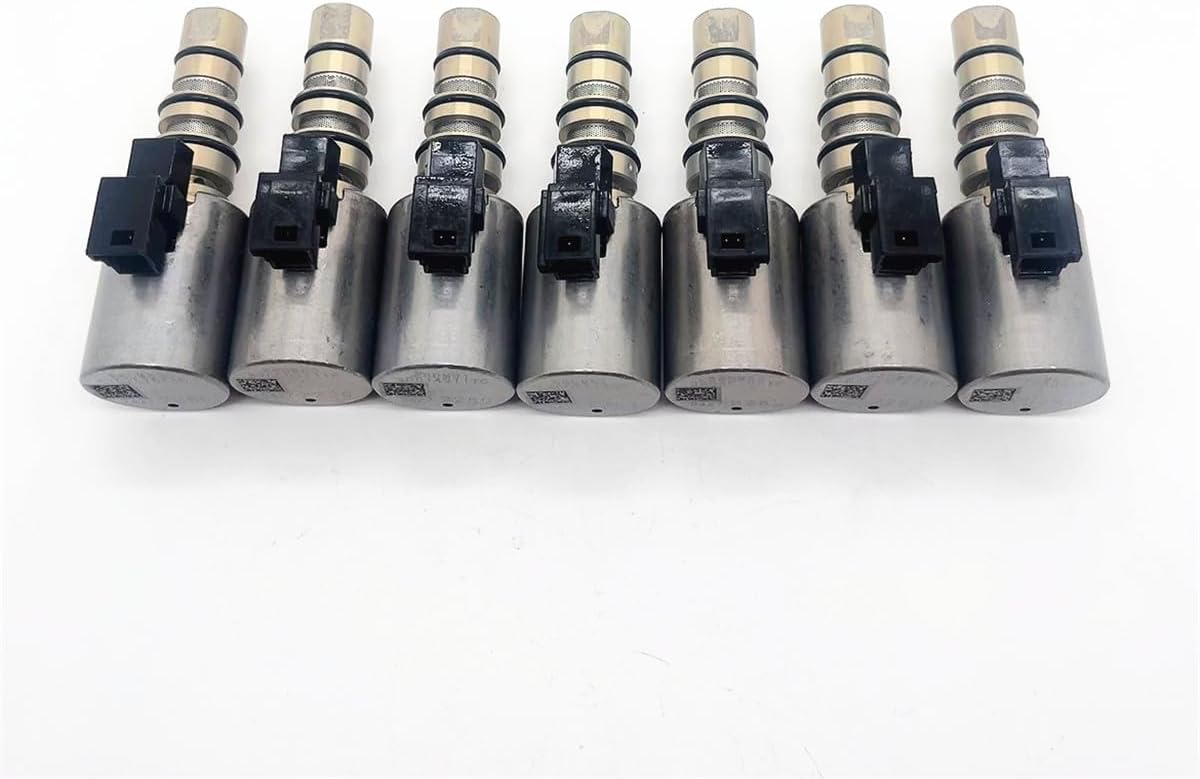
- Check solenoid resistance while the valve body is out. Per GEARS, all seven variable force pressure control solenoids measure 4.5 to 5.5 ohms. Anything outside that is a finding.
- Repair with like material. Sonnax calls for aluminum replacements so the thermal expansion rate matches the bore. Drop-in kit 154740-06K needs no reaming; oversized kit 154740-01K requires reaming with tool 154740-TL. The S1 and S5 clutch control valves have their own kit, 154740-13K.
Two traps on this job. Sonnax kit 154740-11K holds a .443-inch valve that must not go into a 2019-or-later S4 location — that valve went to a single diameter when GM moved from AFM to DFM, and you can spot a 2019-and-later unit from outside by the triangle on the canister. And per GEARS, every one of these solenoids carries a different part number and flow rate despite operating identically, so they go back in their original locations. GM does not sell them separately from the valve body.
Cause 4: adapts and PUN/TUN after a repair
If the no-overdrive complaint showed up right after a valve body, TCM or unit replacement, this is where to look first, and it costs nothing but time.
Per GM bulletin 16-NA-019, the TCM watches the input and output speed sensors during every commanded shift to decide whether it went too fast or too slow, then trims that pressure control solenoid signal. Replace hardware and the learned values no longer describe the parts in the truck. The reset is the Transmission Service Fast Learn procedure in GDS2, under Module Diagnostics → Transmission Control Module → Configuration / Reset Function. It runs in the stall with no driving, and GM lists it as available on all 2015-2021 trucks, cars and SUVs with 8L45 and 8L90 units (RPOs M5U, M5T, M5N, M5X, MQD, MQE).
Then you have to drive it, and there is a temperature gate people miss: transmission fluid temperature has to be between 35°C (95°F) and 95°C (203°F) or the clutches will not learn at all. GM’s targeted procedure for C1, the clutch you need for 7th, is:
- Pressure learn: put the shifter in M and hold 6th gear at 1000 to 1600 engine rpm for about 5 miles, on a road posted 30 to 45 mph. GM notes cruise control speeds the learn up.
- Volume learn: complete 15 light-throttle 6-7 upshifts at roughly 15 percent throttle.
If the 7-8 is the rough one instead, C4 is the applying clutch: hold 7th in M at 1000 to 1750 rpm for 5 miles, then do 15 light-throttle 1-2 upshifts. One more trap straight from the bulletin — when a clutch flips from "No" to "Yes" in GDS2, that only means the learn conditions were met at least twice. It does not mean the clutch finished learning, and a bad shift can still be present.
Finally, the part everyone forgets. A part unique number (PUN) is on the valve body and solenoids, a transmission unique number (TUN) is on the case, and those numbers tell the TCM the real flow characteristics of the solenoids in that unit. GEARS is blunt: change the transmission, valve body, solenoids or TCM and you must reprogram the TCM with the new PUN or TUN through TIS2Web SPS. Skip it and the TCM trims pressures against the wrong flow data, and no amount of relearning pulls it back.
Cause 5: heat, fluid and the thermal bypass
An 8L90 running hot gets pulled out of the top gears by strategy, and this unit has a known path to running hot. Sonnax reports the OE thermal bypass element in GM 6L80, 6L90 and 8L90 transmissions is prone to sticking open or closed, and when it sticks in recirculation mode fluid circulates through the transmission instead of the cooler. Their cooler bypass eliminator kit 104740-32K replaces it with a plug that keeps cooler flow on permanently. If the complaint is "it drops out of overdrive when I tow" rather than "it never goes in," check cooler flow and sump temperature before anything else.
While you are in there, get the fluid right. GM’s 2025 TechLink capacities chart lists the 8L90 under RPO N8X at 7.0 liters / 7.4 quarts for a fluid change, with DEXRON HP. Not DEXRON VI, and not the DEXRON ULV that the 10L80 in the next bay takes.
The order I work it
- Verify the complaint warm, tow/haul off, flat road, steady cruise. Rule out grade braking and cold fluid.
- Scan for codes. A P2670 or any solenoid supply code sends you to the harness and the X175 connector, not to the valve body.
- Reverse and 1-2 capacity test. Good reverse and a clean 1-2 means C1 holds, and you are chasing command or control.
- Log input and output speed against commanded gear. Decide whether the TCM is asking for 7th at all.
- If the unit was just apart, verify speed sensor placement, then run Fast Learn and the C1 targeted learn with fluid temperature inside the 95–203°F window. Confirm PUN/TUN were programmed.
- Pan and filter. Check the magnet. Aluminum or friction material changes the whole plan.
- Valve body out. Vacuum test the signal accumulators with the springs in, check solenoid resistance against 4.5–5.5 ohms, then repair the S1 circuit bores or replace the valve body.
Most no-overdrive 8L90s are solved somewhere in steps 1 through 5. The ones that reach step 7 are usually high-mile units where aluminum bores have been working against a low-flow signal circuit for 150,000 miles, and those respond well to a bore repair without a teardown.
Need parts for this job?
We stock the 8L90 valve body repair side of this fix — signal accumulator and control valve kits, the seven-piece VFS solenoid set, and complete valve bodies — plus filters, fluid and rebuild kits.
Shop 8L90 parts →Shop the part for this fix
The S1 circuit is the one that applies C1 for 7th and 8th. Sonnax kit 154740-13K services the S1 and S5 clutch control valves — the drop-in repair when those bores are leaking apply pressure, instead of buying a whole valve body.
View the Sonnax 154740-13K S1/S5 kit →Full 8L90 parts selection, including the 154740-06K signal accumulator kit, solenoid kits and rebuild kits: CoreTransmissionParts 8L90 collection.
FAQ
Which gears are overdrive on an 8L90?
Only 7th and 8th. Per GM's specification sheet the ratios run 4.56, 2.97, 2.08, 1.69, 1.27, 1.00, 0.85 and 0.65, so 6th gear is a straight 1.00 direct drive and everything above it is overdrive. That matters for diagnosis, because a no-overdrive complaint means the unit tops out in 6th and will not take the 6-7 upshift, which is a far narrower problem than a general shift complaint.
Which clutch does an 8L90 need to shift into 7th gear?
C1, the 1-2-7-8-Reverse clutch. Sixth gear applies C3, C4 and C5, while 7th applies C1, C3 and C5, so C1 is the one element that has to come on to leave direct drive. GM bulletin 16-NA-019 confirms this in its adaptive learn table, which lists the 6-7 upshift as applying C1 and releasing C4.
My 8L90 has good reverse but will not shift into overdrive. What does that mean?
It means C1 almost certainly has holding capacity, because reverse uses the same clutch. That rules out a burnt 1-2-7-8-Reverse pack and points you at the command and control side instead: a TCM that is not asking for 7th, a failsafe condition, or a leak in the S1 signal circuit that feeds the C1 apply valve. It is the cheapest test on the list and it should be the first one you run.
Can bad adapts cause an 8L90 not to shift into overdrive?
They can cause poor or missing top-gear shifts after a repair, yes. GM bulletin 16-NA-019 calls for the Transmission Service Fast Learn in GDS2 after replacing the unit, valve body, solenoids or TCM, followed by targeted clutch learns. Transmission fluid temperature has to be between 95 and 203 degrees F or the clutches will not learn at all, and the PUN or TUN has to be programmed into the TCM so it knows the real solenoid flow characteristics.
Do I have to replace the whole 8L90 valve body to fix a no-overdrive condition?
Often not. The failure is usually wear in the small aluminum signal accumulator and control valve bores that feed the S1 circuit, and Sonnax sells drop-in repairs for exactly that: 154740-06K for the signal accumulator pistons and 154740-13K for the S1 and S5 clutch control valves. Vacuum test the bores with the springs left in the pistons first, then decide. A complete valve body is the answer when the casting itself is past repair.
Related guides
- 8L90 Shift Solenoid Symptoms and Replacement — the S1 through S7 circuits in detail
- 8L90 Slipping: Causes and Fix
- 8L90 P0716: Causes and Fix — the input speed sensor side of a ratio complaint
- 8L90 Pressure Testing: Taps, Specs and Readings
- 8L90 Common Problems and Fixes
Sources
- General Motors Service Bulletin 16-NA-019, "Information on Transmission Adaptive Functions and Correcting Low Mileage Harsh Shifts, Slips, or Flares" (February 2025, hosted by NHTSA) — backs the applying and releasing clutch for every shift (6-7 applies C1 and releases C4; 7-8 applies C4 and releases C3), the GDS2 Transmission Service Fast Learn navigation path and its availability on 2015-2021 8L45/8L90 vehicles under RPOs M5U, M5T, M5N, M5X, MQD and MQE, the 35–95°C (95–203°F) fluid temperature requirement for clutch learning, the C1 learn procedure (6th gear in M at 1000–1600 rpm for about 5 miles, then 15 light-throttle 6-7 upshifts at roughly 15 percent throttle), the C4 learn procedure, and the warning that a clutch learn reading "Yes" in GDS2 only means the learn conditions were met at least twice. static.nhtsa.gov (PDF)
- GM Powered Solutions, 8L90 Hydra-Matic Eight Speed RWD Automatic — features and specifications sheet — backs the gear ratios (4.56, 2.97, 2.08, 1.69, 1.27, 1.00, 0.85, 0.65 and reverse -3.82) that make 7th and 8th the only overdrive gears, the four gear sets and five clutches, the 665 lb-ft maximum gearbox torque rating, and the Automatic Grade Braking and Performance Algorithm Shifting features that can legitimately hold the unit out of top gear. poweredsolutions.gm.com (PDF)
- Sonnax, "Diagnosing 8L45 & 8L90 Shift Complaints: Always Check the VFS Solenoid Circuits" (TASC Force Tips) — backs the seven low-flow VFS circuits and the signal accumulator piston in each, the circuit-to-gear map used in the element table above, the outsized effect of bore wear on a low-flow signal circuit, S3 and S4 as the worst wear locations, the vacuum test performed with the spring left in the piston and the port centered on the spring, the like-material aluminum replacement guidance for matching thermal expansion, and kits 154740-06K and 154740-01K with tool 154740-TL. sonnax.com
- GEARS Magazine (ATRA), "8L90 Solenoid Strategies" — backs the nine-solenoid layout (seven variable force pressure control plus two on/off), the normally-high grouping of S1 (1-2-7-8-R), S4 (2-3-4-6-8), S5 (4-5-6-7-8-R) and line pressure against the normally-low TCC, S3 (1-3-5-6-7) and S2 (1-2-3-4-5-R), the 4.5–5.5 ohm resistance spec for all seven, the S8 fault control shift solenoid operating the default override valve and latching hydraulically in the stroked position, the S9 1-2-3-4-5-reverse boost solenoid, the requirement to return each solenoid to its original location because the flow rates differ, and the PUN/TUN reprogramming requirement through TIS2Web SPS. gearsmagazine.com
- GEARS Magazine (ATRA), Steve Garrett, "What Is Causing That? A Look at the GM 8L90’s Most Common Concerns" — backs the five-clutch design with three clutches applied to attain each gear, the C1 through C5 element-to-gear chart, the RPO identification codes for the 8L90 and 8L45, and the consequences of failing to program PUN or TUN values into the TCM after a valve body or unit replacement. gearsmagazine.com
- Transmission Digest, Wayne Colonna, "8L90 No Upshift After Rebuild" (December 2025) — backs the 2019 Chevy Express case with codes P0722 and P176B appearing after a rebuild, the swapped output and intermediate speed sensor locations as the cause, and the gear-train fact that the reaction carrier is used in all ranges except 1st, 2nd, 7th and 8th. transmissiondigest.com
- Transmission Digest, Craig Sarokoff, "8L90 Intermittent Failsafe Diagnosis and Cause" (August 2026) — backs the 2018 Express 2500 2.8L diesel case, codes P2670 and U0402, the P2670 definition as Actuator High Control Circuit Group 2 Low Voltage, terminal 19 at the transmission X175 connector as the voltage supply to six solenoids, the gray-with-brown-tracer wire, the one-second short-to-ground set criteria, and the chafed harness found resting on the tip of a bolt below the battery. transmissiondigest.com
- GM TechLink, 2025 Transmission Capacities & Fluids (U.S. and Canada) — backs the 8L90 (RPO N8X) fluid change capacity of 7.0 liters / 7.4 quarts and the DEXRON HP fluid specification. gm-techlink.com (PDF)
- Sonnax, Cooler Bypass Eliminator Kit 104740-32K — backs the OE thermal bypass element in GM 6L80, 6L90 and 8L90 units sticking open or closed, restricting cooler flow and leading to overheating, and the plug-style replacement that keeps cooler flow permanently enabled. sonnax.com