A C6 that runs hot rarely tells you until it is too late. There is no temperature sensor, no warning light and no computer to pull timing or line pressure when things get warm. The first sign most owners get is a burned smell, a 1-2 shift that starts to flare, or fluid puking out of the vent after a long pull.
The good news is that almost every cause of C6 overheating can be checked with basic tools before it cooks a band. This guide walks through where the heat comes from, how to find the cause in the order we check it on the bench, and how to keep it from coming back. Sources are listed at the bottom.


Where C6 heat comes from
A C6 makes heat in two places: the torque converter and anything that slips inside the case. It gets rid of heat in one place: the cooler.
The converter never locks
The C6 is a three-speed with an open converter. Ford's own C6 training material explains that when the converter is multiplying torque, the recirculating vortex flow generates heat, and that a constant flow of fluid into and out of the converter is kept up to stop the fluid from overheating. That fluid leaves the converter and goes through a cooler in the radiator tank[1]. The same text makes the point that there is some slippage in the converter at all times[1]. With no lockup clutch, that slip never goes away, even at highway cruise.
Converter charge depends on the pump and the pressure regulator
Fluid does not reach the converter and cooler on its own. Sonnax explains that in many transmissions the main pressure regulator valve also controls the volume of oil fed to the converter, and that it is a priority valve: line pressure comes first, converter and lube come second. When the regulator sits near its balance point, converter charge and lube oil get choked off, and the result is converter overheating[5]. A worn pump, a leaking circuit or low line pressure therefore does double damage on a C6: the clutches and band slip and make heat, and less fluid goes through the cooler to carry it away.
Flow is what cools a converter
Sonnax technical specialist Ed Lee tested flow through converter stator caps and found that the lower the flow rate, the higher the converter temperature. Below 10 GPM through the stator cap passages temperatures became extreme, and the best operating temperature came at 30-32 GPM[6]. Those tests were on GM converters, not the C6, but the principle is the same: a converter only runs as cool as the fluid moving through it.
The cooler shares heat with the engine
The factory C6 cooler is a tank inside the radiator. Hayden's install instructions point out that with that design, extra load or stop-and-go traffic raises engine coolant temperature along with transmission temperature[8]. So a weak radiator, a slipping fan clutch or a lean-running engine all push the transmission hotter.
How hot is too hot
Mike Brown, writing in Gears Magazine, puts the ideal maximum transmission temperature at 200°F and says that for every 20 degrees above that, expected transmission life drops by a factor of two[2]. At 240°F you are running at about a quarter of normal life. A C6 pulling a grade with a restricted cooler can get there fast, and a C6 has no way to tell you.
The seven causes we check, in order
Brown's list of overheating causes is short: plugged cooler lines, a plugged cooler, a plugged filter, overloading the vehicle, an overheating engine and a faulty fan clutch[2]. On a C6 we add internal slip and bad vacuum, because a C6 sets line pressure from its vacuum modulator. Here is the order we work through them, cheapest first.
1. Fluid level and condition
Check the level hot, on level ground, in park with the engine running. Low fluid starves the pump and the converter charge circuit. Overfilled is just as bad. Bill Brayton explains in Gears Magazine that fluid expands as it heats, so a unit filled cold can end up well over the mark, which causes fluid blowing out the vent, aeration or foaming, and overheating[4]. Foamed fluid does not carry heat or make pressure properly. Our C6 fluid type and capacity guide covers the correct fluid and the check.
While the dipstick is out, smell it. Burned fluid means the unit has already seen too much heat, and anything you find next is a cause, not the whole story.
2. Engine cooling and the fan clutch
Brown tells techs to verify engine temperature is holding in the 195-200°F range and to check fan clutch operation before condemning the transmission[2]. Since the C6 cooler sits in the radiator, an engine running 230°F means the transmission fluid leaving the cooler cannot be colder than that. Fix the engine first.
3. Cooler flow
This is the check most people skip. Ford made the fluid cooler flow check a standard step in its automatic transmission diagnosis course, alongside pressure and stall testing, and the course includes a dedicated "Transmission Overheats" diagnosis chart[1]. Brown's number: flow should be at least a gallon per minute[2]. The simple version of the test:
- Disconnect the cooler return line and route it into a clean container.
- Start the engine in park at idle, with the fluid full, and let flow settle.
- Catch fluid for 15 seconds. A quart in 15 seconds is one gallon per minute.
- Shut off before the level gets low and top off.
Low flow means a restriction: kinked or crushed steel lines, a collapsed rubber section, a plugged radiator tank, or debris from a previous failure. Lance Wiggins writes in Gears Magazine that clogged or damaged coolers cause overheating and eventual failure, and that a cooler is either functional or defective; do not reuse a bad one[3]. Ford's diagnosis guide even has a line for whether the oil cooler was flushed with a mechanical cleaner[1]. If flow is good at idle but the unit still runs hot, move on. Our cooler flush guide covers cleaning the lines.
When you reconnect, Ford's C6 specifications call for 18-23 lb-ft on the cooler line connector fittings at the case and 12-18 lb-ft on the 5/16 in. tube nuts[9]. Overtightening the fitting in an aluminum case is a common way to start a leak.
4. The filter and pan
A plugged filter starves the pump, which starves the converter and cooler. Check the pan bottom too. TransGo's C6 instructions warn that a pan bottom bent upward can press against the filter opening, restrict flow through the filter and damage the transmission, and say to flatten it with a mallet[7]. C6 pans get pushed in by jack pads and rocks all the time. Our C6 filter and pan service guide covers the job.
5. Vacuum to the modulator
Low vacuum or a leaking modulator gives soft, slow, slipping shifts, and every slow shift is heat in the band or the direct clutch. TransGo's gas-engine checks: with the engine idling, pull the modulator hose, and the engine should speed up or idle rough. Then check for trapped vacuum: start the engine, shut it off, wait until it stops, count to five and pull the hose; escaping vacuum points to a bad hose, check valve or shared canister[7]. Pull the modulator and look for ATF in the vacuum side. A leaking diaphragm pulls fluid into the engine and drops level at the same time.
On IDI diesel C6 units the modulator runs off a vacuum pump and regulator. TransGo says to make sure the truck is at operating temperature before adjusting, because heat affects the setting[7].
6. Band adjustment
A loose intermediate band slips in second, and second is where a loaded C6 spends its time on a hill. TransGo's adjustment: wheels off the ground, neutral, engine off; snug the screw until the output shaft will not turn backward by hand, back it off until the shaft just turns, then loosen 1/4 turn more and lock it[7]. Ford's specification for the band adjusting screw locknut is 35-45 lb-ft[9].
7. Internal slip or a failing converter
If level, cooling, flow, filter, vacuum and band all check good and it still runs hot, the heat is coming from inside: worn clutches, a glazed band, a leaking servo or a converter that is tired. A stall test tells you a lot here, but do it by Ford's rules. Ford's diagnosis guide says never to hold the throttle open for more than five seconds during a stall test, and to run the engine at 1,000 rpm in neutral after each test to cool the transmission[1]. Holding a stall longer is one of the fastest ways to overheat a C6 on purpose. Our C6 slipping guide walks through reading the results.
Prevention: keeping a C6 cool for good
- Keep the level right. Check it hot. Do not fill to the top of the crosshatch cold and walk away.
- Service it before the fluid turns. Fresh fluid and a clean filter keep the pump and converter charge circuit fed.
- Add a cooler if you tow or haul. Hayden recommends plumbing an add-on cooler in series with the radiator cooler, so fluid goes through the radiator tank and then the add-on unit[8]. Our C6 towing upgrades guide covers sizing.
- Flush or replace the cooler after any failure. Debris left in the cooler and lines goes straight into the next unit[3].
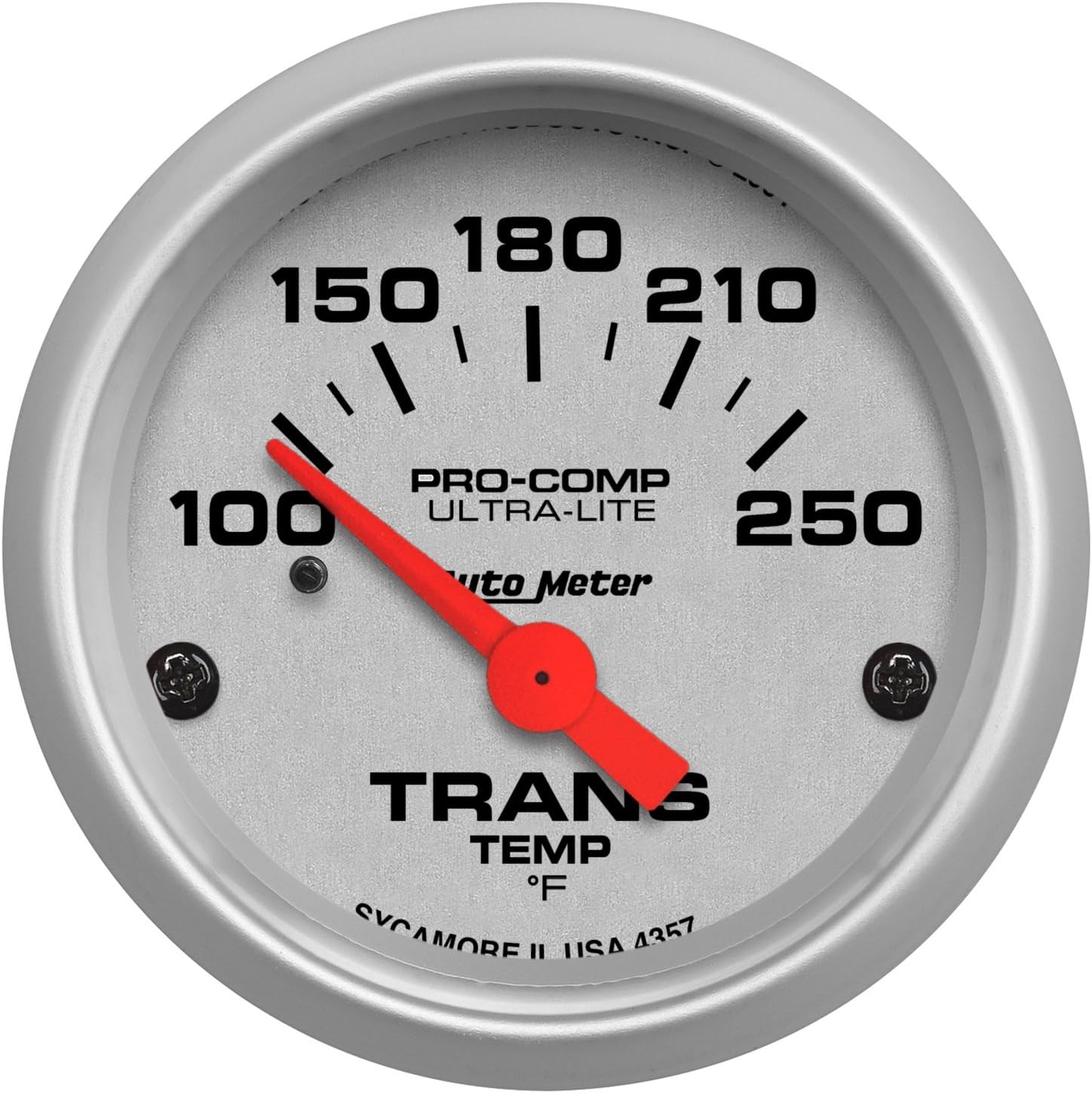
- Install a temperature gauge. A C6 has no sensor. A gauge lets you drop to second on a long grade instead of lugging in third.
- Keep the engine cooling system healthy. Radiator, fan clutch and thermostat all affect transmission temperature on a C6[2].
- Check vacuum and band at every service. Both cost nothing to check and both cut slip.
Shop the part for this fix: a fresh C6 filter
A plugged filter starves the pump, converter and cooler. If you are chasing heat, a new filter is the first part to put in. CoreTransmissionParts stocks the late-style filter for 1975-1996 units.
View the C6 filter for 1975-1996 at CoreTransmissionPartsEarly unit? Grab the C6 filter for 1966-1974, or browse all C6 parts.
Need parts for this job?
Our parts shop carries add-on transmission coolers, temperature gauges, cooler flush and C6 valve bodies, all on our own checkout. Fluid specs are in our transmission fluid spec chart.
FAQ
What causes a Ford C6 to overheat?
The usual causes are a restricted cooler or cooler lines, a plugged filter or pushed-in pan, low or overfilled fluid, an engine cooling problem, and internal slip from a loose band, low vacuum or worn clutches. Because the C6 has no lockup clutch, its converter also makes heat any time it is driving.
How do you test C6 transmission cooler flow?
Disconnect the cooler return line into a container, run the engine at idle in park with the fluid full, and catch fluid for 15 seconds. Gears Magazine puts the minimum at a gallon per minute, which is a quart in 15 seconds. Less than that means a restriction in the lines, the radiator tank or the cooler.
How hot is too hot for a C6?
Gears Magazine puts the ideal maximum at 200 degrees F and says every 20 degrees above that cuts expected transmission life in half. At 240 degrees F the unit is running at roughly a quarter of its normal life. The C6 has no sensor, so a gauge is the only way to know.
Can overfilling a C6 cause overheating?
Yes. Fluid expands as it heats, so a unit filled to the mark cold can end up well over it hot. Gears Magazine lists blowing fluid out the vent, aeration or foaming, and overheating as the results. Always check the level with the fluid hot.
Related guides
Sources
- Ford Motor Company, Automatic Transmission Diagnosis training course for FMX, C4 and C6 (Forel Publishing reprint, demo pages), including Diagnosis Guide FD-1863-AT. Backs converter vortex flow generating heat, the constant converter-to-cooler flow through the radiator tank cooler, slip in the converter at all times, the fluid cooler flow check and the Transmission Overheats chart in the course, the oil-cooler-flushed line on the guide, and the five-second stall limit with 1,000 rpm neutral cool-down. forelpublishing.com (PDF)
- Mike Brown, "48RE/68RFE/AS68RC Transmission Overheating," Gears Magazine (ATRA), September 2019. Backs the list of overheating causes (plugged lines, cooler, filter, overload, engine overheating, fan clutch), the minimum cooler flow of a gallon per minute, the 200°F ideal maximum with life halving every 20 degrees above it, and checking engine temperature at 195-200°F and the fan clutch. gearsmagazine.com
- Lance Wiggins, "Removing and Replacing the Transmission: The Do's and Don'ts," Gears Magazine (ATRA), April 2025. Backs clogged or damaged coolers causing overheating and failure, not reusing a faulty cooler, and replacing failed coolers so they do not contaminate a new transmission. gearsmagazine.com
- Bill Brayton, "Checking the Fluid: Is It that Big of a Deal?," Gears Magazine (ATRA). Backs fluid expanding as it heats and overfill causing fluid blown out the vent, aeration or foaming, and overheating. gearsmagazine.com
- Sonnax, "Anatomy of a Transmission: Oil Flow in the Pump-PR-Converter-Cooler-Lube Circuits." Backs the pressure regulator valve controlling converter feed volume, its priority of line pressure over converter and lube, and restricted converter charge leading to converter overheating. sonnax.com
- Ed Lee, Sonnax, "Orifice Control Within the Converter, Part 2." Backs lower flow meaning higher converter temperature, extreme temperatures below 10 GPM through stator cap passages, and optimum temperature at 30-32 GPM (GM converters tested). sonnax.com
- TransGo, SK C6 shift kit instructions. Backs the bent pan restricting the filter warning, the gas vacuum and trapped-vacuum checks, adjusting the diesel vacuum setup at operating temperature, and the intermediate band adjustment procedure. transgo (PDF)
- Hayden Automotive, Transmission Oil Cooler Kit Installation Procedure (8P103). Backs the in-radiator OE cooler raising engine coolant temperature under load and the recommended in-series add-on cooler hookup. haydenauto.com (PDF)
- Ford C6 rebuild procedures and specifications (Ford shop manual section, hosted by Gary's Garagemahal). Backs the 18-23 lb-ft cooler line connector fitting torque, 12-18 lb-ft cooler tube nut torque and 35-45 lb-ft band adjusting screw locknut torque. garysgaragemahal.com (PDF)