Every V8 Jaguar from the mid-2000s into the early 2010s, and most of the six-cylinder S-Types, puts its power through a ZF six-speed. That covers the S-Type, the X350 and X351 XJ, the X150 XK and the first XF. The unit is the same basic 6HP26 or 6HP28 that BMW, Ford and Land Rover used, but the Jaguar versions have their own failure pattern. Jaguar wrote a bulletin for one of those failures that skips the repair entirely and just replaces the whole transmission.
These cars now come in with five complaints. Ratio codes from a worn bushing, harsh shifts from adaptations that have drifted, fluid nobody ever changed, valve body wear, and the failsafe faults and leaks that show up after somebody else has had the pan off. Here's how I sort them out, from the cheapest check to the most expensive one.


First, Which 6HP Is in This Jaguar
Jaguar used both sizes of the big ZF six-speed. In JLR Technical Bulletin JTB00305NAS1, the 2009-2011 XF (X250), the 2008-2009 XJ (X350) and the 2008-2011 XK (X150) are listed with the 6HP26. The 2010-2011 X351 XJ is listed with the 6HP28. That bulletin only covers certain VIN ranges, but it shows the split: earlier V8 cars have the 6HP26, and the 5.0-liter era brought in the 6HP28.
The two units come from different generations. Sonnax's ZF6 training material puts the 6HP19, 6HP26 and 6HP32 in Generation 1 (about 2001-2005 designs). The 6HP21, 6HP28 and 6HP34 are Generation 2. Gen 2 got a different mechatronic, a different solenoid firing order and different valve bodies (Sonnax ZF6 webinar). The car's badge won't tell you which generation you have. The ZF tag on the case will. Read it before you order anything for the valve body.
One more difference matters at service time. ZF Service Information 50145 lists Jaguar under both the 6HP26 and the 6HP28 in its oil change kit table. It flags the Jaguar 6HP28 as a "version with thermostat valve," and that unit needs an extra step when you set the level. That step is covered below.
Problem 1: Ratio Codes From a Worn Bushing
This is the most expensive Jaguar 6HP problem, and it has an OEM bulletin. JTB00305NAS1 (section 307-01, dated 22 April 2015) covers a transmission MIL with any of these codes stored in the TCM: P0729 through P0735, P0783, and P2702 through P2704. Jaguar's stated cause is "degradation and failure of the lead-free bush," which then degrades the transmission. The dealer fix was an exchange transmission (a new one if no exchange unit was available), labor operation 44.20.01, quoted at 3.1 to 4.6 hours depending on the car (JLR JTB00305NAS1).
The same bulletin says that if the fluid comes out burnt or contaminated, the oil cooler gets replaced too. Don't skip that on a rebuild. A cooler full of bushing material and clutch debris will feed it right back into a fresh unit.
Why a bushing sets ratio codes
Look at which clutches those codes involve. In the 6HP, the E clutch is applied in 4th, 5th and 6th. P0729 is the 6th-gear ratio code. P0730 through P0735 are the general and per-gear ratio codes. P0783 is the 3-4 shift, and P2702 through P2704 are the apply-time codes for friction elements C, D and E. A lot of those point at the E clutch circuit. E clutch oil reaches the clutch through sealing journals and bushings near the stator support. When a bushing wears, it leaks apply oil. The clutch then slips, takes too long to apply, and finally burns.
Sonnax confirms this from the rebuild side. It makes an upgraded rear stator support bushing, part 95030-02, for the 6HP26 and 6HP28 (and the related Ford 6R80). Sonnax says the OE bushing material wears prematurely and causes loss of correct pressure to the E clutch, gear ratio and solenoid codes, and a burned E clutch. Sonnax's installation note: use an arbor press only, because a hydraulic press or a driver and hammer will distort the bushing (Sonnax 95030-02).
Confirming it on the bench
On the car, a low-mileage code that came back after adaptations were cleared, with E-clutch-related ratio or apply-time faults, means you're looking at a teardown, not a valve body. Sonnax's symptom chart also lists a moan or growl on coast-down shifts as a sign of internal driveline wear, bushings or bearings included. Once it's apart, the GEARS Magazine series on the Gen 2 E clutch is the best procedure I know. Air test the E drum at full shop pressure with some fluid in it, not the usual 35 psi. Inspect the stator support and every bushing on that circuit. Flat-sand the pump halves too, since there's no gasket between them (GEARS, ZF6HP21 E clutch failure). Those checks apply to the same circuit in a Jaguar 6HP28, and with a 6HP26 the bushing story is the same.
A full rebuild with new bushings, the E clutch pack and a new cooler is a fraction of the cost of a dealer exchange unit. It also fixes the cause, which an exchange unit with the same OE bushings may not.
Problem 2: Harsh Shifts From Adaptive Drift
The cheap Jaguar problem is a harsh 1-2, a bang on the 3-2, or a thump at roll-out, with no codes stored. Jaguar's harsh-shift bulletin for the S-Type, XJ and XK (JTB000712, issue 2) blames the adaptive shift strategy. It says the strategy "can drift over time," and the result is higher than normal clutch pressures. The fix needs no parts. Clear the adaptations, reconfigure the TCM, and run the transmission adaptions drive cycle. Jaguar also tells the owner that shift quality should keep improving as the unit relearns. That bulletin is a dealer document with no public copy that I could verify, so get the current procedure from JLR service information.
Before you reset anything, rule out the two things that make adaptations go wrong in the first place. Sonnax's ZF6 symptom chart calls low fluid level "one of the most common and overlooked issues on the 6HP" for erratic shifting. The same chart notes that battery or charging voltage below 9 or above 16 volts causes erratic transmission control. An aging Jaguar battery with a weak alternator is no rarity. Check the level properly and load-test the charging system, then reset. If you reset adaptations on a unit that's low on fluid, it will learn the wrong pressures.
Problem 3: "Sealed for Life" Fluid That Isn't
Most of these cars were sold as no-service transmissions. ZF disagrees. Its LifeguardFluid 6 data sheet says ZF transmissions are generally filled with lifetime oil. It then recommends an oil change after 150,000 km (about 93,000 miles), and earlier for high temperatures, heavy loads or unknown history. It also warns that unsuitable oil can cause anything from poor shift quality to transmission failure (ZF LifeguardFluid 6 data sheet). A 15-year-old supercharged XJ with no service records fits every one of those.
ZF's procedure, applied to the Jaguar
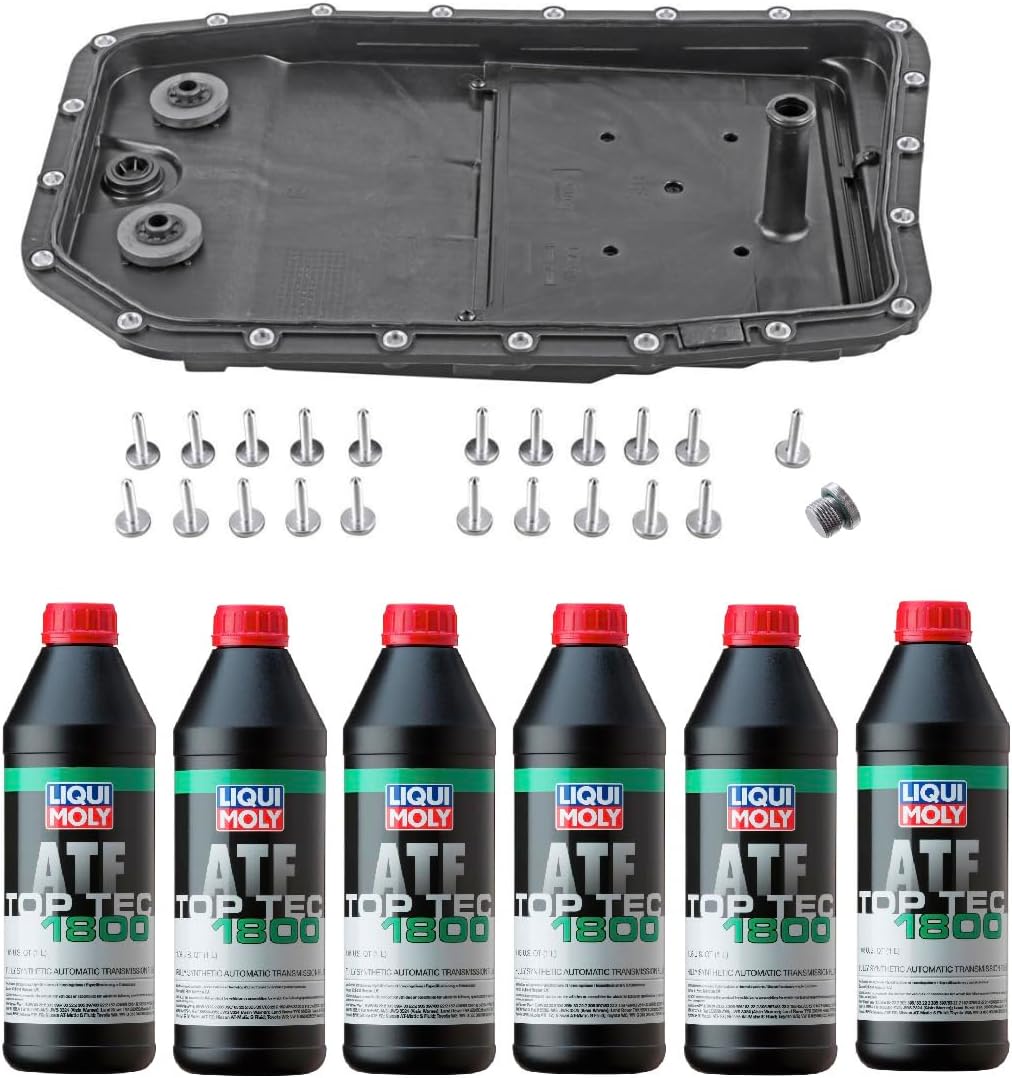
ZF SI 50145 assigns oil change kit 1068.298.062 (with oil) or 1068.298.083 (without oil) to the 6HP26 and 6HP28, Jaguar included. Its Jaguar 6HP26 table gives an M24 x 1 drain plug (10 mm hex) at 8 Nm and an M18 x 1.5 filler plug (8 mm hex) at 35 Nm plus or minus 3.5 Nm. The filter is part of the plastic pan, so you're replacing the pan. Plastic pan bolts are 10 Nm (ZF SI 50145).
- Put the car on a level lift, set the parking brake and connect a scan tool that reads transmission temperature. ZF requires idle at 650-950 rpm. Outside that range the level can't be set correctly.
- Drain and look at the fluid. If it smells burned or there are large chips or fragments in the pan, ZF says to stop the oil change. The transmission is already damaged, and on a Jaguar that usually means Problem 1.
- Fit the new pan and seal. Tighten the bolts in sequence to 10 Nm.
- Fill until fluid runs out of the filler hole. Start the engine, run through the selector positions and fill until it overflows again.
- Set the final level between 30 and 35 C. If the fluid gets above 50 C during the check, the level will read low. Let it cool and start over.
- For the thermostat-valve 6HP28, ZF requires a test drive that brings the fluid to at least 75 C so the thermostat opens and fills the cooler circuit. Then let it cool and recheck the level.
Use only ZF LifeguardFluid 6 or the Jaguar-approved fluid, and add no additives. ZF's own service sheet says additives change the oil's chemistry. Reset adaptations after the service.
Problem 4: Valve Body Wear and Solenoid Codes
Old fluid also wears valve bores, and on a ZF6 that usually shows up as pressure or solenoid complaints before anything breaks. Sonnax's chart sends reverse slip, harsh shifting once hot, and a 4-5 slip or flare to valve body repair. On a Jaguar, look at the code list before you condemn the valve body. Ratio and apply-time codes on the E clutch circuit point to Problem 1. A bad valve body can't fix a bushing that's leaking oil.
Solenoid map and test values
On a Gen 1 6HP26, EDS1 runs the A clutch, EDS2 the B clutch, EDS3 the C clutch, EDS4 the D/E clutch, EDS5 pressure control and EDS6 the converter clutch. Gen 2 (6HP28) changes the order: the TCC moves to EDS2, and EDS7 becomes pressure control. Sonnax lists the PWM solenoids at about 5 ohms at 20 C and the on/off MV1 and MV2 at 10-10.5 ohms. Normal current is roughly 700-850 mA at high duty cycle and 50-100 mA at low (Sonnax ZF6 webinar). A replacement mechatronic has to be programmed to the car. If it isn't, Sonnax notes the vehicle stays limited to about 8 mph.
Problem 5: Failsafe and Leaks After Someone Else's Service
Many Jaguar 6HP complaints start right after a pan job or mechatronic swap. The Sonnax chart lists an immediate failsafe after mechatronic or valve body service as a chassis harness-to-case connector that isn't fully engaged. The sleeve that carries the connector through the case seals with O-rings, and so does the plastic pan. A sleeve that weeps, or a pan that was overtightened past 10 Nm, is a leak and also a low-fluid problem that leads straight back to Problem 2. Seat the connector fully, replace the sleeve seals and the pan seal together, and set the level by ZF's procedure, not by guessing.
Jaguar 6HP Quick Map
| Complaint | Most likely cause | First check |
|---|---|---|
| MIL with P0729-P0735, P0783, P2702-P2704 | Lead-free bushing wear, E clutch oil loss | JTB00305NAS1, fluid condition, plan teardown |
| Harsh 1-2 or 3-2, no codes | Adaptive strategy drift | Fluid level, 9-16 V supply, then reset adaptations |
| Unknown or original fluid | Overdue service | ZF SI 50145 procedure, 30-35 C level check |
| Reverse slip, 4-5 flare, harsh when hot | Worn valve body bores | Vacuum test, Gen 1 or Gen 2 parts |
| Failsafe right after pan or mechatronic job | Connector not fully engaged | Seat connector, check sleeve seals |
| Moan or growl on coast-down shifts | Bushing or bearing wear | Teardown inspection |
| Burned fluid or chips in the pan | Internal damage | Stop the service. Rebuild and replace the cooler. |
Shop the part for this fix
When a Jaguar 6HP26 or 6HP28 has bushing-related ratio codes or burned fluid, a rebuild is the fix. Core Transmission Parts carries ZF six-speed overhaul and master rebuild kits. Match the tag on the case before you order.
See ZF rebuild kits at Core Transmission Parts →Frequently Asked Questions
What transmission is in a Jaguar XJ, XK, XF or S-Type?
Most automatic S-Type, XJ, XK and early XF models from the mid-2000s use a ZF six-speed. JLR bulletin JTB00305NAS1 lists the 6HP26 for the 2009-2011 XF, the 2008-2009 X350 XJ and the 2008-2011 XK, and the 6HP28 for the 2010-2011 X351 XJ. Read the ZF tag on the case before ordering, because the 6HP26 is a Generation 1 unit and the 6HP28 is Generation 2, with different valve bodies and solenoid layouts.
What causes P0729 or P2704 on a Jaguar?
On the Jaguar 6HP26 and 6HP28, JLR bulletin JTB00305NAS1 ties codes P0729 through P0735, P0783 and P2702 through P2704 to degradation and failure of a lead-free bushing. A worn bushing leaks E clutch apply oil, so the clutch slips, applies late and eventually burns. Jaguar's dealer fix was an exchange transmission. In a shop it is a rebuild with new bushings and clutches, plus a new oil cooler if the fluid is burnt.
Why does my Jaguar transmission shift hard?
If there are no codes, the usual cause is adaptive drift. Jaguar bulletin JTB000712 says the adaptive shift strategy can drift over time and raise clutch pressures, and the fix is to clear adaptations, reconfigure the TCM and run the adaption drive cycle. Check the fluid level and the battery and charging voltage first, because low fluid and voltage outside 9-16 volts also cause erratic shifts.
Does a Jaguar ZF 6-speed need a fluid change?
Yes, despite the sealed-for-life label. ZF's LifeguardFluid 6 data sheet recommends an oil change after 150,000 km, about 93,000 miles, and sooner under heat, heavy load or unknown history. ZF Service Information 50145 assigns kit 1068.298.062 to the Jaguar 6HP26 and 6HP28, with the filter built into the plastic pan and the level set at 30-35 C.
Sources
- Jaguar Land Rover North America, Technical Bulletin JTB00305NAS1, "Transmission MIL Illuminated," section 307-01 (22 April 2015). Backs the XF X250, XJ X350/X351 and XK X150 applications and their 6HP26/6HP28 listings, codes P0729-P0735, P0783 and P2702-P2704, the lead-free bush cause, the burnt-oil cooler replacement note, the exchange transmission fix, and labor operation 44.20.01 at 3.1-4.6 hours. NHTSA (PDF)
- ZF Friedrichshafen AG, Service Information 50145, "Oil change kit for ZF 5HP/6HP automatic transmission" (03.2023). Backs the Jaguar 6HP26 and 6HP28 kit assignment 1068.298.062/.083, the Jaguar 6HP26 drain plug (M24 x 1, 8 Nm) and filler plug (M18 x 1.5, 35 Nm), the 10 Nm plastic pan bolts and integrated filter, the 650-950 rpm idle check, the burned-oil and chips stop rule, the 30-35 C level check and 50 C limit, the 75 C thermostat-valve test drive, and the no-additives warning. aftermarket.zf.com (PDF)
- ZF Friedrichshafen AG, Product Data Sheet, ZF LifeguardFluid 6. Backs the lifetime-oil wording, the 150,000 km oil change recommendation, earlier changes under heat, load or unknown history, and the warning against unsuitable oils. aftermarket.zf.com (PDF)
- Sonnax, ZF6 technical webinar. Backs the Gen 1 and Gen 2 groupings, the Gen 1 and Gen 2 solenoid assignments, resistances and current draw, the 9-16 V supply note, the unprogrammed-mechatronic speed limit, and the symptom chart (low fluid, valve body symptoms, coast-down moan, failsafe after service). Sonnax (PDF)
- Sonnax, Rear Stator Support Bushing 95030-02 (ZF6HP26, ZF6HP28, 6R80). Backs the premature OE bushing wear, the loss of E clutch pressure, the ratio and solenoid codes, the burned E clutch, and the arbor-press-only installation note. sonnax.com
- GEARS Magazine (ATRA), Rob Faucett, "Tracking Down the ZF6HP21 E Clutch Failure." Backs the full-shop-pressure E drum air test, the stator support and bushing inspection, and flat-sanding the pump halves. gearsmagazine.com
Shop rebuild kits, pan and filter kits, solenoids and valve bodies for the ZF 6HP26 and 6HP28 in Jaguar S-Type, XJ, XK and XF, on our own secure checkout.
Shop ZF6HP parts →Related ZF6HP guides
- ZF6HP BMW 5 Series Common Problems and Fixes
- ZF6HP P0729: Gear 6 Incorrect Ratio Causes & Fix
- ZF6HP P0730: Incorrect Gear Ratio Causes & Fix
- ZF6HP Harsh Shift: Causes and Fix
- ZF 6HP19 / 6HP26 Problems: Mechatronic Seals, Solenoids, and Torque Converter Failure
- ZF6HP Fluid Type and Capacity: The Right Spec for Every Variant