The call sounds the same every time. A Ram 1500, a Grand Cherokee, a Challenger, a 300. The dash lights up, the shifts stop, and the truck will move but only in one gear and only to about 25 or 30 mph. The owner assumes the transmission is finished. On a ZF8HP or its Chrysler twin the 845RE, that is often not true, and treating failsafe as a death sentence leads to a lot of needless teardowns.
Failsafe mode is not a failure in itself. It is the TCM deciding it can no longer trust something about the commanded clutch state, and locking the unit into a conservative gear and pressure until that trust is restored. The job is finding exactly what it stopped trusting, and that list has a short, specific set of real-world causes on this platform.
What Failsafe Mode Actually Does
"Failsafe" is not a vague limp. On this transmission it is a specific set of commanded restrictions, and a real shop case documented in Gears Magazine shows exactly what they are. When the TCM in a Dodge Challenger's 845RE set code P1DD2-00, meaning a torque request signal from the TCM over the CAN bus was being denied, the module responded with: TCC solenoid current limited to 50 mA with the torque converter clutch held open, maximum hydraulic pressure limited, shift adaptation functions disabled, and the Start/Stop feature disabled. No gears were lost, no clutch pack was condemned. The TCM simply refused to trust a torque figure it could not verify, and backed every hydraulic and electrical function off to a conservative baseline until it could.
That distinction matters for how you diagnose the complaint. Failsafe tells you the TCM stopped trusting something. It does not tell you whether that something is a broken part, a bad calibration, or three inches of corroded wire. The rest of this comes down to finding which one.
Cause One: Sheared E-Clutch Hub Splines
This is the real mechanical failure behind a large share of ZF8HP and 845RE failsafe complaints, and Sonnax documents it in detail. The "E" clutch hub inside these units ships from the factory cast from A380 aluminum, a material Sonnax flatly calls too weak for the torque these transmissions generate. The lock splines on that hub shear or break, and at the same time the steel clutch plates start digging into the worn splines on the drum, which makes the plates hang up and burn. Sonnax's own documentation puts the failure window at as few as 20,000 miles, which means a nearly new unit in failsafe is not automatically cleared of this cause.
The symptom set Sonnax lists is specific and worth matching against your scan data before you do anything else: failsafe mode, gear ratio codes, code P0731, and the loss of 2nd, 3rd, 4th, 6th, and 8th gears. That particular combination of missing gears is the tell, because those are the ratios that depend on the E-clutch holding correctly.
| Application | OE spline count | Sonnax heavy duty hub |
|---|---|---|
| ZF8HP70 | 38-spline (some updated to 48-spline) | 35572-38T / 35572-48T |
| 845RE / ZF8HP45 | 53-spline (some updated to 62-spline) | 35572-53T |
| 850RE / ZF8HP51 / ZF8HP55 | 62-spline | 35572-62T |
That update history is the trap. Chrysler and ZF both revised some applications to a higher spline count after earlier field failures, so two 845RE units of the same model year can carry different hub counts. Sonnax's own warning is direct: verify spline count before ordering, because the wrong hub will not fit. The correction in every case is the same shape, replace the weak OE hub with a forged aluminum hub built to hold the splines, not a code clear or a fluid change.
Cause Two: A TCM Calibration Bug With No Hardware Fault at All
Not every failsafe event means something broke. NHTSA-hosted TSB 21-036-16, issued November 19, 2016 for 2015 Ram 1500 trucks with the 845RE, documents a transmission control module condition coded P1DCD, described as the TCM monitoring processor detecting what looks like multiple clutches locked up simultaneously, along with two related codes, P1B13 (Park-By-Wire unintended out-of-park position) and P0734 (gear 4 incorrect ratio). The fix in the bulletin is a TCM reprogram with updated software. No valve body, no hub, no clutch pack.
The mechanism here is instructive even outside this specific bulletin. The TCM constantly checks the clutch state it commanded against the clutch state it expects given current gear and shaft speeds. Early calibrations on some of these units could flag a mismatch that was not a real mechanical conflict, just a monitoring quirk, and the TCM reacted to that false read exactly as conservatively as it would to a real one. If the vehicle and VIN range match a known TCM software TSB, that reflash belongs ahead of any teardown, not after one.
Cause Three: Wiring Faults the TCM Cannot Verify
The same Gears Magazine case that documented what failsafe actually restricts also shows how far a diagnosis can wander before the real cause turns up. The Challenger initially threw code P0335, a crankshaft position sensor circuit code, which then did not return. Techs reprogrammed the PCM and TCM, replaced the crank sensor outright, and ran the cam/crank relearn procedure, and the P1DD2-00 torque-request-denied code kept coming back. The actual fault, found on closer harness inspection, was a deteriorated wire in the crank sensor wiring loom barely making contact, an intermittent connection that produced a signal fault the TCM read as a torque request it could not verify over CAN.
The lesson is not about crank sensors specifically. It is that this TCM will not guess. If it cannot verify a signal relevant to torque delivery, intermittent or not, it drops into failsafe rather than risk a bad clutch apply, and a part swap that does not fix the actual connection will not clear the code for good. A proper wiggle test and a voltage-drop test under load on the suspect circuit will find what a visual connector check misses.
Cause Four: Pressure Faults From Valve Body Wear
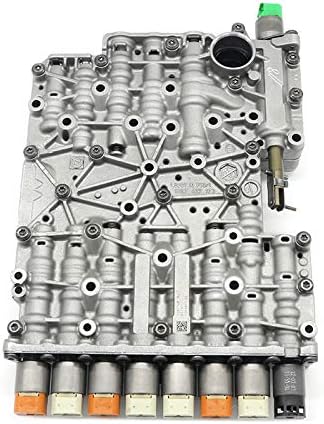
The fourth real cause is hydraulic rather than electrical. Sonnax's published vacuum test guide for the ZF8HP45, ZF8HP70 and Chrysler 845RE valve body documents specific test ports and the symptom sets tied to worn bores in the pressure regulator and converter circuits. A bore worn enough to leak line pressure can produce the same low-pressure fault codes the TCM uses to justify dropping into failsafe, even with every clutch mechanically sound. Test each valve at its rest position per Sonnax's published locations; a low vacuum reading at a specific port tells you which bore is the leak, and reconditioning that bore with an oversized valve is the correction, not a blanket valve body swap. We go through that process in full in our ZF8HP valve body wear guide.
Fluid condition belongs in this same category. A unit that is low or filled with the wrong fluid behaves hydraulically like a worn bore, producing the same kind of pressure instability that can trip a failsafe threshold intermittently rather than every time. Confirm fluid identity and level before condemning a bore; we cover the exact fill procedure in our ZF8HP fluid type and capacity guide.
The Order I Work It
- Pull every stored code, not just the one that lit the MIL, and read the freeze frame data for each.
- If the codes show a ratio fault alongside loss of 2nd, 3rd, 4th, 6th or 8th, suspect the E-clutch hub first. Verify spline count before ordering the replacement.
- If the codes point at TCM processor performance or a CAN communication rejection with no mechanical ratio complaint, check for an applicable TCM software TSB for that VIN and calibration before touching hardware.
- If a code set once and will not return, do not assume the part it points at is the fault. Wiggle-test and voltage-drop-test the specific circuit under load.
- If the complaint is pressure-related and nothing above explains it, vacuum test the valve body at the published Sonnax locations.
- Verify fluid identity and level last, since a bad fill can mimic a worn bore and will undo any other repair if it is not corrected.
Worked in that order, a ZF8HP or 845RE in failsafe is not automatically a transmission on its way out. Some of the time it is a forty-dollar hub, some of the time it is a software flash, and some of the time it is a wire that never should have corroded in the first place. Finding out which one is the entire diagnosis.
Shop ZF8HP and 845RE valve bodies, solenoid kits and overhaul kits — shipped fast from the USA.
Shop ZF8HP parts →FAQ
Can I just clear the code and keep driving in limp mode?
Not safely. Failsafe limits line pressure and locks out most gears on purpose to stop a questionable clutch apply from turning into real damage. Clearing the code without finding why the TCM distrusted the apply just lets it set again, and if the real cause is a sheared E-clutch hub spline, continued driving lets steel clutch plates keep digging into the drum splines until they burn.
Does ZF8HP limp mode always mean the transmission needs to be rebuilt?
No. NHTSA TSB 21-036-16 documents a 2015 Ram 1500 845RE case where failsafe-adjacent code P1DCD was resolved entirely with a TCM software reprogram, no parts replaced. A sheared E-clutch hub is a hardware repair, but a TCM calibration quirk or a corroded sensor wire is not, and the two look identical from the driver's seat.
What is the first thing to check when a ZF8HP or 845RE goes into failsafe?
Pull every stored code, not just the one that set the light, and read the freeze frame. A P0731-family ratio code paired with specific missing gears points at the E-clutch hub. A communication or processor-performance code with no mechanical complaint points at TCM software or wiring before any hard parts get touched.
How many miles can a ZF8HP E-clutch hub last before the splines shear?
Sonnax documents OE E-clutch hub spline failure happening in as few as 20,000 miles. It is a material defect in the original cast A380 aluminum hub, not a mileage-based wear item, so a low-mileage unit in failsafe is not automatically ruled out from this cause.
Is the Chrysler 845RE the same transmission as the ZF8HP45?
Yes. The 845RE is the Chrysler/Stellantis designation for the ZF8HP45, built under license, and most technical resources and repair kits list both names together for this reason.
Sources
- Sonnax — "Heavy Duty 'E' Clutch Hub" product and tech page. Backs the failsafe/gear-ratio-code/P0731 symptom list, the loss of 2nd, 3rd, 4th, 6th and 8th gears, the OE A380 cast aluminum hub, lock splines shearing or breaking, steel clutch plates digging into drum splines, the as-few-as-20,000-mile failure window, and the ZF8HP70 38-spline/48-spline hub part numbers 35572-38T and 35572-48T. sonnax.com
- Gears Magazine (ATRA) — "New Sonnax Heavy Duty 'E' Clutch Hubs," July 9, 2024. Backs the 845RE/ZF8HP45 hub part number 35572-53T and the 850RE/ZF8HP51/ZF8HP55 part number 35572-62T, and the note that some 845RE/ZF8HP45 units were factory-updated to the 62-spline hub. gearsmagazine.com
- Gears Magazine (ATRA) — "Challenging Times: A Dodge Challenger with an 845RE in Failsafe," June 2021. Backs the exact failsafe actions on code P1DD2-00 (TCC solenoid current limited to 50 mA with TCC held open, maximum hydraulic pressure limited, shift adaptation disabled, Start/Stop disabled), the initial P0335 crank sensor circuit code, the PCM/TCM reprogram and crank sensor replacement that did not fix it, and the deteriorated crank sensor wiring loom conductor found on closer inspection as the actual fault. gearsmagazine.com
- FCA US LLC Technical Service Bulletin 21-036-16 (NHTSA reference 10121879), published November 19, 2016. Backs the 2015 Ram 1500 845RE application, diagnostic codes P1DCD (TCM monitoring processor performance, multiple clutches locked up), P1B13 and P0734, and the TCM software reprogram repair with no parts replacement. static.nhtsa.gov
- Sonnax — "ZF8HP45, ZF8HP70 & Chrysler 845RE Vacuum Test Guide," December 7, 2016. Backs the vacuum test port locations and symptom sets for worn pressure regulator and converter circuit bores, and the rule that a low vacuum reading at a given port indicates bore wear requiring an oversized valve correction. sonnax.com
- ZF Friedrichshafen AG — ZF LifeguardFluid 8 Product Data Sheet (revision 2021-07-19). Backs the fluid friction behavior being specifically adapted to this transmission and the recommendation to verify fluid identity and level, since a bad fill produces pressure instability similar to bore wear. aftermarket.zf.com