A customer comes in with a vague complaint — the truck feels like it hesitates, or bumps into gear, or the dash flashed a transmission warning for a second and cleared itself — and the shop instinct is to order a solenoid pack. Sometimes that is exactly right. On a ZF8HP or Chrysler-built 845RE, it is just as often a worn bore in the valve body producing the same symptom, or a TCM running outdated calibration that a flash fixes for free. All three show up as "bad shift" to the driver. Only one of them is actually a solenoid.
This is the order that keeps you from replacing good parts: read the codes, check for an open bulletin, test the solenoid electrically if the codes point that way, and only then open the pan.
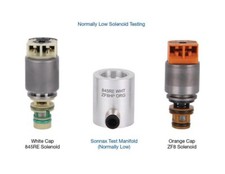
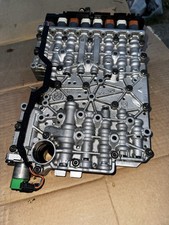
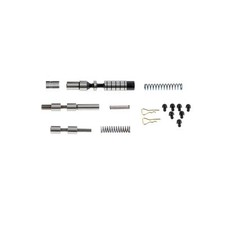
What the Solenoids Actually Control
The ZF8HP mechatronic unit bolts to the valve body and carries eight positions of variable-force solenoids that set line pressure, apply and release the torque converter clutch, and control the five shift clutches that produce the eight forward ratios. A worn or electrically failing solenoid at any one position shows up as a problem with exactly the function it controls: a bad line pressure solenoid produces pressure-related complaints across every gear, a bad TCC solenoid produces shudder or no lockup, and a bad clutch solenoid produces a slip, flare or ratio code tied to that one clutch.
That precision is useful once you have a code. It is also why guessing from a vague complaint wastes money — "it shifts funny" could be any one of eight circuits, or none of them.
Symptoms That Point at the Solenoid Circuit
Across the ZF8HP and 845RE family, solenoid-circuit complaints cluster into a short list:
- Harsh, soft or erratic shifts that do not track with a specific driving condition
- A flare or slip concentrated on one shift (commonly the 1-2 or a mid-range upshift)
- Neutral sensation between gears, or a delayed or wrong-gear start from a stop
- Torque converter shudder, delayed lockup, or no lockup at all
- A "Transmission Malfunction" message and a drop into a protective reduced-gear or safe mode
- Gear ratio or solenoid performance codes stored with no obvious mechanical cause
The generic SAE codes that point directly at a solenoid are pressure control solenoid performance or stuck-off faults — P0776 (pressure control solenoid B) and P0796 (pressure control solenoid C) are the common examples, with the letter identifying which solenoid position in the TCM's naming is implicated. On the Chrysler-built 845RE, FCA's own calibration can also set P1DCD, which FCA service bulletins describe as the TCM monitoring processor detecting performance consistent with multiple clutches locked up simultaneously — an internal logic check, not a direct short or open circuit, which is part of why it can be a software issue rather than a hardware one.
Check Software Before You Buy Parts
This is the step that gets skipped because it feels too easy. FCA service bulletin 21-036-16, dated November 19, 2016, reprograms the TCM on 2015 Ram 1500 Pickup trucks built with the 3.6L engine (sales code ERB) and the 845RE 8-speed automatic (sales code DFL) to resolve a documented set of symptoms: DTC P1DCD, DTC P1B13 (Park-By-Wire unintended out-of-park), DTC P0734 (gear 4 shift incorrect ratio), a bump sensation during engine start/stop transitions on light throttle, less-than-desired downshifts during normal driving and passing maneuvers, and less-than-desired upshift quality in the lower gears. The bulletin is a pure reflash — no solenoid, valve body or mechatronic unit is replaced — and it explicitly warns not to clear the TCM's shift adaptives during the process, because doing so can leave the transmission shifting rough until the adaptives relearn on their own.
This bulletin superseded an earlier version, 21-025-15 REV. A from August 2015, that covered the identical symptom list, which tells you this was not a one-off: FCA revised the fix twice for the same complaint pattern on the same transmission. Before you tear into a solenoid or order a mechatronic unit on an affected truck, confirm with a scan tool whether the TCM is already at the latest calibration.
When It Looks Electrical but Is Actually a Worn Bore
Solenoids don't work in isolation — each one regulates pressure through a valve riding in an aluminum bore, and that bore wears. Sonnax, which builds the aftermarket repair kits for this valve body, documents a specific and common failure here: the latch valve end plugs that cap and seal five bores in the ZF8HP50, ZF8HP75 and Chrysler 850RE valve bodies wear against those bores from repetitive spring motion and fluid pressure cycling. As the fit degrades, solenoid control pressure escapes the circuit it is supposed to hold. The resulting symptoms, per Sonnax: low solenoid feed pressure, erratic shift feel and engagements, inconsistent shift quality, and premature clutch failure — a list that overlaps almost completely with what a bad solenoid produces. Sonnax's fix is kit 35740-44K, which replaces the worn OE plugs with O-ringed versions across all five bores rather than relying on a new solenoid to compensate for a leaking circuit it was never the cause of.
On the earlier-generation ZF8HP45, ZF8HP55, ZF8HP70 and 845RE, the same class of symptom — TCC codes and lining failures, harsh, soft or erratic shifts, gear ratio and solenoid performance codes — is addressed by a broader valve body repair kit, Sonnax's SK®8HP, which includes a redesigned pressure regulator valve, a drop-in TCC regulator valve and spring, an oversized pressure-reducing valve and spring, two end plug retainers, and seven solenoid damper rubber inserts. Note this kit is Gen1-specific; it does not fit the Gen2 ZF8HP50, ZF8HP75 or 850RE.
The practical takeaway: a shift complaint with solenoid-type codes is not proof the solenoid itself failed. It is proof that the circuit that solenoid controls is not holding the pressure it should. Confirming which one failed is the next step.
Diagnosis Order
- Pull codes and record freeze frame. Note which solenoid position or clutch the code implicates, and whether it is a performance code (circuit works but pressure is wrong) or an electrical code (open or short in the wiring or coil).
- Check for an open TCM bulletin. On an 845RE in the affected build range, confirm current TCM calibration against the latest release before assuming a hardware fault.
- Test the solenoid circuit electrically. An open or shorted coil, or a damaged connector or harness pin at the mechatronic unit, is a hard electrical fault and does point at the solenoid or mechatronic unit itself, not the valve body.
- If the electrical test is clean but the symptom persists, the fault is most likely hydraulic — a worn bore, end plug, or regulator valve bleeding off the pressure that solenoid is trying to hold. This is where a vacuum test on the pulled valve body, not a parts swap, answers the question.
- Match the repair to what actually failed: a confirmed solenoid or mechatronic fault gets a solenoid kit or mechatronic replacement; confirmed bore wear gets the appropriate Sonnax repair kit for the generation on the bench.
Fluid After Any Solenoid or Valve Body Job
Whatever you open up, close it up correctly. ZF's product data sheet for LifeguardFluid 8 specifies a semi-synthetic ATF approved under ZF's own TE-ML 11 classification, with a stated density of 846 kg/m³ at 15°C and viscosity of 26 mm²/s at 40°C, and is explicit that no additives of any kind are permitted because they change the fluid's chemistry. A unit that was drained dry for a valve body or mechatronic repair takes roughly 9 liters (9.5 quarts) through the rear case fill plug before it goes back in the vehicle, filled with the transmission tipped on its side per Sonnax's fill procedure — and once it is installed, getting fluid back in requires more effort than gravity alone provides. Final level is set hot, against a scan-tool-read transmission temperature, not a dipstick, so don't skip the level-set step because the fill looked full going in.
FAQ
What does a bad shift solenoid feel like on a ZF8HP?
Harsh or erratic shifts, a flare or slip during a specific gear change, a neutral sensation between gears, delayed engagement after Park or Reverse, loss of torque converter lockup, or the dash warning that the transmission is in a protective limp mode. Because the valve body and solenoid pack share the same hydraulic circuits, a single worn bore can mimic an electrical solenoid fault almost exactly, which is why a scan tool and not a parts cannon is the right first move.
What codes point at a ZF8HP solenoid problem?
Pressure control solenoid performance or stuck-off codes such as P0776 and P0796 are the generic SAE codes for that fault family. On the Chrysler-built 845RE, FCA's own TCM logic can also set P1DCD, described in FCA service bulletins as the TCM monitoring processor detecting performance consistent with multiple clutches locked up, along with related codes P1B13 and P0734.
Can a software update fix a ZF8HP solenoid code?
Yes, for a documented population of vehicles. FCA service bulletin 21-036-16 reprograms the 845RE's TCM to resolve P1DCD, P1B13, P0734 and a list of shift-quality complaints on 2015 Ram 1500 trucks built with the 3.6L engine and 845RE transmission, with no parts replaced. Checking for an open TCM flash before ordering a solenoid pack or mechatronic unit can save a comeback and a warranty claim.
Do I need to replace the whole mechatronic unit or just a solenoid?
On most ZF8HP variants the solenoids are integrated into a mechatronic unit bolted to the valve body, so an individual solenoid is not a stand-alone serviceable part the way it is on an older unit. The repair path depends on what is actually failing: a verified open or shorted solenoid coil points at the mechatronic unit or a solenoid kit built for it, while erratic shift feel with good electrical readings points at valve body bore wear, which Sonnax addresses with kits like the latch valve end plug kit rather than a solenoid swap.
What ATF does a ZF8HP need after a solenoid or valve body repair?
ZF's own product data sheet specifies ZF LifeguardFluid 8, a semi-synthetic fluid under ZF's TE-ML 11 approval, with no additives of any kind permitted because they alter the fluid's chemistry. A unit refilled dry after a valve body or mechatronic job takes roughly 9 liters through the rear case fill plug before it goes back in the vehicle, with final level set against a temperature-gated procedure, not a dipstick.
Sources
- FCA US LLC / NHTSA — Service Bulletin 21-036-16, "Flash: 845RE Transmission Shift Enhancements," November 19, 2016. Backs the 2015 (DS) Ram 1500 Pickup application with the 3.6L engine (sales code ERB) and 845RE 8-speed automatic (sales code DFL), the symptom list (DTC P1DCD, DTC P1B13, DTC P0734, start/stop bump sensation, reduced downshifts and upshift quality), the pure-reflash remedy with no parts replaced, the warning against clearing shift adaptives during the flash, and that this bulletin supersedes 21-025-15 REV. A dated August 5, 2015, which covered the identical symptom set. static.nhtsa.gov (PDF)
- Sonnax — "O-Ringed Latch Valve End Plug Kit" product page, part 35740-44K. Backs the ZF8HP50, ZF8HP75 and Chrysler 850RE application, the wear mechanism (repetitive spring motion and fluid pressure variations wearing the plug-to-bore fit across five bores), and the resulting symptoms: low solenoid feed pressure, erratic shift feel and engagements, inconsistent shift quality, and premature clutch failure. sonnax.com
- Transmission Digest / Gears Magazine — "ZF8HP/845RE SHIFT KIT® Valve Body Repair Kit," May 2025. Backs the Gen1-only compatibility (ZF8HP45, ZF8HP55, ZF8HP70, ZF8HP90, Chrysler 845RE; not Gen2 ZF8HP50/75 or 850RE), part number SK®8HP, the symptoms the kit addresses (TCC codes and lining failures, harsh/soft/erratic shifts, gear ratio and solenoid performance codes), and the kit contents including the redesigned pressure regulator valve, TCC regulator valve and spring, oversized pressure-reducing valve and spring, end plug retainers and solenoid damper inserts. gearsmagazine.com
- Sonnax — Technical Resource #1425, "ZF 8 Speeds: How to Properly Fill with ATF." Backs the 9-liter (9.5 quart) fill quantity for a dry, overhauled unit prior to installation via the rear case fill plug with the transmission tipped on its side, and the note that an already-installed unit requires a forceful fill technique and that fill procedures vary by specific ZF 8-speed application. sonnax.com
- ZF Friedrichshafen AG — Product Data Sheet, ZF LifeguardFluid 8 (spec S671.090.312). Backs the fluid as a semi-synthetic ATF approved under ZF's TE-ML 11 classification, developed specifically for 8HP automatic transmissions, with density 846 kg/m³ at 15°C, viscosity 26 mm²/s at 40°C, and the no-additives requirement. Fluid PDS (PDF)