P0700 is the code techs love to hate, because it never actually tells you anything. It's the SAE-generic Transmission Control System (MIL Request) code, and on a ZF8HP, 845RE or 850RE it means exactly one thing: the TCM found a fault it considers serious enough to warrant the check-engine lamp, and it asked the PCM to turn it on. That's the entire message. The real fault -- the code that actually names a sensor, a solenoid, a gear ratio, or a processor fault -- lives in the TCM's own memory as a separate, companion DTC, and a basic code reader that only polls the engine computer will often show you P0700 and nothing else.
This guide covers what P0700 actually represents on this platform, two real Stellantis factory bulletins that show the TCM itself can be the source of an erroneous MIL request with no mechanical fault present, a documented case where the opposite was true and a physical sensor failure masqueraded as a software problem, and the diagnostic order that tells you which situation you're actually in before you start ordering parts.
What P0700 Actually Means
Every OBD-II transmission control module can detect faults the engine computer has no way of seeing on its own -- a bad shift solenoid, a gear ratio that doesn't match what was commanded, an internal processor fault. SAE built a standard way for the TCM to flag this: when it logs a fault it considers MIL-worthy, it sends a request over the vehicle network asking the PCM to illuminate the check-engine lamp, and the PCM logs that request as P0700. The PCM isn't diagnosing anything itself here -- it's just relaying a request. The actual diagnostic information, the specific DTC that explains what went wrong, is stored in the TCM's own fault memory, not the PCM's.
That split matters mechanically for how you scan the vehicle. A basic, engine-only code reader talks to the PCM. It will show P0700 and stop, because it has no way to read the TCM's internal codes. To see what actually triggered the MIL request, you need a scan tool capable of addressing the transmission control module directly -- on these Stellantis platforms that's wiTECH, the same tool Chrysler/Jeep/Ram dealers use to run the factory bulletins covered below, though a quality aftermarket scanner with full bi-directional transmission access will also pull the TCM's codes.
Two Real Factory Bulletins Where the TCM Itself Was the Fault
It's tempting to treat P0700 as proof that something is mechanically wrong inside the transmission. Two documented Stellantis bulletins on this exact platform show that isn't always true -- sometimes the TCM's own software logic is wrong, and it reports a fault that was never really there.
TSB 21-006-15 Rev. B, dated August 5, 2015 and hosted by NHTSA, covers 2015 Dodge Challenger models built in a narrow March 2015 window with the 3.6L engine and the 845RE automatic (sales code DFL). The bulletin states that a small number of these vehicles may show a MIL "due to an erroneous Diagnostic Trouble Code," specifically naming P1DCD (TCM processor performance, multiple clutches showing locked up), P1B13 (Park-By-Wire unintended out-of-park position), and P0734 (gear 4 incorrect ratio set in TCM memory), alongside a list of harsh or erratic downshift symptoms. The stated cause is TCM software, and the entire repair procedure is a TCM reprogram with wiTECH -- no parts, no valve body, no clutch work. Chrysler's own language calls these "erroneous" codes, meaning the fix is correcting what the TCM reports, not what the transmission is doing.
TSB 21-034-24, dated May 17, 2024, covers 2022 Jeep Wrangler models with the 2.0L turbo engine and the 850RE 8-speed automatic (sales code DFT). The customer symptom listed is a MIL illumination, and the bulletin names the exact companion code: P0701 -- Transmission Control System Range/Performance. The stated cause is TCM software, and again the entire repair is reprogramming the TCM with the latest available calibration. P0701 is a close cousin of P0700 in the same code family -- it's slightly more specific, flagging a range/performance problem rather than a pure MIL request -- but it's the same pattern: a software bug in the TCM's own logic, not a hydraulic or mechanical fault, generating a code that looks like real trouble.
Both bulletins are narrow. They apply to specific build-date windows and specific sales codes, not every 845RE or 850RE on the road. Before assuming your vehicle qualifies, run the VIN and confirm the exact calibration and build date against the bulletin -- Stellantis dealers verify this through wiTECH before performing the reflash, and you should too.
When the Companion Code Points to Hardware, Not Software
Those two bulletins can create a false sense that every TCM-related code on this platform is a reflash away from fixed. A documented repair published in Transmission Digest shows the opposite can also be true. A 2019 Chrysler 300 with the 845RE came into AAction Transmissions with a complaint of not engaging Park, the Park indicator blinking in both the shifter console and the instrument cluster. The scan tool returned two codes: P07B9-00 (Park Switch 2 Circuit Low) and P1B13-00 (Park-By-Wire Unintended Out of Park Position) -- the same P1B13 that shows up in the 845RE software bulletin above, but this time for an unrelated, physical reason.
The technician pulled the pan and inspected the Manual Park Release mechanically; it worked correctly by hand, and the transmission held and released Park normally when actuated directly. With nothing mechanically wrong, the codes were cleared -- and P07B9 came back immediately on the next key cycle. The theory of operation for that code, pulled from Alldata, explained why: the Park Pawl position sensor on this transmission's Park-By-Wire system isn't a separate, serviceable part. It's a magnetic sensor built directly into the TCM's own lead frame, reading a magnet on the park linkage as it moves. The TCM assembly was replaced and reprogrammed, and the Park complaint was resolved. No reflash would have fixed that fault, because the problem wasn't the TCM's software -- it was a physically failed sensor that happens to live inside the TCM housing.
That's the real lesson behind P0700 on this platform: the same module can be the correct fix for one companion code and completely unrelated to another. You cannot tell which situation you're in from P0700 alone, or even from a P1B13 alone -- you need the full code set, the build date, and in ambiguous cases a look at whether a bulletin exists for your specific calibration before you decide between a reflash and a module replacement.
Rule Out Fluid Before You Chase Electrical Gremlins
Low or incorrect fluid can produce shift-quality and ratio-type companion codes that ride in under the same P0700 MIL request, and it's the cheapest thing on this list to check. A common and costly mistake on this platform is topping off or refilling with ATF+4 because it's the fluid Chrysler specifies for other transmissions in the same parts catalog. The 845RE and 850RE are ZF-designed units and take ZF's own fluid -- Mopar's part is labeled ZF 8 & 9 Speed ATF, built to the Lifeguard 8/Lifeguard 9 specification ZF itself owns and approves. It is not interchangeable with ATF+4.
Fill procedure matters as much as fluid choice. Per Sonnax's own technical bulletin on filling ZF 8-speeds, the 845RE and ZF8HP45/50/70 take a dry fill of roughly 9 liters (9.5 quarts) when the unit is overhauled and the torque converter hasn't been installed yet, and that fill is done by tipping the transmission onto its side and filling through the oil fill plug on the right rear of the case -- not through the dipstick-style fill most techs expect. Sonnax specifically warns that a unit showing full after only about 4 quarts has not actually been filled; the procedure matters, not just the volume poured in. A low or shorted fill that never reached spec can present as erratic shift behavior that lands a companion code without a single internal part being worn.
Diagnostic Order: What to Check, In What Sequence
- Pull the TCM's own codes, not just P0700. Use a scan tool with full transmission-module access -- wiTECH or an equivalent aftermarket scanner -- and record every companion DTC, not just the first one shown.
- Confirm the transmission and sales code. 845RE, 850RE, and the various ZF8HP export designations don't all share hardware or software calibrations. Match the VIN, build date and transmission sales code before assuming a bulletin applies.
- Check for an open bulletin matching your exact companion code and build window. P1DCD, P1B13 or P0734 on a 2015 Challenger built in the March 2015 window points to TSB 21-006-15 Rev. B. P0701 on a 2022 Wrangler with the 850RE points to TSB 21-034-24. Neither applies outside its stated population.
- If a bulletin matches, reprogram the TCM first before replacing any part. Both documented bulletins resolve with software alone.
- If no bulletin matches, or the same code returns immediately after being cleared, treat it as a real fault and inspect the physical system the code describes -- Park linkage, speed sensor wiring, valve body -- rather than defaulting to a TCM reflash.
- Check fluid level, condition and spec -- confirm it's ZF 8 & 9 Speed ATF, not ATF+4 -- before condemning a sensor or solenoid for a shift-quality complaint riding under P0700.
- Clear codes and road test after any reflash, module replacement, or fluid correction before concluding the fix held.
P0700 by itself tells you almost nothing except that the TCM wants your attention. On the 845RE and 850RE, the documented record shows that attention is sometimes owed to a software bug Stellantis already has a reflash for, and sometimes owed to a physical sensor failure that a reflash can't touch. The only way to know which is pulling the real code hiding behind the wrapper before you reach for a part number.
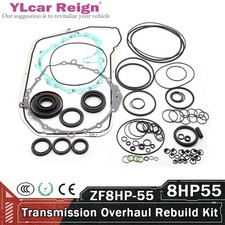
850RE Transmission Overhaul Kit
If the companion code traces to internal wear rather than a TCM software bug or a Park-position sensor, Core Transmission Parts stocks a full overhaul kit for the 850RE.
Shop the 850RE overhaul kit at Core Transmission Parts →FAQ
What's the difference between P0700 and a code like P0701 or P0734 on this platform?
P0700 is the generic SAE wrapper: Transmission Control System (MIL Request). It means the TCM told the PCM to turn the MIL on, nothing more. P0701, P0734, P1DCD and similar codes are the actual faults the TCM logged in its own memory -- a range/performance problem, a gear-ratio error, a processor fault. A basic code reader often shows P0700 alone because it only talks to the engine computer. You need a scan tool that can address the TCM directly, such as wiTECH on these Stellantis platforms, to pull the companion code that tells you what's actually wrong.
Will a TCM reflash always clear a P0700 on a 845RE or 850RE?
Not always, and that's the trap. Stellantis has issued real reflash bulletins where a calibration bug in the TCM's own code logic caused it to log an erroneous DTC and request the MIL with no actual mechanical problem present -- TSB 21-006-15 Rev. B on the 845RE and TSB 21-034-24 on the 850RE are both exactly that. But a documented case from Transmission Digest shows the opposite: a 2019 Chrysler 300's park-position sensor, which is physically built into the TCM's lead frame, failed and set a real companion code that looked identical on a scan tool until the technician replaced the TCM assembly itself. Reflashing a TCM with a failed internal sensor does nothing. Confirm which TSB, if any, actually matches your VIN and build date before assuming a software update is the fix.
Can I diagnose P0700 with a basic OBD-II code reader?
You can read it, but you can't diagnose it. A basic reader that only polls the engine computer will show P0700 and stop there, because the actual fault code lives in the TCM's own memory, not the PCM's. On Chrysler, Jeep, Dodge and Ram vehicles with the 845RE or 850RE, that means a wiTECH-capable scan tool or an aftermarket scanner with full bi-directional transmission module access. Skipping this step and swapping parts based on P0700 alone is how techs end up replacing a TCM that was never the problem, or a valve body when the real fault was a reflash bulletin.
Is ATF+4 the correct fluid for the 845RE or 850RE?
No, and this trips up more shops than it should. ATF+4 is Chrysler's specification for the 42RLE, 545RFE, and similar legacy units. The 845RE and 850RE are ZF-designed transmissions and require ZF's own fluid -- Mopar's part for it is labeled ZF 8 & 9 Speed ATF, which is the Lifeguard 8/Lifeguard 9 family ZF itself produces and approves. Low or degraded fluid can produce erratic shift quality and ratio-type companion codes that ride in under the P0700 umbrella, so confirm the fluid in the pan matches the ZF spec, not the ATF+4 bottle on the shelf, before you chase an electrical fault.
Does P0700 mean the TCM itself has failed?
Not by itself. P0700 only means the TCM asked for the MIL -- it says nothing about whether the TCM, a sensor, a solenoid, a valve body, or software is the actual cause. On this platform the real cause has turned out to be a software calibration bug fixed by a reflash in two separate factory bulletins, and in a separate documented case, a physically failed sensor built into the TCM that required replacing the module. The only way to tell which one you have is to pull the companion code and work the diagnosis from there.
Sources
- FCA US LLC / NHTSA — Technical Service Bulletin 21-006-15 Rev. B, "Flash: 845RE Transmission Shift Enhancements," August 5, 2015. Backs the 2015 Dodge Challenger (3.6L, 845RE, sales code DFL) population, the P1DCD/P1B13/P0734 erroneous-DTC symptom set, and the TCM-reprogram-only repair procedure. static.nhtsa.gov (PDF)
- FCA US LLC / NHTSA — Technical Service Bulletin 21-034-24, "Flash: Transmission Control Module (TCM) Updates," May 17, 2024. Backs the 2022 Jeep Wrangler (2.0L turbo w/ESS, 850RE, sales code DFT) population, the P0701 companion code, the TCM-software cause, and the reprogram-only repair. static.nhtsa.gov (PDF)
- Wayne Colonna — "845RE Park-by-wire malfunction," Transmission Digest, August 19, 2024. Backs the documented 2019 Chrysler 300 case: the P07B9/P1B13 code set, the Park Pawl sensor being physically integrated into the TCM's lead frame, and the TCM-replacement (not reflash) repair that resolved it. transmissiondigest.com
- Sonnax — "ZF 8 Speeds: How to Properly Fill with ATF," tech resource. Backs the 845RE/ZF8HP45/50/70 dry-fill capacity (approximately 9 L / 9.5 qt), the tip-on-side fill procedure through the right-rear case plug, and the warning against a partial, underfilled unit reading full. sonnax.com
- ZF Friedrichshafen AG — Product Data Sheet, ZF LifeguardFluid 8. Backs the requirement that this transmission family run ZF's own Lifeguard 8/9 specification fluid rather than a generic Chrysler ATF, and the stated risk of substituting another fluid. aftermarket.zf.com (PDF)