P0778 is a narrow code. It's not "transmission problem" -- it's Pressure Control Solenoid B Electrical, the SAE-generic fault reserved for an electrical-circuit failure on one specific solenoid, as opposed to a hydraulic performance deviation. It sits in a four-code family covering that same physical circuit: P0776 (Performance), P0777 (Stuck On), P0778 (Electrical), and P0779 (Intermittent). On the ZF8HP45/55/70 and its Chrysler-badged twin, the 845RE -- shared across Charger, Challenger, 300, Grand Cherokee and Ram applications -- knowing which of those four you actually have changes where you point a meter before you order a part.
This guide covers which physical solenoid "B" is on this platform, the actual bench spec for testing it, why an "electrical" code is more often a wiring problem than a dead coil, and a documented case where the real fix was a software update, not a part.

What P0778 Actually Means
The four-code family P0776 through P0779 all point at the same physical circuit -- generic Pressure Control Solenoid B -- but each covers a different failure mode. P0776 is a performance code: the TCM commanded a pressure and the measured hydraulic result didn't match, which can happen with a perfectly healthy electrical circuit if the valve the solenoid operates is simply worn. P0777 is stuck-on. P0779 is intermittent. P0778 is specifically an electrical fault: the TCM's solenoid driver circuit saw an open, a short to ground, a short to voltage, or a current/voltage reading outside the range it expects for the commanded output. That's a meaningfully different diagnostic starting point -- you're chasing wiring, a connector, or a coil, not a worn bore.
Which Solenoid Is "B" on the 845RE/ZF8HP?
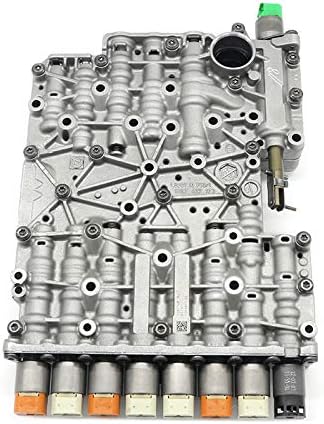
Sonnax's Solenoid Identification & Location Chart, published in the installation and testing booklet for the ZF8-ZIP valve body kit covering the Chrysler 845RE and ZF8HP45/55/70, labels the unit's eight solenoid bores A through H and cross-references both ZF's internal part designation and Chrysler's wiring-diagram label for each position. Position B is ZF's EDS-7, which Chrysler labels SOL LPS -- the line pressure solenoid. This is not one of the on/off shift solenoids tied to a single gear; it's the solenoid that modulates the main pressure regulator valve and sets line pressure for the whole transmission. That's why an electrical fault here tends to produce symptoms across every gear rather than one specific shift.
One caution worth repeating from Sonnax's own documentation: the valve body layout changed between Gen 1 units (8HP45/70/90, 845RE) and Gen 2 units (8HP50/75/95, 850RE that arrived around 2019), and the B and D solenoid positions swap locations between the two generations. Confirm which generation you're working on from the valve body casting and separator plate code before you assume position B is in the same physical spot a Gen 2 diagram shows -- see our ZF8HP identification guide for the generation split in more detail.
Bench-Testing the Circuit: The Actual Spec
Sonnax's installation and testing booklet gives a specific, documented spec for this solenoid coil: 5.0 ohms at 20°C (68°F), measured with the mechatronic circuit board removed so you're reading the coil in isolation rather than through the TCM's own circuitry. The same document carries an explicit caution: do not use an ohmmeter with more than 0.6 volts of test supply, because a higher-voltage meter can return a false reading or stress the winding.
Getting to that coil means accessing the valve body the way Sonnax's own teardown procedure describes it: the valve body comes down from the case on 14 bolts, four more bolts release a metal bracket holding the TCM connector, and the connector then pulls gently out of the case. Sonnax flags one specific thing to watch during this step -- note the location of the B release rubber feed tube before you pull the valve body, since it can come out of its seat in the case and needs to go back exactly where it was. If the resistance reads well outside 5.0 ohms, you've confirmed a coil fault. If it reads in spec, the electrical fault most likely lives in the connector, the harness, or the TCM driver circuit -- not the solenoid itself.
One more detail that matters if you pull the pack: the TCM learns a flow rate for each solenoid based on its specific bore position. A reused, still-good solenoid should go back into the exact bore it came out of. Mixing positions -- even among solenoids that look identical -- can produce shift-quality complaints that look like a new failure but are really a mismatched flow-rate adaptation.
Electrical Faults Are Often Wiring, Not the Solenoid
An "electrical" code name can be misleading, because it sounds like it must mean the solenoid coil itself. In practice, on this exact transmission family, a documented case shows the opposite. Gears Magazine (ATRA) published a shop case study of a 2016 Dodge Challenger with a 3.6L engine and an 845RE that went into transmission failsafe after the owner repeatedly jump-started a dead battery. The shop chased a TCM-rejected sensor signal code through a full diagnostic tree -- scan tool communication checks, a PCM/TCM reprogram, a sensor replacement -- with no change, until they unwrapped the harness near the sensor and found a single wire with poor internal contact that fell apart when handled, with no outward sign of damage or tampering. Repairing that one wire cleared the code and ended the failsafe condition.
That case wasn't a pressure control solenoid code, but it's the same lesson applied to the same platform: an "electrical" fault the TCM reports can trace to one degraded strand inside a harness that looks completely normal from the outside. Before you condemn the line pressure solenoid coil for a P0778, inspect the TCM connector for corrosion or pushed-back terminals, check the harness near the valve body mounting bolts and any exhaust heat exposure for chafe, and confirm a clean ground. A degraded wire that measures fine when the engine is cold and fails under heat or vibration is a common reason a "new solenoid" doesn't fix the code.
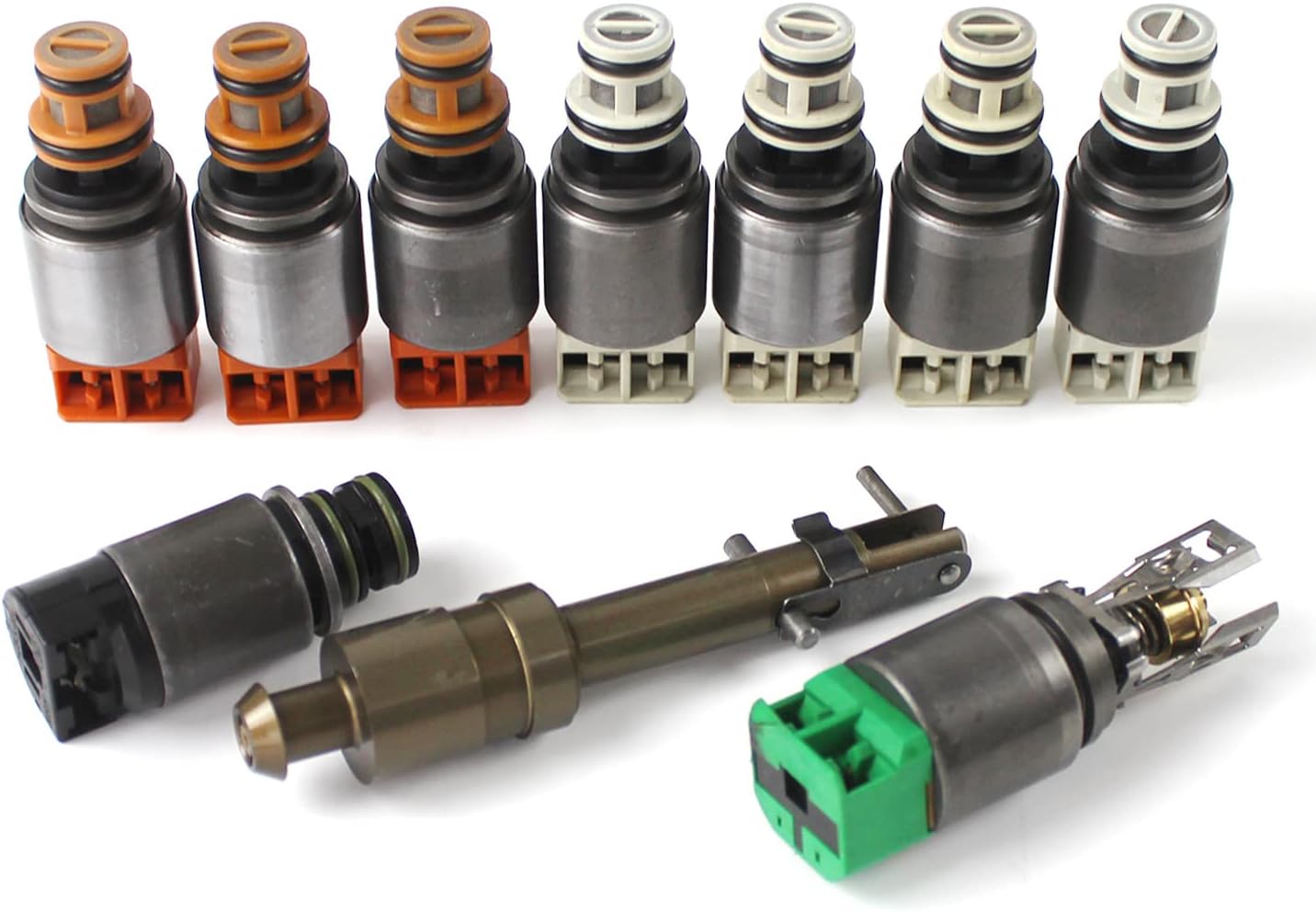
ZF 8HP45/8HP70 Mechatronic Solenoid Kit, 9-Piece
If the connector and harness check out and the coil resistance is confirmed out of spec, replace the full solenoid pack rather than guessing at one coil -- the TCM's learned flow rates make a full-kit swap the more reliable fix on this platform.
View the 9-piece mechatronic solenoid kit →Before You Replace Anything: Check for a TCM Software Bulletin
FCA US LLC Service Bulletin 21-025-15 Rev. A, dated August 5, 2015 and hosted by NHTSA, is a useful reminder of how often an 845RE electrical complaint turns out to be software, not hardware. It covers 2015 (DS) Ram 1500 Pickups built on or after April 15, 2015 with the 3.6L engine (sales code ERB) and the 845RE 8-speed automatic (sales code DFL), and documents a cluster of erroneous DTCs -- P1DCD (TCM monitoring processor performance, multiple clutches locked up), P1B13 (park-by-wire unintended out-of-park position), and P0734 (gear 4 shift incorrect ratio) -- along with a bump sensation on engine stop/start and inconsistent up- and downshifts. The entire documented repair is a TCM reprogram to the latest available software; the bulletin explicitly warns not to clear the shift adaptives during that process, since doing so can leave the transmission shifting rough until they relearn.
That bulletin doesn't cover P0778 specifically, but it's hard evidence that this platform's TCM has shipped with erroneous-DTC software bugs before, corrected with nothing more than a flash. Before you spend money on a solenoid or a valve body for an electrical code, confirm the TCM calibration is current and check for an applicable bulletin on your exact build date and sales codes. It's the cheapest diagnostic step available and it's sometimes the whole fix.
Fluid and Torque Reference
If you're servicing the valve body while you're in there, ZF's own product data sheet for LifeguardFluid 8 is explicit that only LifeguardFluid 8 or the newer LifeguardFluid 9 may be used in these transmissions -- the fluid's friction behavior is calibrated to the unit, and substituting another ATF can degrade shift quality or contribute to failure. ZF lists the fluid as green, with a viscosity of 26 mm²/s at 40°C and 5.6 mm²/s at 100°C, a pour point of -42°C, and a flash point of 206°C. These are generally lifetime-fill units, but ZF recommends a change at 150,000 km, sooner under high heat, heavy load, or unknown prior use.
| Spec | Value |
|---|---|
| Fluid (ZF) | ZF LifeguardFluid 8 (or LifeguardFluid 9) |
| Fluid (Mopar equivalent) | Mopar 6815795AA, green |
| Service fill | Approx. 4.2 qt. / 4 L |
| Complete dry fill | Approx. 9.5 qt. / 8 L (check at 122°F) |
| Solenoid coil resistance | 5.0 ohms at 20°C/68°F, circuit board removed |
| Mechatronic/valve body half bolts | 10 Nm / 89 in-lb |
| Complete valve body-to-case bolts | 14 Nm / 10 ft-lb |
| Plastic oil pan-to-case | 10 Nm / 89 in-lb |
After any solenoid or valve body service, run the drive-cycle relearn Sonnax specifies: verify fluid temperature is at 122°F, then perform 6 to 10 light throttle-up and coast-down shift cycles for a partial relearn. Skipping that step is a common reason a correctly repaired unit still shifts rough on the test drive.
Diagnostic Order: What to Check, In What Sequence
- Confirm the generation and build date. Read the valve body casting and separator plate code, and note the vehicle's build date and sales codes, before you order parts or search for bulletins.
- Check for an open TCM bulletin. A software fix like FCA's 21-025-15 is faster and cheaper than a teardown, and it's the right first call on an electrical-type code with no obvious wiring damage.
- Inspect the connector and harness. Pull the TCM connector per the documented procedure, and check pins for corrosion or push-back, and the harness for chafe, before you assume the coil is bad.
- Bench-test the solenoid. 5.0 ohms at 68°F with the circuit board removed, using an ohmmeter under 0.6V. Confirmed out-of-spec means the coil itself has failed.
- Repair or replace accordingly -- a wiring or connector repair for a confirmed electrical fault outside the coil, a full solenoid kit for a confirmed coil failure (reusing good solenoids in their original bores), or a valve body if the regulator bore is also worn.
- Run the drive-cycle relearn after any repair: 122°F fluid temp, 6-10 light throttle-up and coast-down cycles.
Worked in that order, an electrical code gets diagnosed as what it actually is -- a circuit problem, which might be a wire, a connector, outdated software, or a coil -- instead of becoming an expensive guess that starts and ends at "replace the solenoid."
Shop ZF8HP line pressure solenoids, mechatronic solenoid kits, valve bodies and ZF-spec fluid — shipped fast from the USA.
Shop ZF8HP parts →FAQ
What's the difference between P0778 and P0776, P0777 or P0779 on a ZF8HP?
All four codes cover the same physical circuit, generic Pressure Control Solenoid B, but describe different failure types. P0776 is a performance code: the TCM commanded a pressure and the hydraulic result didn't match, which can happen even with a perfectly healthy electrical circuit if the valve body bore is worn. P0777 is stuck-on. P0779 is intermittent. P0778 specifically means the TCM's driver circuit saw an electrical fault -- open circuit, short to ground, short to voltage, or a current/voltage reading outside the expected range -- which points you at wiring, the connector, or the solenoid coil itself rather than at hydraulic wear.
Which physical solenoid is "Pressure Control Solenoid B" on the 845RE/ZF8HP?
Sonnax's published Solenoid Identification & Location Chart for the Chrysler 845RE and ZF8HP45/55/70 valve body, included in the ZF8-ZIP kit's installation and testing booklet, labels the eight solenoid bores A through H. Position B is ZF's EDS-7, which Chrysler's wiring diagrams and TCM label SOL LPS -- the line pressure solenoid that sets main line pressure for the entire unit, not a shift solenoid tied to one gear.
Can I bench-test for P0778 with just a multimeter, and what's the spec?
Yes, within limits. Sonnax's ZF8-ZIP installation and testing booklet specifies 5.0 ohms at 20°C (68°F) for this solenoid coil, checked with the mechatronic circuit board removed so you're reading the coil in isolation. The same booklet warns against using an ohmmeter with more than 0.6 volts of test supply, since a higher-voltage meter can give a false reading or stress the winding. A resistance reading well outside 5.0 ohms confirms a coil fault; a reading in spec means the electrical fault is more likely in the connector, harness, or TCM driver circuit.
Will a weak battery or a bad jump-start cause a P0778 code?
It can contribute, though not by damaging the solenoid directly. Gears Magazine documented a 2016 Dodge Challenger 845RE that went into transmission failsafe after repeated jump-starts, ultimately traced to a single degraded wire in the harness near a sensor that the TCM read as an invalid signal -- not a solenoid failure at all. A sagging charging system or a marginal ground during a jump-start can expose an already-weak wire or connection to the point where the TCM flags an electrical fault on a circuit, including a pressure control solenoid circuit, that was borderline before.
Does P0778 always mean I need a new solenoid, or could it be wiring?
Don't assume it's the solenoid. Because P0778 is specifically an electrical-circuit code, a wiring or connector fault produces the identical code to a failed solenoid coil. Check the TCM connector and harness for corrosion, pushed-back terminals, and chafe before condemning the solenoid, and confirm the TCM software is current -- FCA's own Service Bulletin 21-025-15 Rev. A documents erroneous DTCs on the 845RE that were corrected with a TCM reflash alone, no hardware replaced. Bench-test the solenoid's resistance only after you've ruled out the wiring and the software level.
Sources
- Sonnax — ZF8-ZIP Zip Kit Installation & Testing Booklet, Chrysler 845RE/ZF8HP45/ZF8HP55/ZF8HP70. Backs the Solenoid Identification & Location Chart (position B = ZF EDS-7 / Chrysler SOL LPS), the 5.0-ohm at 20°C/68°F resistance spec with circuit board removed, the under-0.6V ohmmeter caution, the valve body/connector removal procedure, torque specs, and fluid fill capacities. cdn.transend.us (Sonnax document)
- ZF Friedrichshafen AG — ZF LifeguardFluid 8 Product Data Sheet. Backs the requirement that only ZF LifeguardFluid 8 or ZF LifeguardFluid 9 may be used in these transmissions, the fluid's color and viscosity characteristics, and the 150,000 km recommended change interval. aftermarket.zf.com
- FCA US LLC — Service Bulletin 21-025-15 Rev. A, "845RE Transmission Shift Enhancements" (hosted by NHTSA). Backs the 2015 Ram 1500/845RE erroneous DTC cluster (P1DCD, P1B13, P0734) and the documented TCM-reflash-only repair procedure. static.nhtsa.gov
- Gears Magazine (ATRA) — "Challenging Times: A Dodge Challenger with an 845RE in Failsafe," June 2021. Backs the real-world case of a degraded harness wire on an 845RE producing a TCM-rejected signal and failsafe condition after jump-starts, resolved by a wiring repair rather than a parts replacement. gearsmagazine.com
- Gears Magazine (ATRA) — "Solenoid Test Methods," August 2020. Backs the general bench-test methodology for pressure control/linear solenoids (sub-10-ohm coil resistance, current sweep against outlet pressure, hysteresis as a wear indicator). gearsmagazine.com
- Sonnax (Jim Dial) — "Chrysler ZF8 generations 1 and 2 identification guide," Transmission Digest, April 20, 2023. Backs the Gen 1 (8HP45/70/90, 845RE) vs. Gen 2 (8HP50/75/95, 850RE) split and the B/D solenoid position swap between generations. transmissiondigest.com