The ZF8HP's pressure control solenoid is not the same part as the shift solenoids people usually mean when they say "solenoid problem." ZF's own documentation labels it EDS-7 with the function code LP, for line pressure; Chrysler calls the exact same part SOL LPS on its wiring diagrams and in the TCM. On Sonnax's published solenoid identification chart for the 845RE/ZF8HP45/55/70 eight-solenoid pack, it sits in position B -- a different bore, a different job, and a different failure signature than the shift solenoids that just turn hydraulic circuits on and off.
That distinction matters because the pressure control (also called EPC, for electronic pressure control) solenoid doesn't pick a gear. It modulates the main pressure regulator valve -- ZF calls it SYS-DR-V, Chrysler calls it LP-V/RED-V -- which sets line pressure for the entire unit. When this circuit goes out of spec, you don't get one gear acting up. You get symptoms that show up across every gear and every shift, because the whole transmission is running on the wrong base pressure.
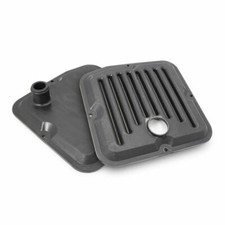

Gen 1 vs. Gen 2: Confirm Which Unit You're Working On First
Sonnax technical specialist Jim Dial's generation identification guide lays out the split clearly: Gen 1 units are classified 8HP45, 8HP70 and 8HP90, badged 845RE on Chrysler/Dodge/Jeep/Ram applications. In 2019, some of those same applications moved to Gen 2, classified 8HP50, 8HP75 and 8HP95, badged 850RE. The hardware changed -- Gen 2 eliminated the B2 release circuit and added wave springs to the clutch packs -- and so did the controls. Gen 2 solenoids use new-style cream and blue caps and are not interchangeable with the Gen 1 units, because the snout diameters differ. The valve body layout shifted too: the B and D solenoid positions swap locations between generations.
None of this is cosmetic. Order the wrong generation's pressure control solenoid or kit and it will not seat, or it will seat and not seal, and you will be back under the vehicle. Confirm the generation from the valve body casting and the separator plate code -- Sonnax's documentation lists A048/B048 and A054/B054 as the Gen 1 (8HP45/8HP70) codes -- before you order anything.
Symptoms of a Failing Pressure Control / Line Pressure Solenoid
Because this solenoid and the main pressure regulator valve it operates control line pressure for the whole transmission, the symptom list is broad rather than gear-specific. Per Sonnax's documented failure modes for the Main PR Valve and Main PR Sleeve on this platform, you'll see:
- Harsh or soft shifts -- line pressure swinging high or low instead of holding the commanded value
- Erratic or high line pressure -- readable on a scan tool if you have access to the commanded vs. actual pressure PID
- Burnt clutches -- sustained high pressure cooking clutch material, or sustained low pressure letting clutches slip and glaze
- Broken internal parts -- from excessive, unregulated line pressure stressing components not designed to see that load
- Restricted converter and lube flow -- the same regulator circuit that sets line pressure also feeds the converter and lube circuits downstream
- Delayed or flared engagement, and gear ratio or solenoid performance codes stored alongside the pressure codes
On the code side, a failing or out-of-spec pressure control solenoid circuit typically sets a generic Pressure Control Solenoid code in the P0960-P0969 range -- circuit open, circuit low, circuit high, or range/performance, depending on exactly what failed -- rather than the P0750-series codes associated with the on/off shift solenoids. If you're staring at a shift-solenoid code instead, you're looking at a different part in a different bore; see our ZF8HP shift solenoid symptoms guide for that failure mode.
Don't Skip This: Not Every Harsh Shift Is the Solenoid
FCA's own Service Bulletin 21-018-15 is worth reading before you start pulling a valve body. It covers 2015 Jeep Grand Cherokee SRT models built on or before March 3, 2015, with the 6.4L engine and the 8HP70 transmission, and documents a near-identical symptom list to what a worn pressure control circuit produces: harsh or inconsistent upshifts, harsh or inconsistent downshifts while coasting or during passing maneuvers, erratic 1-2 upshifts in cold ambient temperatures, and delayed engagement shifting from reverse to drive.
The entire fix FCA specifies for that bulletin is a TCM software reflash to the latest calibration -- no solenoid, no valve body, no hardware at all. That's the trap: shift-feel complaints that match a hardware wear pattern can also come from outdated adaptive strategy in the TCM. Before you commit to parts, confirm the TCM software level is current and pull actual pressure control solenoid codes (P096x) or an out-of-spec resistance reading. A vehicle with stored codes and a bad resistance reading has a hardware problem. A vehicle with none of that and old software often doesn't.
How to Actually Test the Solenoid
Sonnax's installation and testing booklet for its ZF8-ZIP valve body kit -- which covers this exact solenoid and valve pairing on the 845RE/ZF8HP45/55/70 -- gives a specific bench spec: check solenoid resistance at 5.0 ohms at 20°C (68°F), with the mechatronic circuit board removed so you're reading the coil in isolation rather than through the TCM's circuitry. The same document carries an explicit caution for techs doing this test: do not use an ohmmeter with more than 0.6 volts of test supply, since a higher-voltage meter can give a false reading or stress the winding.
A couple of reassembly details matter as much as the test itself. First, the TCM learns a flow rate for each solenoid based on its specific bore position, so a reused original solenoid needs to go back in the exact bore it came out of -- Sonnax calls this out directly and recommends marking solenoids before removal to avoid mixing them up. Second, after any solenoid or valve body service, run the drive-cycle relearn: verify fluid temperature is at 122°F, then perform 6 to 10 light throttle-up and coast-down shift cycles for a partial relearn. Skipping that step is a common reason a "properly repaired" unit still shifts rough on the test drive.
The Root Cause Is Usually a Worn Bore, Not Just the Solenoid
Replacing the solenoid alone and nothing else is a common half-fix on this platform. Sonnax's documentation for the Main PR Valve and Main PR Sleeve identifies the actual wear mechanism: the valve and sleeve bores wear enough to let line pressure fluid escape past the spool instead of staying in the circuit where it belongs. A new solenoid can send a perfect commanded signal and the pressure will still be erratic, because the valve it's actuating can no longer hold the pressure the solenoid is asking for.
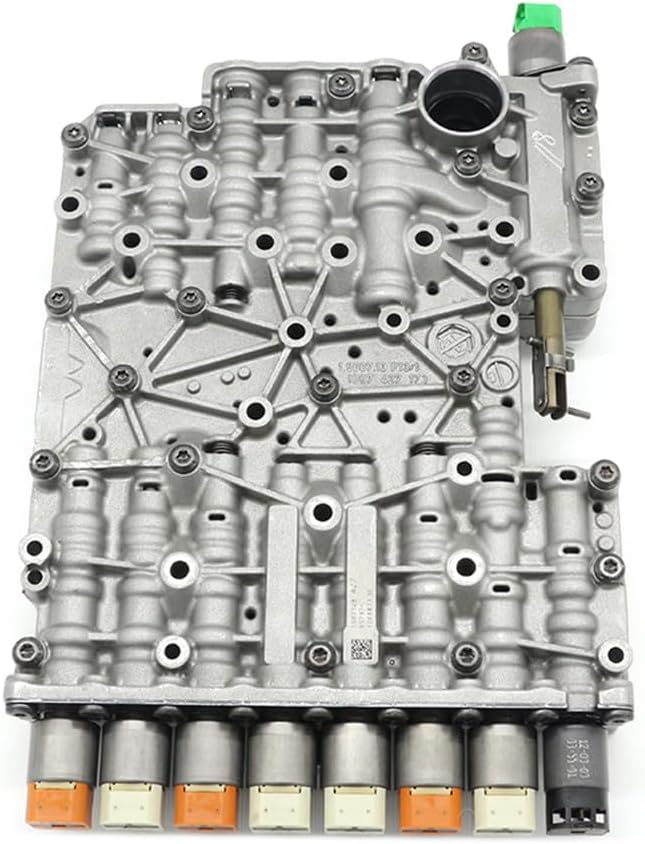
8HP70 Valve Body with Solenoids, Remanufactured
If resistance tests fine but line pressure is still erratic or high under load, the regulator valve bore has worn past what a solenoid swap alone will fix. A remanufactured valve body replaces both the worn bore and the solenoid pack in one part.
View the remanufactured 8HP70 valve body →This is also why aftermarket kits for this platform bundle a redesigned pressure regulator valve alongside the solenoid-adjacent parts rather than selling a solenoid fix in isolation. Sonnax's ZF8-ZIP kit includes a Main PR Valve (part 35740-01K) and Main PR Sleeve (part 35740-03) specifically to correct this bore wear, and TransGo's competing SK8HP Shift Kit covers the same Gen 1 platform with its own redesigned pressure regulator valve, calibrated spring and bushing, plus solenoid damper rubber inserts aimed at the same harsh/soft/erratic shift complaints. Either approach treats the valve and the solenoid as one system, which is how the platform actually fails.
Fluid Matters Here Too
ZF's product data sheet for LifeguardFluid 8 is explicit that only LifeguardFluid 8 or the newer LifeguardFluid 9 may be used in these transmissions -- using anything else can degrade shift quality or contribute to failure. Sonnax's service documentation for the 845RE/ZF8HP45/55/70 lists a dry fill of approximately 8.5 quarts (8.0 liters), with the Chrysler-branded equivalent sold as Mopar part 6815795AA (also green). If you're chasing a pressure complaint, confirm the fluid in the unit is correct and full before you condemn the solenoid or valve body -- wrong fluid changes the hydraulic behavior of every circuit the pressure regulator feeds.
Diagnostic Order: What to Check, In What Sequence
- Confirm the generation. Read the valve body casting and separator plate code so you're ordering parts that actually fit (Gen 1: 8HP45/70/90, 845RE. Gen 2: 8HP50/75/95, 850RE).
- Pull codes and check for an open TCM recall or TSB. A software fix like FCA's 21-018-15 is cheaper and faster than a teardown, and it's the right call if there are no P096x codes and no resistance fault.
- Bench-test the solenoid. 5.0 ohms at 68°F with the circuit board removed, using an ohmmeter under 0.6V. Out of spec means the solenoid coil itself has failed.
- Check line pressure behavior if you have scan tool access to commanded vs. actual pressure. A solenoid testing in spec with erratic actual pressure points at a worn regulator valve bore, not the solenoid.
- Repair or replace accordingly -- a solenoid kit for an isolated coil failure, a valve body repair kit (Sonnax Zip Kit or TransGo SK8HP) for worn bores on a unit that's otherwise sound, or a full remanufactured valve body if wear is extensive.
- Run the drive-cycle relearn after any repair: 122°F fluid temp, 6-10 light throttle-up and coast-down cycles.
Worked in that order, you're spending money on the part that's actually failed instead of guessing off shift feel alone -- which, on a platform where a $0 software reflash and a $400 valve body produce overlapping symptoms, is the difference between a quick fix and a comeback.
Shop ZF8HP pressure control solenoids, mechatronic solenoid kits, valve bodies and ZF-spec fluid — shipped fast from the USA.
Shop ZF8HP parts →FAQ
What is the ZF8HP pressure control solenoid called on a scan tool, and what codes does it set?
ZF's own documentation labels it EDS-7, with the function code LP for line pressure; Chrysler's wiring diagrams and TCM label the same solenoid SOL LPS. It sits in position B of the eight-solenoid pack according to Sonnax's published solenoid identification chart for the 845RE/ZF8HP45/55/70 valve body. A failing or out-of-spec circuit on this solenoid typically sets a generic Pressure Control Solenoid code in the P0960-P0969 range -- circuit open, circuit low, circuit high, or range/performance, depending on the exact fault -- rather than a shift-solenoid code in the P0750s.
What's the actual resistance spec to bench-test the ZF8HP line pressure solenoid?
Sonnax's installation and testing booklet for the ZF8-ZIP kit specifies 5.0 ohms at 20 degrees C (68 degrees F), checked with the mechatronic circuit board removed so you are reading the solenoid coil alone. The same booklet warns not to use an ohmmeter with more than 0.6 volts of test supply, since a higher-voltage meter can give a false reading or stress the coil. A reading noticeably above or below 5.0 ohms at room temperature points at a winding fault in that specific solenoid, not the valve it operates.
Is harsh or inconsistent shifting on my 8HP70 always the EPC/line pressure solenoid?
No, and this is the mistake that gets people into a $400 valve body they did not need. FCA's own Service Bulletin 21-018-15, covering 2015 Jeep Grand Cherokee SRT models with the 6.4L engine and 8HP70, documents harsh or inconsistent upshifts, harsh or inconsistent downshifts while coasting or passing, erratic 1-2 upshifts in cold weather, and delayed reverse-to-drive engagement -- and the entire fix is a TCM software reflash, not a solenoid or valve body replacement. Before replacing hardware, confirm the TCM calibration is current and check for the specific pressure control solenoid codes; a vehicle throwing P096x codes with an out-of-spec resistance reading is a hardware problem, while a vehicle shifting oddly with no codes and old software is often not.
Can I mix up the eight solenoid positions when I reinstall or replace them?
You should not. Sonnax's technical documentation notes the TCM learns a flow rate for each solenoid based on its bore location, so a reused original solenoid should go back into the exact bore it came out of. Mixing positions, even among solenoids that look identical, can produce shift quality complaints that look like a new failure but are actually a mismatched flow-rate adaptation. If you are unsure which bore held which solenoid, use Sonnax's published solenoid ID chart (positions A through H, cross-referenced to both ZF's EDS numbering and Chrysler's SOL naming) before reassembly.
Does the Gen 1 ZF8HP use the same pressure control solenoid as Gen 2?
No. Sonnax technical specialist Jim Dial's generation identification guide documents that 2019 and later Gen 2 units (8HP50, 8HP75, 8HP95, Chrysler 850RE) moved to solenoids with different cream and blue caps than the Gen 1 units (8HP45, 8HP70, 8HP90, Chrysler 845RE), and that the two are not interchangeable because the snout diameters differ. The valve body layout also changed enough between generations that the B and D solenoid positions swap locations. Confirm which generation you have, by the valve body casting and separator plate code, before ordering a replacement solenoid or kit.
Sources
- Sonnax — ZF8-ZIP Zip Kit Installation & Testing Booklet, Chrysler 845RE/ZF8HP45/ZF8HP55/ZF8HP70. Backs the solenoid resistance spec (5.0 ohms at 20°C/68°F, circuit board removed), the under-0.6V ohmmeter caution, the EDS-7/LP (ZF) and SOL LPS (Chrysler) solenoid identification at position B, the Main PR Valve and Main PR Sleeve failure symptoms, dry fill capacity, torque specs, and the drive-cycle relearn procedure. cdn.transend.us (Sonnax document)
- Sonnax — ZF8-ZIP Zip Kit product page. Backs the kit's purpose of sealing critical circuit pressure losses -- main line, solenoid regulator, reverse, clutch control and solenoid apply circuits -- on the ZF8HP45/55/70 and Chrysler 845RE valve body. sonnax.com
- ZF Friedrichshafen AG — ZF LifeguardFluid 8 Product Data Sheet. Backs the requirement that only ZF LifeguardFluid 8 or ZF LifeguardFluid 9 may be used in these transmissions, and the fluid's color and viscosity characteristics. aftermarket.zf.com
- Sonnax (Jim Dial) — "Chrysler ZF8 generations 1 and 2 identification guide," Transmission Digest, April 20, 2023. Backs the Gen 1 (8HP45/70/90, 845RE) vs. Gen 2 (8HP50/75/95, 850RE) split, the non-interchangeable solenoid caps and snout diameters, and the B/D solenoid position swap between generations. transmissiondigest.com
- Chrysler Group LLC Service Bulletin 21-018-15, "Flash: 8HP70 SRT Transmission Shift Enhancements" (hosted by NHTSA). Backs the 2015 Jeep Grand Cherokee SRT/8HP70 symptom list of harsh/inconsistent upshifts and downshifts, erratic cold 1-2 upshift, and delayed reverse-to-drive engagement, with a TCM reprogram as the complete documented fix. static.nhtsa.gov
- TransGo — SK8HP Shift Kit, via Transmission Digest product coverage. Backs the Gen 1-only fitment (8HP45/55/70/90, 845RE) and the kit's redesigned pressure regulator valve, calibrated spring and bushing, and solenoid damper rubber inserts as a competing fix for the same harsh/soft/erratic shift complaint set. transmissiondigest.com