P0729 is the SAE-generic code for Gear 6 Incorrect Ratio -- the TCM commanded 6th gear, and the measured relationship between input and output shaft speed didn't match the ratio 6th gear is supposed to produce. On most transmissions that's a generic statement that could point almost anywhere. On the ZF8HP it's more specific than that, because 6th gear is mechanically the odd one out in this unit's entire gear set, and understanding why changes where you start looking.
This guide covers the verified clutch application chart that explains why 6th behaves differently from every other gear on this transmission, the Gen 1/Gen 2 split that determines which hardware you're actually working on, a documented valve body failure point in this platform family worth ruling out, and a diagnostic order that doesn't start with ordering a part.


What P0729 Actually Means
Every modern automatic runs a ratio monitor: the TCM reads the input shaft (turbine) speed sensor and the output shaft speed sensor, divides one by the other, and compares the result against the known mechanical ratio for whatever gear it just commanded. If the measured ratio falls outside the tolerance window for more than a calibrated amount of time, the TCM concludes the commanded gear isn't actually the gear that's engaged -- something is slipping, not fully applying, or applying a different element than expected -- and sets a ratio code. P0729 is that exact logic applied specifically to 6th gear.
This is a different kind of fault than a communication or sensor code. The TCM isn't confused about what it told the transmission to do; it's reporting that the transmission didn't deliver the mechanical result that command should have produced. That points you toward the hydraulic and mechanical side of the unit -- clutch apply, line pressure, fluid condition -- rather than toward wiring or a control module fault, though you should still rule out a bad speed sensor signal before you assume the slip is real.
Why 6th Gear Is a Special Case on the ZF8HP
The ZF8HP's gearset is built from two fixed brakes (Brake A and Brake B) and three rotating clutches (Clutch C, D and E), combined with four planetary gear sets. Every forward and reverse gear uses exactly three of those five elements applied at once, with the other two released. Sonnax's published clutch application chart for the unit lays out which three elements hold in each gear:
| Gear | Brake A | Brake B | Clutch C | Clutch D | Clutch E |
|---|---|---|---|---|---|
| 1st | ON | ON | ON | ||
| 2nd | ON | ON | ON | ||
| 3rd | ON | ON | ON | ||
| 4th | ON | ON | ON | ||
| 5th | ON | ON | ON | ||
| 6th | ON | ON | ON | ||
| 7th | ON | ON | ON | ||
| 8th | ON | ON | ON | ||
| R | ON | ON | ON |
Look at that table closely and one row stands out: 6th gear is the only gear in the entire set with both brakes released. Every other gear, forward or reverse, uses at least one brake holding an element to the case, which is a mechanically simple, high-margin connection. 6th gear instead runs entirely on three rotating clutches -- C, D and E -- all gripping and transmitting torque to each other simultaneously, with zero brake backing any of it up. That's also why 6th is the transmission's direct 1:1 gear: with no brake reducing or multiplying anything through the planetary sets, the clutch combination locks the gearset into a straight-through connection.
The practical consequence is diagnostic, not academic. Clutches C, D and E aren't exclusive to 6th -- C also holds in 1st, 3rd, 5th and 7th; D also holds in 5th, 7th and 8th; E also holds in 2nd, 3rd, 4th and 8th. A clutch with a small amount of wear or a minor hydraulic leak can often still hold well enough in a gear where a brake is sharing the load, and only show up as an actual ratio fault in the one gear that asks all three clutches to carry the full load with no help. That's a real mechanical reason 6th-gear ratio codes show up as often as they do on this platform, independent of which specific clutch or valve is ultimately at fault.
Confirm the Generation Before You Touch Anything
In 2019, Chrysler/Ram/Jeep applications using this transmission moved to a second-generation unit, and the two generations are not interchangeable at the hardware level. Per Sonnax technical specialist Jim Dial's identification guide published in Transmission Digest, Gen 1 units are the ZF8HP45, ZF8HP70 and ZF8HP90, along with the Chrysler-built 845RE. Gen 2 units are the ZF8HP50, ZF8HP75 and ZF8HP95, along with the Chrysler 850RE. The Gen 2 change wasn't cosmetic -- it came with hard-part changes tied to a gear ratio change, the "B" brake piston's B2 release circuit was eliminated in favor of a return spring, wave springs were added to the A and B brake plate assemblies for faster release, and the valve body itself changed enough that the B and D solenoid positions swapped locations between generations.
None of that changes the clutch application logic above -- both generations still build 6th gear from C, D and E with the brakes released -- but it changes which parts, which valve body, and which solenoid positions you're actually working with. Pull the casting and separator plate codes and confirm the generation before you order anything, including a replacement valve body or solenoid pack.
A Documented Valve Body Failure Point in This Family
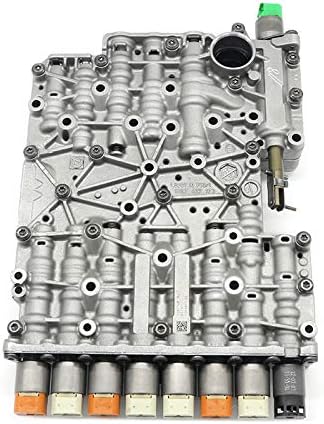
The valve body on this platform is not a theoretical weak point -- it's a documented, OEM-replaced component with an open Stellantis bulletin as of this writing. TSB 21-016-25 Rev. B, dated August 7, 2025 and hosted by NHTSA, covers 2025 Ram 1500 pickups and 2023-2025 Wagoneer/Grand Wagoneer and Jeep Grand Cherokee models equipped with the 8HP75, 850RE or 8HP50 -- all Gen 2 units. The stated cause is CAN terminals inside the valve body corroding and losing communication with the vehicle, which sets U0101 (lost communication with the TCM), U0402 (implausible data from TCM) or U0418 (implausible data from the brake system control module), drops the transmission into limp-in, and once shifted to Park it will not go back into a forward or reverse gear. The factory repair is a full valve body replacement followed by TCM programming -- not a repair kit, not a reflash alone.
That bulletin is about communication codes, not a ratio fault, and you shouldn't assume a P0729 on a Gen 2 unit is the same root cause. What it does establish is that the valve body in this transmission family is a part Stellantis itself replaces wholesale when it fails -- not something techs are reading into from aftermarket forum chatter. If you're chasing P0729 on a Gen 2 vehicle and also seeing any of those three U-codes or a limp-in/no-Park-release pattern, run the VIN for 21-016-25 before you spend time vacuum testing a hydraulic circuit; the actual fault may be electrical, not a worn clutch.
Check the Hard Parts, Not Just the Hydraulics
If the fault turns out to be mechanical rather than hydraulic or electrical, don't assume a worn OE part is a drop-in replacement for another worn OE part. Sonnax's own heavy-duty clutch hub program exists because the factory changed hardware mid-production on this platform: the ZF8HP70's E clutch hub shipped from the factory on a 38-spline design, but some units were field-updated to a 48-spline hub and planetary after an earlier failure, and Sonnax sells separate heavy-duty hubs for the 845RE/ZF8HP45 (part 35572-53T) and the 850RE/ZF8HP51/ZF8HP55 (part 35572-62T) specifically because the spline count and planetary differ. If you're pulling the unit apart far enough to inspect or replace a clutch hub involved in 6th gear, count the splines and confirm which hub and planetary are actually in the case before you order a part, since some 845RE and ZF8HP45 units already carry the updated hub from a prior repair.
Fluid Condition Is the Cheapest Thing to Rule Out First
Before any of the above, confirm the fluid is correct and in good condition. ZF's own product data sheet for this transmission's fluid is unambiguous: only ZF LifeguardFluid 8 or the newer LifeguardFluid 9 may be used, with no additives of any kind, because the friction behavior is calibrated specifically to this transmission's clutch packs. ZF states plainly that substituting another oil "can lead to various adverse effects, ranging from significant deterioration in shifting characteristics to transmission failure." The fluid is green, with a viscosity of 26 mm²/s at 40°C and 5.6 mm²/s at 100°C, a pour point of -42°C and a flash point of 206°C. These are lifetime-fill units in ZF's own terminology, but ZF still recommends a change at 150,000 km, sooner under heavy load, high heat, or when the vehicle's prior service history is unknown.
Low fluid level or badly degraded fluid can drop clutch apply pressure enough on its own to produce a real ratio error in the one gear -- 6th -- that has the least margin to absorb it, with nothing mechanically wrong inside the unit. Check level and condition before you condemn a clutch, a solenoid, or a valve body.
845RE Friction Clutch Kit, 2011-2025
If the fluid checks out and the fault traces to worn friction material rather than a hydraulic or electrical cause, Core Transmission Parts stocks a direct-fit friction clutch kit built for clutch pack slipping and lost-gear complaints on this platform.
Shop the 845RE friction clutch kit at Core Transmission Parts →Diagnostic Order: What to Check, In What Sequence
- Confirm the generation. Read the valve body casting and separator plate code, or match the VIN and transmission sales code. Gen 1 (8HP45/70/90, 845RE) and Gen 2 (8HP50/75/95, 850RE) don't share valve body hardware or solenoid positions.
- Check fluid level and condition. Confirm it's actually ZF LifeguardFluid 8 or 9, not a substitute, and that the level is correct. This alone resolves a surprising share of ratio complaints.
- Run the VIN for open bulletins. On a Gen 2 vehicle with any U0101/U0402/U0418 pattern or a Park-release complaint alongside the ratio code, check TSB 21-016-25 before assuming the fault is hydraulic.
- Scan-monitor input speed, output speed and commanded gear through a 5th-to-6th-gear road test. A code that sets every time points at a real, repeatable mechanical or hydraulic fault; an intermittent one under load points more toward a marginal leak or a borderline clutch.
- If hydraulic, pull and inspect the valve body and clutch packs with the correct generation's service information, checking the C, D and E clutch circuits specifically since those are the three elements 6th gear depends on with no brake to share the load.
- Confirm hard-part fitment -- spline count and planetary generation -- before ordering any hub, drum or clutch pack replacement, since this platform has field-updated parts in circulation that don't match the original casting.
- Clear codes and road test again after any fluid, electrical, or hydraulic repair before concluding the fix held.
A 6th-gear ratio code on this transmission is rarely a mystery once you know what 6th gear actually is mechanically: the one gear with no brake backing up the clutches. Rule out fluid and communication faults first, confirm the generation, and let the clutch application chart tell you exactly which three elements are actually under suspicion before you start ordering parts.
FAQ
What's the difference between P0729 and other ZF8HP gear ratio codes like P0730 or P0734?
They're all the same family of fault -- the TCM commanded a gear and the measured ratio between input and output speed didn't match it -- but each code names a specific gear. P0730 is the generic incorrect-ratio code some scan tools show when the TCM can't tie the fault to one gear. P0731 through P0736 are gear-specific: P0731 is 1st, P0732 is 2nd, and so on. P0729 is the ZF8HP's 6th-gear version, which matters because 6th is mechanically different from every other gear in this transmission -- it runs on three clutches with no brake, so the diagnostic logic for P0729 isn't identical to chasing a 2nd or 4th gear ratio code.
Why does 6th gear set ratio codes more easily than other gears on this transmission?
Per Sonnax's published clutch application chart for the ZF8, every gear from 1st through 8th uses exactly three of the five apply elements -- two brakes (A, B) and three rotating clutches (C, D, E) -- except 6th, which is the only gear built from clutch C, D and E together with both brakes released. A brake holding to the case is a comparatively simple, high-margin hold. Three rotating clutches all having to transmit torque to each other with zero brake backup means there's no redundancy: if any one of C, D or E has even a small hydraulic leak or a glazed friction surface, 6th gear is where it shows up first as a ratio error, even if the same clutch holds fine in other gears where a brake is doing more of the work.
Could a fluid problem alone cause a P0729 code, or does it mean worn clutches?
Fluid condition should be the first thing you rule out, not the last. Low fluid level, the wrong fluid, or badly degraded ZF LifeguardFluid 8 can all drop line pressure or clutch apply pressure enough to produce a measurable ratio error without a single worn part in the unit. ZF's own product data sheet is explicit that substituting another fluid for LifeguardFluid 8 or 9 can range from degraded shift quality to transmission failure. Confirm level and condition, and confirm the fluid is actually the correct spec, before you assume the code means a clutch or valve body is worn.
Do I need to pull the valve body to diagnose P0729, or can it be done with a scan tool?
Start with the scan tool, not the valve body. Monitor input speed, output speed and the TCM's calculated gear in real time while road testing through 5th and 6th -- a code that sets every time versus one that's intermittent under load tells you whether you're chasing a hard failure or a marginal one. Check for related codes, confirm the generation (8HP45/70/90 and 845RE are Gen 1; 8HP50/75/95 and 850RE are Gen 2, per Transmission Digest's identification guide, and they don't share valve body hardware), and rule out fluid before you pull anything apart. The valve body only comes off once you've confirmed the fault is hydraulic or mechanical rather than a fluid or software issue.
Sources
- Sonnax — "A New Path for ZF," tech resource, December 7, 2016. Backs the full 8-speed clutch application chart (Brake A, Brake B, Clutch C, D, E across 1st through 8th and Reverse) confirming 6th gear is built from Clutch C, D and E with both brakes released, plus the OE valve naming conventions for the converter circuit. sonnax.com
- Sonnax (Jim Dial) — "Chrysler ZF8 generations 1 and 2 identification guide," Transmission Digest, April 20, 2023. Backs the Gen 1 (8HP45/70/90, 845RE) vs. Gen 2 (8HP50/75/95, 850RE) split, the 2019 production change, the hard-part differences in the A and B brake assemblies, and the B/D solenoid position swap between generations. transmissiondigest.com
- FCA US LLC / NHTSA — Technical Service Bulletin 21-016-25 Rev. B, "Valve Body Replacement," August 7, 2025. Backs the 2025 Ram 1500 and 2023-2025 Wagoneer/Grand Wagoneer/Jeep Grand Cherokee population with 8HP75, 850RE and 8HP50 transmissions, the CAN terminal corrosion root cause, the U0101/U0402/U0418 DTCs, the limp-in and no-Park-release symptom, and the valve body replacement plus TCM programming remedy. static.nhtsa.gov (PDF)
- ZF Friedrichshafen AG — Product Data Sheet, ZF LifeguardFluid 8. Backs the requirement that only ZF LifeguardFluid 8 or 9 be used with no additives, the stated risk of using a substitute fluid, the color and viscosity characteristics (26 mm²/s at 40°C, 5.6 mm²/s at 100°C, pour point -42°C, flash point 206°C), and the 150,000 km recommended change interval. aftermarket.zf.com (PDF)
- Gears Magazine (ATRA) — "New Sonnax Heavy Duty 'E' Clutch Hubs," July 2024. Backs the field hardware split on the E clutch hub -- heavy-duty hub 35572-53T for 845RE/ZF8HP45 and 35572-62T for 850RE/ZF8HP51/ZF8HP55 -- and the caution that some 845RE and ZF8HP45 units already carry an updated OE hub and planetary from a prior repair, requiring spline-count confirmation before ordering. gearsmagazine.com