Nobody kills a ZF8HP by overloading it on torque. The clutches and gearset in the 8HP70 and 845RE/850RE family are rated for a lot more than most owners will ever ask of them behind a 5.7L Hemi or a Pentastar V6. What actually ends these units early when they spend their life pulling a trailer is heat, and heat is a cooling and fluid problem, not a strength problem. If you are setting up a Ram 1500, Grand Cherokee, Durango, or Charger/Challenger for regular towing, the upgrades that matter are the ones that keep oil temperature and oil pressure where the transmission was designed to run, not anything that touches shift feel.
That distinction matters because most of the aftermarket conversation around towing and this transmission is about tune and shift firmness. Those changes can help wear patterns, but they do nothing for the two places this unit actually loses the fight against heat: the cooler and lube flow circuit inside the valve body, and the heat exchanger that shares coolant with the engine.

Why a Towing Load Hits This Unit Harder Than City Driving
An 8-speed has tighter ratio spacing than the 4- and 6-speeds it replaced, which is good for fuel economy and bad for towing heat. Climbing a grade with a trailer forces more shift events per mile as the transmission hunts for the ratio that keeps the engine loaded correctly, and every shift event and every torque converter clutch apply or release is a friction event that dumps heat into the fluid. ZF says it plainly in its own service information for the 8HP oil change kit: the oil ages faster at very high operating temperatures, and "many trips while towing a trailer" is one of the examples it gives. The same document warns that if the oil level is too low the transmission will be damaged, and if it is too high the excess oil leaks out through the overflow when heated, where it can ignite on hot parts such as the exhaust. [5] A transmission that is low or overfull going into a tow is already starting the day with less thermal margin than it was built with.
The Cooler and Lube Flow Circuit Is the Part That Actually Wears Out
Inside the valve body, a set of valves regulates how much pressure and flow goes to the torque converter, the cooler, and lube. Those bores see constant modulation, and like any aluminum bore running a hardened valve under pressure cycling, they wear. Sonnax's own documentation for its ZF8-ZIP valve body kit names the failure directly: loss of oil pressure due to worn components in the main line, solenoid regulator, reverse, clutch control and solenoid apply circuits on the ZF8HP45, ZF8HP55, ZF8HP70 and Chrysler 845RE, with excess heat listed alongside delayed engagement, harsh engagement, broken parts and firm shifts as the resulting symptoms. That is the mechanism in plain terms: a bore wears, pressure that should stay in a circuit leaks past the valve instead, and the unit cannot regulate flow and pressure the way it was calibrated to. Towing does not cause this wear by itself, but more hours under load and more heat cycling gets a marginal bore to the point of leaking sooner than it would under light duty.
This is also why a tune or a firmer shift calibration alone will not fix a cooling complaint. Those changes do not restore a worn bore's ability to hold pressure. If the unit is already past the point of leaking pressure in these circuits, the fix is mechanical: a valve body kit like the ZF8-ZIP that drops in oversized or reconditioned components, not a software change.
ZF 8HP45/8HP70 Mechatronic Solenoid Kit, 9-Piece
If the solenoid apply circuit is part of what is leaking, the solenoids themselves are also living in hotter, dirtier fluid than they were designed for. A full 9-piece mechatronic solenoid kit is the companion repair to valve body bore wear, not a substitute for it.
View the solenoid kit →The Heat Exchanger: Where Towing Heat Meets the Cooling System
The ZF8HP uses a heater/cooler assembly that routes engine coolant close to the transmission fluid so the unit warms up faster from a cold start, with the fluid then routed out to the main cooler once it is up to temperature. That shared-coolant design is efficient for warm-up, but it is also a single point where a transmission problem becomes a cooling-system problem. On 2015 Ram 1500 trucks built on or after December 1, 2014 and equipped with the 8HP70 or 845RE, this is a documented issue: per NHTSA-hosted Chrysler bulletin 21-037-15 REV A, the heater assembly's thermal bypass valve can fail and let transmission fluid cross into the engine coolant, and the repair calls for inspecting the assembly and replacing it with part number 52014750AD if contamination is found. The giveaway is coolant that looks pink or milky in the overflow tank. Towing raises the thermal cycling this assembly sees every trip, which is exactly the kind of repeated stress that pushes a marginal heater assembly from "fine" to "failed." A truck that tows should have this assembly checked, not just the transmission fluid.
Fluid Is Part of the Cooling System, Not an Afterthought
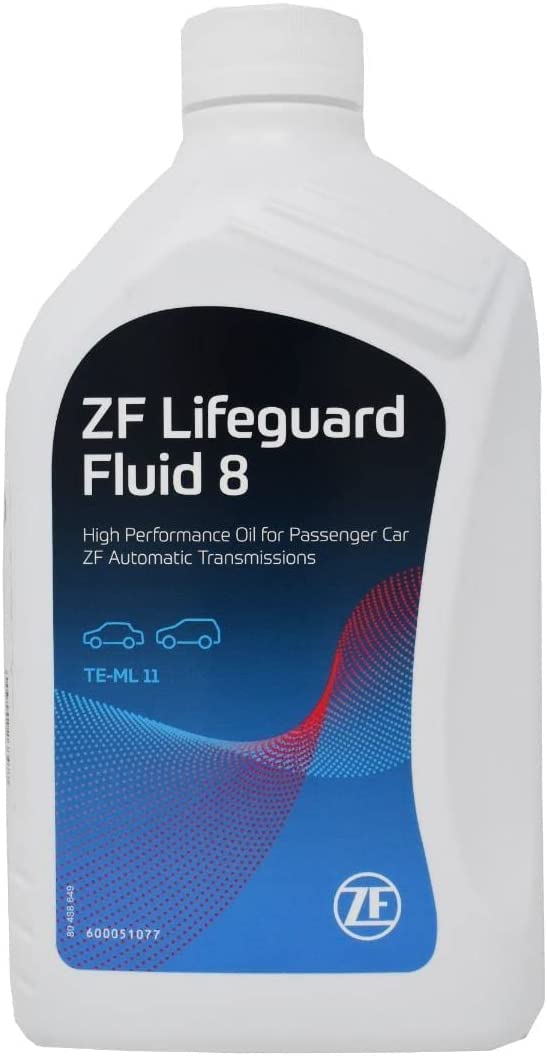
ZF is specific about this in its own LifeguardFluid 8 product data sheet: the fluid was developed specifically for 8HP transmissions, and only ZF LifeguardFluid 8 or the newer LifeguardFluid 9 may be used in these units. That is not boilerplate. The friction modifiers in this fluid are tuned to how this transmission's torque converter clutch and shift clutches are controlled, and that friction stability is part of what keeps heat from running away during exactly the kind of sustained, loaded operation that towing produces. A generic ATF, or an off-spec "universal" fluid, does not carry heat or hold friction properties the same way, and it shows up first as shudder or shift quality complaints under load, before it shows up as a temperature light.
Level matters as much as fluid identity, and on this unit the level is set by temperature, not by a dipstick. ZF's 8HP procedure checks the level with the transmission oil at 30-50°C (86-122°F), read with a scan tool. With the engine running, hold 2,000 rpm for 30 seconds to fill the torque converter, then idle, select P, R and D, and manually shift D1 and D2, holding each gear for about 10 seconds. Open the fill plug, add LifeguardFluid until it runs out of the fill hole, and close it once only single drops come out. If the oil is above 50°C, ZF says to let it cool down first. [5] ZF also says not to use additives at all, because they alter the oil's chemical composition. [5] Check the level hot off the highway, or skip the converter fill step, and the unit can end up low. A transmission that is quietly low because of a rushed fluid service has already lost cooling capacity before the first tow of the season.
The Actual Upgrade Path for a ZF8HP That Tows
- Service the fluid correctly first. ZF LifeguardFluid 8, filled and leveled with the cooler lines properly purged. This is free performance if the last service was rushed.
- Add or upgrade the auxiliary cooler. A factory tow package usually includes a larger cooler, but a dedicated auxiliary cooler plumbed in addition to the factory circuit buys real margin on long grades, in stop-and-go traffic with a trailer, and in hot climates where the stock circuit is already working near its ceiling.
- Have the heater assembly checked if the truck falls in the TSB 21-037-15 window, or at the first sign of pink or milky coolant on any ZF8HP application. Do not keep towing on a unit that is cross-contaminating fluid and coolant; a full cooling system flush is required once contamination is confirmed.
- Address valve body wear with a kit, not a tune, if the symptoms are already there: shudder, delayed engagement, harsh engagement, or a transmission that runs hotter than it used to under the same load. The ZF8-ZIP style repair targets the actual worn circuits instead of papering over the symptom.
Worked in that order, towing stops being the thing that ends this transmission early. It is a well-engineered 8-speed with a known cooling and lube circuit wear pattern, and every part of that pattern has a documented fix.
Shop ZF8HP coolers, ZF-spec fluid, mechatronic solenoid kits and valve body components — shipped fast from the USA.
Shop ZF8HP parts →FAQ
Does the ZF8HP need an aftermarket cooler for towing?
If you tow regularly or near the vehicle's rated capacity, yes. A factory tow package usually adds a larger or supplemental cooler, but even ZF's own service literature treats correct fluid level and flow to the cooler as a prerequisite for avoiding overheating, not an optional extra. An auxiliary cooler plumbed in addition to the factory circuit gives the unit margin on long grades, in traffic with a trailer, or in hot climates where the stock circuit is already working near its limit.
What fluid does the ZF8HP use and does it matter for heat tolerance?
ZF LifeguardFluid 8, and per ZF's own product data sheet only LifeguardFluid 8 or the newer LifeguardFluid 9 may be used in these units. The fluid's friction properties are matched to this transmission's clutch and torque converter clutch design, so a generic or mismatched ATF does not just risk shift quality, it reduces the fluid's ability to carry heat and hold up under the repeated clutch cycling that towing produces.
What does it mean if coolant looks pink or milky after towing?
It means transmission fluid and engine coolant are mixing inside the transmission heater assembly, the unit that uses engine coolant to help warm the ATF. On 2015 Ram 1500 trucks built on or after December 1, 2014 with the 8HP70 or 845RE, this is a documented failure covered under TSB 21-037-15 REV A, which calls for inspecting the heater assembly's thermal bypass valve and replacing it with part 52014750AD if contamination is found. Towing load accelerates the thermal cycling that pushes a marginal heater assembly into failure, so do not ignore pink-tinted coolant just because the truck still shifts fine.
What internal wear actually causes ZF8HP overheating under tow?
Worn valve bores in the cooler and lube flow control circuit. Sonnax's own technical documentation for its ZF8-ZIP kit identifies loss of oil pressure in the main line, solenoid regulator, reverse, clutch control and solenoid apply circuits as the root cause behind excess heat, delayed engagement and harsh engagement complaints on the ZF8HP45, ZF8HP55, ZF8HP70 and Chrysler 845RE. That wear is a function of hours and heat cycles, and towing puts more of both on the unit per mile than normal driving does.
Will using tow/haul mode alone prevent transmission damage?
No. Tow/haul mode changes shift timing and torque converter clutch behavior to reduce unnecessary shifting and keep the engine in a better power band, and that does cut down on some heat generation, but it is a calibration change, not a cooling upgrade. It cannot compensate for a marginal fluid level, the wrong fluid, a failing heater assembly, or valve bores that have already worn enough to leak pressure. Treat it as one part of a towing setup, not the whole plan.
Sources
- ZF Friedrichshafen AG — ZF LifeguardFluid 8 Product Data Sheet. Backs the requirement that only ZF LifeguardFluid 8 or ZF LifeguardFluid 9 may be used in ZF 8HP automatic passenger car transmissions, and that the fluid was specially developed for use in these units. aftermarket.zf.com
- Chrysler Group LLC Technical Service Bulletin 21-037-15 REV A, "Transmission Heater Assembly" (hosted by NHTSA). Backs the affected population of 2015 Ram 1500 vehicles built on or after December 1, 2014 with the 8HP70 or 845RE transmission, the symptom of transmission fluid appearing in the engine coolant, the thermal bypass valve as the failure point in the heater assembly, and replacement part number 52014750AD. static.nhtsa.gov
- Sonnax — ZF8-ZIP Zip Kit product page. Backs the root cause of loss of oil pressure due to worn components in the main line, solenoid regulator, reverse, clutch control and solenoid apply circuits on the ZF8HP45, ZF8HP55, ZF8HP70 and Chrysler 845RE valve body, and excess heat, delayed engagement, harsh engagement, firm shifts and broken parts as the resulting symptoms. sonnax.com
- Gears Magazine (ATRA) — "The ZF 8HP: The New Kid on the Aftermarket Block," September 2020. Backs incorrect fluid level as one of the most common causes of ZF 8HP unit failure, with overheating, flared or harsh shifts, gear ratio codes and solenoid performance codes as resulting symptoms, and the requirement that fluid be flowing to the cooler with cooler lines full before letting the vehicle cool for the final level check, with up to 1 liter of additional fluid needed if that step is skipped. gearsmagazine.com
- ZF Friedrichshafen AG — Service Information 50130 EN, "Oil change kit for ZF 8HP automatic transmission" (11.2024). Backs faster oil aging at high operating temperatures including frequent trailer towing, the warnings on low and high oil level (damage, overflow leakage and ignition risk), the no-additives rule, and the level-check procedure: 30-50°C oil temperature, 2,000 rpm for 30 seconds to fill the converter, P-R-D and D1/D2 holds of about 10 seconds, and filling until single drops come from the fill hole. aftermarket.zf.com (PDF)