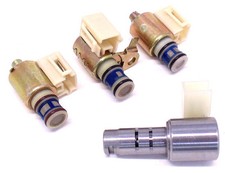
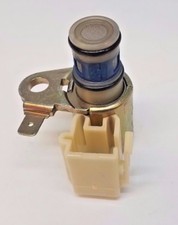
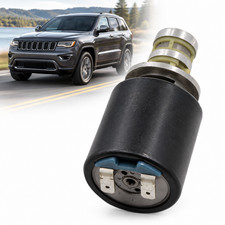
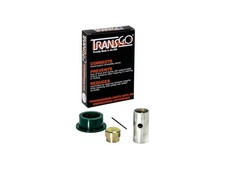
This kit is for the 1990s 4L30E, the small four-speed automatic behind the Isuzu Trooper and Rodeo, Honda Passport, Acura SLX, Cadillac Catera, Opel Omega and the BMW E34 5 Series, E36 3 Series and Z3. If yours has started holding one gear with the check light on, shifting late and soft, firming up into every gear, or acting up in reverse on cold mornings, the electrical side of the valve body is a sensible place to start. The kit pictured is four new pieces: three tan-connector on-off solenoids and the cylindrical pressure control force motor, which together cover the solenoids that wear most on these early units.
What the solenoid kit does in a 1990s 4L30E
The 4L30E came out of GM's Strasbourg, France plant and was shared by several automakers, which is why the same transmission sits in a BMW sedan and an Isuzu SUV. It has no throttle cable or governor; the transmission control module picks every shift by switching on-off shift solenoids, which steer line pressure to the shift valves, and it sets shift firmness by varying current to the force motor, which regulates line pressure. Converter lockup is also solenoid controlled. On the 1990-99 units it is an on-off apply. Transmission Digest reports that for 2000 the Trooper and BMW applications switched to a pulse-width-modulated converter clutch with a new TCC PWM solenoid and a redesigned pump, while the Catera, Rodeo and Passport kept the on-off two-valve pump. That change is the main reason this kit is split from the 2000 kits.
Symptoms of worn 1990s 4L30E solenoids
- Locked in one gear (failsafe) with the check-trans or check engine light on
- Late, mushy or missing upshifts, or a downshift that hangs
- Harsh engagements and firm shifts when the force motor sticks or its screen plugs
- No converter lockup at highway speed, with higher RPM and worse fuel economy
- Reverse that slips, neutrals or feels like the converter is partly applied, usually worst when cold
- Solenoid circuit codes on 1996-99 OBD-II vehicles; earlier BMW and Isuzu models need a reader for their pre-OBD-II systems
How to confirm before you buy
Check fluid level and condition first. Burnt fluid with friction material in the pan means worn clutches, and solenoids will not fix that. Next, read codes and measure each solenoid circuit at the transmission connector for resistance and shorts to ground; our multimeter solenoid test guide shows how, and bench testing covers checking the old parts once they are out. For a reverse complaint, Transmission Digest points out that TCC solenoid signal oil acts on the reverse-lockout valve, so a leaking TCC solenoid can cause neutral or slip in reverse; the same article notes the converter solenoid's screen is often missing when the solenoid is bad, so look for it in the auxiliary valve body.
Fitment
Listed fitment is the 4L30E from 1990 through 1999. Common applications in that span include the 1990-96 BMW 525i and 518i, 1992-98 BMW 318i, 1996-99 328i, 1996-99 Z3, 1991-99 Isuzu Rodeo, 1990-99 Trooper, 1994-99 Honda Passport, 1996-99 Acura SLX and 1997-99 Cadillac Catera. Because several automakers used this unit, Transmission Digest warns that the adapter case, center support and spacer plate differ by manufacturer and do not interchange, so do not assume a BMW part matches an Isuzu one. Compare the connectors and shape of your old solenoids with the photo, or send us your year and VIN and we will confirm. A 2000-up Trooper or BMW should use the 2000 4L30E solenoid kit.
Install notes
- Drop the pan and filter, then unplug and remove each solenoid from the valve body one at a time so each new part goes back in the same location.
- Install new O-rings lubricated with clean ATF and tighten retaining bolts gently; the valve body is aluminum.
- Make sure the TCC solenoid screen is in place before you button it up.
- Inspect the internal harness and case connector for heat-cracked insulation or oil wicking through the plug.
- Fill with the ATF your owner's manual specifies and check the level hot using the vehicle's procedure.
- Clear codes and road test through every gear so the module can adapt shift pressure.
A new filter and pan gasket is cheap while the pan is off; BMW owners can use the 4L30E filter and pan gasket kit for E34, E36 and E39. If only the converter circuit is faulted, the single 1990-1999 4L30E TCC solenoid may be all you need.