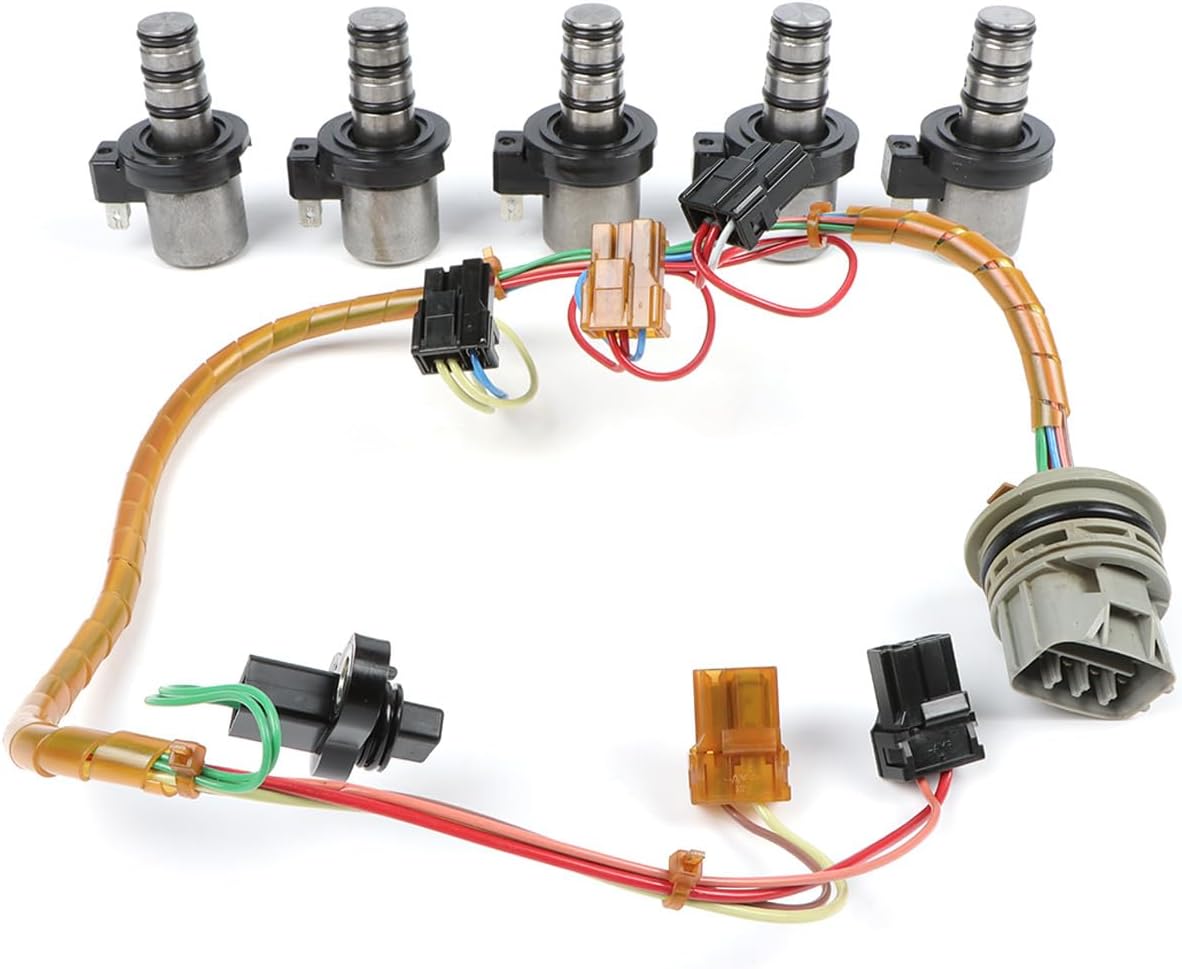
If your 2001-2011 Hyundai Sonata 2.4L, Kia Optima or Rondo 2.4L, Santa Fe 2.7L, Tiburon 2.0L, or a Mitsubishi Lancer, Galant, Eclipse or Outlander with the four-speed automatic suddenly bangs into gear, flares between shifts, stops upshifting or drops into a single-gear failsafe with an open or shorted solenoid code, this kit is aimed at that repair. It is a remanufactured set of the valve-body solenoids for the Mitsubishi-designed F4A41 and F4A42 family, cleaned, inspected and tested, and it comes with the internal wiring harness that runs from the solenoids to the case connector. Manufacturer part number COP-I12D0422.
What the solenoids do in an F4A41 or F4A42
This transaxle has no conventional shift valves driven by throttle and governor pressure. The control module shifts it by pulsing solenoids mounted on the upper valve body, one each for the low/reverse clutch, underdrive clutch, second brake and overdrive clutch, plus one for the torque converter clutch. In the ATSG article on F4A42/F4A51 valve-body function, Pete Luban points out that all five solenoids are physically the same part, and every one except the converter clutch solenoid feeds its own pressure-control valve that sets how firmly that clutch applies, much like a Chrysler 604. When a solenoid coil goes high in resistance or its seat wears, the module still commands the shift but the clutch gets the wrong pressure at the wrong time. When the module sees an open or shorted circuit, it shuts the solenoids down and the transaxle sits in its failsafe gear.
Symptoms of failing F4A41 and F4A42 solenoids
- Harsh or erratic shifts, especially a bang into 2nd
- Flare or slip between gears as clutch pressure is mistimed
- No upshift past one gear, or stuck in failsafe until the engine is restarted
- Converter shudder at light throttle or no converter lockup at cruise
- Solenoid circuit codes, often P0750, P0755, P0765 or P0741, logged with the complaint
- Fluid weeping at the case connector, a sign the internal harness or its seal has hardened
How to confirm before you buy
Transmission Digest's July 2004 bulletin summary describes exactly this pattern on Hyundai F4A42/51 units: erratic or harsh shifting, third-gear failsafe and one or more open or shorted solenoid circuit codes, which is why the electrical side is the first place to look. Check fluid level and condition, then measure each solenoid circuit through the case connector and compare the readings with each other, since all five solenoids are identical; a high or open reading on one circuit points at that solenoid or its harness lead. Our guide to testing a transmission solenoid with a multimeter covers the meter work, and solenoid testing without a factory scan tool covers command checks for owners without a dealer tool. A cheap meter such as the AstroAI digital multimeter is enough for this. If every circuit reads normal and the shifts are still harsh or flared, the problem is more likely in the valve body bores or the clutches than in the solenoids.
Fitment
The listing references the F4A41, F4A42, F4A51, V4A51 and R4A51 solenoid families and lists Hyundai Sonata 2001-2011 2.4L, Santa Fe 2001-2009 2.7L and Tiburon 2003-2008 2.0L; Kia Optima 2001-2010 2.4L and Rondo 2007-2010 2.4L; and Mitsubishi Lancer 2003-2011 2.0L, Galant 2001-2010 2.4L, Eclipse 2003-2011 2.4L, Outlander 2003-2006 2.4L, Grandis 2007-2008 2.4L, Space Star 1999-2004 1.8L and Mirage 1998-2002 1.5L. Engine and model-year splits matter on these, and later Hyundai and Kia models moved to the five-speed and six-speed units, so confirm the transaxle code on your case tag and compare the harness case connector with yours, or send us your year and VIN before ordering. The same harness and solenoid layout is not shared with the five-speed F5A51 family.
Install notes
No case teardown is needed. Drain the fluid, drop the pan and remove the filter. Unplug the harness at each solenoid and release the case pass-through connector before removing any retainers, and tag every solenoid position as it comes out so the harness routes the same way on reassembly. Fit the new solenoids with fresh O-rings lubed in clean fluid, route the new harness clear of the valve body and pan, seat the case connector seal fully and torque the retainer bolts lightly into the aluminum. Refill with the SP-III type fluid called for on your dipstick or in your owner's manual and check the level hot. Clear codes and drive through all four gears several times so the module relearns clutch fill times. If the shifts stay harsh after new solenoids, look at the F4A51 valve body for the V6 units, or plan a full overhaul with the F4A41/F4A42 master rebuild kit, and reset adaptive shift values afterward as described in our adaptive relearn guide.