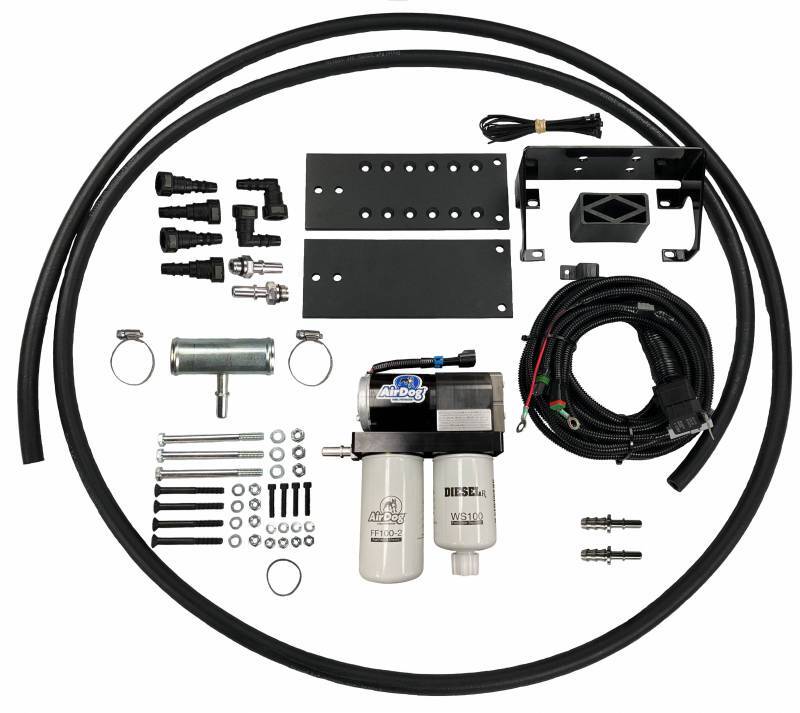
This listing is a full case of twelve AirDog WS100 water separators, the spin-on pre-filter that sits on the suction side of AirDog and AirDog II lift pumps on Cummins, Duramax and Power Stroke pickups. If you run an AirDog and service it yourself, run a fleet of diesel trucks, or keep a shop shelf stocked for customers with AirDog systems, a case covers years of service intervals at once. If you only need one or two for your own truck, ask us before ordering, because this price is for the twelve-pack.
What the WS100 does in an AirDog system
An AirDog pulls fuel from the tank, and before that fuel reaches the gerotor pump it passes through the water separator. The WS100 catches free water and the larger debris that would otherwise wear the pump and load up the final filter. After the pump, fuel goes through the fine fuel filter (AirDog pairs the WS100 with its FF100-2 2-micron filter on pickup and light-duty units) and then on to the injection pump. Air and vapor are removed and returned to the tank. AirDog describes the WS100 as a serviceable separator with a drain, meaning water that collects in the canister is meant to be drained at regular intervals rather than left to build up.
That matters on these trucks because the injection pump is cooled and lubricated by the fuel. A VP44 on a 1998.5-2002 Cummins, a CP3 on a Duramax or later Cummins, or the high-pressure pump on a Power Stroke can all be damaged by water reaching them. The separator is the first line of defense.
Signs your water separator is due
- Water visible when you open the drain, or a water-in-fuel warning after a questionable fill-up
- Supply pressure on your gauge reading lower than normal, especially under load or when towing
- Hard starts or power that falls off on a grade after a long service interval
- A fuel filter that plugs early, which often means the separator ahead of it is loaded with debris
- You are at the mileage AirDog lists for filter service and have no record of the last change
How to confirm before you blame the pump
Drain the separator into a clear container and look for water or sediment. Then check supply pressure at the injection pump inlet at idle and under load. If pressure recovers after fresh filters, the filters were the restriction. If it stays low with new filters, look at the pump, the tank pickup and the suction line. Also rule out the drivetrain: a tach that flares on a shift or under load is a transmission slip, not a fuel problem. Our guide to 48RE Cummins transmission problems covers how to tell the two apart on a Ram.
Fitment
The WS100 is the water separator for AirDog's pickup-truck and light-duty systems. AirDog lists it as performance matched to its FPII-100 pickup systems and FPII-125 light industrial systems, and AirDog dealers list it as a direct fit for AirDog I, AirDog II, AirDog II-4G and AirDog II-5G units. That covers kits like the AirDog II-5G DF-100-5G for the 24-valve 5.9 Cummins and the FP-100-4G for 2011-2014 Duramax. The simplest check is the part number printed on the separator already on your pump. Heavy-duty AirDog systems use a different, larger separator (WS200-WD), so do not order this for a truck-fleet or industrial unit without checking. If you are unsure, send us the pump model or a photo of the label. See every AirDog system we carry in engine performance.
Service notes
- Change the separator and the fuel filter together on a set schedule. AirDog's installation manual for its 24-valve Cummins kit gives typical filter life as 15,000-20,000 miles and calls for replacing the water separator every other filter change.
- Fill a new separator with clean diesel before installing it so the pump does not have to pull a dry canister. Follow the tightening instructions printed on the canister rather than reefing on it with a wrench.
- Bleed air at the filter after the change, start the truck, and check both canisters for leaks before you drive.
- Drain water from the separator between changes, and more often after fueling at a station you do not trust.
- Write the date and mileage on the canister. With a case on the shelf there is no reason to stretch an interval.
Pumps for other platforms, such as the FP-100-4G for the 2008-2010 6.4L Power Stroke, use the same service routine.