A 10L90 that sits there and does nothing, in Drive or Reverse, with the engine idling clean, is a different animal from a 10L90 that just lost Reverse. We already covered no reverse with the forward gears working fine, and that one is almost always a single valve body circuit. This is the opposite problem: nothing applies, anywhere, which means whatever failed is upstream of the clutches entirely. On GM's 10-speed family that short list is the network connection to the transmission control module, the pump's ability to build line pressure, or the park pawl actuator not releasing after a repair. Pulling the transmission before checking those three wastes a day.
This applies to the 10L90 as GM actually ships it: the Camaro SS and ZL1 (RPO MX0), the ZL1 1LE with the 10-speed option that GM added in a mid-February 2019 running change (RPO MGL), and the Cadillac CT4-V, CT5-V and Escalade-V (RPO MHO). The 10L80, used in trucks and SUVs with the smaller V8s, shares the same pump and valve body architecture, so most of what follows applies there too. Facts below come from GM's own installation documentation, Transmission Digest and ATRA's GEARS magazine, all listed at the bottom. Where it's my own bench judgment, I say so.
| What you have | Most likely cause | Where to look first |
|---|---|---|
| No movement in Drive or Reverse, TCM not responding on the scan tool | Open or corroded circuit on the GM high-speed CAN network | DLC pins 6 and 14, harness near chassis/body control module |
| No movement, TCM communicates, no or low line pressure at the pan | Worn pump idler gear bearing or gear mesh in the stator shaft support housing | Front cover / stator shaft support assembly |
| No movement right after a valve body or transmission install, P187E or P18AB | Park pawl actuator piston missing or not engaged | Your own installation, before any new parts |
| No movement, unusual noise from the front of the case beforehand | Idler gear spinning loose on its bearing's outer race | Idler gear and ball bearing, stator shaft support housing |
| Only Reverse or only certain forward gears missing, rest work fine | Single valve body circuit, not a no-movement condition | See our 10L90 no-reverse guide instead |

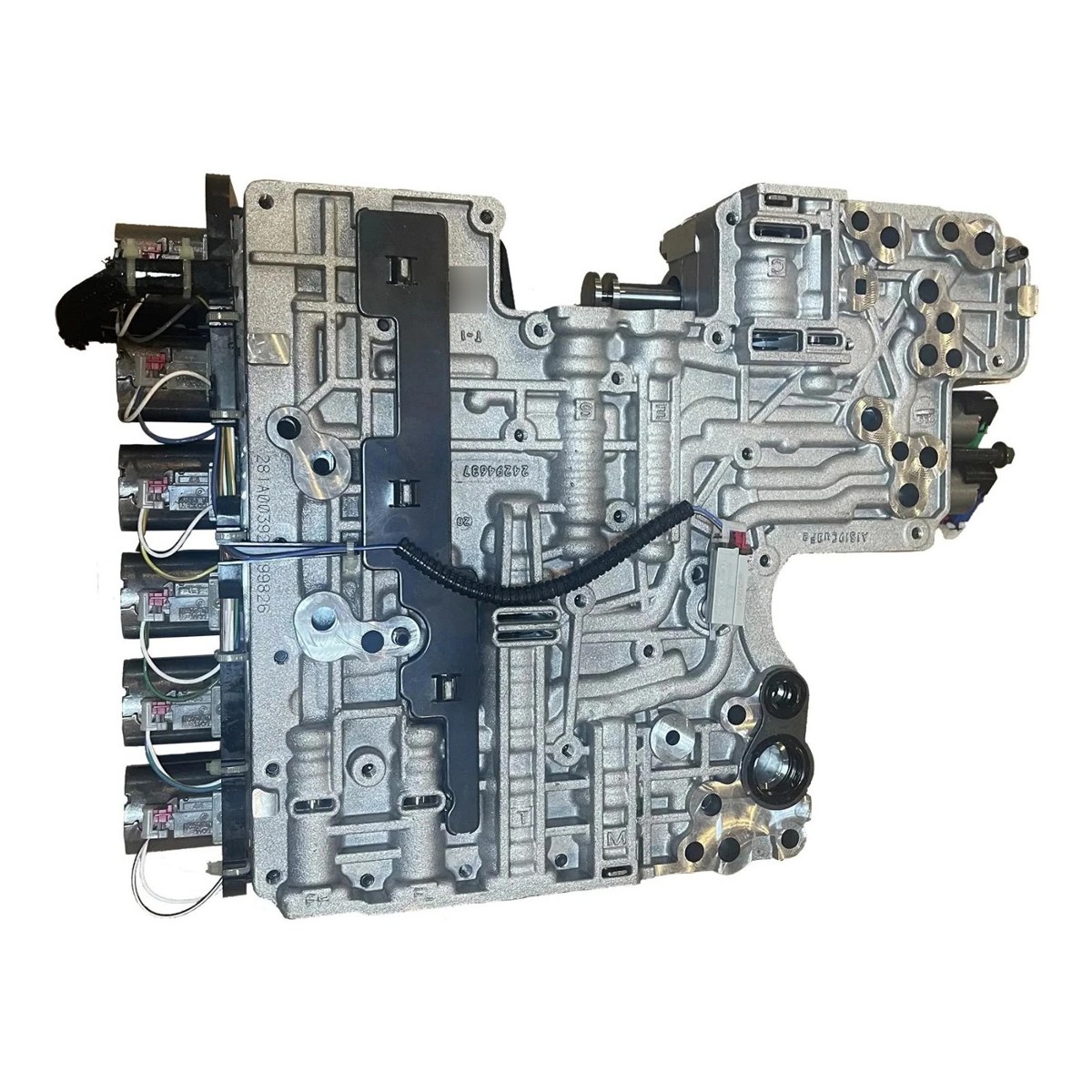

Why no movement in any gear is a different problem than no reverse
ATRA's Keith Clark lays out the core rule for this family in Diagnosing the 10L Series Transmission: every range, forward or reverse, needs four clutch elements applied at once to make a power flow path through the geartrain. A single stuck valve or worn check ball only knocks out the elements that one circuit feeds, which is why a 10L90 can lose Reverse and still pull cleanly through all ten forward gears, as we cover in the no-reverse guide. No movement in any gear at all means none of those elements are applying in any combination, which almost never happens from one bad valve. It happens when something feeding the whole system fails: the TCM can't talk to the rest of the car, the pump isn't making pressure to apply anything, or a mechanical block (the park pawl) was never released in the first place.
Clark's article also notes the scan tool's bidirectional controls can command range changes directly, and that forcing a second-gear start with the paddle shifter, or 4WD Low on 4WD trucks, is a standard way to isolate whether the TCM itself is driving the fault. If the TCM won't respond to those commands at all, you're looking at the network, not the valve body.
Rule out the network before you touch the transmission
Transmission Digest ran a case in 2026 that is worth reading before you pull a single pan bolt. A 2020 Chevrolet Express with an 8L90 (same TCM-dependent control architecture as the 10L90, built by the same GM powertrain group) came in towed, would not move in either direction, with the StabiliTrak and check-engine lights on and the gear selector showing no range at all. A full scan found only the ECM and ABS modules communicating; the TCM, fuel pump control module and body control module were all silent. Stored codes were U0101 (lost communication with TCM), U0109 (lost communication with fuel pump control module), U0073 (control module communication bus A off) and U0140 (lost communication with body control module), all pointing at the same high-speed CAN network rather than four separate failures.
The technician checked network resistance at pins 6 and 14 of the data link connector. A healthy GM high-speed CAN bus reads roughly 60 ohms, from two 120-ohm terminating resistors in parallel; this one read 120 ohms, meaning one side of the network was open. Tracing the harness found a corroded, disintegrated section of wire about eight inches from a connector, where GM's factory harness routing created a drip loop that let water collect inside the split loom. Splicing the wire and rerouting the harness restored communication, and the transmission engaged Reverse and Drive normally on the next try. The transmission itself was never the problem.
The lesson carries straight over to a 10L90 no-move complaint, especially on trucks and SUVs that share the same body/chassis control module layout: confirm every module answers the scan tool and pull the stored network codes before you assume the fault is inside the transmission. A transmission with no communication from its own control module cannot move no matter what condition it's actually in.
The pump: how a 10L90 builds pressure in the first place
If the network and TCM check out and there's still no movement, the next question is whether the transmission has line pressure at all. On the Gen. 1 10L80/10L90, the pump is not driven directly off the torque converter. Transmission Digest's Wayne Colonna documented the layout: the stator shaft support housing carries a converter drive gear and an idler gear, and the idler gear (pressed onto a ball bearing in that housing) is what actually drives the pump's driven gear. GM cuts these as helical gears for quieter running. The whole drive gear, idler gear and bearing assembly comes from GM as one part under front cover assembly number 24053051; it is not sold piece by piece.
That bearing is the weak point. Colonna's reporting describes a 2021 GMC Yukon where the idler gear could be lifted off its bearing with bare fingers, while the bearing itself stayed tight in the housing bore; the cause was the idler gear spinning loose on the bearing's outer race. That case presented as a new front-of-case noise, not a no-move, but it's the same wear mechanism that can progress to a pump that no longer turns reliably enough to build and hold line pressure. No pressure means no clutch applies, forward or reverse, which is exactly the no-movement symptom this guide is about.
If you're sourcing a replacement front cover and comparing it against the related Ford 10R80, know that the parts are not interchangeable as a set. GM's gears are helical; Ford cuts its 10R80 gears straight. Ford does sell its driven pump gear separately (part number HL3Z-7J048-A, around $28) and its bracket support assembly separately (JL3Z-7A130-B, around $340), which some rebuilders use as a cheaper path than GM's $460-$500 front cover assembly, but Ford's straight-cut gears only mesh with Ford's own driven gear. Mixing a GM helical idler gear with Ford's straight-cut set doesn't work; the one swap that does work is reusing GM's converter drive gear, idler gear and the washer underneath it in a Ford-sourced front cover housing, which keeps the GM gear mesh intact.
No movement right after your own valve body or transmission install
If the no-move condition showed up immediately after you did a valve body or transmission job, and the unit is a shift-by-wire 10L90 (which all of them are), check your own work before anything else. Clark's GEARS article documents DTCs P187E and/or P18AB setting when the park pawl actuator piston is missing or didn't fully engage during installation. The fix is procedural, not a parts replacement: the park pawl actuator lever has to be in the fully forward park position, the piston servo opening slot has to be oriented vertically, and the valve body needs to lower into place without being forced past the switch housing, magnet carrier or lever end. If it doesn't drop in cleanly, it isn't seated right, and no amount of re-torquing the bolts will fix a no-move that's really a piston sitting in the wrong position.
Fluid, level and the pump prime check
Before you split anything open, confirm the fluid itself is correct and at the right level, hot. Chevrolet Performance's own installation instructions for the 10L90E crate transmission kit specify DEXRON ULV only, GM part number 19352619 in the US or 19352620 in Canada, and explicitly warn against substituting DEXRON VI or DEXRON HP. The same documentation lists a 7.7 liter (8.1 quart) pan-and-filter capacity as the baseline fill, though any job that drops the pan or the valve body drains more than that and needs a level check at operating temperature, not a fill-to-the-line-and-done approach. A low fluid level or the wrong viscosity fluid can keep a marginal pump from priming cleanly on startup, which shows up looking exactly like a pump failure until you've ruled out the fluid itself.
The diagnostic order that actually saves time
- Scan every module, not just the transmission. If the TCM doesn't answer, or you see U0101, U0109, U0073 or U0140-family codes, go to the network and the DLC before you touch the transmission.
- Check DLC pins 6 and 14 for network resistance. Roughly 60 ohms is healthy; 120 ohms means an open circuit on one side of the high-speed CAN bus.
- If communication is good, verify fluid level and type at operating temperature. DEXRON ULV only, per Chevrolet Performance's install documentation.
- Check for line pressure. No or low pressure with good communication and correct fluid points at the pump, specifically the idler gear and bearing in the stator shaft support housing.
- If the no-move started right after your own valve body or transmission job, recheck the park pawl actuator piston position before ordering any parts.
- Use the scan tool's bidirectional controls or the paddle shifter to force a range change and confirm whether the TCM is actually driving the fault once the above are ruled out.
10L90 Sonnax Pump Vane 124533
When a no-movement diagnosis traces back to pump wear rather than the network or the park pawl actuator, this is the specific pump vane part for the 10L90's Gen. 1 pump.
See the 10L90 Sonnax Pump Vane →FAQ
What's the difference between no movement in any gear and no reverse on a 10L90?
No reverse alone is almost always a valve body problem in one circuit, such as the 1-2-8-9-10-R or 4-5-6-7-8-9-10-R clutch regulator valve, because the forward gears that do not share that circuit still work fine. No movement in any gear points upstream of the clutches entirely: the TCM has no communication, the pump is not building pressure, or the park pawl actuator never released, because none of the ten forward ratios or reverse can apply without those three things working first.
Can a bad network connection cause a GM 10-speed to not move?
Yes. Transmission Digest documented a 2020 Chevrolet Express with an 8L90 that would not move in either direction, where the TCM, fuel pump control module and body control module had all lost communication. The cause was a corroded CAN circuit inside the harness loom, not the transmission. Once the wire was repaired and communication returned, the transmission engaged Reverse and Drive normally. The same TCM-dependent architecture applies to 10L90 trucks and SUVs, so a no-move diagnosis should rule out network faults before the transmission is condemned.
Will a worn pump idler gear bearing cause a 10L90 to lose movement completely?
It can progress to that. The 10L80/10L90 pump is driven by a converter drive gear and idler gear pressed onto a ball bearing in the stator shaft support housing, documented by Transmission Digest. When that bearing wears, the idler gear can spin loose on the bearing's outer race, which starts as a noise complaint but reduces how reliably the pump turns. A pump that cannot build or hold line pressure cannot apply any clutch, in any range.
What fluid does a GM 10L90 use, and can the wrong fluid cause a no-move condition?
Chevrolet Performance's installation instructions for the 10L90E specify DEXRON ULV only, GM part number 19352619 in the US or 19352620 in Canada, and state not to use DEXRON VI or DEXRON HP. The wrong viscosity fluid can affect pump priming and line pressure buildup at cold startup, which is why fluid type and level are checked early in any no-move diagnosis, not as an afterthought.
Why would a 10L90 not move at all right after a valve body or transmission install?
On shift-by-wire 10-speed units, ATRA's GEARS magazine documents a no-movement condition after a valve body or transmission service caused by the park pawl actuator piston being missing or not fully engaging, which can set DTC P187E and/or P18AB. The fix is procedural: the park pawl actuator lever has to sit in the fully forward park position with the piston servo opening slot vertical before the valve body is lowered into place.
Sources
- ATRA / GEARS Magazine — Keith Clark, “Diagnosing the 10L Series Transmission.” Backs the four-clutch-element power flow rule for every range, the scan tool bidirectional range commands and paddle-shifter second-gear start method, and the park pawl actuator piston / P187E / P18AB no-move condition after valve body or transmission service, including the actuator lever and piston servo opening slot installation detail. View source
- Transmission Digest — Wayne Colonna, “GM 10L80: A new kind of pump noise.” Backs the pump drive layout (converter drive gear and idler gear in the stator shaft support housing, pressed onto a ball bearing), the 2017 production start, and the idler-gear-spinning-loose failure case on a 2021 GMC Yukon. View source
- Transmission Digest — Wayne Colonna, “10L80 and 10R80 pump gear differences.” Backs the GM front cover assembly part number 24053051, GM's helical gear cut versus Ford's straight-cut gears on the related 10R80, and Ford part numbers HL3Z-7J048-A (driven pump gear) and JL3Z-7A130-B (bracket support), including the GM/Ford cross-parts caveat. View source
- Transmission Digest — Paul Loch, “8L90 No-Move Condition: It's Not Always the Transmission.” Backs the 2020 Chevrolet Express case study: the no-communication scan result, DTCs U0101, U0109, U0073 and U0140, the DLC pin 6/14 network resistance test (60 ohms healthy versus 120 ohms measured), and the corroded harness circuit root cause and repair. View source
- Chevrolet Performance — 10L90E Transmission Kit for LT1/LT4 Crate Engines, installation instructions 19420481. Backs the DEXRON ULV-only fluid requirement (GM part numbers 19352619 US / 19352620 Canada), the warning against DEXRON VI or DEXRON HP, and the 7.7 liter (8.1 quart) pan-and-filter capacity. View source (PDF)
- GM TechLink — “2019 Camaro ZL1 1LE with 10-Speed Automatic Transmission,” March 21, 2019. Backs the RPO MGL 10L90 running change added to the Camaro ZL1 1LE in a mid-February 2019 production update, and the recommended fluid change interval of every 15 hours of track use. View source