A 10L90 valve body rarely fails all at once. It starts as a 4-5 that bangs one day and flares the next, a converter that shudders at 40 mph, or a Camaro that drops out of 8th into 2nd with the rear tires chirping. By the time a code sticks, the bore that caused it has usually been leaking for thousands of miles. Almost every drivability complaint on this unit that is not a burned clutch pack comes back to a valve or a bore in this casting.
This guide covers the 10L90 in the Camaro SS and ZL1, the Cadillac CT4-V, CT5-V and CT6, and the Escalade. It maps symptoms to valves, explains the Gen. 1 and Gen. 2 split, and shows how to prove bore wear with a vacuum gauge. The facts come from Sonnax, GM's recall filing with NHTSA and ATRA's GEARS magazine, listed at the bottom. Where something is my own bench opinion, I say so.
| Symptom | Valve or part to suspect first | Which generation |
|---|---|---|
| Drops from 7th or 8th into 2nd, momentary wheel lock-up, P0747, worse when hot | Feed limit low valve (solenoid feed to the default disable solenoid) | Gen. 2 (late 2019 on) |
| Stuck in 5th with a service engine light and reduced propulsion message | Recall software that detected feed limit low wear | Gen. 2 cars under recall 25V-148 |
| Erratic shifts, delayed engagement, solenoid codes, burnt clutches | Latch valves (A, B, C, F) worn by the retainer clip or a buckled spring | Gen. 1 only |
| No reverse, missing gear ranges, gear ratio codes | One of the six clutch control (regulator) valves | Both |
| Low line pressure, delayed engagement, poor shift quality | Main pressure regulator valve | Both |
| Converter shudder, TCC slip, low apply pressure in full lockup | TCC regulator valve (and boost valve on Gen. 2) | Both |
Why the 10L90 valve body is where the problems live
The 10L60, 10L80 and 10L90 use casting-integrated, direct-acting solenoids. Sonnax describes them as linear-force solenoids with an individual pin that pushes directly on the clutch regulating valve behind it. There is no separate solenoid feed circuit for the clutch regulators, and the solenoids only make clutch pressure when they have current. Sonnax's Jim Mobley puts the consequence plainly: a 10-speed has no movement when it is unplugged, and the solenoids themselves "rarely fail." The valves and bores they push on are what wear.
ATRA's Keith Clark explains why the wear hurts more on a ten-speed. The TCM overlaps the on-coming and off-going clutch for roughly 0.3 seconds, so any pressure lost to a worn bore is felt as a harsh shift. A flare-and-bump and a binding shift feel the same from the seat. Clark lists weak solenoid retainer clips, sticking clutch control valves and a worn LPC accumulator bore among the root causes and writes that "the source of most issues tends to lie in the valve body."
Gen. 1 or Gen. 2: identify the valve body before you diagnose it
This is the step that decides which valves you test and which parts you buy. Sonnax's Jim Dial dates the split to late 2019.
- Gen. 1 controls each clutch with a regulating valve plus a latch valve. The regulating valve starts the apply. Once apply pressure builds, the latch valve strokes against its spring and connects full line pressure to the clutch. There are four latch valves in the Gen. 1 10L60, 10L80 and 10L90.
- Gen. 2 removes the latch valves. It adds two new valves, feed limit low and feed limit high, working with check balls Sonnax calls "boost balls." On the A clutch circuit, for example, the feed limit low output holds the #5 boost ball against the separator plate while line pressure is under 120 psi. Above the limit spec of 119 psi the ball unseats and the clutch regulator moves faster.
Parts do not cross over. A latch valve kit is useless in a Gen. 2 body, and a feed limit kit has nowhere to go in a Gen. 1. Clark recommends starting every diagnosis by scanning the QR label on the driver's door B-pillar with a phone to read the RPO codes. That also tells you whether the unit is shift-by-wire (ETRS) or cable-shifted, and whether it has auto stop-start.
Gen. 2: the feed limit low valve and the wheel lock-up recall
This is the failure that made the news, and on 10L90 cars it has a federal paper trail. GM's Part 573 report for NHTSA recall 25V-148 (GM number N242480630, March 6, 2025) covers 90,081 vehicles with the 10-speed: the 2020–2022 Camaro (50,147 units), the 2020–2021 CT4 and CT5, and the 2019–2020 CT6. GM's stated cause is excessive valve body wear causing "a fluid leak leading to a pressure drop that causes certain valves to move unexpectedly." The lock-up is momentary, under 150 ms, on a downshift from 8th.
Sonnax traced the leak to the feed limit low valve. Besides feeding the boost balls, it limits solenoid feed to the default disable (DD) solenoid, which is on all the time and holds the default enable and default select valves in place. If the DD solenoid drops out, those valves route line pressure through the exhaust circuit and apply the A, B, C and D clutches: 2nd gear, the power-down default. A worn feed limit low bore starves the DD solenoid, the default valves move on their own, and you get a drop to a lower gear or a bind-up.
Dial's field notes:
- It is a hot complaint. Let the vehicle cool and it usually drives normally until temperature comes back up.
- The code that rides along is P0747, which says the E clutch is on when it should be off.
- Continued driving destroys clutch packs, because the unit binds up intermittently.
The recall remedy is software. Per the 25V-148 filing, the new TCM calibration detects valve wear about 10,000 miles before a lock-up could occur, then limits the transmission to 5th gear until the next key cycle, with a service engine light and a reduced propulsion message. The 2021 CT6, 2022 CT4 and CT5, and 2023 Camaro got that software from the factory. A 10L90 car stuck in 5th may be a valve body the TCM already flagged. Software does not repair the bore, and GEARS reports that GM's steel feed limit low valve (24059372) and higher-rate spring (24279142) were released first for the 10L1000 only.
Gen. 1: latch valve wear
Sonnax's Chris Leach explains that the Gen. 1 latch valves move constantly and carry heavy side loads. Regulated line pressure on the large spool can drive the stem into its retainer hard enough to damage both, and a deformed stem can hang in the retainer slot. What that does:
- Bore leakage lets regulated line pressure exhaust past the spring and clip, causing erratic shifts, delayed engagement, solenoid codes and burnt clutches.
- A valve stuck in the latched position cannot shuttle back to rest, which Leach says causes extremely harsh shifts and dangerous bind-up.
- A buckling spring can hog out the bore badly enough that skipping the repair means an immediate comeback.
Sonnax says every 10-speed rebuild should replace or modify the latch valves. For the Gen. 1 10L90 that means stem repair kit 105740-47K or oversized kit 105740-71K (reamer kit F-105740-TL18).
The symptom-to-valve map for the rest of the casting
Sonnax's critical wear area guide for the 10R60/10R80 and GM 10L60/80/90 Gen. 1 pairs each valve with the complaints it causes. The valves on that map, with Gen. 2 part numbers where Sonnax lists them:
- Main pressure regulator valve: low line pressure, delayed engagement, poor shift quality, burnt clutches, various shift concerns.
- LPC signal damper piston: harsh shifts, high line pressure. Sonnax lists 105740-04K for Gen. 1 and 105740-05K for Gen. 2.
- TCC regulator valve: converter shudder and TCC slip, low TCC apply pressure in full lockup. Oversized kit 105740-16K fits Gen. 1; 105740-17K (regulator and boost valve) fits Gen. 2.
- TCC priority valve: TCC apply and release concerns, overheated fluid, TCC slip codes (105740-03K, oversized 105740-22K).
- Clutch gain control valve (Gen. 1 map): harsh or flared 4-5, harsh 6-4 downshift, passing-gear flare back to 4th.
- The six clutch control valves, A through F: no reverse, reverse slip, slips on take-off, whole gear ranges missing, and gear ratio codes. The guide lists the exact gear ranges for each valve.
Look at how many clutch control valve entries end in "gear ratio codes." On a clutch-to-clutch unit, a leaking regulator bore rarely sets a pressure code. It shows up as the TCM seeing a ratio it did not command. My bench opinion: scattered ratio codes with clean fluid and no clutch debris in the pan almost always mean a worn valve bore, not a hard-parts failure.
Two more items affect the whole body. Weak solenoid retainer clips cost you shift solenoid control pressure; Sonnax sells retainer 105740-19K and clip insert 105740-01K, and Clark says to address the clips on every valve body service. Sonnax also warns that the impregnated filters on the separator plate can come loose and stick valves, which you only find by pulling the plate.
In the vehicle: rule things out before the pan comes down
- Scan every module. Clark notes chassis code C0267 (low brake fluid) causes no upshifts in Tow/Haul, and P175E (shift limiting active) means the TCM is protecting the unit from a sensor input problem, not a valve body fault.
- Run the VIN for open campaigns. On a 2020–2022 Camaro or 2019–2021 CT4, CT5 or CT6, check 25V-148 before you quote a valve body job.
- Do the cool-down test on any lock-up or drop-to-2nd complaint. If it only happens hot, the feed limit low valve moves to the top of the list on a Gen. 2.
- Test the batteries. Sonnax has traced post-repair harsh engagements and erratic shifts that looked like valve body problems to weak batteries.
- Check fluid level and condition with DEXRON ULV only. Heavy clutch material in the pan means the job has gone past the valve body.
On the bench: vacuum test the bores
Bore wear is a leak, and a leak can be measured. Seal the test port, pull vacuum with a hand pump, and read what it holds. Sonnax's numbers for this family:
- Test valves in their rest position unless the guide says otherwise. On the A, B, C and F latch valve locations, you have to seal the bore with your thumb to get a valid reading.
- Latch valves: 16 in-Hg or higher at all three test locations on each valve. Also check the bore with a flashlight for scoring from a buckled spring. Vacuum alone can miss it.
- Feed limit low and high (Gen. 2): test at the balance end, where most of the wear happens. The two readings should match, and a typical good reading is 18 in-Hg or higher. Below 8 in-Hg, Sonnax says a drop-in kit may not be enough; use oversized kits 105740-59K (low) and 105740-60K (high) and ream the bore.
- Check balls: Sonnax's 10000-08 replaces the 0.250 in. (6 mm) balls in both generations. Any time a feed limit valve is serviced, GEARS recommends replacing the check balls too.
Repair, replace, and the service valve body catch
Clark notes that wear in the LPC accumulator bore or the linear pintle solenoid bores means a new valve body. When he wrote, the solenoids were not sold separately, so you ordered a valve body and programmed its Part Unique Number (PUN) or MCVM data. A donor solenoid has to match the original's band number.
Sonnax reports a Gen. 3 service valve body released June 19, 2025, as 24071206 (3.0L diesel) and 24071207 (5.3L and 6.2L gas), with one feed limit valve and a redesigned default circuit that prevents the lock-up. Sonnax says both fit only ETRS trucks with electronic park control. Do not assume either fits a Camaro or Cadillac car; verify by VIN. After any valve body work, run GM's Fast Learn with the fluid at temperature.
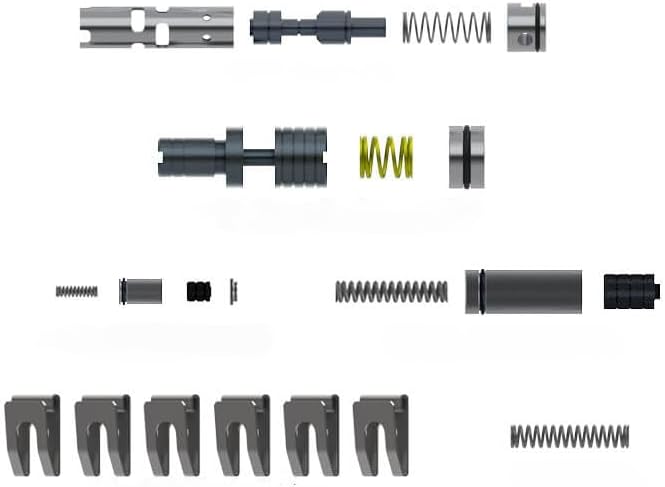
10L90 Sonnax Feed Limit Low Valve Kit (105740-54K)
For Gen. 2 10L90s with P0747, a hot drop to 2nd, or the recall's 5th-gear limit, this drop-in kit restores the bore that feeds the default disable solenoid. On a Gen. 1 unit, the latch valve stem repair kit 105740-47K is the matching part.
See the 105740-54K kit →FAQ
What are the symptoms of a bad 10L90 valve body?
The common ones are harsh or flared shifts, delayed engagement, converter shudder, gear ratio codes, and missing gears or no reverse. On Gen. 2 units built from late 2019, a worn feed limit low valve can drop the transmission from 7th or 8th into 2nd or momentarily lock the wheels, usually when hot, with P0747 set. Sonnax's vacuum test guide ties each of those complaints to a specific valve.
Does recall 25V-148 cover the 10L90?
It covers the 10-speed in the 2020-2022 Camaro, 2020-2021 Cadillac CT4 and CT5, and 2019-2020 CT6, which is 90,081 vehicles. The remedy is TCM software that detects valve wear about 10,000 miles before a lock-up could happen and limits the transmission to 5th gear with a reduced propulsion message. It does not replace the worn valve.
How do I tell a Gen. 1 10L90 valve body from a Gen. 2?
Sonnax dates the change to late 2019. Gen. 1 bodies use four latch valves alongside the clutch regulating valves. Gen. 2 bodies drop the latch valves and add feed limit low and feed limit high valves with boost check balls. Scan the QR label on the driver's door B-pillar for the RPO codes, then confirm what you find when the body is on the bench.
What vacuum reading means a 10L90 valve bore is worn?
Sonnax gives 16 in-Hg or higher at all three test locations for a Gen. 1 latch valve. For the Gen. 2 feed limit valves, a typical good reading at the balance end is 18 in-Hg or higher. Below 8 in-Hg, Sonnax recommends oversized valve kits and reaming the bore rather than a drop-in repair.
Can I replace just the solenoids on a 10L90 valve body?
Usually that fixes nothing, because Sonnax says the direct-acting solenoids rarely fail and the valves and bores they push on are what wear. ATRA notes the linear pintle solenoids were not sold separately when it published, so a valve body was ordered and its PUN or MCVM data programmed. A donor solenoid has to match the original's band number.
Sources
- General Motors — Part 573 Safety Recall Report 25V-148 (GM recall N242480630), March 6, 2025 (NHTSA). Backs the 90,081-vehicle population; the 2020–2022 Camaro (50,147 units, April 15, 2019 to June 28, 2022 production), the 2020–2021 CT4 and CT5, and the 2019–2020 CT6; the valve body wear, fluid leak and pressure drop cause; the lock-up under 150 ms on a downshift from 8th; the software remedy that detects wear about 10,000 miles ahead and limits the transmission to 5th gear with a reduced propulsion message; and the factory-software model years. View source (PDF)
- Sonnax — Jim Dial, “Understanding the ’19-Later GM 10-Speed Safety Recall” and “Understanding ’19-Later GM 10-Speed Clutch Regulating Changes.” Back the Gen. 1 latch valve versus Gen. 2 feed limit low/high and boost ball design, the late 2019 changeover, the 119/120 psi #5 boost ball behavior, the default disable solenoid and default enable/select valve mechanism, the 2nd gear default, the hot complaint and cool-down check, P0747, the 18 in-Hg typical and 8 in-Hg oversize thresholds, and kits 105740-54K, -58K, -59K and -60K. Recall article • Clutch regulating changes
- Sonnax — Ford 10R60, 10R80 & GM 10L60/80/90 (Gen. 1) Vacuum Test Guide, and the GM 10L90 Gen. 1 and Gen. 2 unit pages. Back the valve-by-valve symptom map, the rest position testing rule, sealing latch valve bores with your thumb, and the Gen. 1 and Gen. 2 part numbers for the LPC signal damper, TCC regulator, TCC priority, solenoid stabilization and 10000-08 check ball parts. Vacuum test guide • 10L90 Gen. 1 • 10L90 Gen. 2
- Sonnax — Chris Leach, “Why Every 10-Speed Rebuild Needs Latch Valve Attention”; Jim Dial, “GM Trucks Gen. 3 10L60/80/90 Service Valve Body”; Jim Mobley, “Tackling Ford & GM 10-Speed Valve Body Problems” and “Tips for Success with the GM Transmission Fast Learn Process.” Back the four Gen. 1 latch valves and their failure modes, the 16 in-Hg latch valve reading, kits 105740-47K and -71K; the Gen. 3 service valve body 24071206/24071207 dated June 19, 2025 and its ETRS-truck-only fitment; the direct-acting solenoid design, rarely failing solenoids, loose plate filters and weak batteries; and the Fast Learn procedure after valve body work. Latch valves • Gen. 3 valve body • Valve body problems • Fast Learn
- ATRA / GEARS Magazine — Keith Clark, “Diagnosing the 10L Series Transmission,” June 2024. Backs the B-pillar QR label RPO identification, Gen. 1/Gen. 2 and ETRS variants, the 0.3-second shift overlap, the valve body as the source of most high-mileage shift complaints, retainer clips, LPC accumulator and linear pintle solenoid bore wear requiring valve body replacement, PUN/MCVM programming and band-matched donor solenoids, and C0267 and P175E. View source
- ATRA / GEARS Magazine — Steve Garrett, “P0747 on GM 10-Speed Applications.” Backs GM's steel feed limit low valve 24059372 and higher-rate spring 24279142 being released first for the 10L1000, and the advice to replace check balls with any feed limit repair. View source