The 10L90 lives in three very different kinds of vehicle: a Camaro that might see a road course, a CT5 that mostly sees a commute, and an Escalade that spends its life hauling three rows of people through summer traffic. GM's owner literature treats the fluid as close to lifetime for easy driving, then gives hard numbers for hot, heavy and track use. Most 10L90 filter and pan jobs I see go wrong not in the wrenching, but in picking the interval and in the level set afterward.
This is the whole job on a GM 10L90: when GM actually says to do it, including the 15-hour track rule most owners have never heard of, what to have on the bench, how the pan and filter come out, how to read what you find, and how to set the level without a dipstick. The specs come from GM's own documents, cited as we go and listed at the bottom. Where it is my bench opinion instead of a GM number, I say so.
| 10L90 service item | Spec | Source |
|---|---|---|
| Normal-schedule fluid change | Not listed. GM says checking the level is not necessary | Camaro Owner Manual (2020-2022) |
| Severe-schedule fluid and filter | Every 45,000 mi (three times across the 150,000 mi chart) | Camaro Owner Manual (2020-2022) |
| Track use | Change fluid after every 15 hours of track use; set to the track-specific level before track use | GM bulletin 19-NA-038; Owner Manual |
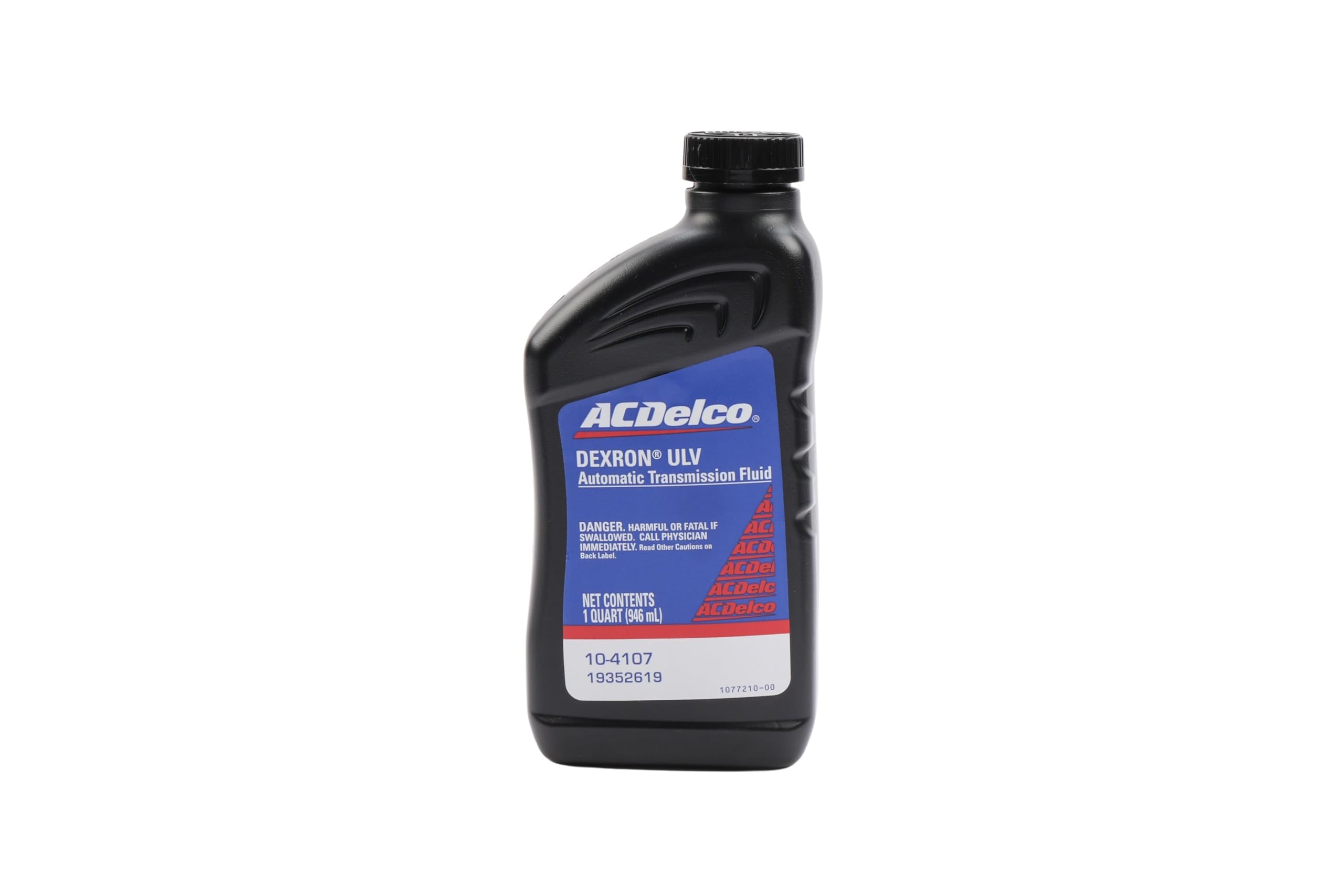
| Fluid | DEXRON ULV only (P/N 19352619 US, 19352620 Canada) | Chevrolet Performance 19420481 |
| Pan and filter capacity | 7.7 L / 8.1 qt | Chevrolet Performance; GM TechLink 2025 |
| Level-set temperature | 75–80°C (167–176°F) TFT; never below 70°C (158°F) | Chevrolet Performance 19420481 |
| Level check plug torque | 22 N·m (16 lb-ft) | Chevrolet Performance 19420481 |
Confirm it is a 10L90 before you order a filter
The 10L60, 10L80 and 10L90 share a case family, and the RPO code is how you tell them apart. Chevrolet Performance's 10L90 installation sheet says its crate unit is based on the production 2017–2021 Camaro 10L90, RPO MI4, and tells buyers to reference service parts to that build. GM bulletin 19-NA-038 covers the 2019 Camaro ZL1-1LE with the 10L90 under RPO MGL. GM TechLink's 2025 capacity chart lists the CT5 under RPO MHX and the Escalade and Escalade ESV under RPO MHO. TechLink's January 2025 ten-speed diagnostic article lists MHO and MHX alongside the 10L60 and 10L80 codes across CT4, CT5, Escalade, Camaro and the full-size trucks.
Read the RPO label or run the VIN. The filter, fluid and level procedure carry across the family, and the current 10L60/10L80/10L90 pan service kit is sold under GM filter number 24294355 with the gasket.
When GM says to do it: street, severe and track
Here is where the 10L90 gets misunderstood. The Camaro Owner Manual (2020-2022) says flatly that it is not necessary to check the transmission fluid level, that a leak is the only reason for fluid loss, and that the vehicle has no dipstick. Its normal maintenance chart has no transmission fluid line at all. People read that and conclude the fluid is lifetime. It is lifetime only if you drive the way the normal schedule describes.
The same manual's severe chart lists "Change automatic transmission fluid and filter" three times across its 150,000-mile span, the 45,000-mile cadence. Look at who GM puts on the severe schedule: vehicles mainly driven in heavy city traffic in hot weather, mainly driven in hilly or mountainous terrain, frequently towing, used for high speed or competitive driving, or used for taxi, police or delivery. That describes a lot of 10L90s. An Escalade in Sun Belt school-run traffic is severe service by GM's own definition. So is any Camaro or CT5 that goes to a track day.
The 15-hour track rule
Track use gets its own rule, and it is not a mileage number. Bulletin 19-NA-038 and the Camaro manual's Track Events section say the same three things: have the transmission fluid set to the track-specific fluid level before track use, change the fluid after every 15 hours of track usage, and have the level set or change done at the dealer.
Do the math on a real owner. Five 20-minute sessions a day is under two hours of lapping, so a driver doing a couple of events a month can hit 15 hours in one season while the odometer shows a few thousand miles. A mileage-only interval will never catch that car. Keep a track-hours log in the glovebox and service off it.
GM does not print the track-specific level in the owner manual; it sends that to the dealer. I will not guess at it here. If a customer's car goes to the track, get the track level set through service information or the dealer before the event, and put it back to the street level after.
My bench opinion for street cars: on a 10L90 that sees any of the severe conditions, I want the pan down at 45,000 miles as GM's severe chart says. On a truly easy-life CT5 or Camaro, pull the pan once somewhere around 60,000 to 75,000 and let what you find set the next interval.
Why the filter matters more on this unit
The 10L90's pump is not bolted to the front of the case. Chevrolet Performance describes an off-axis, variable-vane pump packaged very low in the transmission, located in the valve body, effectively two pumps in the space of one. That pump draws straight through the sump filter, so the filter is part of the pump's inlet circuit, not a debris catcher hanging off to the side.
The filter itself is a two-stage part. Mike Souza's teardown for Transmission Digest shows one housing with a coarse orange media and a fine white media, with a thermal plate between them. Cold, most flow takes the low-restriction path so the pump primes fast on a cold start. As fluid heats and thins, the thermal plate closes toward a ledge in the housing and routes more volume through the fine media, where the small stuff is actually caught.
Put those two facts together and you see why hot, hard use loads this filter. A Camaro on track or an Escalade in August runs the whole time in the fine-media phase, with clutch material being generated at its fastest rate. As the fine media loads, restriction climbs at the pump inlet exactly when the fluid is thinnest. GM TechLink's January 2025 diagnostic article names the result: aeration at the pump inlet causes an erratic whine, and cavitation can cause rattling, whirling or grinding. The listed causes include a low fluid level, a filter condition, or a damaged O-ring. All three are touched by this service, which is why the job has to be done carefully.
What to have on the bench
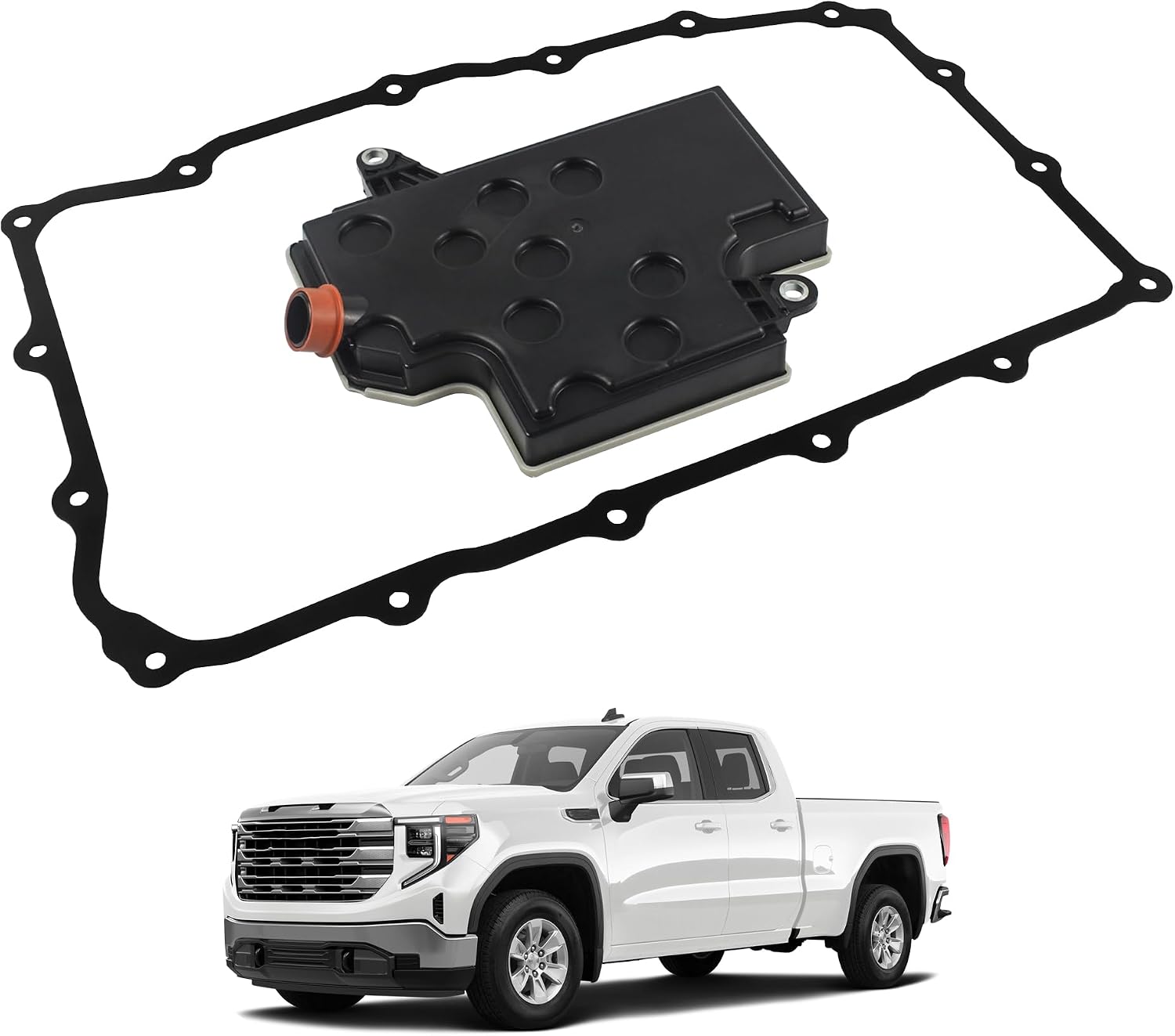
- Filter and pan gasket kit for the 10L60/10L80/10L90 pan (24294355 service kit). Do not reuse the pan gasket.
- Nine quarts of DEXRON ULV. GM's service number is 8.1 qt; nine keeps you from running short at the plug with TFT climbing. GM's sheet says to shake each quart before pouring, and says not to use DEXRON VI or DEXRON HP.
- A fill pump or threaded fill adapter. There is no fill tube. Fluid goes up into the pan.
- A scan tool that reads TFT. Without it you cannot hit the level window, and the level is the whole job.
- Compressed air, a mirror, a large catch pan and an exhaust shield.
Pan and filter, step by step
- Get the car level on the lift. The level is set by a tube standing in the pan, so a tilted car moves your reference.
- Protect the exhaust. GM's 10L90 sheet warns that fluid on hot exhaust is a fire risk. On a Camaro or CT5 the exhaust runs close to the pan, so drape it before anything comes loose.
- Drain what you can at the plug, then break the pan loose at one corner. The check plug only drops the fluid above the level tube; the rest comes out when the pan tips. Loosen the bolts on one end first and let the bulk drain into the catch pan.
- Lower the pan flat. What is sitting in the bottom is your diagnosis. Do not slosh it.
- Pull the filter straight down and check the seal. The seal must come out with the filter, not stay in the bore. A leftover or torn seal is exactly the "damaged O-ring" TechLink lists as an aeration cause.
- Read the pan and magnet (table below), then clean both. Wipe; do not blow shop air into an open case.
- New filter, fully seated, new gasket, pan back up. Torque the pan bolts in sequence to the figure in service information for your RPO and year, by hand. No impact gun on a pan rail.
Read the pan before you clean it
| What is in the pan | What it tells you |
|---|---|
| Fine gray film on the magnet, evenly spread | Normal wear. Clean and continue. |
| Fine black friction material suspended in the fluid | Clutch wear. Normal-ish on a track car at 15 hours; a warning on a 40,000-mile commuter. Check shift quality before selling the service as a fix. |
| Bright metallic flake or chunks, heavy paste on the magnet | Something hard is coming apart. Fluid will not fix it, and the cooler circuit is already contaminated. |
| Dark fluid with a burnt smell | The unit has been hot. Look at the cooler line and bypass valve before refilling (next section). |
| Milky or cloudy fluid | Water or coolant intrusion. Find it first. GM's sheet calls the vent tube critical for keeping water out. |
If the car came in running hot, read GM bulletin 22-NA-182 before you blame the fluid. It covers the 10L90 along with the 6L80, 6L90, 8L90, 10L80 and 10L1000, and names a twisted rubber cooler line as a cause of high fluid temperature, harsh shift, shudder and surge on low-mileage vehicles. The fix is to untwist it at the auxiliary cooler and replace it if it stays misshapen. The same bulletin puts the ten-speed's thermal bypass valve inside the valve body, opening at 143°F (61°C).
Fill and level set: where the service is won or lost
Pump in about 8 quarts through the check plug, reinstall it, and start the engine. Then follow GM's level procedure from the 10L90 sheet:
- Idle and bring the fluid up to temperature, watching TFT on the scan tool.
- Foot on the brake, run the shifter through every range with at least a three-second pause in each, back to Park at 500–800 RPM, and idle at least one minute.
- If you need heat, brake-torque in gear 10 seconds on, 10 seconds off, never above 1500 RPM. GM warns that longer or higher stalls can damage the unit.
- Do not check the level until TFT has reached at least 70°C (158°F). The internal bypass means earlier readings are meaningless.
- At a TFT of 75–80°C (167–176°F), car level, engine running, shifter in Park: clean around the plug with air and confirm with a mirror, then pull the plug. A steady stream means wait for a drip. Nothing coming out means add until it streams, then drips.
- Reinstall the plug at 22 N·m (16 lb-ft).
GM spells out both misses. Set it above 80°C and you are under-filled, which means premature wear. Set it below 75°C and you are over-filled, which can push fluid out the vent tube onto hot exhaust and cause foaming and pump cavitation. And pull the plug with the engine off and you will drain well past the level.
One trap is specific to this case. Souza documented two large plugs on the rear driver's side of the case marked CAR and TRK, plus a smaller GM-only plug on top. They are factory-use only, and the level tube in the pan sits higher than the bottom of those holes. Fill to one of them and you have an under-filled 10L90 that someone signed off as full.
If it whines afterward
Check the level first, correctly, at 75–80°C. Then check your filter seal. TechLink's tip for isolating a pump-side whine is to sweep engine speed slowly from idle to about 2,500 RPM in Park. A whine that shows up in Park points at the pump side of the unit, which is where a bad seal or an under-fill will show itself. A whine that only appears in certain gears while driving is a different conversation and not something the pan service caused. On start/stop vehicles, the auxiliary pump cycling in Park with the engine off is normal, per the same article.
10L90 Transmission Filter with Gaskets
The sump filter plus gaskets in one kit, so the pan goes back up with everything it needs for a clean seal.
See the 10L90 filter and gasket set →FAQ
How often should a 10L90 transmission filter be changed?
GM's normal maintenance schedule does not list a transmission fluid change at all. The severe schedule, which covers heavy city traffic in hot weather, hilly terrain, towing and high speed or competitive driving, calls for the fluid and filter every 45,000 miles. Cars used on track should have the fluid changed after every 15 hours of track use regardless of mileage.
Does the 10L90 have a drain plug or dipstick?
It has no dipstick and no fill tube. The pan has a level check plug with a tube standing inside it that sets the level, so pulling that plug only drains the fluid above the tube. The rest comes out when the pan is lowered, and the refill is pumped up through the same plug.
How much fluid does a 10L90 filter and pan service take?
GM lists 7.7 liters, 8.1 quarts of DEXRON ULV for a pan removal and filter replacement on the 10L90. Have nine quarts on hand so you are not short while setting the level at temperature. The fluid must be DEXRON ULV; GM says not to use DEXRON VI or DEXRON HP.
What is the 15-hour rule for the 10L90 on track?
GM bulletin 19-NA-038 and the Camaro owner manual say the transmission fluid should be set to a track-specific level before track use and changed after every 15 hours of track usage, with the level set or change done at a dealer. Because it is based on hours, not miles, a car doing regular track days can reach it in a single season.
Why does my 10L90 whine after a filter change?
Check the fluid level first, set correctly at 75 to 80 C with the engine running. GM TechLink lists low fluid level, a filter condition and a damaged O-ring as causes of pump aeration and cavitation noise. Also confirm the old filter seal did not stay in the bore when the filter came out.
Sources
- General Motors — 2022 Chevrolet Camaro Owner Manual, Service and Maintenance and Track Events sections (same wording as the 2020 manual). Backs the statement that it is not necessary to check the transmission fluid level and the car has no dipstick, the absence of a transmission fluid line on the normal schedule, the severe-schedule "Change automatic transmission fluid and filter" entries at 45,000-mile steps, the severe-service definitions (heavy city traffic in hot weather, hilly terrain, towing, high speed or competitive driving, taxi/police/delivery), the track-specific fluid level and 15-hour track change interval, and DEXRON ULV for the 10-speed. View source (PDF)
- General Motors — Service Bulletin 19-NA-038, “2019 Camaro ZL1-1LE with 10-Speed Automatic Transmission New Model Features” (February 2019, NHTSA-hosted). Backs the 10L90 RPO MGL identification for the ZL1-1LE, setting the track-specific fluid level before track use, changing the fluid after every 15 hours of track usage, and having level sets and changes done at the dealer. View source (PDF)
- Chevrolet Performance (General Motors) — Supermatic 10L90 Transmission Kit Installation Instructions, 19420481, Rev 08SE22. Backs the 2017–2021 Camaro RPO MI4 reference, the off-axis variable-vane pump located in the valve body, DEXRON ULV only with P/N 19352619 / 19352620 and no DEXRON VI or HP, shaking the quarts, the 7.7 L / 8.1 qt pan-and-filter capacity, the range-sweep and 10-on / 10-off stall limit under 1500 RPM, the 70°C floor and 75–80°C level window with its over- and under-fill consequences, the engine-running plug removal, the 22 N·m (16 lb-ft) plug torque, and the vent tube water-intrusion and exhaust fire warnings. View source (PDF)
- General Motors TechLink — “10-Speed Automatic Transmission Diagnostic Tips,” Mid-January 2025 (Vol. 27, No. 2). Backs the 10L60/80/90 RPO list including MHO and MHX, pump inlet aeration causing an erratic whine, cavitation causing rattling, whirling or grinding with low fluid level, a filter condition or a damaged O-ring as causes, the idle-to-2,500 RPM sweep in Park to isolate pump whine, and normal auxiliary pump cycling on start/stop vehicles. View source (PDF)
- General Motors — Service Bulletin 22-NA-182, covering 6L80, 6L90, 8L90, 10L80, 10L90 and 10L1000 vehicles with harsh shift, shudder, surge, overheating or high fluid temperature (NHTSA-hosted). Backs the twisted cooler line cause and repair and the 10-speed thermal bypass valve inside the valve body opening at 143°F (61°C). View source (PDF)
- General Motors TechLink — 2025 Transmission Capacities & Fluids (U.S. and Canada). Backs the 10L90 rows for the CT5 (RPO MHX) and Escalade/ESV (RPO MHO) at 7.7 L / 8.1 qt of DEXRON ULV. View source (PDF)
- Transmission Digest — Mike Souza, “10R80/10L90 Ford & GM Ten Speed Unique Filter System,” April 2019. Backs the dual-media filter with coarse and fine media and a thermal plate, how flow shifts between them as fluid heats, the GM pan with fill level tube and plug, and the CAR/TRK and GM-only case plugs being factory-use only and sitting below the level tube. View source