GM's 10L90 shows up in the Camaro ZL1, Escalade, Tahoe/Suburban RST and Yukon Denali, and it shares its front cover, pump drive and charge-pressure circuit with the 10L80. When a customer says "I think the pump is going out," on this transmission that complaint usually means one of two very different things under the valve body: a genuinely worn pump-drive bearing making noise, or a sealing ring and bushing problem that starves the pump's charge pressure without the pump itself being bad. Mixing those two up means buying the wrong part. Here's how to tell them apart and what each repair actually costs.

Two Different Failures Both Get Called "the Pump"
The 10L90's front cover houses a converter drive gear and an idler gear, and that idler gear is what actually spins the pump's driven gear. The idler gear and its ball bearing are press-fitted into the stator shaft support housing as an assembly. When that bearing wears, the idler gear can lift off the bearing's outer race, and the transmission starts making noise -- that's a real, mechanical pump-drive failure.
Separately, GM's 10-speed family (10L60/10L80/10L90, plus the Ford 10R60/10R80/10R90/10R140 and Allison 10L1000 that share the same basic architecture) is known for sealing ring and hub bushing wear inside the rotating clutch assemblies. Transmission Digest's repair overview of these units names worn sealing rings and hub bushings as "some of the biggest causes of loss of charge pressure," which leads to lockup and overheat concerns, slipping, slide bumps, neutral conditions and ratio-error codes. The pump is doing its job in that scenario; the fluid it's moving is leaking out of worn circuits before it gets where it needs to go.
Both failures can produce a customer complaint that sounds like "transmission feels weak" or "takes a second to go into gear," which is exactly why they get lumped together as "pump problems." They are not the same repair, and they are not the same price.
Symptom Set 1: Pump-Drive Bearing Noise
This is the more literal pump failure. Transmission Digest covered a case from Tommy Boys Performance where a 2021 GMC Yukon came in with an unusual sound from the front of its 10L80 (the 10L90 uses the same front-cover design). The technician found the idler gear could be lifted off its ball bearing by hand once the housing was apart -- the bearing's outer race had worn enough that the gear was no longer held with the factory interference fit. The ball bearing itself stayed tight in the housing; it was the gear riding loose on it that made the noise. Replacing the drive gear, idler gear and bearing assembly (sold only as a set with the stator shaft support housing, not piecemeal) resolved it.
- What it sounds like: a new whine or rattle from the front of the transmission case, distinct from torque converter or engine noise, that wasn't there before.
- When it shows up: Transmission Digest's reporting notes this pattern on a 2021 model-year unit, and flags that as these early 10L80/10L90 units pass out of their factory warranty window, techs should expect to see more of this bearing wear in the aftermarket rather than only at the dealer.
- What it is not: a loss of line pressure by itself. A unit with this noise can still build and hold pressure normally until the bearing wear progresses far enough to affect gear mesh.
Symptom Set 2: Charge-Pressure Loss From Bushing and Sealing Ring Wear
This is the failure that gets mistaken for "the pump is weak." Per Transmission Digest's 10-speed overview, wear on the sealing ring and hub bushing inside the rotating assemblies bleeds charge pressure before it reaches the clutch packs. You won't hear a new noise from the front of the case for this one -- you'll see it on a scan tool and feel it on a road test.
- Delayed or soft engagement into drive or reverse after sitting.
- Slipping or "slide bumps" during shifts, especially under load.
- Neutral conditions where the transmission momentarily feels like it's lost drive.
- Ratio-error DTCs as the TCM detects commanded gear versus actual output speed mismatches.
- Overheating on units where torque converter clutch apply and charge pressure share the same starved circuit.
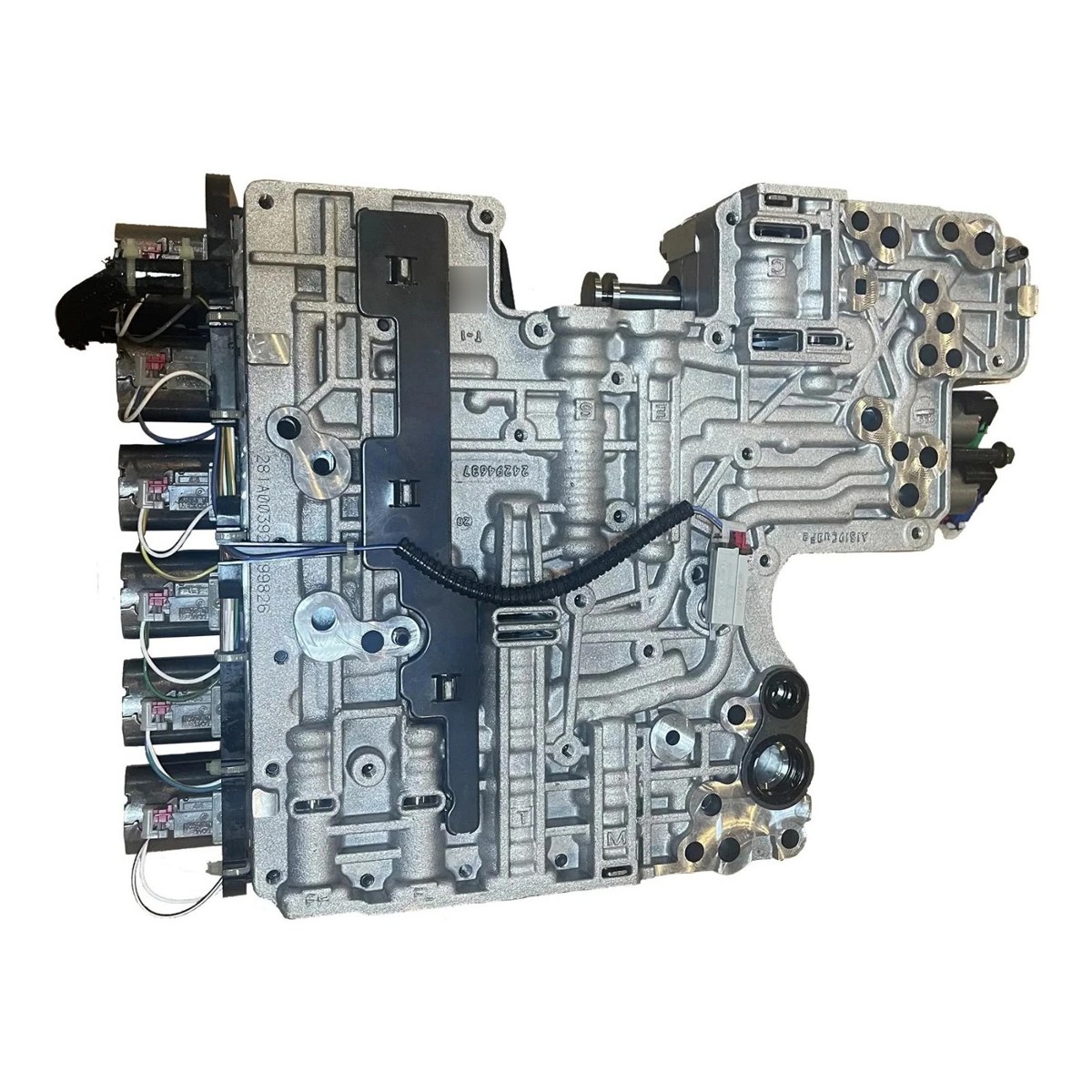
ATRA's own trade press backs this with hardware: Sonnax sells an oversized main pressure regulator valve kit (#105740-20K for Gen. 1 GM 10L60/80/90 and Ford 10R60/80/90/140, #105740-21K for Gen. 2 GM units) specifically to restore line pressure control once the regulator bore and valve spool wear, per GEARS Magazine's July 2023 coverage of Sonnax's 10-speed valve kit lineup. That kit addresses the valve body side of pressure loss; Core Transmission Parts also stocks the matching case bushing kit and zip kit that address the rotating-assembly sealing rings this same wear pattern affects.
How to Tell Which One You're Looking At
- Listen before you touch anything. A new, speed-dependent whine or rattle from the front of the case, with normal shift timing otherwise, points toward the idler gear/bearing wear pattern described above.
- Pull codes and log line pressure. Ratio-error codes, slip codes, or a line pressure PID that's low or unstable at idle and under load points toward sealing ring/bushing wear rather than the front-cover bearing.
- Air-check the pump circuit before condemning parts. Transmission Digest's 10-speed repair piece recommends air-checking the complete rotating assembly through the pump before it goes back in the case -- this catches clutch-drum and shaft-plug leaks that mimic a weak pump without the pump being at fault.
- Vacuum test the valve body's pressure regulator bore once it's out, rather than assuming the pump itself is worn. A bore reading outside spec calls for the oversized valve kit, not a pump or front-cover replacement.
- Confirm the fluid is correct before you chase anything else. These units are sensitive to fluid spec -- see the fluid note below -- and the wrong ATF alone can produce pressure-loss-like symptoms on a mechanically sound unit.
Replacement: What It Actually Takes
If you've confirmed pump-drive bearing wear, the repair is the drive gear/idler gear/bearing assembly built into the stator shaft support housing -- GM does not sell the bearing by itself. GM's front cover assembly (part number 24053051) runs roughly $460-500. Because the GM and Ford 10-speeds share a lot of architecture, Transmission Digest documented a cheaper path: Ford's equivalent "Bracket Support" front cover (part number JL3Z-7A130-B, about $340) plus Ford's separate driven pump gear (part number HL3Z-7J048-A, about $28) totals near $370 -- but GM uses helical gears for quiet operation while Ford uses straight-cut gears, so the assemblies aren't a drop-in match. The documented workaround is pulling the GM converter drive gear, idler gear, and the washer GM runs under the drive gear off the worn GM cover and installing that gear set into the Ford housing, rather than mixing GM and Ford gear sets. The front cover also carries the low roller clutch, which Transmission Digest notes is a second, separate wear item worth inspecting any time the cover is off.
If you've confirmed sealing ring/bushing-driven pressure loss instead, the repair path is different: the rotating clutch assemblies need the correct sealing rings and bushings (included in a full overhaul/rebuild kit), and if the valve body's pressure regulator bore has worn out of spec, that bore needs an oversized valve kit or a replacement valve body -- not a pump.
One step that's easy to skip on either repair: GM's PIP5477K bulletin, which covers the 10L90/10L80 transmission assembly restriction on 2017-2019 Camaro, Escalade, Suburban RST, Tahoe RST and Yukon Denali models, notes that after a transmission assembly goes back in, the solenoid valves must be characterized, and failing to run that procedure can cause the exact kind of shift concerns you just fixed. Run the same characterization step after a front cover or pump-related repair on an in-vehicle unit. Separately, if your diagnosis leads all the way to a full transmission assembly replacement on one of the restricted RPOs covered by that bulletin, GM wants a Product Quality Center case opened before the swap, not after.
Working a 10L90 pump or pressure complaint this week?
Valve bodies, overhaul kits, case bushing kits and filter/pan gasket service parts for the 10L90, shipped fast from the USA.
Shop 10L90 parts →The Fluid Note That Changes Everything
Transmission Digest's 10-speed overview is specific about this: use Dexron ULV or Mercon ULV, not a universal or previously designed fluid. Transmission fluid for these units is thinner than older ATF specs, and it's designed specifically to reduce friction and workload in the pump. A universal fluid will produce shift complaints and can cause premature failure in the exact circuits this article covers. If a 10L90 is showing pressure-loss symptoms and the fluid history is unknown or the fluid doesn't match that description, correct the fluid before you commit to a bushing or valve body repair -- see our 10L90 fluid type and capacity guide for the full spec and fill procedure.
FAQ
What does a bad 10L90 pump sound like?
Transmission Digest documented a 2021 GMC Yukon 10L80 (the same front-cover design as the 10L90) with an unusual noise from the front of the transmission that traced to the idler gear lifting off its ball bearing inside the stator shaft support housing. The idler gear drives the pump's driven gear, so wear there shows up as a new whine or rattle from the front of the case rather than a dead pump with no pressure at all.
Can low line pressure on a 10L90 happen without the pump actually failing?
Yes, and ATRA-trained techs see this more often than an outright pump failure. Transmission Digest's 10-speed repair overview names wear on the sealing ring and hub bushing as one of the biggest causes of charge pressure loss on these units, which produces the same slipping and delayed-engagement symptoms as a weak pump without the pump itself being bad.
Is a 10L90 pump failure covered by GM's part restriction program?
GM bulletin PIP5477K put the 10L90 and 10L80 transmission assembly on a parts restriction through its Product Quality Center starting 07/20/18, covering specific RPOs in the Camaro, Escalade, Suburban RST, Tahoe RST and Yukon Denali. By the time of that bulletin's final revision the listed RPOs were fully serviceable under published service information, but a shop replacing the full assembly on a restricted unit still needs to open a PQC case first.
Can you use Ford 10R80 parts to fix a GM 10L90 pump?
Partially, and only for the 10L80/10L90's front cover, not a true 10L90-specific swap. Transmission Digest found that GM's front cover uses helical gears while Ford's 10R80 uses straight-cut gears, so a complete GM-to-Ford swap doesn't bolt together as-is. Techs have cross-utilized the parts by taking the GM converter drive gear, idler gear and washer off a worn GM cover and installing them in a Ford front cover assembly, which runs cheaper than GM's own part.
Does replacing the 10L90 pump or front cover require reprogramming?
GM's PIP5477K bulletin notes that after a transmission assembly is installed, the solenoid valves must be characterized, and that failing to run that procedure can cause customer shift concerns. A front cover or pump replacement on an in-vehicle transmission should get the same solenoid valve characterization step before the vehicle goes back to the customer.
Sources
- Transmission Digest — "GM 10L80: A new kind of pump noise," Wayne Colonna, August 8, 2022. Backs the idler gear/ball bearing failure in the stator shaft support housing, the 2021 GMC Yukon case, and the repair (replacing the drive gear/idler gear/bearing assembly). transmissiondigest.com
- Transmission Digest — "10L80 and 10R80 pump gear differences," Wayne Colonna, February 19, 2024. Backs GM part number 24053051 and its cost, Ford's cross-reference parts (JL3Z-7A130-B and HL3Z-7J048-A) and their cost, the helical-versus-straight-cut gear difference, the GM/Ford gear cross-utilization method, and the low roller clutch wear note. transmissiondigest.com
- Transmission Digest — "What you need to know about 10-speed transmission repair," Caleb Perham, April 7, 2025. Backs the sealing ring/hub bushing wear pattern and resulting charge-pressure loss, the slipping/slide bump/neutral/ratio-error symptom list, the pump air-check recommendation, and the Dexron ULV/Mercon ULV fluid requirement. transmissiondigest.com
- General Motors — Bulletin PIP5477K, "10L90 10L80 10 Speed Automatic Transmission Restriction," published June 18, 2019 (via NHTSA). Backs the affected models and RPOs, the Product Quality Center restriction process, and the post-installation solenoid valve characterization requirement. static.nhtsa.gov
- GEARS Magazine (ATRA) — "New Sonnax 10R/10L Oversized Main Pressure Regulator Valve Kits & TCC Priority Valve Kit," July 18, 2023. Backs Sonnax kit part numbers 105740-20K (Gen. 1) and 105740-21K (Gen. 2) for GM 10L60/80/90 and their purpose of restoring line pressure control. gearsmagazine.com