"It slips" is the least specific complaint a 10L90 owner can bring in, and the one most likely to end in an expensive guess. On a ten-speed, the feeling of slipping can come from six different clutches, the torque converter clutch, a hydraulic circuit that is bleeding pressure, a fluid level nobody set correctly, or a cooler line that got kinked when the truck was built. Some of those cost nothing to fix. One of them costs a rebuild.
This guide works through the causes in the order I check them on a Camaro, CT5-V, Escalade or full-size truck with the 10L90 (and its 10L80 sibling, which shares most of the internals). Facts come from GM service information, Sonnax, Gears Magazine and Raybestos, listed at the bottom. Where something is my bench opinion rather than published data, I say so.
| What you feel | Most likely area | First check |
|---|---|---|
| Engine flares between gears, then the shift lands | Clutch apply pressure or timing (fluid, valve body, adapts) | Fluid level at temperature, codes, recent repairs |
| RPM creeps up at steady highway cruise, no shift | Torque converter clutch slip | Commanded TCC state vs. engine and turbine speed |
| Flare or neutral feel plus high fluid temperature | Cooling circuit | Twisted cooler line, thermal bypass valve (GM 22-NA-182) |
| Slips in the same gears every time, worse hot | A specific clutch pack or its hydraulic circuit | Map the gears to the clutch apply chart |
| Erratic, worst cold, settles once warm | Voltage supply | Battery test before any valve body work |


How the 10L90 decides it is slipping
Chevrolet Performance's 10L90 installation sheet describes the unit as four simple planetary gearsets controlled by two brake clutches and four rotating clutches, six multi-disc clutches that produce ten forward ratios and reverse. It also notes the transmission uses three speed sensors for shift response and accuracy. That matters for diagnosis: the TCM knows input and output speed, so it can calculate the ratio it is actually getting and compare it to the gear it commanded. When the two disagree beyond calibration limits, it sets an incorrect-ratio or clutch performance code and may limit shifting.
Per Keith Clark's 10L diagnostic article in Gears Magazine, the 10L series needs four components applied for power to flow through the geartrain, and the TCM manages each shift by controlling both the releasing and the applying clutch through roughly 0.3 seconds of overlap. With that little margin, any loss of apply pressure or any extra clearance in a pack shows up as a flare: the off-going clutch lets go before the on-coming clutch has capacity, and engine speed runs up in the gap. Clark also lists P175E, Transmission Control System Shift Limiting Active, as the code the TCM sets when it has started protecting itself because of bad sensor data from the engine or transmission side.
First practical point: separate a shift flare (engine speed jumps only during a gear change) from a steady-state slip (engine speed and ratio drift while the transmission is holding one gear or the converter is supposed to be locked). They have different causes.
Cause 1: Fluid level and fluid type
There is no dipstick. GM's 10L90 procedure sets the level at the case check plug with the engine running, the vehicle level and transmission fluid temperature at 75–80°C (167–176°F), after cycling the shifter through every range with at least a 3-second pause in each. The sheet also warns that fluid may drain from the hole if the plug is pulled with the engine off, which is how a lot of these units end up a couple of quarts low after a quick-lube "check." A low 10L90 aerates the pump pickup, clutch apply pressure drops, and the first symptom is usually a flare on a shift, often worse on turns or hard stops.
Fluid type is not optional. GM specifies DEXRON ULV only (P/N 19352619 in the US) and says in plain words not to use DEXRON VI or DEXRON HP, and that the quart containers must be shaken before pouring to mix the additives. The pan-and-filter service takes approximately 7.7 liters (8.1 quarts); a full system with the cooler holds 12.52 liters (13.23 quarts). The level-set window, capacities and plug torque are covered in our 10L90 fluid type and capacity guide.
Cause 2: A twisted cooler line and the thermal bypass valve
This one is worth checking before you open anything. GM bulletin 22-NA-182 covers 6L80, 6L90, 8L90, 10L80, 10L90 and 10L1000 vehicles with harsh shifts, shudder, surge, stall, neutral/flare, overheating or high fluid temperature, before or after an overhaul. The September 2024 revision lists 2021–2025 Escalade models (including the LT4-powered Escalade-V, which uses the 10L90), plus the 2021-and-later Silverado, Sierra, Tahoe, Suburban and Yukon.
The cause GM names on low-mileage vehicles is a twisted cooler line. On ETRS (electronic shifter) transmissions it can set P27EC. The fix is to untwist the line at the auxiliary cooler, replace it if it stays misshapen, and then set the fluid level per service information. If the lines are fine, GM points at the thermal bypass valve: on the 10-speeds it is inside the valve body and opens at 143°F (61°C), except on the 3.0L diesels, where it sits on the frame rail and opens at 194°F (90°C).
Why a cooling problem feels like slipping, in my experience: overheated ULV thins out, internal leakage past every valve and sealing ring goes up, and clutch apply pressure at the pack falls below what the TCM's adapts expect. The flare is real, but the clutches are the victim, not the cause. Fix the flow first or the new clutches go the same way.
Cause 3: Converter clutch slip, not transmission slip
A lot of "slipping at highway speed" complaints are the torque converter clutch. With a scan tool, watch commanded TCC state against engine speed and turbine (input) speed. If the TCC is commanded applied and engine speed stays measurably above turbine speed, or the slip number wanders under light throttle, the converter clutch is not holding. If the ratio between input and output speed is changing, that is a clutch inside the transmission.
On the valve body side, Sonnax's write-up on 10-speed valve body problems lists wear in the main pressure regulator valve, TCC priority valve, TCC regulator valve and boost valve bores. The TCC priority valve kits (105740-03K, and oversized 105740-22K for badly worn bores) are listed for TCC apply and release concerns, overheated fluid, TCC slip codes, and low line pressure. Note the overlap with Cause 2: a leaking TCC circuit also starves cooler flow and runs the fluid hot. If the converter itself is suspect, it is a separate repair; our 10L90 common problems guide covers the converter side.
Cause 4: Valve body leaks that bleed clutch apply pressure
The 10L90's clutches are applied through feed limit valves and clutch control valves, not straight from line pressure. Sonnax's 10L1000 casting and clutch application article (which also covers the Gen. 2 10L60/80/90) gives the numbers: feed limit low is 95–119 psi and controls the A and B clutch circuits; feed limit high is 145–181 psi and controls the C and F circuits. On Gen. 2 units a checkball in line with each feed limit valve unseats when pressure exceeds the limit and lets the control valve stroke, bringing apply pressure up to line pressure faster.
Worn bores in that system mean less pressure at the pack than the TCM commanded, which is the textbook recipe for a flare. Clark's Gears article adds a worn LPC accumulator bore, weak solenoid retainer clips and sticking linear pintle solenoids as common high-mileage valve body faults, and warns that reused sealing rings will leak and cause intermittent shift quality problems after a rebuild. For Gen. 1 bodies, the Sonnax Zip Kit targets main line, TCC and clutch apply pressure losses in one package.
One trap worth naming: feed limit low valve wear is the subject of GM safety recall N242480630 on 2019-and-later Gen. 2 units. Sonnax explains that wear in that valve's balance end drops feed to the default solenoid and can put the unit in partial default, letting more than four clutches apply. That is a bind-up, not a slip, but owners sometimes describe the sudden downshift as "it slipped out of gear." Check open recalls by VIN before anything else. The solenoid side is covered in our 10L90 shift solenoid guide.
Cause 5: Weak battery and charging voltage
This sounds like a shortcut, but Sonnax calls it out specifically for GM and Ford ten-speeds: batteries in these vehicles only last about three years, and shops misdiagnose battery problems as valve body failures after a transmission repair. The pattern Sonnax describes is drivability trouble at first that settles down once the vehicle reaches operating temperature. The solenoids are current-controlled pressure regulators; give them unstable supply voltage and apply pressure moves around. Load test the battery and check charging voltage before you order a valve body.
Cause 6: Adapts after a repair
The TCM learns fill pressure and volume for every clutch and stores them as adapts. After a valve body swap, clutch work or a reflash, those values are wrong or cleared, and the first shifts can flare or bang until relearned. GM documents this for its 8-speed in bulletin 16-NA-019, which defines "low mileage" as roughly 5,000 miles or less or within about 5,000 miles of a valve body, clutch or transmission replacement, and uses Service Fast Learn followed by adaptive learning. On a 10L90 that has had valve body or solenoid work, confirm the solenoid characterization data was programmed and the adapts were relearned before you condemn anything else.
Sonnax's fast learn write-up for GM 8-, 9- and 10-speeds gives the conditions that have to be met, and they are worth printing for the bay: fluid at 167–185°F (75–85°C) unless the current TCM program says otherwise, normal line pressure of at least 55–60 psi in Drive with a rise on throttle, verified fluid level, a quarter to three-quarters tank of fuel, no stored powertrain or ABS codes, and a healthy battery and charging system. The same article lists what keeps fast learn from completing: clutch circuit leaks, pressure regulator wear, worn end plugs, cut solenoid O-rings and valve body assembly mistakes. A fast learn that will not finish is telling you the slip is hydraulic, not a learning problem. TCC adapts can still take 200–300 miles after it completes. If the complaint is a slow garage shift rather than a flare, see our 10L90 delayed engagement guide.
Cause 7: Worn clutches, and how to find which pack
When the fluid is right, the cooler flows, voltage is good, the valve body is not leaking and the adapts are learned, and the unit still slips in the same gears every time, you are looking at friction material or clearance. Map the slipping gears to the clutch apply chart. Sonnax notes GM changed the clutch application between Gen. 1 (2019 and earlier) and Gen. 2 (2020 and later) units, so use the chart for the unit in front of you. For example, the E clutch applies in 1st, 3rd and 5th through 9th on both generations, while on Gen. 2 the A clutch applies in 1st through 6th and reverse. If the complaint lives only in gears that share one clutch, that pack or its circuit is your suspect.
Clearance matters as much as the friction. Raybestos' installation guide for its 10L80/10L90 F clutch kit (RTK-10R86) specifies 0.048–0.068 in. clearance, set with snap rings available from 1.5 mm to 2.5 mm in 0.2 mm steps. Excess clearance lengthens clutch fill time, and with a 0.3-second overlap window that shows up as a flare even on fresh frictions. My bench rule: if you are in there for slipping, measure every pack, replace sealing rings rather than reusing them, and inspect the drum bores and hubs for heat damage.
Sonnax's Caleb Perham names sealing ring and hub bushing wear as some of the biggest causes of lost charge pressure on the GM 10L60/80/90 and Ford 10-speeds, and points out that the shafts carry plugs that keep oil in its circuit; a leaking plug produces shift complaints too. Air check each drum with the input and its mating part, then air check the complete assembly through the pump before it goes in the case. A leak you hear on the bench is a slip you do not have to find on the road test.
Diagnostic order that saves the most money
- Check for open recalls and bulletins by VIN, especially N242480630 and 22-NA-182.
- Pull all codes with freeze frame. Note incorrect-ratio codes, P175E, P27EC, and any TCC slip codes.
- Test the battery and charging system.
- Set the fluid level correctly with DEXRON ULV, engine running, at operating temperature. Look at the fluid and smell it.
- Inspect the cooler lines for twists and check fluid temperature behavior.
- Road test with data: commanded gear, input and output speed, engine speed, TCC command and fluid temperature. Decide: shift flare, steady-state clutch slip, or TCC slip.
- If there was recent repair work, confirm solenoid characterization and relearn adapts.
- Then the valve body, then the clutch packs, using the apply chart to target the right one.
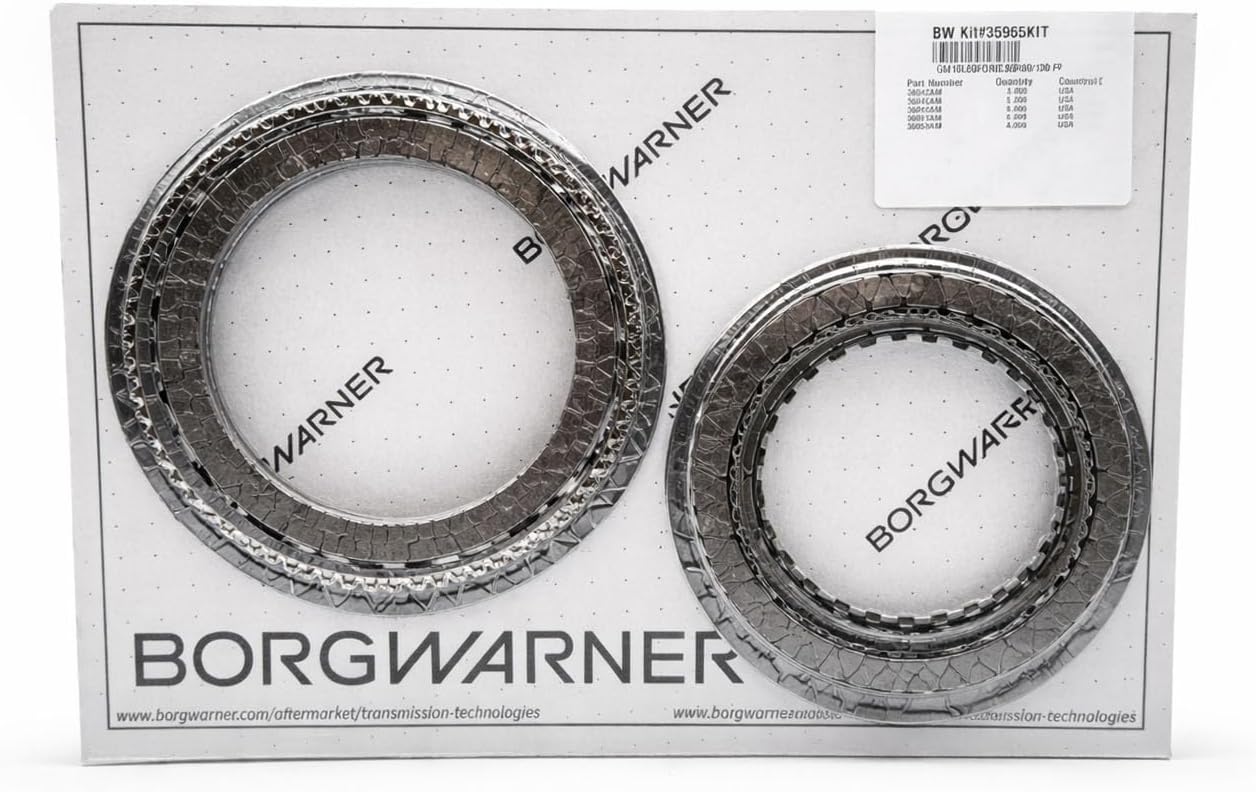
10L90 Friction Clutch Kit 2018-Up (Raybestos)
If the diagnosis ends at worn frictions, this is the clutch set for the job. Measure and set clearance on every pack when it goes in.
See the 10L90 friction clutch kit →FAQ
Why does my 10L90 feel like it is slipping between gears?
A flare between gears usually means the on-coming clutch is not getting enough apply pressure in time. The 10L90 overlaps the releasing and applying clutch for only about 0.3 seconds, so low fluid, overheated fluid, a leaking valve body bore, excess clutch clearance or unlearned adapts all show up as engine speed running up during the shift. Check fluid level at temperature and look for codes before anything else.
How do I check the fluid level on a 10L90 with no dipstick?
GM sets the level at the case check plug with the engine running, the vehicle level, the shifter cycled through every range with a 3-second pause in each, and the fluid at normal operating temperature. Pulling the plug with the engine off lets fluid drain out, which is a common way these units end up low. Use DEXRON ULV only; GM says not to use DEXRON VI or HP.
Can a cooler line problem make a 10L90 slip?
Yes. GM bulletin 22-NA-182 lists neutral/flare, shudder, harsh shifts and high fluid temperature on 10L80 and 10L90 vehicles, with a twisted cooler line as the cause on low-mileage units. It can set P27EC on electronic-shifter transmissions. If the lines are fine, GM points to the thermal bypass valve, which opens at 143 degrees F (61 degrees C) inside the valve body.
Is it the torque converter or the transmission slipping?
Watch the data. If the converter clutch is commanded on and engine speed stays above turbine speed at steady cruise, the TCC is slipping. If the ratio between input and output speed changes while the transmission holds a gear, a clutch inside the transmission is slipping. Worn TCC priority or regulator valve bores in the valve body are a common cause of TCC slip codes.
Can a weak battery cause shifting problems on a 10L90?
It can. Sonnax warns that batteries in GM and Ford ten-speed vehicles last about three years and are often misdiagnosed as valve body failures, especially when the problem is worst cold and settles down once the vehicle is warm. The solenoids regulate pressure by current, so unstable voltage moves apply pressure around. Load test the battery before buying a valve body.
Sources
- General Motors — Service Bulletin 22-NA-182, “Information on 6L80, 6L90, 8L90, 10L80, 10L90, 10L1000 Equipped Vehicles With a Harsh Shift, Shudder, Surge, Stall, Neutral/Flare, Transmission Overheating and/or High Transmission Fluid Temperature” (September 2024, NHTSA-hosted). Backs the neutral/flare condition, the covered 2021–2025 Escalade and 2021-and-later GM truck and SUV applications, the twisted cooler line cause, P27EC on ETRS units, the untwist/replace and level-check correction, and the 10-speed thermal bypass valve opening at 143°F (61°C) inside the valve body (194°F/90°C on the frame rail for the 3.0L diesel). View source (PDF)
- Chevrolet Performance (General Motors) — Supermatic 10L90 Transmission Kit Installation Instructions, 19420481, Rev 08SE22. Backs the two brake clutches and four rotating clutches (six multi-disc clutches), three speed sensors, DEXRON ULV only (P/N 19352619) and not DEXRON VI or HP, shaking the quart containers, fluid draining if the plug is removed with the engine off, the running level-check procedure at 75–80°C with a 3-second pause in each range, and the 7.7 L (8.1 qt) service and 12.52 L (13.23 qt) total capacities. View source (PDF)
- Sonnax — Caleb Perham, “GM 10L1000 Casting Identification & Clutch Application.” Backs the Gen. 1 versus Gen. 2 (2020-later 10L60/80/90) clutch application change, the E clutch and Gen. 2 A clutch application, feed limit low at 95–119 psi feeding the A and B circuits, feed limit high at 145–181 psi feeding C and F, the checkballs in line with the feed limit valves, and feed limit low wear causing partial default with more than four clutches applied (recall N242480630). View source
- Sonnax — “Tackling Ford & GM 10-Speed Valve Body Problems, Failing Batteries & More.” Backs wear in the main pressure regulator, TCC priority, TCC regulator and boost valve bores, TCC priority valve kits 105740-03K and oversized 105740-22K for TCC slip codes, overheated fluid and low line pressure, and the warning that batteries in these vehicles last about three years and get misdiagnosed as valve body failures. View source
- Gears Magazine (ATRA) — Keith Clark, “Diagnosing the 10L Series Transmission.” Backs four components applied for power flow, the approximately 0.3-second shift overlap, P175E shift limiting active, worn LPC accumulator bores, weak solenoid retainer clips and sticking linear pintle solenoids, and reused sealing rings leaking and causing intermittent shift quality. View source
- Raybestos Powertrain — “10R80, 10R100, 10L80, 10L90 F Clutch Installation, RTK-10R86.” Backs the F clutch clearance of 0.048–0.068 in. and selective snap rings from 1.5 mm to 2.5 mm in 0.2 mm increments. View source
- Sonnax — Jim Mobley, “Tips for Success with the GM Transmission Fast Learn Process” (Aug. 10, 2023). Backs the 167–185°F fast learn temperature window, 55–60 psi minimum line pressure in Drive, the fuel-level and no-codes requirements, the list of faults that prevent fast learn from completing, and TCC adapts taking 200–300 miles. View source
- Sonnax — Caleb Perham, “Troubleshooting Pressure Loss in 10-Speed Clutch Packs” (Apr. 7, 2025). Backs sealing ring and hub bushing wear as leading causes of charge pressure loss on GM 10L60/80/90 units, leaking shaft plugs, and air checking drums and the assembly through the pump. View source