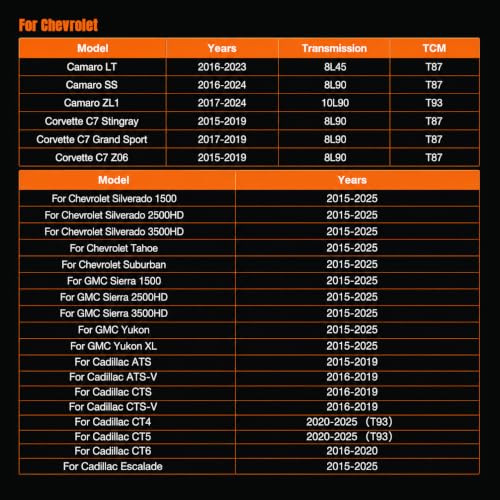
A Camaro SS comes in with a flare on the 3-4 shift. An Escalade bangs into 2nd. A CT5-V holds a gear too long and then slams the next one. All three owners have been told the same thing somewhere else: "it's a shift solenoid." On a 10L90 that sentence is usually half right, and the half that is wrong is what costs a customer a second visit.
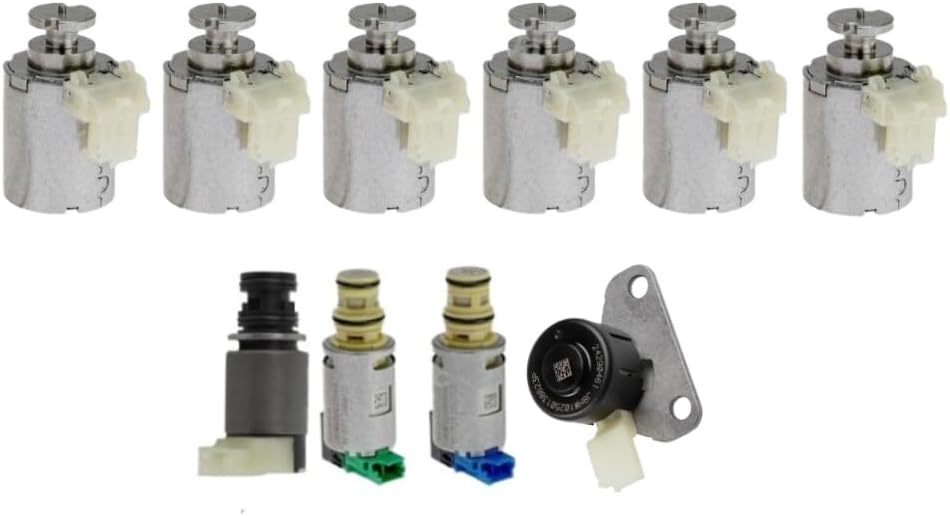
The 10L90 does not have shift solenoids in the old on/off sense. It has eight control solenoid valves and a default disable solenoid living on the lower valve body, each doing a different job, and every one of the eight is matched to the transmission control module by a data file. Below: what each one does, what a failure feels like, why a new solenoid can shift worse, and three valve body faults that mimic a bad solenoid. Sources are listed at the bottom; bench opinion is labeled as such.
| 10L90 solenoid | Job | What a fault looks like |
|---|---|---|
| Solenoid valves 1–6 | Clutch control. Each one strokes the clutch control valve for one of the six clutches | A problem on the specific shifts or gears that use that clutch: flare, bind-up, slip, harsh engagement |
| Solenoid valve 7 | Line pressure. Normally high variable force solenoid | Lose control of it and pressure goes to maximum: harsh shifts everywhere, not in one gear |
| Solenoid valve 8 | Torque converter clutch. Normally low variable force solenoid | Converter clutch that will not apply, applies rough or slips |
| Default disable (DD) solenoid | Holds the default enable and default select valves off | Power-down default: drop to a fixed gear, harsh shifts, clutches applied that should not be |

What the solenoids are actually moving
Chevrolet Performance's 10L90 installation sheet describes the unit as four simple planetary gearsets run by two brake clutches and four rotating clutches, six multi-disc clutches in all, which deliver ten forward ratios and reverse. First is 4.696, seventh is 1.000 and tenth is 0.636. Every shift is one clutch releasing while another applies, timed to a few hundredths of a second, and the TCM does that timing entirely through pressure.
Mike Souza's breakdown of the solenoids for Transmission Digest describes GM's transmission control solenoid valves 1 through 8 as pressure-regulating valves. Solenoids 1 through 6 are the linear clutch-control solenoids. Each one sends a signal to a clutch control valve, and that valve decides how much regulated line pressure reaches its clutch. A solenoid accumulator smooths the signal, and the TCM controls both the power and the ground side of each circuit. Souza notes a detail that matters if you are sorting parts on the bench: regulating valves 1, 2, 3 and 6 are four-land valves, while 4 and 5 are five-land valves.
Solenoid 7 is the line pressure solenoid, a normally high variable force solenoid. Solenoid 8 is the TCC solenoid, a normally low variable force solenoid. That normally high versus normally low distinction explains most of what you feel from the driver's seat when one of them loses its circuit.
Then there is the one that gets missed: the default disable solenoid. Sonnax's write-up on the 2019-and-later GM ten-speed recall describes it as controlling two valves, the default enable and default select valves, which manage the transmission's emergency operation. While DD has its feed pressure and stays on, those valves stay out of the way. Lose DD's feed and the default circuit takes over.
Symptoms, sorted by which solenoid is involved
A clutch-control solenoid (1 through 6)
The signature of a clutch-control problem is that it is selective. Because each solenoid serves one clutch, the complaint shows up only on the shifts and gears that apply or release that clutch. A flare on one upshift, a bind-up on one downshift, a slip in a couple of gears, a harsh garage shift. The car can drive perfectly in six gears and badly in four.
The TCM watches ratio, not just current. If a commanded clutch does not change the ratio as expected, it can set a "stuck on" or "stuck off" code naming the solenoid even though the coil is healthy.
The line pressure solenoid (7)
Normally high means full line pressure with no current. So when solenoid 7 loses its circuit, or the TCM gives up controlling it, the 10L90 does not go soft. It goes hard: firm, clunky shifts across the board and hard garage engagements. If every shift got harsh at once instead of one shift pair, look at line pressure control first, then at anything that drags base pressure around, before you touch a clutch solenoid.
The TCC solenoid (8)
Normally low means no apply without current. A TCC solenoid or its circuit shows up as a converter clutch that never locks, locks late, cycles, or slips under light throttle at highway speed, often with shudder. Before blaming solenoid 8 on a hot car, read GM bulletin 22-NA-182: it covers the 10L90 with shudder, surge and high fluid temperature and names a twisted cooler line as a cause on low-mileage vehicles. Our 10L90 common problems guide covers that one in detail.
The default disable circuit
This is the scary one. Sonnax's Gen. 2 10L60/80/90 valve body layout lists the symptoms for wear in the valve that feeds DD: momentary wheel lockup, code P0747, downshift to 2nd from high gear, harsh shifts, 5th gear only, a reduced propulsion message, burnt clutches and clutch failure. That list reads like a solenoid failure. It is not one, as the valve body section below explains.
Why a new solenoid can make a 10L90 shift worse
Here is the part that trips up people coming from older GM units. The 10L90's solenoids are not interchangeable parts with a single resistance target.
Per Transmission Digest, every GM control solenoid valve is flow tested after assembly to find its output pressure at set electrical values, once with current increasing and once with it decreasing. Those current-versus-pressure data points are saved as a file, the file gets a number, and that number is marked on the solenoid housing end or on the valve body. The data file lives on GM's Techline Information System and is programmed into the TCM. Replace a solenoid, the valve body, the TCM or the whole transmission and the TCM has to be programmed with the new or existing solenoid data. Souza adds that the six clutch-control solenoids, though they work the same way, each carry a different part number for a different flow rate and have to go back in their original locations.
GM says the same thing in its own words. Chevrolet Performance's 10L90 sheet warns that each solenoid within the transmission is characterized and that information is loaded into the controller, that each controller is "flashed" with the solenoid characteristics of one specific transmission, and not to mix transmissions and controllers. GM's exchange-program bulletin PIP5477D for the 10L90 and 10L80 adds that after a transmission is installed the solenoid valves must be characterized, and that skipping it may result in customer shift concerns.
Swap in a generic solenoid, move solenoids between positions, or install a used valve body without characterization, and the TCM is working from the wrong pressure map. The car shifts badly, often with no code, because nothing is electrically wrong. My bench rule: if a 10L90 got worse right after a valve body or solenoid job, check characterization first.
The letter O problem
One GM bulletin exists purely because of this procedure. PIP5654A covers 10L80 and 10L90 transmissions in 2017–2021 Camaro, 2020–2021 CT4 and CT5, 2018–2021 Escalade and the full-size trucks and SUVs. When a technician replaces the valve body, the software may refuse the valve body's Part Unique Number (PUN) during characterization. The reason: the PUN may contain the letter O or the number 0, and they look alike on the casting. If the tool rejects what you typed, try the other character before you decide the valve body is wrong.
Three valve body failures that look like a bad solenoid
1. Solenoid retention and a worn clutch valve bore
For the Gen. 2 10L60/80/90 valve body, Sonnax sells a solenoid stabilization clip insert (105740-01K) and a solenoid stabilization retainer (105740-19K), and lists the same symptoms for both: loss of shift solenoid control pressure, poor shift quality, various shift concerns, burnt clutches, TCC apply and release concerns, and a damaged valve body casting. The same layout lists a clutch control valve bore sizing tool (105740-BST).
Read that list as a mechanic. It is every symptom in the section above, caused by how a solenoid is held in the casting rather than by the solenoid's coil. My bench explanation: a linear solenoid that is not held square wears the bore of the valve it is working, pressure leaks past the valve, and the clutch it feeds sees less than the TCM asked for. A new solenoid dropped into the same loose retainer and the same worn bore fixes nothing. Every time the pan is off a 10L90 for a shift complaint, check each solenoid for movement in its retainer.
2. Spacer plate and check balls
GM bulletin 25-NA-014 (February 2025) is the clearest example of a code that names a solenoid while the real fault is elsewhere. It covers 2024 Silverado 1500 and Sierra 1500 trucks with the 5.3L L84 and the 10L80 (RPO MHT) with no Reverse, or no shift past 3rd, and P2732, Transmission Control Solenoid Valve 6 Stuck Off. The cause is not solenoid 6. It is a mis-stamped spacer plate and a worn check ball inside the control valve. The fix is a new spacer plate (GM 24299519) and check ball (96020431), with the spacer plate bolts torqued to 9 N·m (80 lb-in), and GM allows 3.5 hours.
That bulletin is a 10L80 truck, not a 10L90, but the lesson carries across the family: a "stuck off" code says the ratio did not do what the TCM expected, not that the solenoid is dead. GM also warns of five loose check balls that can fall out when the body is split.
3. Feed limit low valve wear and the recall
In March 2025 GM issued safety recall N242480630 covering the 10L1000 and the Gen. 2 10L60, 10L80 and 10L90 in 2019-and-later vehicles, per Sonnax. The mechanism: the feed limit low valve regulates solenoid feed to the default disable solenoid. As its bore wears, control pressure to DD drops, DD effectively turns off, and the default valves apply clutches that should not be applied. The result can be a momentary wheel lock-up at speed or a sudden downshift to 2nd, with P0747 in memory. Sonnax says it can happen as early as 35,000 miles.
GM's recall remedy is software that puts the transmission in 5th gear when it detects the wear, so the driver can get off the road. That protects the driver but does not fix the bore. Sonnax's test is a vacuum test on the valve's balance end, with readings below 18 in-Hg indicating wear, and its repair is the feed limit low valve kit 105740-54K, an oversized 105740-59K for badly worn bores, and 105740-58K if the feed limit high valve is also worn.
A diagnostic order that avoids buying the wrong part
- Set the fluid level correctly first. No dipstick; GM's 10L90 procedure sets the level at the pan check plug with the engine running at 75–80°C transmission fluid temperature. Low fluid produces shift complaints on its own. See our 10L90 fluid guide.
- Check open recalls and bulletins by VIN. If N242480630 is open, that comes before anything else.
- Pull every code and freeze frame. Circuit codes (open, short, low or high voltage) point at wiring, connectors, the solenoid coil or the TCM. Performance codes (stuck on, stuck off) point at the hydraulics as often as the solenoid.
- Map the complaint to clutches. One shift pair points at one clutch-control circuit. Every shift harsh points at line pressure. Converter behavior points at TCC. A drop to a fixed gear points at the default circuit.
- Ask what was done before. Any prior valve body, solenoid, TCM or transmission replacement means you confirm characterization was done, with the right PUN, before you diagnose anything else.
- Pan down: inspect before you buy. Check solenoid retention, look for debris, and vacuum test the feed limit low valve balance end.
- Only then replace solenoids, in their original positions, then characterize.
Sonnax Solenoid Stabilization Retainer Kit 105740-19K for the 10L90
The retainer Sonnax lists against loss of solenoid control pressure and poor shift quality on the Gen. 2 valve body. Fix the retention before you blame the solenoid.
See the 105740-19K retainer kit →FAQ
What are the symptoms of a bad shift solenoid on a 10L90?
It depends on which solenoid. A clutch-control solenoid (1 through 6) causes problems only on the shifts or gears that use its clutch, such as a flare on one upshift or a harsh engagement. The line pressure solenoid (7) is normally high, so losing control of it causes harsh shifts everywhere. The TCC solenoid (8) shows up as a converter clutch that will not apply, cycles or shudders.
Can you replace a single solenoid on a 10L90?
Physically yes, but each clutch-control solenoid has its own part number and flow rate and must go back in its original position. Every GM 10-speed solenoid is flow tested and its current-versus-pressure data is programmed into the TCM, so after replacing solenoids or the valve body the TCM has to be programmed with the correct solenoid data. Skipping that step can leave the car shifting worse with no code.
Why does my 10L90 shift worse after a new valve body?
The most common reason is that the solenoid characterization was not done or was done with the wrong data. GM bulletin PIP5654A also notes the valve body Part Unique Number can contain the letter O or the number 0, and the software may reject the number if the wrong one is entered. Confirm characterization and the PUN before diagnosing further.
Does P0747 on a 10L90 mean a bad solenoid?
Not necessarily. On Gen. 2 10L90 units, P0747 with a downshift to 2nd or momentary wheel lock-up is tied to wear in the feed limit low valve, which feeds the default disable solenoid. GM recall N242480630 covers it. Sonnax tests the valve with a vacuum test and repairs the bore with a valve kit rather than a new solenoid.
Sources
- Transmission Digest — Mike Souza, “10R80/10L90 10-Speed Solenoid Function.” Backs GM control solenoid valves 1–8 as pressure-regulating valves, flow testing with increasing and decreasing current, the current/pressure data file number marked on the solenoid or valve body, storage on TIS and programming into the TCM, clutch-control solenoids 1–6 with different part numbers and flow rates that must go in their original locations, four-land regulating valves on 1, 2, 3 and 6 and five-land on 4 and 5, the solenoid accumulator and TCM control of power and ground, solenoid 7 as normally high variable force line pressure and solenoid 8 as normally low variable force TCC. View source
- Chevrolet Performance (General Motors) — Supermatic 10L90 Transmission Kit Installation Instructions, 19420481, Rev 08SE22. Backs the four simple planetary gearsets, two brake clutches and four rotating clutches, six multi-disc clutches, the ten gear ratios (4.696 first, 1.000 seventh, 0.636 tenth), each solenoid being characterized with that data loaded into the controller, controllers flashed with one transmission's solenoid characteristics and not to be mixed, and the 75–80°C level-set window. View source (PDF)
- General Motors — Preliminary Information PIP5654A, “10L90 10L80 10L60 10 Speed Automatic Transmission Valve Body Part Unique Number PUN May Contain the Letter O Or The Number 0” (April 2021, NHTSA-hosted). Backs the covered vehicles (2017–2021 Camaro, 2020–2021 CT4 and CT5, 2018–2021 Escalade and the full-size trucks), valve body replacement leading to characterization, and the software rejecting a PUN that contains the letter O or the number 0. View source (PDF)
- General Motors — Service Bulletin 25-NA-014, “No Reverse, No Shift Past Third Gear – DTC P2732 Set” (February 2025, NHTSA-hosted). Backs P2732 Transmission Control Solenoid Valve 6 Stuck Off on 2024 Silverado/Sierra 1500 L84 with RPO MHT, the cause being a mis-stamped spacer plate and worn check ball, parts 24299519 and 96020431, the five loose check balls, the 9 N·m (80 lb-in) spacer plate bolt torque and the 3.5-hour labor time. View source (PDF)
- Sonnax — GM 10L60/80/90 (Gen. 2) Valve Body Layout. Backs the solenoid stabilization clip insert 105740-01K and retainer 105740-19K with their symptom list, the clutch control valve bore sizing tool 105740-BST, and the feed limit low valve symptom list (momentary wheel lockup, P0747, downshift to 2nd, harsh shifts, 5th gear only, reduced propulsion, burnt clutches). View source
- Sonnax — “Understanding the '19-Later GM 10-Speed Safety Recall.” Backs recall N242480630 (March 2025) covering the 10L1000 and Gen. 2 10L60/80/90, the feed limit low valve regulating feed to the default disable solenoid and its default enable and default select valves, wheel lock-up and downshift to 2nd with P0747, onset as early as 35,000 miles, the vacuum test threshold of 18 in-Hg, GM's 5th-gear software remedy, and kits 105740-54K, -59K and -58K. View source