A 10L90 pressure complaint usually arrives one of two ways. The Camaro or Escalade owner says it "bangs into every gear," or the tech on the phone says the scan tool shows a pressure control code and asks where to buy the solenoid. On a 10L90 the failed solenoid and the worn valve bore produce opposite symptoms, and most of the time it is the bore.
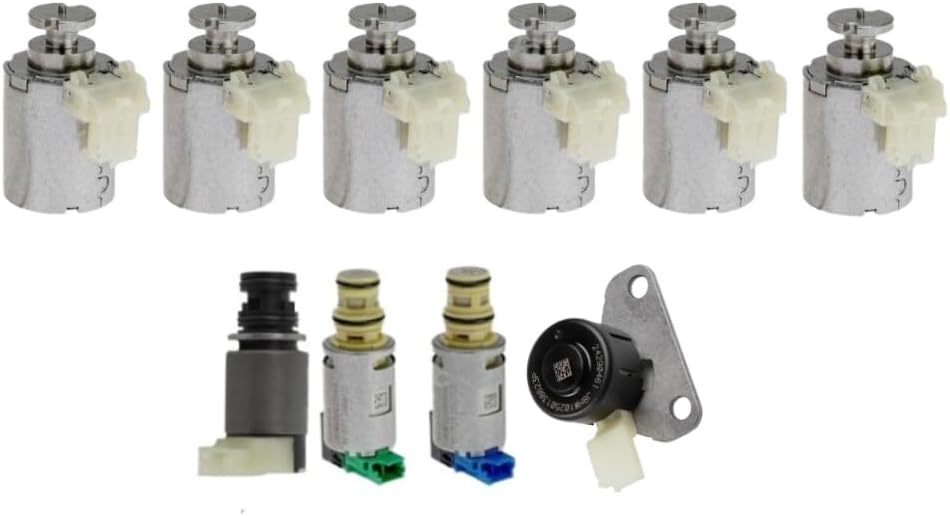
Start with the hardware. Per Transmission Digest's breakdown of the GM and Ford 10-speed solenoid layout, the 10L90 valve body carries eight pressure solenoids: solenoids 1 through 6 are normally low linear solenoids for shifts and clutch control, solenoid 8 runs the converter clutch, and solenoid 7 is the line pressure solenoid, a normally high variable force solenoid. There is no separate "EPC" part in the Ford sense. When people say 10L90 EPC or pressure control solenoid, solenoid 7 is the part they mean.


What "normally high" tells you about the failure
A normally high solenoid produces its maximum output pressure with no current applied. The TCM pulls line pressure down from that ceiling by adding current. That design choice is deliberate: if the wire breaks, the connector backs out, or the TCM driver quits, the transmission gets full line pressure instead of none, and a unit with too much pressure keeps its clutches clamped instead of burning them.
Work that forward and you get the first rule of 10L90 pressure diagnosis. An electrical failure of solenoid 7 makes the transmission harsh, not soft. Hard engagements into Drive and Reverse, firm upshifts in every gear, and a truck that feels like it has a shift kit it never had. A 10L90 that slips, flares, engages late or burns clutches is almost never a dead line pressure solenoid, because a dead one fails high. That complaint points at pressure leaking away downstream of the solenoid.
Symptom group 1: harsh everything, high line pressure
If every shift and both garage engagements are hard, you are looking at either the solenoid 7 circuit or the part that smooths its signal.
The electrical side. The generic SAE code set for pressure control solenoid "G" (P2812 open, P2814 low) maps to the seventh solenoid, which on this valve body is the line pressure solenoid. GM circulated dealer preliminary information in 2021 (PIP5799) covering P2812 and P2814 on 2019-2021 10-speeds that tells dealer techs to replace the valve body when the published circuit diagnostics do not find the root cause. That instruction exists because of how this valve body is serviced, covered below: the solenoid is part of the assembly, not a shelf part.
The hydraulic side. The line pressure control signal runs through an LPC signal damper, a small spring-loaded piston that takes the ripple out of the solenoid's output before it reaches the pressure regulator. Sonnax's documentation for its LPC signal damper piston kits says bore or piston wear there "can prevent proper main line pressure control and cause excessively high line pressure," with harsh shifts as the complaint. That produces the same feel as a failed-high solenoid with no electrical code at all. If the scan tool is clean and the unit is harsh across the board, this bore is the first place I look once the pan is down.
The fix is a drop-in. Sonnax's kit uses an O-ring sealed piston and a wear-resistant sleeve, so there is no reaming. Get the right one for the generation: 105740-04K for Gen. 1 10L90 valve bodies, 105740-05K for Gen. 2.
Symptom group 2: soft, late or slipping
Delayed engagement, a flare on the upshift before the clutch catches, poor shift quality that gets worse as the fluid heats up, and burnt clutch material on the magnet. This is low line pressure, and since solenoid 7 fails high, the pressure is being lost after the solenoid commands it.
The usual leak is the main pressure regulator valve bore. That valve oscillates constantly in normal operation, and on a high-mileage 10L90 it wears its bore until signal oil cross-leaks to exhaust. The solenoid does its job and the pressure never arrives. The other leaks that produce the same feel are the ones ATRA lists for high-mileage 10L units generally: sticking linear pintle solenoids and clutch control valves, a worn LPC accumulator bore, and excess clutch clearance.
Symptom group 3: P0747, a drop to 2nd, momentary lock-up
This is the pattern that drives most 10L90 pressure control searches, and it is the one where the code name misleads people the most. The complaint list: a sudden downshift to 2nd from a high gear, a harsh hit or a momentary wheel lock under a forced downshift, often only at a certain fluid temperature, and on recall-updated vehicles a 5th-gear-only mode with the check engine light on.
What P0747 means here. The SAE name is pressure control solenoid stuck on, but ATRA's Steve Garrett, writing in Gears in November 2025, is plain about it: on the GM 10-speeds this is a mechanical and hydraulic fault, not an electrical one. The TCM sets it two ways. During a shift, if slip speed shows torque still being carried by a clutch that is commanded off, the clutch is judged not to be releasing. In steady state, GM's "startle mitigation" logic watches for a clutch applying when no shift is commanded. Garrett's list of causes: a sticking feed limit low valve, a sticking 1-2-3-4-5-6-R clutch regulator valve, a faulty solenoid, burned or locked clutches, and cross-leaks in the valve body, seals or gaskets. The solenoid is one line out of five.
Why Gen. 2 units get it. GM rebuilt the clutch control circuit in late 2019. Sonnax's Jim Dial explains that the Gen. 2 valve bodies dropped the latch valves and added a feed limit low valve and a feed limit high valve, working with checkballs Sonnax calls boost balls. The feed limit low valve regulates solenoid feed to the default disable solenoid, and that solenoid holds the default enable and default select valves in place. The DD solenoid stays on at all times; if its feed pressure falls, those valves move and the transmission drops toward its power-down default of 2nd gear in Drive, plus Reverse.
Dial also gives the number that explains when it happens: the feed limit low valve comes into play when line pressure exceeds 119 psi, and below 120 psi the #5 boost ball stays seated against the separator plate. In other words the circuit that fails is the one that works hardest when line pressure is high, which is exactly when a 10L90 is under load, hot, and asking for a big pressure number. That lines up with the pattern shops see: hot, loaded, upshifting into the top gears.
The recall is a detector. GM's safety recall N242480630 (NHTSA 25V-148) and its companion N242454440 install TCM software that spots the wear signature and puts the unit in 5th gear before a lock-up can happen. If a 10L90 arrives with the recall done and a 5th-gear-only complaint, the software worked. The worn valve is still in the casting.
Before the pan comes down
- Get the history, not just the current code. A pressure complaint with P0747 in history is a different job from one with a solenoid 7 circuit code. Note which, and at what fluid temperature it set.
- Rule out cold-start strategy. ATRA documents the catalytic converter light-off program on these vehicles: if engine coolant is below 158F (70C) at start-up, the strategy runs for 25 to 90 seconds and can make the first engagement firm. A harsh shift only in that window is normal.
- Check the cooler lines and fluid level. GM bulletin 22-NA-182 (March 2024 revision) covers 10L80, 10L90 and 10L1000 vehicles with harsh shift, neutral/flare, shudder and overheating, before or after an overhaul, caused by a twisted cooler line on low-mileage vehicles. The same bulletin notes the 10-speed thermal bypass valve sits inside the valve body and opens at 143F (61C). A restricted cooler circuit changes fluid temperature and level, and both change shift feel. Fix that before blaming pressure control.
- Read the pan. Uniform friction dust across several clutches points at line pressure. One cooked clutch with the rest clean points at that clutch's own regulator or its clearance.
On the bench: vacuum test, and what the numbers mean
Vacuum testing is what separates this repair from a guess. For the Gen. 2 feed limit valves, Sonnax gives a working benchmark: a typical reading on a valve like this is 18 in-Hg or higher. A bore that tests below 8 in-Hg is worn badly enough to call for the oversized kits rather than the standard ones. Sonnax's part numbers for the Gen. 2 10L60/80/90 and 10L1000:
- Feed limit low valve: 105740-54K standard, 105740-59K oversized
- Feed limit high valve: 105740-58K standard, 105740-60K oversized
Why you cannot just swap solenoid 7
This is where 10L90 pressure jobs go wrong after the diagnosis was right.
The solenoids are characterized. Each solenoid is flow-tested at the factory, and its current-versus-pressure data is stored as a file tied to that solenoid or valve body. Per Transmission Digest, replacing the transmission, the lower valve body with solenoids, the TCM, or any solenoid requires programming the TCM with the correct solenoid performance data. Skip it and the module drives the new solenoid 7 on the old solenoid's curve, and line pressure is wrong at every current it commands.
The parts are not sold loose from GM. ATRA reports that the linear pintle solenoids were not available separately, so a GM service part means a valve body ordered by its Part Unique Number (PUN) or MCVM number. ATRA's note on donors is the useful one: you can replace a faulty solenoid with a donor, but you must match the band number of the original solenoid.
So the honest sequence on a solenoid 7 electrical fault is: prove the circuit (connector, harness, TCM driver), and only then replace the solenoid with a band-matched part or the valve body, and program the data either way. If you are not set up to program a GM TCM, that part of the job has to go to someone who is.
Matching the repair to the symptom
| Complaint | Most likely cause | Repair |
|---|---|---|
| Harsh everything, solenoid 7 circuit code | Solenoid 7 circuit or solenoid | Circuit test first; band-matched solenoid or valve body, then program |
| Harsh everything, no code | LPC signal damper bore or piston | Sonnax 105740-04K (Gen. 1) or 105740-05K (Gen. 2) |
| Late engagement, flare, burnt clutches | Main pressure regulator valve bore | Main regulator valve kit; oversized if the bore is gone |
| P0747, drop to 2nd, momentary lock-up (Gen. 2) | Feed limit low valve | 105740-54K, or 59K if under 8 in-Hg; do the high valve too |
| Harsh or flare that changes with temperature | Cooler circuit, fluid level | Per GM 22-NA-182: untwist or replace line, set level per SI |
When the valve body is open for any of these, the Sonnax Zip Kit covers the common wear bores in one box, and the filter and pan gasket go on the same order so the pan only comes down once.
Sonnax LPC Signal Damper Piston Kit (10L90)
The honest pitch: if your 10L90 is harsh on every shift and engagement with no solenoid circuit code, a worn LPC signal damper is the most common reason line pressure runs high. It is a drop-in repair with an O-ring sealed piston, no reaming. This link is the Gen. 2 kit, 105740-05K, for late-2019-on valve bodies. For a Gen. 1 unit, use the 105740-04K instead.
Shop the part for this fix →Chasing a different bore? The full 10L90 parts collection carries the feed limit low and high valve kits, the main pressure regulator kit, solenoid stabilization retainers and the Zip Kit.
Need parts for this job?
The 10-speed solenoid kit, the Sonnax Zip Kit, the filter and pan gasket kit and DEXRON ULV are on our GM 10-speed parts page (the 10L80 and 10L90 share the valve body service parts), with checkout on site.
FAQ
What are the symptoms of a bad pressure control solenoid on a 10L90?
Because the 10L90 line pressure solenoid (solenoid 7) is normally high, an electrical failure gives maximum line pressure: harsh engagements into Drive and Reverse and hard shifts in every gear. Slipping, flare, late engagement and burnt clutches point the other way, at pressure leaking from valve body bores after the solenoid. A drop to 2nd gear, momentary wheel lock-up or P0747 on a Gen. 2 unit is usually the feed limit low valve, not the solenoid.
Is P0747 on a 10L90 a bad solenoid?
Usually not. ATRA's Gears Magazine describes P0747 on GM 10-speeds as a mechanical and hydraulic fault, set when a clutch keeps carrying torque after it is commanded off or applies when no shift is commanded. The listed causes are the feed limit low valve, the 1-2-3-4-5-6-R clutch regulator valve, a faulty solenoid, burned clutches and valve body cross-leaks. Vacuum test the feed limit valves before you condemn the solenoid.
Can I replace just the line pressure solenoid on a 10L90?
Not the simple way. ATRA reports the solenoids were not sold separately by GM, so the service part is a valve body ordered by its PUN or MCVM number, and a donor solenoid must match the band number of the original. Whatever you install, the TCM has to be programmed with the new solenoid performance data or line pressure will be wrong at every commanded current.
Why does my 10L90 shift hard only when it is cold?
If the harsh engagement only happens right after a cold start, it may be normal. ATRA documents a catalytic converter light-off strategy that runs for 25 to 90 seconds when engine coolant is below 158F (70C) at start-up, and it can make the first engagement firm. A harsh shift that persists after the engine is warm is a real complaint.
What vacuum reading is good on a 10L90 feed limit valve?
Sonnax gives 18 in-Hg or higher as a typical reading for the Gen. 2 feed limit valves. A bore that tests below 8 in-Hg is worn enough to call for the oversized kit, 105740-59K for the low valve or 105740-60K for the high valve, rather than the standard 54K or 58K.
Related guides
- 10L90 Valve Body Symptoms
- 10L90 Shift Solenoid Symptoms
- 10L90 Harsh Shift Causes
- 10L90 Limp Mode Causes
- 10L80 Pressure Control (EPC) Solenoid Symptoms
Sources
- Transmission Digest, "10R80/10L90 10-Speed Solenoid Function" — solenoids 1-6 as normally low linear solenoids, solenoid 7 as the normally high variable force line pressure solenoid, solenoid 8 for the converter clutch, and the solenoid performance data that must be programmed into the TCM when the transmission, valve body, TCM or any solenoid is replaced. Read the article
- ATRA / Gears Magazine, Steve Garrett, "Checking Out Your Seat Belt to See How Well It Works: P0747 on GM 10-Speed Applications" (Nov. 3, 2025) — P0747 as a mechanical/hydraulic fault on GM 10-speeds, the shift-time slip-speed and steady-state startle mitigation set logic, and the cause list (feed limit low valve, 1-2-3-4-5-6-R clutch regulator valve, solenoid, burned clutches, cross-leaks), plus campaigns N242480630 and N242454440. Read the Gears article
- ATRA / Gears Magazine, "Diagnosing the 10L Series Transmission" — high-mileage shift quality causes (sticking linear pintle solenoids and clutch control valves, worn LPC accumulator bore, clutch clearance), pintle solenoids not sold separately, valve body ordered by PUN or MCVM number, donor solenoids requiring a matching band number, and the catalytic converter light-off strategy below 158F (70C) for 25 to 90 seconds. Read the Gears article
- Sonnax, Jim Dial, "Understanding '19-Later GM 10-Speed Clutch Regulating Changes" (May 6, 2025) — Gen. 2 valve bodies replacing latch valves with feed limit low/high valves and boost balls, the feed limit low valve operating above 119 psi line pressure, and the #5 boost ball seated below 120 psi. Read the Sonnax tech article
- Sonnax, "Understanding '19-Later GM 10-Speed Safety Recall" — the default disable solenoid controlling the default enable and default select valves, default drive mode of 2nd gear and Reverse, the feed limit low valve as the solenoid feed regulator for the DD circuit, the 18 in-Hg typical vacuum reading and sub-8 in-Hg threshold for oversized kits, and kit numbers 105740-54K, -58K, -59K and -60K. Read the Sonnax tech article
- Sonnax, LPC Signal Damper Piston Kit product documentation — bore or piston wear in the LPC signal damper causing excessively high line pressure and harsh shifts, drop-in O-ring sealed repair with no valve body modification, 105740-05K for Gen. 2 10L80/10L90 and 105740-04K for Gen. 1. View the Sonnax documentation
- General Motors Service Bulletin 22-NA-182 (March 2024), via NHTSA — harsh shift, shudder, neutral/flare and overheating on 10L80/10L90/10L1000 vehicles before or after overhaul caused by a twisted cooler line, and the 10-speed thermal bypass valve located in the valve body opening at 143F (61C). Read the bulletin (NHTSA)