Two GM automatics show up in the same conversation all the time: the 10L90 ten-speed out of the Camaro ZL1, CT5 and Escalade, and the Allison 1000 six-speed out of the Duramax trucks. Hot rodders want to know whether the 10L90 can live behind a diesel or a big-torque swap. Truck owners hear "ten-speed" and assume newer means stronger. The answer depends on what each unit was designed to carry, and the factory paperwork lays that out pretty clearly.
This guide compares them the way a rebuilder sees them: architecture, ratios, torque ratings, fluid and capacity, cooling, service intervals, the known weak spots, and which one belongs in which build. Every spec below comes from GM, Allison, ATRA or Transmission Digest documents listed at the bottom.
The Short Answer
- 10L90: ten forward speeds, rated at 650 lb-ft in Chevrolet Performance's Supermatic kit form, about 237 lb dry, DEXRON ULV, 8.1 qt for a pan and filter service [1][2].
- Allison 1000: six forward speeds, paired by GM with a Duramax making 765 lb-ft at 1600 rpm, Castrol TranSynd (Allison TES 295/668/389 approved fluids), 15.3 qt at overhaul [3][2][4].
- Pick by duty cycle: the 10L90 is a high-rpm gas transmission with very close ratios; the Allison is a low-rpm, high-torque truck transmission built for heat and load.
Where Each One Came From
The 10L90 is GM's heavy version of its rear-drive ten-speed family. Chevrolet Performance's installation instructions for the Supermatic 10L90 kit (P/N 19420480 for LT4, 19432851 for LT1) say the kit is built from 2017-2021 Camaro production parts and rate it at 650 lb-ft [1]. GM's 2025 TechLink capacity chart lists production 10L90s in the Cadillac CT5 (RPO MHX) and Escalade/ESV (RPO MHO) [2]. These are supercharged and big-displacement gas V8 applications that make their torque high in the rpm band.
The Allison 1000 is the medium-duty-derived six-speed GM paired with the Duramax in the HD pickups. GM's 2016 Silverado HD spec sheet lists it behind the 6.6L Duramax at 765 lb-ft @ 1600 rpm, while the gas 6.0L in the same truck got the Hydra-Matic 6L90 [3]. That split tells you how GM thinks about it: diesel torque at low rpm goes to the Allison.
One point of confusion worth clearing up: the ten-speed in 2020-and-later Silverado and Sierra 2500/3500 HD trucks is the 10L1000, not the 10L90. GM's 2025 chart lists the 10L1000 under Silverado 2500/3500 HD (RPOs MKM, MGM, MGU) at 13.6 L / 14.4 qt of DEXRON ULV, against 7.7 L / 8.1 qt for the 10L90 [2]. Different unit, different parts, different fill quantity.
Architecture Side by Side
10L90
GM's own description in the Supermatic instructions: ten ratios from four simple planetary gearsets, two brake clutches and four rotating clutches, six multiple-disc clutches total. The rotating clutches sit forward of the gearsets, the case has an integral bellhousing, and the pump is an off-axis, gear-driven variable vane pump mounted next to the valve body. The TCM is external, three speed sensors feed it, and the converter is a 4-element unit with a pressure plate splined to the turbine. GM lists the weight at 107.586 kg (237.19 lb) [1].
Because every shift is clutch-to-clutch, the control system is doing a lot of work. In GEARS Magazine's "Shift Anatomy: The GM 10-Speed," Sean Boyle notes the C, D and E clutches are the busiest in the range chart, that a clutch-to-clutch ratio change takes about 125 to 500 milliseconds, that the TCM pulses the solenoids at 3140 Hz to move a pintle only about 0.098 in, and that the only factory pressure tap is line pressure [5]. That last point matters on the bench: you cannot gauge individual clutch circuits without building your own test fixture.
Allison 1000
The six-speed Allison is a simpler, heavier mechanical layout with fewer ratios and wide steps. Its valve body has gone through four versions, and Transmission Digest's identification article (written by Sonnax's Jeff Parlee) breaks them down: 2001-2003 five-speed with six solenoids and one tube; 2004-2005 five-speed adding solenoid G to drop line pressure at idle and light cruise; 2006-2009 six-speed with a second tube and a TCC solenoid with a red connector; and a totally redesigned 2010-and-later body that does not interchange with anything earlier and is the only Allison separator plate with bonded gaskets (P/N 29545980) [6].
Gear Ratios
This is where the two units feel completely different on the road.
- 10L90 [1]: 4.696, 2.985, 2.156, 1.779, 1.526, 1.278, 1.000, 0.854, 0.689, 0.636.
- Allison 1000 [3]: 3.10, 1.81, 1.41, 1.00, 0.71, 0.61, reverse 4.49.
The 10L90 starts much deeper (4.70 vs 3.10) and ends at about the same overdrive (0.64 vs 0.61), with ten small steps in between. A gas V8 that makes its power at 5000-plus rpm loves that: it never falls far out of its band on an upshift. The Allison's steps are wide because a diesel makes peak torque at 1600 rpm and does not need to be kept wound up. The GEARS article points out how small the 9-10 step is on the GM ten-speed and that, unlike Ford's ten-speed, it rarely uses skip shifts [5], so it is constantly changing gear under load.
For a tech, the practical takeaway is that a ten-speed with a slipping clutch shows up as a ratio error between commanded and calculated gear far more often, because the same few clutches are cycling all day. The Allison usually tells on itself with a flare on one specific shift.
Fluid, Capacity and Level Check
10L90
- Fluid: DEXRON ULV, GM P/N 19352619 (US) / 19352620 (Canada) [1].
- Pan and filter service: 7.7 L / 8.1 qt. Overhaul (transmission only): 10.95 L / 11.6 qt [1][2].
- Level check: engine running, fluid temperature (TFT) between 75-80 C (167-176 F), check plug removed until the stream turns to a drip, plug torqued to 22 N·m (16 lb-ft) [1].
Allison 1000
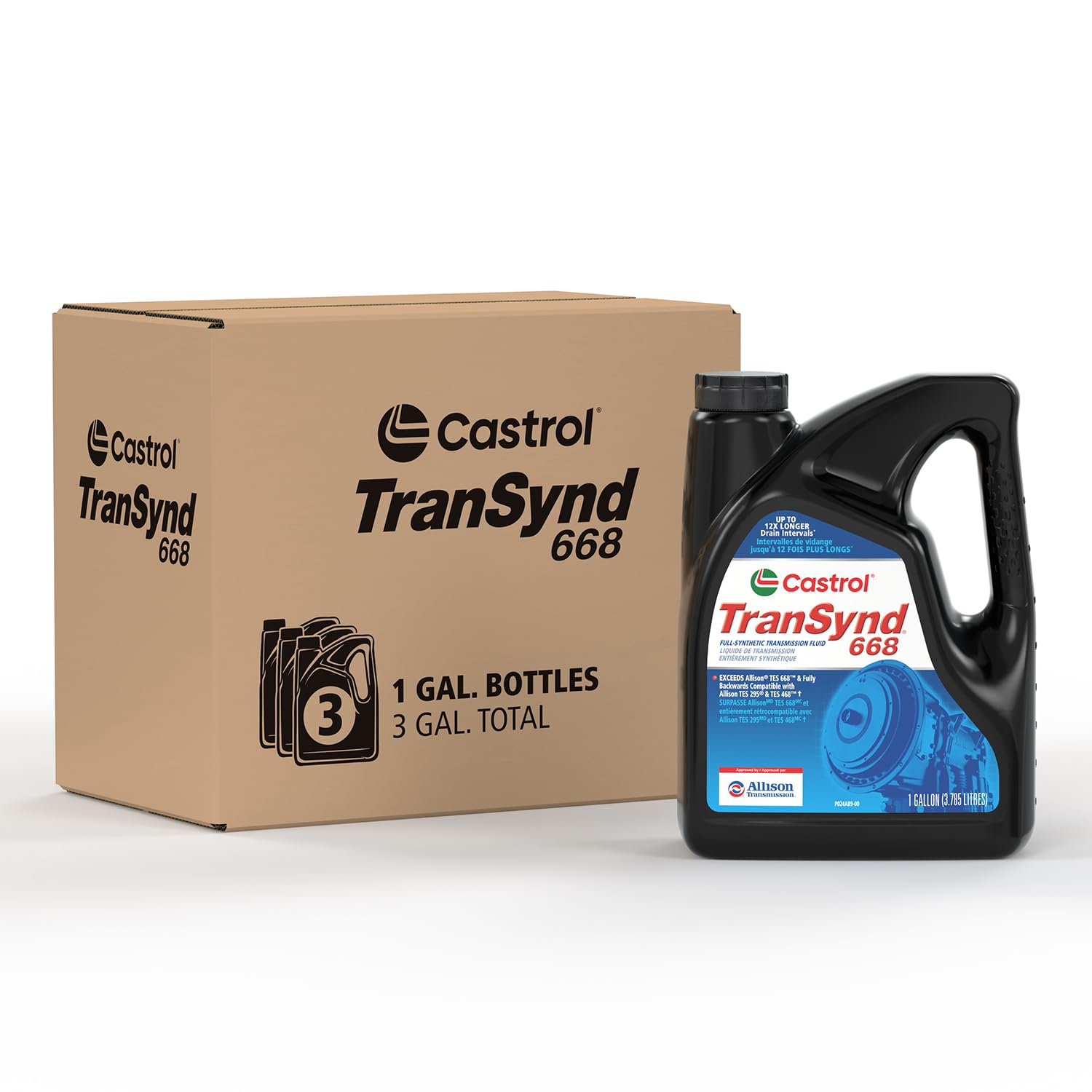
- Fluid: GM lists Castrol TranSynd for the LCT1000 (RPO MW7) at 14.5 L / 15.3 qt at overhaul [2]. Allison approves TES 295, TES 668 and TES 389 fluids [4].
- Prognostics: Allison's service prognostics require TES 295, TES 668 or TES 389 fluid and Control Main Filter P/N 29539579 [4].
- Level check: Allison's hot check is valid at a normal sump temperature of 71-93 C (160-200 F) [4].
These fluids do not cross. ULV is a very thin fluid built for the ten-speed's tight clearances and efficiency targets; TranSynd and the TES 668 family are built for the Allison's heat and load. A wrong-fluid fill on either one shows up as shift quality complaints first and burnt clutches later.
Service Intervals
Allison publishes a real interval table in operator manual OM8471EN (Table 6-2). For TES 668 or TES 295 fluid: 150,000 miles / 4,000 hours / 48 months general duty and 75,000 miles / 3,000 hours / 36 months severe duty. For TES 389 fluid the general interval drops to 50,000 miles / 2,000 hours / 24 months [4]. If the truck tows for a living, it is severe duty.
The 10L90 does not have an Allison-style interval chart in the Supermatic paperwork. In our shop a towing Escalade or a road-course CT5 gets treated as severe service: drop the pan, change the filter, refill with ULV by the TFT procedure above, well ahead of 75,000 miles. ULV does not give you much margin once it has been cooked.
Cooling and Overheat Complaints
GM bulletin 22-NA-182 covers harsh shift, shudder, surge, stall, flare and overheating on the 6L80, 6L90, 8L90, 10L80, 10L90 and 10L1000. On low-mileage vehicles it points first at a twisted cooler line, and notes it can set DTC P27EC on ETRS transmissions. If the line is fine, the thermal bypass valve is next: on the ten-speeds it opens at 143 F (61 C) and lives inside the valve body (except on the 3.0L diesel, where it is on the frame rail and opens at 194 F) [7].
So a 10L90 running hot is not automatically a converter or clutch problem. Check the cooler line routing, then the TBV, before you condemn the unit. On an Allison, run-hot complaints usually trace to towing load, a restricted cooler, or a low fluid level checked cold instead of in the 160-200 F window [4].
Known Weak Spots
10L90
- Busy clutches. The C, D and E clutches do most of the work [5]. A slip that only shows in certain gear pairs points at whichever of those clutches is common to them.
- Matched solenoids. GM says each solenoid is characterized and the controller is flashed to that transmission; controllers and transmissions are matched and not interchangeable [1]. Swap a valve body or TCM without the right programming and shift quality goes to pieces.
- Display quirks. GM warns aftermarket displays may not show 9th and 10th even when the transmission is using all ten gears [1]. Do not chase a "no 9th/10th" complaint off a gauge alone.
Allison 1000
- Valve body mix-ups. Four versions, and the 2010-up body does not interchange with earlier units [6]. Confirm casting numbers before ordering a reman or a solenoid kit.
- Fluid and filter neglect. Prognostics only work with approved fluid and the correct control main filter [4]. A truck that has been run on the wrong fluid loses that early warning.
- Heat from towing. The unit handles it well when fluid is right and level is checked hot; problems start when owners stretch severe-duty trucks to the general-duty interval.
Diagnosis Notes for Either Unit
On both, start with commanded gear versus actual ratio on the scan tool. On the 10L90, compare input and output speed against the ten ratios listed above; a ratio that drifts in gears sharing one clutch is your clue. Remember the factory only gives you a line pressure tap, so a low line reading points at the pump, pressure regulation or a leak, not at one clutch circuit [5]. On the Allison, a flare on one shift usually means the clutch for that gear or its pressure control, and you need the right valve body version identified before you go further [6].
Fluid temperature changes everything on both. A level or shift-quality check done outside 75-80 C on the 10L90 [1] or 160-200 F on the Allison [4] is not a valid check.
Which One Should You Run?
For a gas performance build or a gas SUV, the 10L90 is the better transmission: deep first gear, tight steps, and a factory rating of 650 lb-ft [1]. For diesel torque, heavy trailers, or a truck that lives at max GVWR, the Allison 1000 is the unit GM put there for a reason [3]. Putting a 10L90 behind a diesel or a big-torque swap past its rating is asking for clutch failure, and putting an Allison in a high-revving car throws away the ratio spread that makes the ten-speed work.
If you need a ten-speed in an HD diesel truck, that is the 10L1000's job, not the 10L90's [2].
Need parts for this job?
Allison 1000 valve bodies, shift repair kits, filters, pans and TranSynd, plus 10L90 overhaul kits, clutch modules, pumps and valve bodies, all with secure checkout.
Shop Allison 1000 parts → 10L90 overhaul kit →FAQ
Is the Allison 1000 stronger than the 10L90?
For sustained heavy towing, yes. GM put the Allison 1000 behind the 6.6L Duramax, rated at 765 lb-ft at 1600 rpm in GM's 2016 Silverado HD specs, while Chevrolet Performance rates its Supermatic 10L90 at 650 lb-ft. The 10L90 is built for high-rpm gas V8s in performance cars and SUVs, not for diesel torque under a gooseneck.
Is the 10L90 the same as the Allison 10-speed in newer HD trucks?
No. The ten-speed in 2020-and-later Silverado and Sierra HD trucks is the 10L1000, a separate and heavier unit. GM's 2025 capacity chart lists the 10L1000 at 14.4 quarts against 8.1 quarts for a 10L90 pan and filter service, so parts and fluid quantities do not cross over even though both take DEXRON ULV.
What fluid do the 10L90 and Allison 1000 take?
The 10L90 takes DEXRON ULV only, GM P/N 19352619 in the US. GM's 2025 chart lists the Allison LCT1000 at 15.3 quarts at overhaul with Castrol TranSynd, and Allison's operator manual approves TES 295, TES 668 and TES 389 fluids for the 1000 Series. Never put ULV in an Allison 1000 or TranSynd in a 10L90.
How often should the fluid be changed?
Allison publishes it: with TES 668 or TES 295 fluid, 150,000 miles or 48 months for general duty and 75,000 miles or 36 months for severe duty; with TES 389 fluid, 50,000 miles or 24 months general. The 10L90 has no published Allison-style chart, so on a towing or track vehicle we treat it as severe service and change the fluid and filter well before 75,000 miles.
Sources
- Chevrolet Performance (General Motors), Supermatic 10L90 Transmission Kit Installation Instructions, P/N 19420481, Rev 08SE22. Backs the 650 lb-ft rating, 2017-2021 Camaro production basis, four-gearset / two-brake / four-rotating-clutch architecture, off-axis variable vane pump, 237.19 lb weight, all ten ratios, DEXRON ULV P/N 19352619, the 8.1 qt and 11.6 qt capacities, the 75-80 C level check and 22 N·m plug torque, matched solenoids, and the 9th/10th display note. chevrolet.com (GM PDF)
- GM TechLink, 2025 Transmission Capacities and Fluids chart. Backs the 10L90 RPOs MHX (CT5) and MHO (Escalade/ESV) at 7.7 L / 8.1 qt DEXRON ULV, the LCT1000 (RPO MW7) at 14.5 L / 15.3 qt Castrol TranSynd at overhaul, and the 10L1000 in Silverado 2500/3500 HD at 13.6 L / 14.4 qt. gm-techlink.com (GM PDF)
- General Motors, 2016 Chevrolet Silverado HD Specifications (GM Media). Backs the Allison 1000 ratios (3.10 / 1.81 / 1.41 / 1.00 / 0.71 / 0.61, reverse 4.49), its pairing with the 6.6L Duramax at 765 lb-ft @ 1600 rpm, and the 6L90 on the gas 6.0L. media.gm.com (GM PDF)
- Allison Transmission, 1000 and 2000 Series Operator's Manual OM8471EN (Sept 2021). Backs the TES 295 / 668 / 389 fluid approvals, prognostics requirement for Control Main Filter 29539579, the Table 6-2 general and severe fluid change intervals, and the 160-200 F hot check window. Allison PDF
- GEARS Magazine (ATRA), Sean Boyle, "Shift Anatomy: The GM 10-Speed." Backs the C, D and E clutches as the busiest, the rare use of skip shifts and small 9-10 step, the 125-500 ms clutch-to-clutch ratio change, the 3140 Hz solenoid frequency and 0.098 in pintle travel, and line pressure as the only factory pressure tap. gearsmagazine.com
- Transmission Digest, "Identifying Allison 1000/2000/2400 Valve Bodies" (Jeff Parlee, Sonnax). Backs the four valve body versions, solenoid G on 2004-2005 units, the 2006-2009 six-speed identifiers, and the non-interchangeable 2010-up redesign with bonded-gasket separator plate 29545980. transmissiondigest.com
- General Motors Service Bulletin 22-NA-182 (NHTSA-hosted). Backs the twisted cooler line cause, DTC P27EC on ETRS units, and the 143 F (61 C) thermal bypass valve inside the valve body on the 10L80, 10L90 and 10L1000. static.nhtsa.gov (PDF)
Shop Allison 1000 parts → 10L90 parts →