Walk a lot full of 2007-and-later GM 2500HD and 3500HD trucks and you will find two different six-speed automatics under them. The gas trucks with the 6.0L got the Hydra-Matic 6L90. The Duramax trucks got the Allison 1000. Customers assume they are the same transmission with a different badge. They are not. They come from different design teams, use different fluids and filters, run different ratios, and break in different places.
This guide puts the two side by side the way a rebuilder sees them: what GM paired each one with, the ratios, the fluid and service rules from the factory books, the known failure points and updated parts, and how to decide what to do when one of them comes in slipping. GM, Allison, ATRA and Transmission Digest references are listed at the bottom.


The Short Answer
The Allison 1000 is the heavier-duty unit. GM put it behind the 6.6L Duramax, which its 2016 Silverado HD spec sheet rates at 765 lb-ft at 1600 rpm, while the 6L90 went behind the 6.0L gas V8 rated at 380 lb-ft at 4200 rpm [1]. Both are six-speed, clutch-to-clutch, electronically controlled automatics with lockup converters. The 6L90 is a GM Hydra-Matic design with its control module mounted on the valve body. The Allison is a commercial-duty design that shares its valve body and service rules with the Allison 2000 and 2400 series, and it uses an external spin-on filter that the 6L90 does not have.
| Item | Hydra-Matic 6L90 | Allison 1000 |
|---|---|---|
| Paired engine (2016 HD) | Vortec 6.0L gas, 380 lb-ft @ 4200 | Duramax 6.6L diesel, 765 lb-ft @ 1600 |
| 1st / 2nd / 3rd | 4.03 / 2.36 / 1.53 | 3.10 / 1.81 / 1.41 |
| 4th / 5th / 6th | 1.15 / 0.85 / 0.67 | 1.00 / 0.71 / 0.61 |
| Reverse | 3.06 | 4.49 |
| GM RPO | MYD | MW7 |
| Fluid (GM 2025 chart) | DEXRON VI, 6.0 qt fluid change | Castrol TranSynd, 15.3 qt overhaul fill |
| Filter | Internal pan filter | Spin-on control main filter plus internal filter |
Gear Ratios: Built Around Two Very Different Engines
GM's own spec sheet lists both units in the same 2016 Silverado HD table [1]. The 6L90 runs 4.03, 2.36, 1.53, 1.15, 0.85 and 0.67 with a 3.06 reverse. The Allison 1000 runs 3.10, 1.81, 1.41, 1.00, 0.71 and 0.61 with a 4.49 reverse. The same sheet lists 4.10 or 3.73 final drives for the gas truck and 3.73 for the diesel [1].
Those numbers make sense once you look at the torque curves. The 6.0L makes its peak torque at 4200 rpm, so it needs a deep 4.03 first gear to get a loaded truck rolling. The Duramax makes 765 lb-ft at 1600 rpm, so a 3.10 first is plenty and the Allison can run two overdrive ratios (0.71 and 0.61) to keep the diesel near its torque peak on the highway. Look at reverse too: the Allison's 4.49 reverse is deeper than its own first gear, which is what you want when backing a gooseneck up a grade. The 6L90's 3.06 reverse is shallower than its 4.03 first, so a gas truck backing a heavy trailer leans harder on its reverse clutch and converter.
The practical point for diagnosis: a scan tool ratio check only helps if you know which ratio set you are looking at. On either unit, compare input (turbine) speed to output speed in each commanded gear. A calculated ratio that drifts off the factory number in one gear while the others hold points at the clutch applied in that gear.
Torque Path and Controls
6L90: Hydra-Matic with an on-board module
The 6L90 is the heavy-duty member of GM's 6L45, 6L50, 6L80 and 6L90 family, and it shares most of its hard-part updates with the 6L80. ATRA's 6L50/6L80/6L90 update presentation lists both by RPO (MYC for the 6L80, MYD for the 6L90) in the same bulletins [4]. The control module is mounted to the valve body inside the pan, so a module failure, a range-sensing fault and a valve body problem all live in the same assembly. When a 6L90 sets a solenoid or pressure code, check the vehicle-side connector, power and grounds before condemning the valve body, because a replacement assembly has to be programmed to the truck.
Allison 1000: commercial controls and prognostics
The Allison uses a separate transmission control module and a valve body that has gone through four versions. Transmission Digest's identification guide lays them out: 2001-2003 five-speed with six solenoids, 2004-2005 five-speed with a seventh solenoid (solenoid G) that lowers line pressure at idle and light cruise, 2006-2009 six-speed with a second tube and different TCC, PCS-1 and PCS-2 solenoids, and a fully redesigned 2010-and-later six-speed with fully variable modulated main pressure that does not interchange with any earlier version [5]. Before you order an Allison valve body or solenoid kit, read the casting numbers. The 2010-up separator plate is the only Allison plate with bonded gaskets [5].
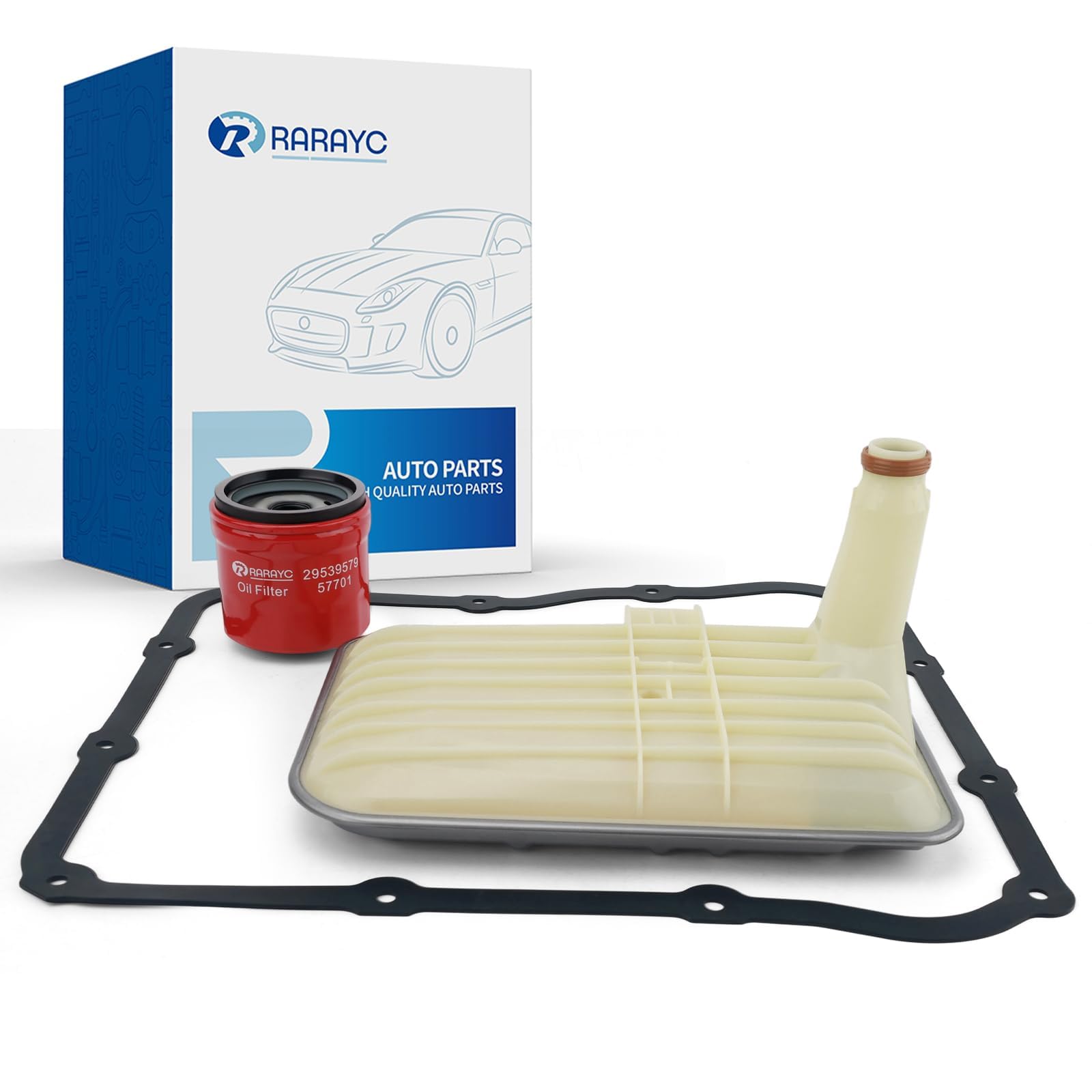
Allison 1000 units calibrated with prognostics run an oil life monitor, a filter life monitor and a transmission health monitor. Allison's operator manual says prognostics require Allison-approved TES 295, TES 668 or TES 389 fluid and control main filter P/N 29539579, and that prognostics must be turned off if any other fluid is used [3]. A truck that came in with the wrong fluid and a service light that will not behave is often this, not a hard fault.
Fluid and Service Specs
6L90: GM's 2025 TechLink fluid capacity chart lists the 6L90 (RPO MYD) at 5.7 L / 6.0 qt for a fluid change, using DEXRON VI [2]. That is a drain-and-fill number, not a dry fill. Most 6L90 trucks have no dipstick, so level is set at the fill-check plug with the engine running and the fluid at the temperature GM's service procedure calls for. Overfilled and underfilled units after quick-lube visits are common.
Allison 1000: the same GM chart lists the LCT1000 (RPO MW7) at 14.5 L / 15.3 qt at overhaul, with Castrol TranSynd as the listed fluid [2]. Allison's 1000/2000 operator manual sets change intervals by fluid type. With prognostics off and 100 percent TES 668 or TES 295 fluid, it calls for a fluid change at 150,000 miles / 48 months in general duty and 75,000 miles / 36 months in severe duty, and a spin-on control main filter change every 50,000 miles / 24 months in either duty class [3]. With TES 389 fluid, fluid and filter both drop to 50,000 miles general and 12,000 miles / 6 months severe [3]. Allison also states that anything less than 100 percent TES 668 or TES 295 counts as a mixture and goes on the TES 389 schedule [3]. If you do not know what is in a used truck, treat it as a mixture.
For the Allison hot check, the manual says to check at a normal sump temperature of 160-200 F (71-93 C), and warns that an overfull transmission can overheat [3]. Read the stick in the HOT band at that temperature, not first thing in the morning on a cold truck.
6L90 master rebuild kit
If the 6L90 is already slipping in more than one gear, a fluid change will not bring it back. A master kit with clutches covers frictions, seals and gaskets for the full overhaul. Install the updated 1-2-3-4 piston while you are in there.
6L90 master rebuild kit with clutches →Need Allison parts instead? Browse Allison 1000 parts at Core Transmission Parts →
What Each One Is Known For
6L90 failures
- 1-2-3-4 slip or no forward movement: ATRA reports that 6L80/6L90 units built before June 2010 can slip in more than one forward gear, or lose forward movement entirely, because the 1-2-3-4 clutch piston breaks or cracks. The fix is the updated piston, GM P/N 24258159, with 22 percent more rib area [4]. On any early unit that comes apart, replace the piston even if it looks whole.
- No forward from the clutch housing: ATRA also documents a mid-2007 housing update for a snap ring that pops out of the 1-2-3-4/3-5-R housing, along with 18-tooth wave plates (P/N 24239828 for 3-5-R, 24239615 for 1-2-3-4) and housing kit 24241232 [4]. These back-service earlier units.
- Low line pressure after a pump cover replacement: Transmission Digest reports that service pump cover P/N 24248573 can carry a waxy rust-inhibitor residue that sticks the pressure regulator valve or isolator valve, or plugs the small orifice in the isolator valve sleeve. If it is missed, clutches can be damaged [6]. Clean and inspect those valves before the cover goes in.
- Low/reverse shudder and 2-6 rattle: ATRA lists updated low/reverse friction plates (P/N 24235460) for a shudder complaint, which need a calibration update when back-serviced, and a radial-groove 2-6 friction (P/N 24240221) for a ticking or rattling noise [4].
Allison 1000 failures
- Wrong valve body or solenoid for the year: four valve body versions, two of them five-speed, and the 2010-up unit interchanges with nothing earlier [5]. A mismatched part on a used unit is the first thing to rule out on a shift complaint after someone else's repair.
- Fluid and filter neglect: the long TES 295/668 intervals assume 100 percent approved fluid [3]. Mixed fluid run on the long schedule is a common setup for varnished valves and worn clutches, and it is why we put every unknown-history truck on the short schedule.
- Overfill and heat on hard tow use: Allison specifically warns that an overfull unit can overheat [3]. Check level hot, in the HOT band, after any service someone else did.
Scan Tool Checks Before You Pull Either One
On both units, start with the same three data points: transmission fluid temperature, commanded gear against calculated ratio, and TCC slip speed. A converter that shows slip well above zero rpm with TCC commanded on, while gear ratios are correct, points at the converter clutch or its control, not the clutch packs. A ratio that wanders in one gear only points at the clutch applied in that gear. On the 6L90, compare against 4.03 / 2.36 / 1.53 / 1.15 / 0.85 / 0.67. On the Allison, use 3.10 / 1.81 / 1.41 / 1.00 / 0.71 / 0.61 [1]. Fluid temperature matters on both: shift timing and pressure control change as fluid heats, and Allison's own level check is only valid at 160-200 F [3].
On a 6L90 that slips in first through fourth but pulls fifth and sixth, the 1-2-3-4 clutch is the common element, and on a pre-June 2010 build the cracked piston described above is the first suspect [4]. On an Allison that flares on one shift only, confirm the valve body version and solenoid part numbers match the year before you spend time on pressure testing [5].
Which One Should You Build?
Build what is in the truck. A 6L90 behind a 6.0L is a correct and durable combination when the updated piston, housing and wave plates are in it and line pressure is right. Swapping an Allison into a gas truck means a different bellhousing, a separate module and harness, a different crossmember and driveshaft length, and calibration work. That costs far more than a 6L90 overhaul.
For a Duramax truck there is no 6L90 option: GM never paired the 6L90 with the diesel's 765 lb-ft [1]. The Allison is the unit to rebuild, and the most important things you do are identify the valve body version before ordering parts [5], fill with 100 percent approved fluid, and set the customer up on the right filter and fluid schedule for their duty cycle [3].
Need parts for this job?
6L90 master kits, bonded pistons, pressure regulator valve kits and valve bodies, plus Allison 1000 filters, pans and solenoid kits, all with secure checkout.
Shop 6L90 parts → Shop Allison 1000 parts →FAQ
Is the Allison 1000 stronger than the 6L90?
Yes for heavy towing. GM paired the Allison 1000 with the 6.6L Duramax, which GM rates at 765 lb-ft at 1600 rpm, while the 6L90 went behind the 6.0L gas V8 rated at 380 lb-ft. The 6L90 is a strong transmission for the gas engine, but it was never meant to carry diesel torque.
Do the 6L90 and Allison 1000 have the same gear ratios?
No. GM's 2016 Silverado HD spec sheet lists the 6L90 at 4.03, 2.36, 1.53, 1.15, 0.85 and 0.67 with a 3.06 reverse, and the Allison 1000 at 3.10, 1.81, 1.41, 1.00, 0.71 and 0.61 with a 4.49 reverse. The 6L90 has a much deeper first gear because the gas engine makes its torque high in the rpm range.
Can I swap an Allison 1000 into a gas 6L90 truck?
It is not a bolt-in job. The Allison uses a different bellhousing, its own control module and wiring, a different crossmember and driveshaft length, and calibration that has to match the engine. On most gas trucks, rebuilding the 6L90 with the updated parts costs far less.
What fluid do the 6L90 and Allison 1000 take?
GM's 2025 fluid chart lists the 6L90 (RPO MYD) at 6.0 quarts for a fluid change using DEXRON VI. The same chart lists the Allison LCT1000 (RPO MW7) at 15.3 quarts at overhaul using Castrol TranSynd, and Allison's own manual approves TES 295, TES 668 and TES 389 fluids for the 1000 Series.
Sources
- General Motors, 2016 Chevrolet Silverado HD Specifications (GM Media). Backs the Hydra-Matic 6L90 (6.0L) and Allison 1000 (Duramax 6.6L) pairings, both ratio sets, reverse ratios, final drives, and engine torque of 380 lb-ft @ 4200 (6.0L gas) and 765 lb-ft @ 1600 (6.6L Duramax). media.gm.com (GM PDF)
- GM TechLink, 2025 Transmission Capacities and Fluids chart. Backs the 6L90 (RPO MYD) fluid change capacity of 5.7 L / 6.0 qt with DEXRON VI, and the LCT1000 (RPO MW7) overhaul capacity of 14.5 L / 15.3 qt with Castrol TranSynd. gm-techlink.com (GM PDF)
- Allison Transmission, 1000 and 2000 Series Operator's Manual OM8471EN (Sept 2021). Backs the prognostics requirements (TES 295/668/389 fluid, filter P/N 29539579), Table 6-2 fluid and filter change intervals, the mixture rule, and the 160-200 F hot check temperature and overfill warning. Allison PDF
- ATRA, "6L50-6L80-6L90 Updates and Product Issues" (Steve Garrett). Backs the pre-June 2010 1-2-3-4 piston failure and updated piston 24258159, the 2007 clutch housing and wave plate updates (24239828, 24239615, 24241232), low/reverse plate 24235460 and 2-6 friction 24240221. atracom (ATRA PDF)
- Transmission Digest, "Identifying Allison 1000/2000/2400 Valve Bodies" (Jeff Parlee, Sonnax). Backs the four valve body versions, solenoid G on 2004-2005 units, 2006-2009 six-speed identifiers, and the non-interchangeable 2010-up redesign with bonded-gasket separator plate. transmissiondigest.com
- Transmission Digest, "Tech Tip: GM 6L80, 6L90 Low Line Pressure." Backs the low line pressure condition after installing service pump cover 24248573, caused by rust-inhibitor residue sticking the pressure regulator or isolator valve or plugging the isolator sleeve orifice. transmissiondigest.com
Shop the 6L90 master kit →