"3-4 clutch" is shop shorthand left over from the Simpson-gear days, when one physical clutch pack really did do that one job. The Ford 10R80 does not have a single clutch assigned to the 3-4 shift. It has a ten-speed planetary gearset where the C, D and F clutch packs all live on one shared cylinder on the input shaft, and Ford's own paperwork on this transmission points to two separate, documented failure points that both land on the customer as the same complaint: a flare, bump or delayed engagement specifically between 3rd and 4th gear.
Three clutches, one cylinder: the CDF circuit
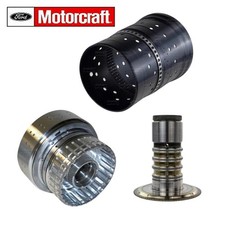
Transmission Digest's Wayne Colonna has written two separate Shift Pointers columns walking through the 10R80's input shaft, which runs roughly two feet long and carries hydraulic feed for multiple clutch circuits at once. Per Colonna, the C, D and F clutch circuits are fed at the front half of the input shaft and exit out the back half, sealing against a sun gear shaft inside what Ford calls the CDF clutch cylinder. The sun gear shaft's outer sealing rings ride against a sleeve inside that cylinder, and that sleeve is the component Ford's own technical service bulletins identify as the weak point: it is known to move axially out of its original position.
Ford confirms this directly in TSB 24-2304 (issued September 24, 2024, superseding TSB 24-2254), which covers non-hybrid 10R80 transmissions in 2020-2022 Explorer, 2020-2023 Transit, 2021-2022 F-150, 2021-2022 Mustang and 2022 Expedition/Navigator vehicles built on or before August 15, 2022. Ford's own language: the condition "may be due to axial movement of the CDF clutch cylinder (7H351) sleeve causing hydraulic circuit leaks." When that sleeve walks, the C, D and F clutch apply circuits lose pressure they should be holding, and because the F clutch does the work on the 3-4 upshift, that is where the complaint usually shows up first.
The F clutch's other failure point: the aluminum drive shell
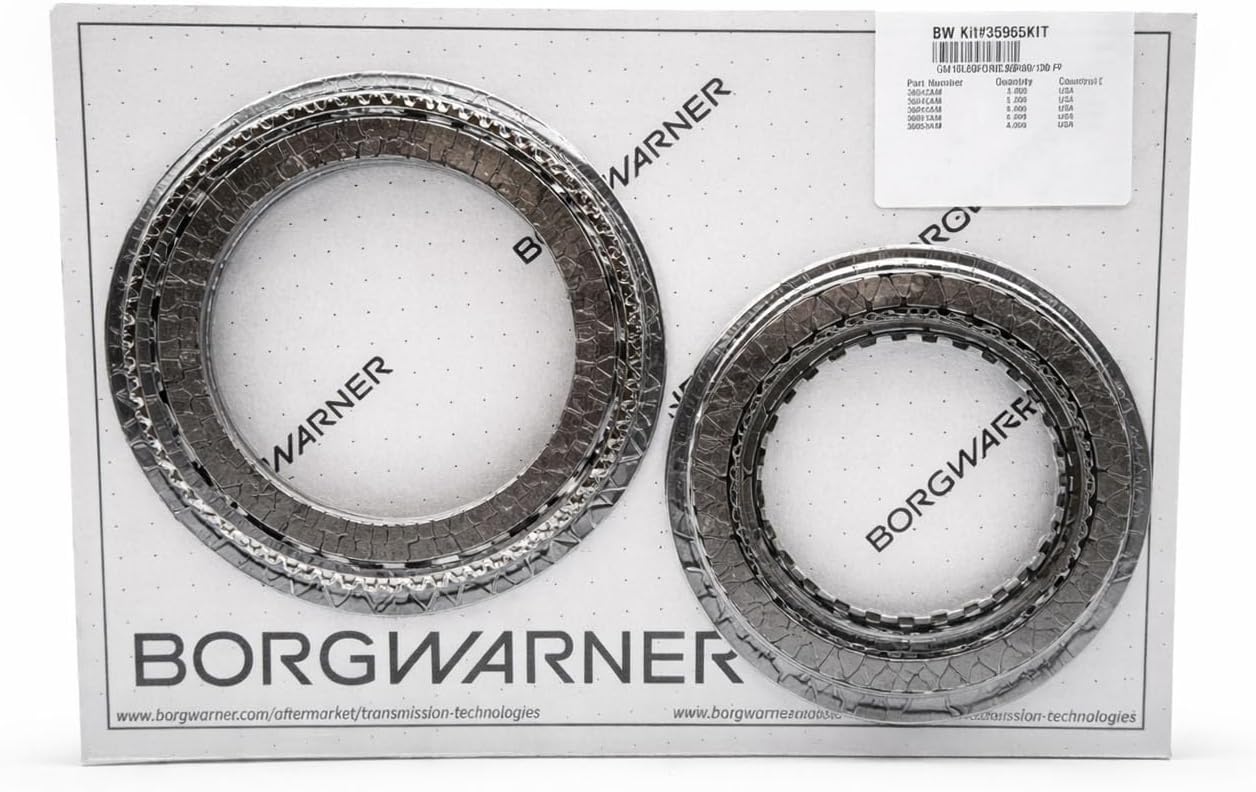
There is a second, mechanically distinct wear pattern Transmission Digest has documented on the same transmission. In a June 2024 Shift Pointers column on 10R80 "aches and pains," Colonna describes the aluminum drive shell that carries the F clutch assembly, nicknamed "the trash can" by techs who see it often. His finding: the external lugs on the F clutch's steel plates are known to dig into this aluminum drive shell, compromising how cleanly that clutch applies and releases. Colonna is specific about which shifts that damage shows up on: "This would affect Reverse engagement and disengagement as well as the 3-4, 4-3 shift. With skip shift capabilities, this could mean a 3-5, 5-3 shift issue or a 2-4, 4-2 shift issue."
Ford has since put its own name on this wear pattern. TSB 26-2408 (16 September 2026, superseding 26-2309) covers 2022-2024 F-150, Expedition, Navigator, Explorer, Mustang and Transit built 16-Aug-2022 through 23-Sep-2024, and 2022-2023 Ranger built on or after 16-Aug-2022, with harsh 3-4 and 4-5 upshifts, harsh 5-3 and 4-3 downshifts and harsh Reverse engagement, all worse when cold. Ford's stated cause is "the F clutch friction plates brinelling into the clutch and planetary container cylinder (7B177)" -- the same aluminum shell Colonna described. Note the build dates: this bulletin picks up exactly where the 15-Aug-2022 cutoff of TSB 24-2304 ends, so a later truck with a 3-4 complaint is more likely an F clutch and shell problem than a walking sleeve.
Ford's gate for 26-2408 is cheap. Pull the transmission fluid filter and look at its top side for gray silt. No silt, and Ford says the article does not apply. Silt present, and the fix is a teardown: new clutch and planetary container cylinder (PC3Z-7B177-A), new F clutch frictions (HL3Z-7B164-D, or PR3Z-7E313-A on 2023-2024 Transit and 2024 F-150) and steels, a valve body overhaul, the sun gear No. 3 and input shaft seals, and an F clutch clearance check with a selective snap ring before an adaptive relearn. Ford pays about 2.0 to 5.0 hours for the filter inspection and 10.4 to 15.1 hours for the repair, depending on the vehicle.
Why the 3-4 in particular? Ford's 10R80 solenoid operation chart shows 3rd gear running the A, C, D and E clutches and 4th running A, C, D and F. The 3-4 upshift is E releasing while F applies, and the 4-3 is the reverse. Reverse also applies F (with A, B and D). A shell that the F plates have dug into makes every one of those apply and release events rough.
That is a mechanical wear problem in the drum itself, not a hydraulic leak in the CDF cylinder, and it is worth telling apart from the TSB 24-2304 condition before you start ordering parts. A sleeve that has walked is a seal and cylinder problem. Lugs that have dug into aluminum are a drum problem, and no amount of reseal work fixes a drum that is already gouged.
What it feels like from the driver's seat
- Flare or RPM flare specifically on the 3-4 upshift. Engine speed rises before the vehicle picks up speed to match, which points at the F clutch not building or holding apply pressure.
- Harsh or delayed engagement. Ford's own TSB language for this condition is "harsh/delayed engagement and/or harsh/delayed shift" -- it can show up as a hard clunk into gear just as easily as a soft, late one.
- A transmission ratio DTC. TSB 24-2304 lists a long run of codes it applies to, including P0733 (Gear 3 Incorrect Ratio) and P0734 (Gear 4 Incorrect Ratio) alongside shift solenoid and friction element codes P0729, P0731, P0732, P0735, P0736, P0751/P0752, P0756/P0757, P0761/P0762, P0766/P0767, P0771/P0772, P2700-P2708, P076F, P07D9, P07F6 and P07F7.
- Reverse or skip-shift complaints alongside the 3-4 issue. If the aluminum drive shell is the actual failure point rather than the CDF sleeve, Colonna's column notes the same wear can show up as a Reverse engagement problem or a 3-5/2-4 skip-shift issue, not just a straight 3-4/4-3 complaint.
How Ford diagnoses it: the VCMM CDF leak test
TSB 24-2304 does not jump straight to tearing the unit down. The service procedure has the technician connect a VCMM pressure transducer to the transmission's line pressure port (an M10x1.0 thread -- Ford is explicit that an NPT fitting there will damage the case) using the Rotunda 164-R9534 extension kit and 164-R9833 pressure vacuum transducer kit. With the vehicle in park, parking brake applied and fluid temperature at 50°C (122°F) or above, the technician commands line pressure to roughly 1900-2000 kPa, then individually commands the SSA and SSC shift solenoid amperages to 1.0A while recording pressure traces. Those recordings feed into Ford's CDF calculator tool, which outputs an "A-clutch Leakage Rate %" and a "C-Clutch vs A-Clutch %" result. Only if both come back failing (red) does the bulletin call for removing the transmission and replacing the CDF clutch cylinder.
That is a deliberate gate, and it matters for cost: TSB 24-2304's own labor times show roughly 0.7 to 0.8 hours just to run the leak test and confirm a pass, versus 10.4 to 14.2 hours to actually pull the transmission, split the case and replace the cylinder when it fails -- the range depends on the specific model, engine and drivetrain. Ford's causal part is the CDF clutch cylinder itself, number 7H351, sold under different base part numbers depending on application: ML3Z-7H351-B for F-150/Expedition/Navigator, JL3Z-7H351-B for 5.0L Mustang, Transit and 3.0L Explorer, and JR3Z-7H351-B for 3.3L Explorer and 2.3L Mustang. The replacement cylinder carries an updated "no-walk" backing lip specifically designed to stop the sleeve from migrating again.
An earlier, different shift-quality TSB
This is not the first bulletin Ford has issued for 10R80 shift complaints. TSB 18-2079, issued March 2, 2018, covers early-build 2017 F-150/Raptor trucks (built on or before August 1, 2017) with harsh or delayed shifts and an illuminated MIL storing DTC P0711 -- a transmission fluid temperature sensor circuit code, not a ratio code, so it is a different root cause from the CDF condition above. Ford's fix there was simpler: reprogram the PCM with the latest calibration via IDS or FJDS software. Both bulletins carry the same customer-facing warning worth repeating to anyone whose 10R80 just had a reprogram, a valve body service, or a CDF cylinder replacement: the transmission's adaptive shift strategy resets and starts relearning, which can mean firmer-than-normal upshifts and downshifts for several days afterward. That is expected behavior, not a sign the repair did not take.
A failure to rule out first: the low roller clutch
Before you commit to a CDF cylinder or drive shell diagnosis, it is worth ruling out a third, unrelated 10R80 failure that also lives in the third-gear range. In an April 2025 column, Colonna traced a common 10R80 low one-way roller clutch failure to a design detail: the cam that controls this roller clutch sits on the outer race, with the smooth inner race built into the stationary front cover. That assembly begins freewheeling in 3rd gear and stays freewheeling through 7th, held stationary only in 9th and 10th by the B clutch. The sustained high-speed freewheeling load is what GM solved on the 4T60-E back in 1996 by relocating a similar cam, and Ford's 10R80 design puts that same roller clutch under comparable stress. A failure here can produce slip or flare symptoms that read similarly to a 3-4 clutch problem on a scan tool, but the fix is a direct parts replacement with no alternative repair, and it is not related to the CDF cylinder or the F clutch drive shell at all.
Fluid matters here too
Ford's own TSB 24-2304 parts list specifies Motorcraft MERCON ULV Automatic Transmission Fluid, part XT-12-QULV, as the fluid used in every 10R80 service procedure referenced in that bulletin, across F-150, Expedition, Navigator, Mustang, Explorer and Transit applications. ULV is a distinct, ultra-low-viscosity spec from Mercon LV, which Ford's own reference material elsewhere calls out for 4WD transfer case and other applications on the same vehicles -- do not treat the two as interchangeable on a 10R80 service. If a unit in front of you has ever been topped off or serviced with the wrong fluid, that belongs at the top of the suspect list before you chase a CDF leak test or pull a pan.
Working the diagnosis in order
- Pull codes from the PCM and TCM, not just one module. P0733 or P0734 narrows this immediately toward the CDF circuit; P0711 points toward the older TFT sensor condition instead.
- Confirm the complaint is isolated to 3-4/4-3, or whether it also shows up on Reverse engagement or a 3-5/2-4 skip shift -- that split is what tells you whether to suspect the CDF sleeve or the aluminum drive shell.
- VIN-check TSB 24-2304's applicability -- non-hybrid 10R80, build date on or before August 15, 2022, one of the listed models.
- Run the VCMM CDF leak test per the bulletin before condemning the clutch cylinder. A pass means the sleeve is not your problem.
- Built on or after 16-Aug-2022? Check TSB 26-2408 instead: pull the filter and look for gray silt on its top side before anything else.
- If the unit is already open, inspect the F clutch steel plates and the aluminum drive shell directly for the lug-digging wear pattern Transmission Digest has documented, independent of what the leak test shows.
- Confirm fluid type. Motorcraft MERCON ULV (XT-12-QULV) only -- verify it has never been serviced with Mercon LV or another spec.
The fix
Two different repairs apply depending on which failure point you confirm. If the VCMM leak test fails, Ford's documented fix is the CDF clutch cylinder itself (causal part 7H351), not a full transmission assembly -- the bulletin's labor times assume the case gets split and the cylinder swapped, with the C, D and F clutch pack seals, balance dams and selective shims replaced in the process per the service procedure. If instead the aluminum drive shell shows the lug-digging wear pattern, the drum needs to be replaced outright, and since the F clutch's own friction and steel plates were cutting into it, that pack is worth replacing at the same time rather than reusing plates that were already being chewed up.
Bonded pistons for the C, D and F clutch circuit
If the CDF cylinder is already apart on the bench, the molded rubber lip seals on the bonded pistons are a known wear item in that same circuit and are worth replacing while the case is split rather than reusing originals that have already seen one leak condition.
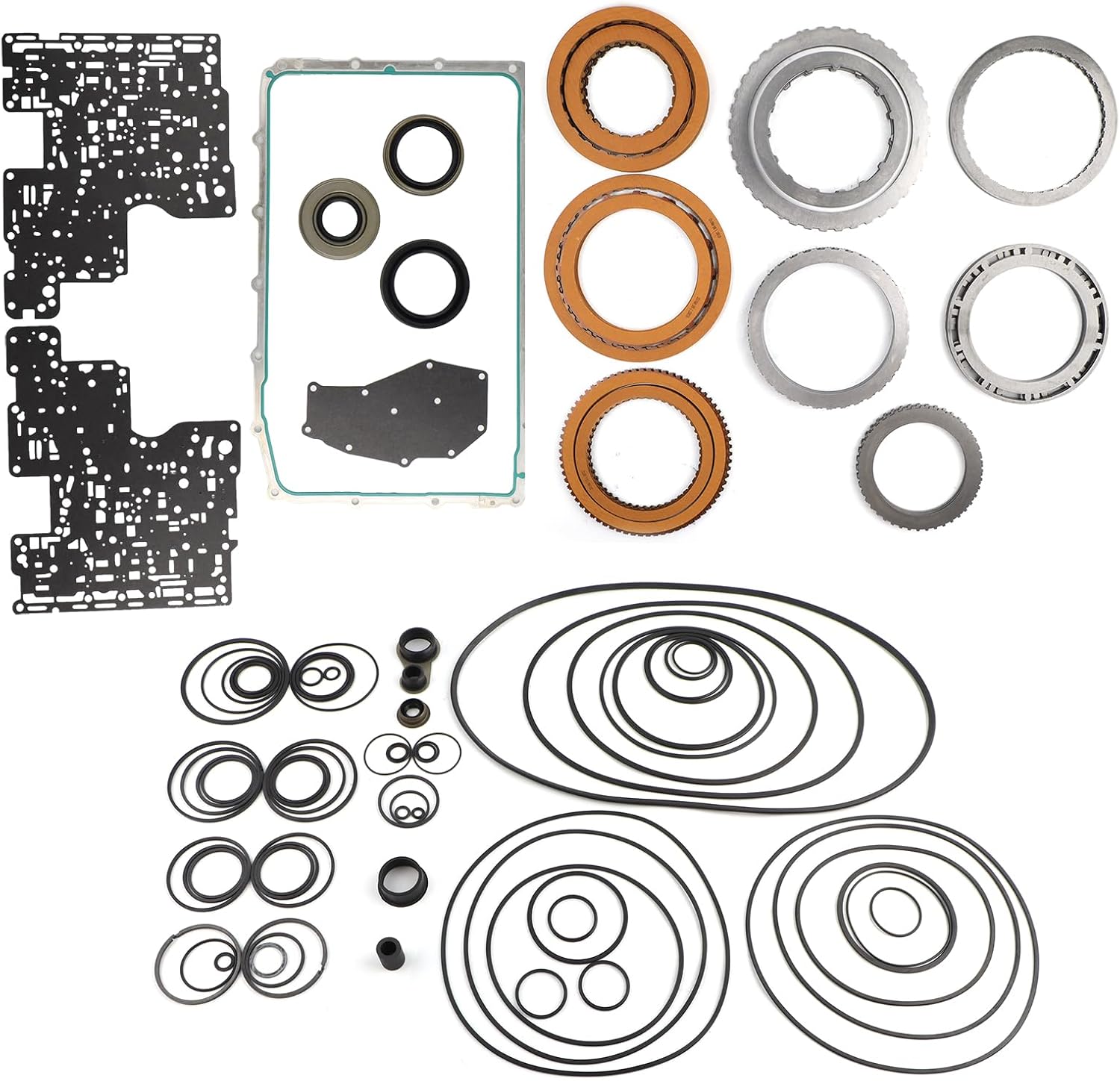
10R80 Bonded Piston Set at CoreTransmissionParts →Also there: the 10R80 deluxe rebuild kit, with frictions, steels, gaskets and sealing rings for a full clutch-and-planetary teardown.
FAQ
Does the 10R80 have one dedicated 3-4 clutch?
Not in the way a Simpson-gear 4-speed did. The 10R80's C, D and F clutch packs share a single CDF clutch cylinder on the input shaft, per Ford TSB 24-2304 and Transmission Digest's teardown coverage. Third and fourth gear both involve this cylinder, and Transmission Digest has specifically documented the F clutch's steel plates as the component whose wear pattern affects the 3-4 and 4-3 shift (along with skip shifts like 3-5 and 2-4), which is why shops shorthand it as the 10R80's 3-4 clutch.
What does a failing 10R80 3-4 clutch feel like?
Per Ford TSB 24-2304, the complaint shows up as harsh or delayed engagement and harsh or delayed shifts, frequently with a transmission ratio DTC such as P0733 (3rd gear incorrect ratio) or P0734 (4th gear incorrect ratio) stored in the PCM or TCM. Transmission Digest adds that when the F clutch's aluminum drive shell is the specific failure point, the same wear can also affect Reverse engagement and disengagement, and skip-shift combinations like 3-5 or 2-4.
What causes the 10R80 to fail specifically on the 3-4 shift?
Ford documents two related but distinct failure points. TSB 24-2304 attributes harsh/delayed 3-4 shifts and ratio codes to axial movement of the CDF clutch cylinder (part 7H351) sleeve, which causes a hydraulic circuit leak in the C, D and F clutch apply circuits. Separately, Transmission Digest's Wayne Colonna has documented the external lugs on the F clutch's steel plates digging into the aluminum drive shell, compromising that clutch's apply and release and affecting the 3-4 and 4-3 shift directly. Either failure can produce a similar complaint from the driver's seat.
Is there a Ford TSB for the 10R80 3-4 clutch problem?
Yes. TSB 24-2304, issued September 24, 2024 and superseding TSB 24-2254, covers 2020-2022 Explorer, 2020-2023 Transit, 2021-2022 F-150, 2021-2022 Mustang and 2022 Expedition/Navigator vehicles with a non-hybrid 10R80 built on or before August 15, 2022. It lists harsh/delayed engagement and harsh/delayed shift alongside a long list of DTCs, including P0733 and P0734, and directs the technician to run a VCMM-based CDF leakage test before condemning the clutch cylinder.
Can a 10R80 3-4 clutch problem be fixed without a full transmission replacement?
Usually. Ford's fix under TSB 24-2304 is to replace the CDF clutch cylinder (causal part 7H351) once the VCMM leak test confirms it, not the whole transmission assembly, with Ford-documented labor times in the 10.4 to 14.2 hour range depending on model and drivetrain. If the failure is instead the F clutch's steel plates chewing into the aluminum drive shell, that drive shell itself needs to be replaced, and the friction and steel plates in that pack are worth replacing at the same time since they were cut by the same wear.
Sources
- Ford Motor Company — Technical Service Bulletin 24-2304, "Various Vehicles Equipped With A 10R80 Automatic Transmission - Harsh/Delayed Engagement And/Or Harsh/Delayed Shift," September 24, 2024 (NHTSA-hosted). Backs the affected models and build-date cutoff (built on or before 15-Aug-2022); the full DTC list including P0733 and P0734; the root cause of axial CDF clutch cylinder (7H351) sleeve movement causing hydraulic circuit leaks; the VCMM pressure transducer leak-test procedure and CDF calculator tool; the causal part numbers ML3Z-7H351-B, JL3Z-7H351-B and JR3Z-7H351-B; the 10.4-14.2 hour replacement labor times; and the Motorcraft MERCON ULV (XT-12-QULV) fluid specification. nhtsa.gov (PDF)
- Ford Motor Company — Technical Service Bulletin 18-2079, "10R80 Automatic Transmission -- Harsh Or Delayed Shift Concerns And/Or Illuminated MIL - DTC P0711," March 2, 2018 (NHTSA-hosted). Backs the earlier 2017 F-150/Raptor harsh/delayed shift bulletin, the P0711 DTC, the PCM reprogram fix via IDS/FJDS, and the adaptive-learning relearn warning text Ford repeats across its 10R80 shift-quality bulletins. nhtsa.gov (PDF)
- Transmission Digest — "10R80 aches and pains: Unintentional park hold," Wayne Colonna, June 13, 2024. Backs the aluminum drive shell ("the trash can") carrying the F clutch assembly, the external lugs on the F clutch's steel plates digging into that drive shell, and the resulting effect on Reverse engagement/disengagement, the 3-4/4-3 shift, and skip shifts such as 3-5/5-3 and 2-4/4-2. transmissiondigest.com
- Transmission Digest — "Shift Pointers: Getting the 10R80 shaft," Wayne Colonna, July 10, 2023. Backs the roughly two-foot input shaft routing the converter, C, D and F clutch circuits; the C, D and F circuits sealing against the sun gear shaft inside the CDF clutch cylinder; and the cup-plug failure mode that can also damage these same clutch circuits. transmissiondigest.com
- Transmission Digest — "The root cause of 10R80 low roller clutch failure," Wayne Colonna, April 11, 2025. Backs the low one-way roller clutch design (cam on the outer race, smooth inner race on the stationary front cover), the assembly freewheeling from 3rd through 7th gear and held stationary in 9th/10th by the B clutch, and the resulting high-speed freewheel failure mode as a distinct, unrelated 10R80 failure point to rule out during diagnosis. transmissiondigest.com
- Ford Motor Company — Technical Service Bulletin 26-2408, "Harsh Shifts Between 3rd And 5th Gears And/Or Harsh Reverse Engagement, Symptoms Worse When Cold," September 16, 2026 (NHTSA-hosted). Backs the 16-Aug-2022 and later build range, the F clutch friction plates brinelling into the clutch and planetary container cylinder (7B177), the gray-silt filter inspection, part numbers PC3Z-7B177-A, HL3Z-7B164-D and PR3Z-7E313-A, and the inspection and repair labor times. nhtsa.gov (PDF)
- Ford Motor Company — 2019 Ranger Workshop Manual, Section 307-01 "Automatic Transmission — 10-Speed — Specifications." Backs the solenoid operation chart showing 3rd gear on A, C, D and E, 4th gear on A, C, D and F, and Reverse on A, B, D and F. Ford specifications (PDF)