A 10R80 that slips only when you load it is not the same complaint as one that slips all the time. There are six clutch packs and four planetary gearsets in there, and the unit uses casting-integrated direct-acting solenoids that produce clutch pressure only when current is applied. Every clutch is holding on a commanded pressure, so a clutch that holds fine at part throttle and lets go at 60% pedal is telling you that pressure is not surviving the trip from the pump to the piston.
There are four places that pressure goes missing on a 10R80, and one of them is not the transmission at all. Work them in order and you will not pull a unit you did not need to pull.
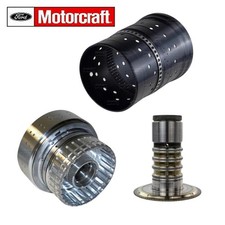
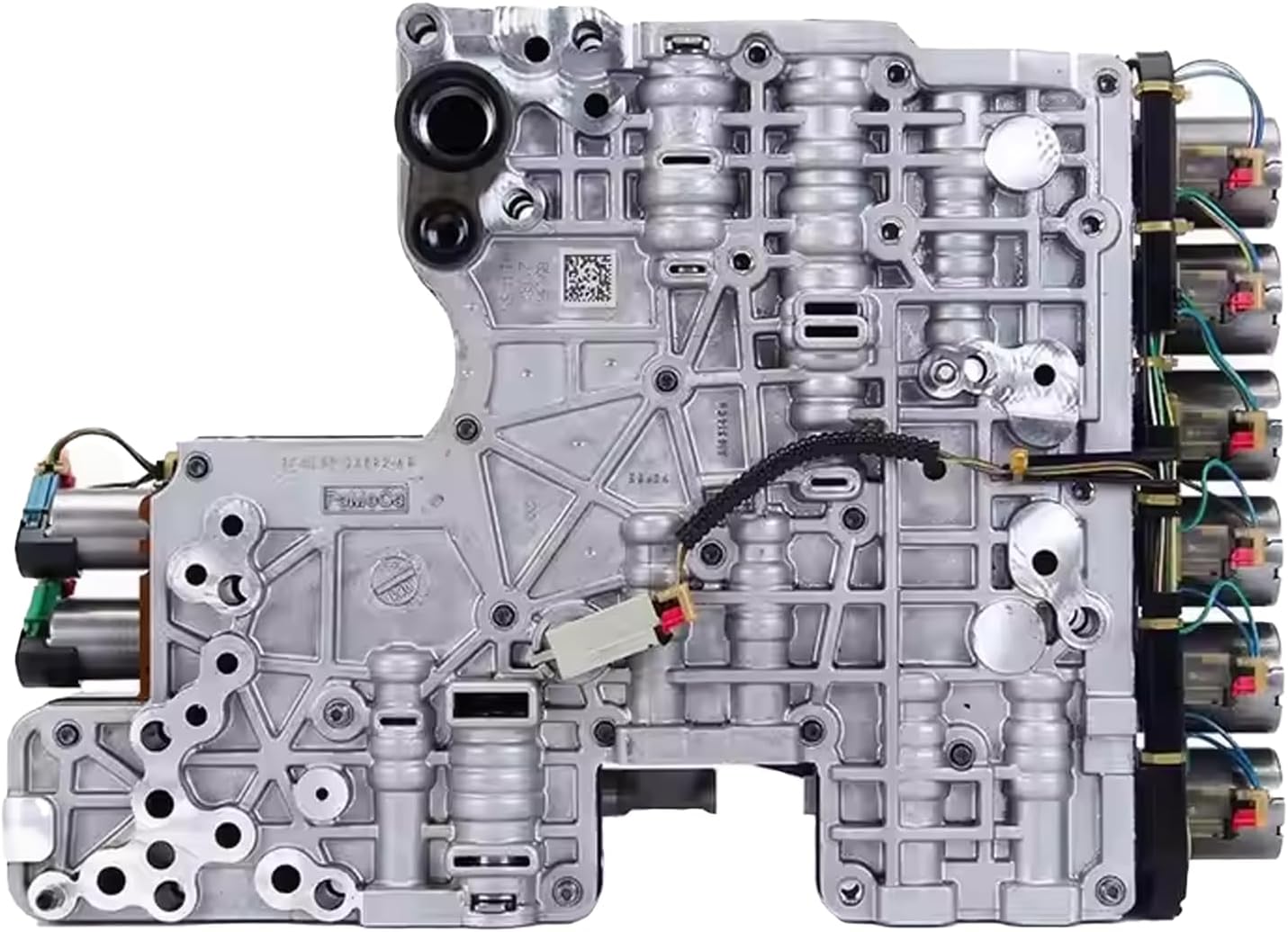
The one Ford put a bulletin on: the CDF clutch cylinder
Start here, because Ford eventually admitted this one in writing. Per Ford TSB 24-2254, dated 23 August 2024, the cause of harsh and delayed engagements and shifts across a large slice of the 10R80 population is "axial movement of the CDF clutch cylinder (7H351) sleeve causing hydraulic circuit leaks."
That is the whole failure in one sentence. The inner sleeve inside the C-D-F clutch cylinder walks rearward in the drum. When it moves it uncovers feed ports that were supposed to stay sealed behind it, and apply oil for the C, D and F clutches bleeds off instead of building against the piston. At light throttle there is enough volume to cover the leak and the truck drives normally. Put a trailer behind it and the leak wins.
The bulletin covers 2020-2022 Explorer, 2020-2023 Transit, 2021-2022 F-150, 2021-2022 Mustang, and 2022 Expedition and Navigator with the 10R80, built on or before 15-Aug-2022, excluding hybrid. Causal part is 7H351, condition code 42. Replacement cylinders are ML3Z-7H351-B for F-150, Expedition and Navigator, JL3Z-7H351-B for the 5.0L Mustang, Transit and 3.0L Explorer, and JR3Z-7H351-B for the 3.3L Explorer and 2.3L Mustang.
What makes this one miserable in the bay is that it does not look like anything when the pan comes off, it does not clear with a relearn, and a new valve body will not fix it either — the leak is upstream of everything the valve body controls.
How to prove it before you pull the unit
Ford's procedure in 24-2254 is a line-pressure leak-down comparison, and it isolates a CDF leak without a teardown.
The transducer goes into the transmission line pressure port. Note this before you thread anything in: the port is M10x1.0, not NPT. The bulletin is explicit that using a National Pipe Thread fitting will damage the case. You need an M10x1.0 male to 1/8 in. FNPT adapter, then 1/8 in. NPT male to 1/4 in. JIC male to reach a standard extension hose.
Then set up the scan tool session with these PIDs:
- LINEDSD — commanded line pressure, controllable
- VMM PVT Pressure — actual measured pressure, scale set to +/- 3447 kPa
- RPM and RPM_DSD — actual and commanded engine speed
- SSA_AMP through SSF_AMP — commanded current to each of the six shift solenoids
- TR_Corrected and TFT — range state and fluid temperature
Vehicle in park, parking brake set, and TFT at 50°C (122°F) or above — do not run this cold. Capture timing gets set to a 25-second duration with 10 pre and 15 post. Command all six solenoids to 0 mA, pull commanded engine speed down to 500-600 rpm, and raise LINEDSD to 1900-2000 kPa (275-290 psi), or the highest you can reach below 2000 kPa. Ford notes that actual pressure will read lower than commanded, which is normal and not a fault by itself.
Record, wait one second, command SSA_AMP to 1.0 A, hold two seconds, drop back to 0 mA. Repeat with SSC_AMP. You now have two traces showing what applying the A clutch and the C clutch each does to line pressure.
The interpretation is a comparison, not an absolute number. Read peak and valley pressure before the ramp and during the apply for both solenoids, and feed the four values into Ford's CDF calculator. If the A-clutch leakage rate comes back out of range, the bulletin does not apply and you go to Workshop Manual 307-01 for A clutch diagnosis. If the A-clutch rate is fine but the C-clutch-versus-A-clutch comparison is out of range, that delta is your CDF cylinder leak and the unit comes out. The logic: the A clutch feed does not run through the CDF sleeve and the C clutch feed does.
If you are rebuilding it anyway
Ford's fix is a new CDF cylinder with a revised backing lip. On the aftermarket side, Sonnax builds a CDF drum saver kit (129910-01K) that attacks the same mechanism: a stepped sleeve that cannot shift rearward in the drum, plus a set screw that keeps it from rotating. Sonnax lists it against slipping, slide bumps, neutral conditions and ratio error codes, which is the same symptom set 24-2254 describes.
Sonnax also makes the case for air checking every drum and the shaft plugs through the pump before the assembly goes back in the case. Those plugs keep fluid in its intended circuit, and a leaking one produces shift complaints that look identical to a worn bore. Catching that on the bench is free.
Valve body: bore wear that only shows up under load
If the CDF comparison comes back clean, the valve body is next. A worn bore is a fixed-size leak: at low commanded pressure the pump keeps up with it, and at high commanded pressure the leak scales with the differential and the regulator runs out of authority. That is why bore wear shows up as a load-only complaint.
Sonnax's vacuum test guide for the 10R60/10R80 and Gen. 1 GM 10L60/80/90 maps wear points to symptoms valve by valve. The ones that matter for a load complaint:
- Main pressure regulator valve — low line pressure, delayed engagement, poor shift quality, burnt clutches, overheated fluid. Sonnax repairs it with 105740-12K, a drop-in with an extended front land so the spool works in unworn bore area, or 105740-20K for a reamed oversized repair on heavier wear.
- TCC regulator valve — low TCC apply pressure in full lockup, converter shudder, TCC slip codes. Sonnax 105740-15K fits the Ford 10R60/80/90.
- TCC priority valve — harsh engagements and downshifts, soft or flared upshifts, overheated fluid. Sonnax 105740-03K.
- Clutch latch valves — these get beaten up by their retainer clips. Sonnax ties C clutch latch valve wear to 1-2 slip and no 2nd through 5th, B clutch latch valve wear to no 8th through 10th, and F clutch latch valve wear to no 4th through 10th, all with gear ratio codes. Repair is 105740-47K or 105740-71K.
- Clutch control valves (A through F, lower valve body) — each maps to a specific set of gears that slip or disappear when its bore wears, and every one sets ratio codes. That mapping turns a ratio code into a bore to test rather than a unit to tear down.
Two practical notes from the guide. When vacuum testing the A, B, C and F clutch latch valve bores you have to seal the bore with your thumb or the reading means nothing. And on the main pressure regulator and damper piston locations, keep the hole on the backside of the valve body uncovered while testing, or you will condemn a good valve.
Sonnax 10R80/10R90 Zip Kit — valve body wear kit
Covers the main line, TCC and clutch apply control circuits in one kit — the pressure losses that show up as flare and slip under load.
View the Sonnax Zip Kit →The low one-way roller clutch, and why it dies
This one is a design consequence, and Wayne Colonna laid out the mechanism in Transmission Digest. On the 10R80, the low one-way roller clutch has the cam as the outer race, with the smooth inner race built into the stationary front cover assembly.
The assembly starts freewheeling in third gear and is then held stationary in ninth and tenth by the B clutch. So from third through seventh, that whole assembly is spinning around a stationary inner race at road speed, and the geometry puts the rollers into the accordion springs while it does it.
Colonna's point is that this is the same arrangement GM had to abandon on the 4T60-E. In 1996 GM relocated the cam into the 1-2 roller clutch support drum specifically so the rollers would move away from the springs during freewheel, eliminating a high-speed freewheel failure. The 10R80 puts the cam back on the side that compresses them, then leaves the assembly freewheeling across five gears. You do not repair this one — new parts only, and per Colonna they come from Ford for somewhat less money than the GM equivalent.
Before you condemn anything: check the engine
This is the one that saves a transmission. ATRA's GEARS magazine documented a 2019 F-150 3.5L that came in with P0735 (gear ratio error in 5th) and P2704 (friction element E apply time) and a confirmed slip in 5th on the road test. Textbook E clutch, and both codes are routine on this unit.
The shop tore it down and everything looked perfect, CDF drum and E clutch included. They reassembled with a dealer valve body and an updated CDF drum. It still slipped in 5th and set the same two codes. A scope on the SSE command showed the 2-3 and 4-5 commands identical, and the truck slipped on the 4-5 and not the 2-3, so the electrical side was cleared. A second builder replaced the E clutch drum and piston on suspicion of a heat crack. Still slipped.
Data recordings finally showed the PCM commanding 2nd immediately after the 5th gear flare, with the range sensor never leaving drive. That looked like a controller fault until someone pulled Mode $06: cylinders 1 and 5 were incrementing misfire counts, not high or steady enough to set a P030x. Swapping coils 1-2 and 5-6 did not move the counts, which cleared the coils. New plugs eliminated the misfires, and the slip went with them.
Keep the gear-specific part in mind. SSE is commanded on in 1st, 3rd and 5th through 9th, and the complaint only appeared in 5th. A partial misfire can confuse the shift controller badly enough to produce a repeatable, single-gear slip that reads exactly like a burnt clutch. Pull Mode $06 before you sell an internal inspection on a 10R80 ratio code. It costs nothing.
Fluid, level, and the relearn
Use Motorcraft MERCON ULV, part XT-12-QULV. It is the fluid Ford's own bulletins list for this repair and it is not interchangeable. Sonnax puts it plainly: the ULV fluids exist to cut friction and pump workload, and a universal or older-spec fluid in a 10-speed produces shift complaints and premature failure.
Level matters as much as type. Overheating from an incorrect ATF level is on Sonnax's short list of common 10-speed problems, and aerated fluid behaves exactly like a leaking circuit — the clutch gets compressible foam instead of oil and gives up under load. Set it by the workshop procedure at the specified fluid temperature, not by eye and not cold.
Finish with the adaptive learning drive cycle. Ford TSB 23-2152 (22 May 2023, superseding 23-2123) covers 2017-2020 F-150, 2018-2021 Expedition, Navigator and Mustang, and 2019-2023 Ranger, and its decision tree is worth copying even outside those applications. If none of the listed DTCs are stored, reprogram the transmission strategy into the PCM/TCM and run the adaptive learning drive cycle first, and only overhaul the main control valve body if the condition survives that. If any of P0751, P0752, P0756, P0757, P0761, P0762, P0766, P0767, P0771, P0772, P2700 through P2705, P2707, P2708, P0729, P0731 through P0736, P076F, P07D9, P07F6 or P07F7 are stored, you skip the software step and go straight to the valve body overhaul. Ford books that overhaul between 4.0 and 5.5 hours depending on driveline and engine, which is a useful sanity check on your own estimate.
Two things from that bulletin that will save you arguments at the counter. Ford states that metal flakes on the transmission fluid pan magnet are a normal condition on this unit, so flakes alone are not a teardown. And a reset adaptive strategy means firmer-than-normal upshifts and downshifts for several days while it relearns — tell the customer before delivery, not after.
The order of operations
- Pull codes and Mode $06 misfire counters. Check battery state of health.
- Verify fluid type, level and condition at temperature.
- No 23-2152 DTCs stored: strategy reprogram plus adaptive learning drive cycle, then re-evaluate.
- Complaint survives: run the 24-2254 leak-down comparison at the M10x1.0 port. A clutch versus C clutch tells you whether the CDF sleeve has walked.
- CDF leak confirmed: unit out, new CDF cylinder or drum saver sleeve, new sun gear No. 3 and input shaft seals, then reset C/D/F endplay and T3 front end clearance.
- No CDF leak: vacuum test the valve body and repair the bores the readings condemn.
- On any teardown, inspect the low one-way roller clutch and air check the drums and shaft plugs through the pump.
- Adaptive learning drive cycle before delivery. Every time.
10R80 master rebuild kits, friction and steel packs, bonded pistons, valve body kits, filters, and the bench tools to set clearance and resize sealing rings — shipped fast from the USA.
Shop 10R80 parts →Sources
- Ford Motor Company — Technical Service Bulletin 24-2254, "10R80 Transmission — Harsh/Delayed Engagement And/Or Harsh/Delayed Shift — Built On Or Before 15-Aug-2022," 23 August 2024 (hosted by NHTSA). Backs the stated cause of axial movement of the CDF clutch cylinder (7H351) sleeve causing hydraulic circuit leaks, the affected model list and build-date cutoff, causal part 7H351 and condition code 42, the CDF cylinder part numbers ML3Z-7H351-B / JL3Z-7H351-B / JR3Z-7H351-B, the M10x1.0 line pressure port and the NPT warning, the PID list (LINEDSD, VMM PVT Pressure, SSA_AMP through SSF_AMP, TR_Corrected, TFT), the TFT 50°C (122°F) minimum, the 500-600 rpm and 1900-2000 kPa (275-290 psi) test conditions, and the A-clutch versus C-clutch leakage comparison and its pass/fail branches. static.nhtsa.gov
- Ford Motor Company — Technical Service Bulletin 23-2152, "10R80 — Harsh Engagement And/Or Harsh/Delayed Shift," 22 May 2023, superseding 23-2123 (hosted by NHTSA). Backs the full DTC list (P0751-P0772, P2700-P2708, P0729-P0736, P076F, P07D9, P07F6, P07F7), the affected 2017-2020 F-150, 2018-2021 Expedition/Navigator/Mustang and 2019-2023 Ranger applications, causal part 7A100 and condition code 49, the decision tree putting strategy reprogram and adaptive learning drive cycle ahead of a valve body overhaul, the 4.0-5.5 hour published labor range, the Motorcraft MERCON ULV XT-12-QULV fluid callout, the statement that metal flakes on the pan magnet are a normal condition, and the customer advisory about firmer shifts during relearn. static.nhtsa.gov
- Sonnax — "Ford 10R60, 10R80 & GM 10L60/80/90 (Gen. 1) Vacuum Test Guide," 29 November 2023. Backs the valve-by-valve wear-to-symptom mapping used above: main pressure regulator valve (low line pressure, delayed engagement, burnt clutches; parts 105740-12K and 105740-20K), TCC regulator valve (low TCC apply pressure in full lockup, shudder, TCC slip codes; 105740-15K for the Ford 10R60/80/90), TCC priority valve (105740-03K), the A/B/C/F clutch latch valves and their gear-specific slip complaints (105740-47K, 105740-71K), the requirement to seal the latch valve bores with your thumb when testing, and keeping the backside hole uncovered on the regulator and damper piston tests. sonnax.com
- Sonnax — "Troubleshooting Pressure Loss in 10-Speed Clutch Packs," Caleb Perham, 7 April 2025. Backs the six clutch packs and four planetary gearsets, sealing ring and hub bushing wear as a primary source of charge pressure loss leading to lockup and overheat concerns, the CDF drum saver kit 129910-01K and the slipping / slide bump / neutral / ratio code symptom set it addresses, air checking each drum and the shaft plugs through the pump before the assembly goes into the case, and the requirement to use Mercon ULV or Dexron ULV rather than a universal or older-spec fluid. sonnax.com
- Transmission Digest — "The root cause of 10R80 low roller clutch failure," Wayne Colonna, 11 April 2025. Backs the low one-way roller clutch geometry (cam as the outer race, smooth inner race on the stationary front cover), the freewheel window from third through seventh gear with the assembly held stationary in ninth and tenth by the B clutch, the 4T60-E precedent where GM relocated the cam into the support drum in 1996 to eliminate high-speed freewheel failure, and the fact that new parts are the only repair option. transmissiondigest.com
- GEARS Magazine (ATRA) — "A 10R80 with P0735 and P2704 Issues." Backs the 2019 F-150 3.5L case study: confirmed 5th gear slip with P0735 and P2704, two teardowns and a dealer valve body that did not fix it, the scope capture showing identical SSE commands on the 2-3 and 4-5 shifts, SSE being commanded on in 1st, 3rd and 5th through 9th, the PCM commanding 2nd after the 5th gear flare with the range sensor still in drive, and the Mode $06 misfire counts on cylinders 1 and 5 that were cured by spark plugs and took the transmission slip with them. gearsmagazine.com