When a 10R80 starts banging one shift, flaring another, or throws a P07-series code with the word "solenoid" in it, the shift solenoids get blamed first. Sometimes that is right. More often on this unit, the solenoid is the messenger. The 10R80's shift solenoids work differently from the ones most of us grew up on, they fail differently, and replacing one is not a plug-and-play job. Put in the wrong one, or the right one without the programming, and the truck shifts worse than it did when it came in.
This is how the six 10R80 shift solenoids work, the symptoms and codes that point at them, what else sets the same codes, how to test them on the truck and on the bench, and how to replace one correctly. Every fact is sourced at the bottom, mostly from Ford's own bulletins, ATRA's GEARS Magazine and Transmission Digest.
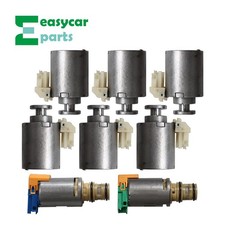
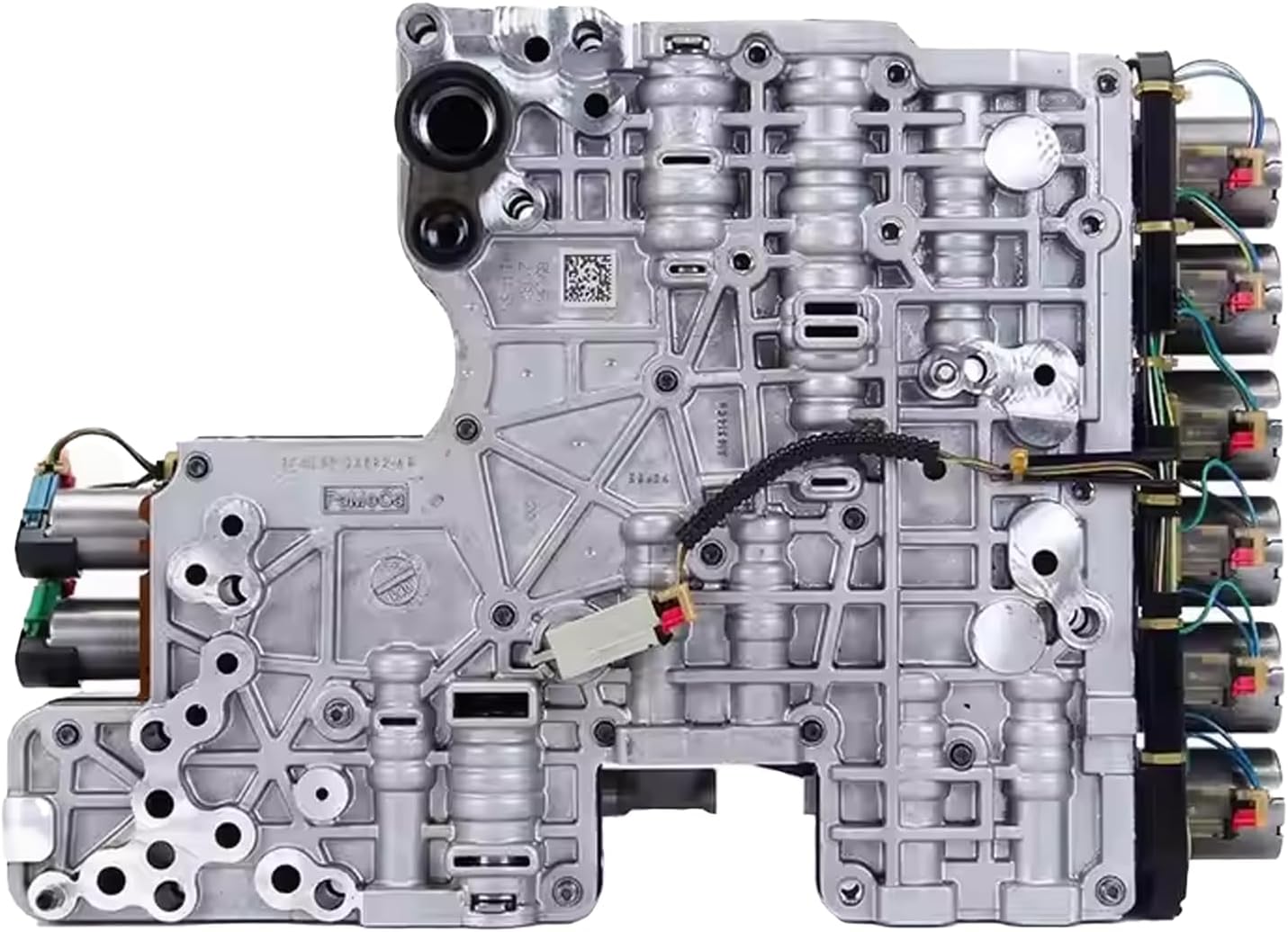
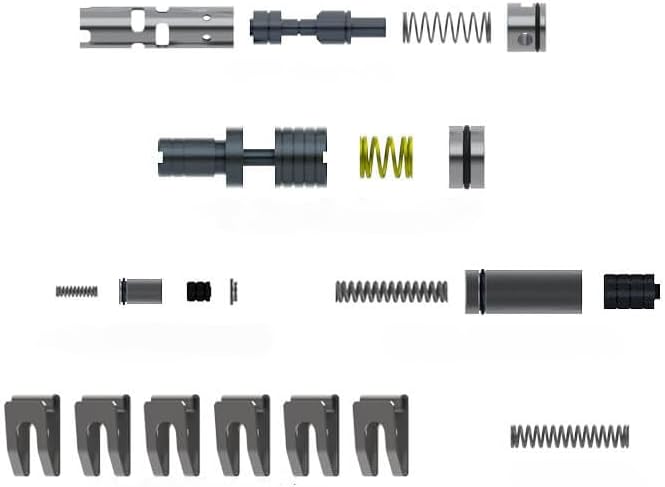
How the 10R80 shift solenoids work
The 10R80 has six clutches, lettered A through F, and six shift solenoids with matching letters. Ford calls them CIDAS, for Casting-Integrated Direct-Acting Solenoids. GEARS Magazine's breakdown of the 10R family explains what makes them different: no transmission fluid passes through them. An armature and pin assembly pushes directly on a regulating valve in the main control, and that valve meters line pressure to its clutch. The relationship is proportional: zero current equals zero pressure, maximum current equals maximum pressure.
Two more solenoids share the main control. The line pressure control (LPC) solenoid is a normally-high variable force solenoid, and the TCC solenoid is normally low. GEARS gives their working range as 50 mA to 850 mA, and notes that their current never drops to zero when commanded low. A small idle current stays on the circuit so the module can monitor it. Do not read that as a stuck solenoid.
The six shift solenoids are not interchangeable. Transmission Digest's Mike Souza points out that each one has a different part number for a different flow rate and belongs in its original location. The regulating valves differ too: shift solenoid valves 1, 2, 3 and 6 use a four-land valve, while 4 and 5 use a five-land valve. On top of that, every solenoid is flow-tested at the factory and carries a band number that tells the module how it performs. Hold onto that detail. It is the whole story when a replacement goes wrong.
Symptoms of a failing 10R80 shift solenoid
Because each solenoid controls one clutch, a solenoid problem shows up on the specific shifts where that clutch applies or releases. That is the most useful thing about this unit when you are diagnosing it.
- Harsh, flared or bound-up shifts on specific gear changes. A problem on the 7-8 and 8-7 shift, for example, narrows to the B and C circuits, because on that shift B comes on and C comes off.
- Slip or a ratio error in one gear. GEARS notes SSE is commanded on in 1st, 3rd and 5th through 9th, so an E-circuit problem can show up as a slip in any of those gears.
- Harsh or delayed engagement into Drive or Reverse, often with a stored code.
- No movement at all. Since zero current means zero pressure, a unit that loses power to its shift solenoids cannot apply any clutch. An unplugged 10R80 does not limp in a default gear the way older Fords did.
- MIL on with one of the solenoid performance or friction element codes below.
The codes, solenoid by solenoid
Ford's harsh-shift bulletin, TSB 23-2123, lists the codes that send the diagnosis to the main control. Grouped by solenoid, they look like this. The definitions are the standard SAE ones: "performance or stuck off" and "stuck on" for the solenoid codes, "apply time" for the friction element codes.
| Solenoid / clutch | Performance or stuck off | Stuck on | Friction element apply time |
|---|---|---|---|
| SSA / A clutch | P0751 | P0752 | P2700 |
| SSB / B clutch | P0756 | P0757 | P2701 |
| SSC / C clutch | P0761 | P0762 | P2702 |
| SSD / D clutch | P0766 | P0767 | P2703 |
| SSE / E clutch | P0771 | P0772 | P2704 |
| SSF / F clutch | P2707 | P2708 | P2705 |
Note what those are. Performance and apply-time codes mean the module commanded a clutch and the ratio or timing did not follow. They do not say the solenoid coil is open. A true electrical fault sets the circuit codes (P0750, P0755, P0760, P0765, P0770 and P2706 for A through F), which point at the solenoid, its connector or the harness. Ford's own correction for the performance codes in TSB 23-2123 is to overhaul the main control valve body, not to replace a solenoid, and the claim is coded to the valve body, causal part 7A100.
What sets the same codes and is not a solenoid
Before anything comes out of the pan, rule these out. Each one has cost somebody a valve body.
A leaking CDF clutch cylinder
Ford TSB 24-2254 lists almost exactly the same code set (P0751 through P0772, P2700 through P2708 and the ratio codes) on 2020-2022 Explorer, 2020-2023 Transit, 2021-2022 F-150 and Mustang, and 2022 Expedition and Navigator built on or before 15 August 2022. The cause is not the solenoids. It is axial movement of the CDF clutch cylinder (7H351) sleeve causing hydraulic circuit leaks. Solenoids and valve body can be perfect and the codes still set, because the pressure leaks downstream of the valve body.
Engine misfire
GEARS documented a 2019 F-150 3.5L with P0735 (5th gear ratio) and P2704 (E clutch apply time) and a slip in 5th only. It got a dealer valve body, a CDF drum update and two overhauls. The fix was spark plugs. Mode $06 showed misfire counts on cylinders 1 and 5, and the fouled plugs were throwing off the commands the PCM gave the transmission. Check misfire data before you drop the pan.
Low system voltage
If pressure follows current, voltage is shift quality. A tired battery produces harsh engagements and erratic shifts that come and go with temperature. Load-test it first. Our 10R80 harsh and delayed shift walkthrough covers that step.
Collapsed solenoid retaining clips
Sonnax notes that the small OE spring steel clips holding these heavy solenoids in the casting are prone to collapse. That lets the solenoid wobble in its bore and stop controlling the shift properly. Ford's TSB 23-2123 parts list calls for six new solenoid retaining clips (HL3Z-7G007-A) and new solenoid retaining plate bolts (W712658-S439) whenever the main control is overhauled. Ford does not expect you to reuse them, and neither should you.
Testing the solenoids on the truck
Scan tool PIDs
Ford's own clutch-circuit test in TSB 24-2254 uses these PIDs: SSA_AMP# through SSF_AMP# (commanded current for each shift solenoid), LINEDSD# (desired line pressure), RPM_DSD#, TR_Corrected and TFT. The setup: vehicle in Park with the parking brake on, TFT at 50 C (122 F) or above, all six shift solenoids commanded to 0 mA, engine held at 500-600 rpm, and line pressure commanded to 1,900-2,000 kPa (275-290 psi). Then a solenoid is commanded to 1.0 A for 2 seconds while a transducer on the line pressure port records what line pressure does as that clutch fills. A circuit that pulls line pressure down more than it should is leaking somewhere.
One warning from the same bulletin: the line pressure port is an M10 x 1.0 thread. Ford states that an NPT fitting will damage the case.
Outside a dealer you will not have Ford's CDF calculator, but the principle holds with any bidirectional tool and a gauge. Command one solenoid at a time with the unit stationary and compare how pressure behaves from circuit to circuit. On the road, log commanded current against gear and ratio, and match the bad shift to the solenoids that change state during it.
Use a scope, not a meter
Chris Adams of Certified Transmission put a scope on all eight solenoids of a 2019 F-150 5.0L and wrote up the results in Transmission Digest. The shift solenoids do not run a steady PWM signal. On SSB in 9th gear, frequency moved between about 625 Hz and 7,150 Hz as the module regulated it. The TCC solenoid ran 35-45% duty cycle at 2.6-3.5 kHz at light cruise. He also found solenoids that the published apply chart shows as off still carrying a regulated signal. A voltmeter will mislead you on this unit. Use a scope.
His pressure readings are worth having for comparison: 72-75 psi at idle in all ranges on his test truck, against the 90 psi shown in many charts, and a reverse stall reading that surged between 239 and 305 psi. He saw the same behavior with a used and a brand-new valve body, so do not condemn a valve body for it.
Bench test
With the main control out, GEARS gives a simple check. The CIDAS solenoids measure about 5 ohms, so a 5-volt source is enough to fire one. Hold it down on the bench, connect the negative lead and tap the positive lead. The pintle should snap out cleanly every time. A 12-volt source works too, but only in short taps, because the solenoid gets very hot if you leave it connected. The carbon fiber sleeve, plunger and pintle inside are not serviceable. If it fails, it gets replaced.
Replacing a 10R80 shift solenoid
- Read the band number before you order. It is printed on the side or end of the solenoid and will be a 1, 2, 3, 4 or 5. The replacement's band number must match the one coming out, and it goes back in the same location. Transmission Digest warns that fitting whatever band number is on the shelf can cause a flare or harsh shift that takes the TCM a long time to learn around.
- Replace the retaining clips. Use new OE clips (HL3Z-7G007-A) or an upgraded retainer such as Sonnax 105740-19K, which lists the 10R80 among its applications and adds 32% more contact area at the casting. Torque the retaining plate bolts to the Workshop Manual (Section 307-01) spec for your vehicle.
- Verify the strategy. The 10R80 carries a 13-digit solenoid body strategy (numbers only) and a 12-digit solenoid body identification. The tag is on the left side of the case, and the 13-digit strategy is etched on the main control casting. If the scan tool, the tag and the casting do not all agree, a strategy download is required. Souza is blunt that a new main control supplied without a replacement strategy tag should not be installed. GEARS adds a trap: entering only the 12-digit identification gives you a partial file download.
- Let it rest, then relearn. After programming, GEARS says to let the vehicle sit at least 10 minutes, then run the adaptive learning drive cycle, which takes 30-45 minutes. Ford's TSB tells you to warn the customer that shifts may be firmer than normal for several days while it relearns.
Why band numbers matter: Wayne Colonna wrote up a case in Transmission Digest where a shop rebuilt a 2018 F-150 10R80 with a new Ford valve body, programmed the strategy and ID, and still had a bind on the 7-8 upshift and 8-7 downshift that would not adapt out. A second new Ford valve body did the same thing. The fix was replacing SSB and SSC with good used solenoids carrying the same band numbers. On the first drive cycle the bind was gone. The module was timing the B-on, C-off overlap against numbers that did not match the parts. New does not always mean right.
Solenoid, or the whole main control?
Ford's decision path in TSB 23-2123 is a good default. With no codes, reprogram the strategy and run the adaptive drive cycle first. That is 0.8 hours of labor. With any of the listed codes, or if the reflash does not fix it, overhaul the main control, which Ford times at 3.9 to 5.5 hours depending on vehicle and engine.
My own rule: replace a single solenoid only when a circuit code, a scope capture or a bench test proves that solenoid bad, and you can get a replacement with the same band number. If it is a performance code and the solenoid tests good, the problem is a valve or bore, the retaining clips, or the CDF cylinder, and a new solenoid will not fix it. Our 10R80 valve body testing guide covers the vacuum test for those bores.
Sonnax solenoid stabilization retainer kit, 105740-19K
Six upgraded retainers that replace the collapse-prone OE spring clips holding the 10-speed shift solenoids. Sonnax lists the 10R80, 10R60 and 10R140 among its applications. Cheap insurance any time the main control is apart. From our sister store CoreTransmissionParts.
Shop the part for this fix →Need more for the 10-speed? The 10-speed parts collection covers solenoid kits, valve body kits, clutches and hard parts.
Need parts for this job?
10R80 shift solenoid kits, complete main controls and Sonnax valve body repair kits are on our 10R80 parts page, with checkout on site. Read your band numbers and strategy tag before you order.
FAQ
What are the symptoms of a bad 10R80 shift solenoid?
Harsh, flared or bound-up shifts on the specific gear changes where that solenoid's clutch applies or releases, slip or a ratio error in the gears that clutch holds, harsh or delayed engagement, and a MIL with a solenoid performance or friction element code. Because zero current means zero pressure on these solenoids, a loss of power to them leaves no clutch applied and no movement.
How many shift solenoids does a 10R80 have?
Six, lettered A through F, one for each clutch. Ford calls them CIDAS, Casting-Integrated Direct-Acting Solenoids, and no fluid passes through them. The main control also has a line pressure control solenoid and a TCC solenoid, for eight in total.
Can you replace just one 10R80 shift solenoid?
Yes, if the replacement has the same band number as the one coming out, which is printed on the side or end of the solenoid, and it goes back in the same location. Replace the retaining clips at the same time and confirm the solenoid body strategy afterward, then run the adaptive learning drive cycle.
What is the resistance of a 10R80 shift solenoid?
GEARS Magazine gives about 5 ohms for the 10R CIDAS shift solenoids. A 5-volt source is enough to bench test one by tapping the positive lead and watching the pintle snap out. On the truck, use a scope rather than a meter, because the control signal changes frequency constantly.
Does a new 10R80 solenoid or valve body need programming?
Yes. The TCM has to know the characteristics of the solenoids installed. The 13-digit solenoid body strategy and 12-digit identification must match the tag on the left side of the case and the number etched on the main control, or a strategy download is required. Entering only the 12-digit identification gives a partial download.
Related guides
- 10R80 Valve Body Problems and Testing
- 10R80 Harsh and Delayed Shifts
- 10R80 Common Problems and Fixes
- 10R80 P0741 Torque Converter Clutch Stuck Off
- 10L80 Shift Solenoid Symptoms (the GM twin)
Sources
- Ford Motor Company, Technical Service Bulletin 23-2123, "10R80 - Harsh/Delayed Engagement And/Or Harsh/Delayed Shift," 13 April 2023, via NHTSA. Backs the DTC list, the reprogram-first decision path (0.8 hr) and main control overhaul (3.9-5.5 hr, causal part 7A100), the six HL3Z-7G007-A solenoid retaining clips and W712658-S439 retaining plate bolts, and the firmer-shift relearn note. static.nhtsa.gov (PDF)
- Ford Motor Company, Technical Service Bulletin 24-2254, "10R80 Transmission - Harsh/Delayed Engagement And/Or Harsh/Delayed Shift," 23 August 2024, via NHTSA. Backs the same code set caused by CDF clutch cylinder (7H351) sleeve movement, the SSA_AMP# through SSF_AMP#, LINEDSD#, RPM_DSD#, TR_Corrected and TFT PIDs, the 50 C / 500-600 rpm / 1,900-2,000 kPa / 1.0 A test, and the M10 x 1.0 line pressure port. static.nhtsa.gov (PDF)
- GEARS Magazine (ATRA), "Direct Connection: 10R60, 10R80, and 10R140 Solenoids Make Shifts Happen!" Backs the CIDAS design with no fluid through the solenoid, proportional current and pressure, the 50-850 mA LPC and TCC range, band number matching, the 12- and 13-digit identifiers and partial download warning, and the 10-minute rest and 30-45 minute drive cycle. gearsmagazine.com
- GEARS Magazine (ATRA), "Let's Have Fun With CIDAS Solenoids." Backs the 5 ohm resistance, the 5-volt bench tap test, the 12-volt heat warning and the non-serviceable internal parts. gearsmagazine.com
- GEARS Magazine (ATRA), "A 10R80 with P0735 and P2704 Issues." Backs SSE being commanded on in 1st, 3rd and 5th-9th and the misfire-caused 5th gear slip fixed with spark plugs. gearsmagazine.com
- Transmission Digest, Mike Souza, "10R80/10L90 10-Speed Solenoid Function." Backs the different part numbers and flow rates per solenoid position, the four-land and five-land regulating valves, and the strategy tag and casting-etch verification. transmissiondigest.com
- Transmission Digest, Chris Adams, "Scope testing the Ford 10R80." Backs the variable 625-7,150 Hz shift solenoid signal, the TCC duty cycle and frequency, 72-75 psi idle line pressure, the reverse stall surge and the scope-over-meter advice. transmissiondigest.com
- Transmission Digest, Wayne Colonna, "10R80 caught in a bind on the seventh to eighth shift." Backs the 7-8 bind on two new valve bodies, fixed by SSB and SSC solenoids with matching band numbers. transmissiondigest.com
- Sonnax, Solenoid Stabilization Retainer Kit 105740-19K. Backs the collapse-prone OE spring retainers letting solenoids wobble, the 32% added contact area and the 10R80 application. sonnax.com