A 10R80 filter and pan service is one of the simplest jobs on a Ford 10-speed, and one of the easiest to get slightly wrong. The pan is plastic, the filter neck seal likes to stay behind in its bore, the magnet tells you more about the unit than any scan tool will, and the job is not finished until the level has been set hot. Get those four things right and the service does what it should.
This guide covers the 10R80 in the F-150, Expedition, Navigator, Mustang, Ranger, Explorer and Transit: the Ford part numbers for the filter, pan gasket and seals, what the pan and gasket are made of, a step-by-step pan drop, how to read the magnet, the second filter most people never hear about, and the refill. Every source is linked at the bottom.
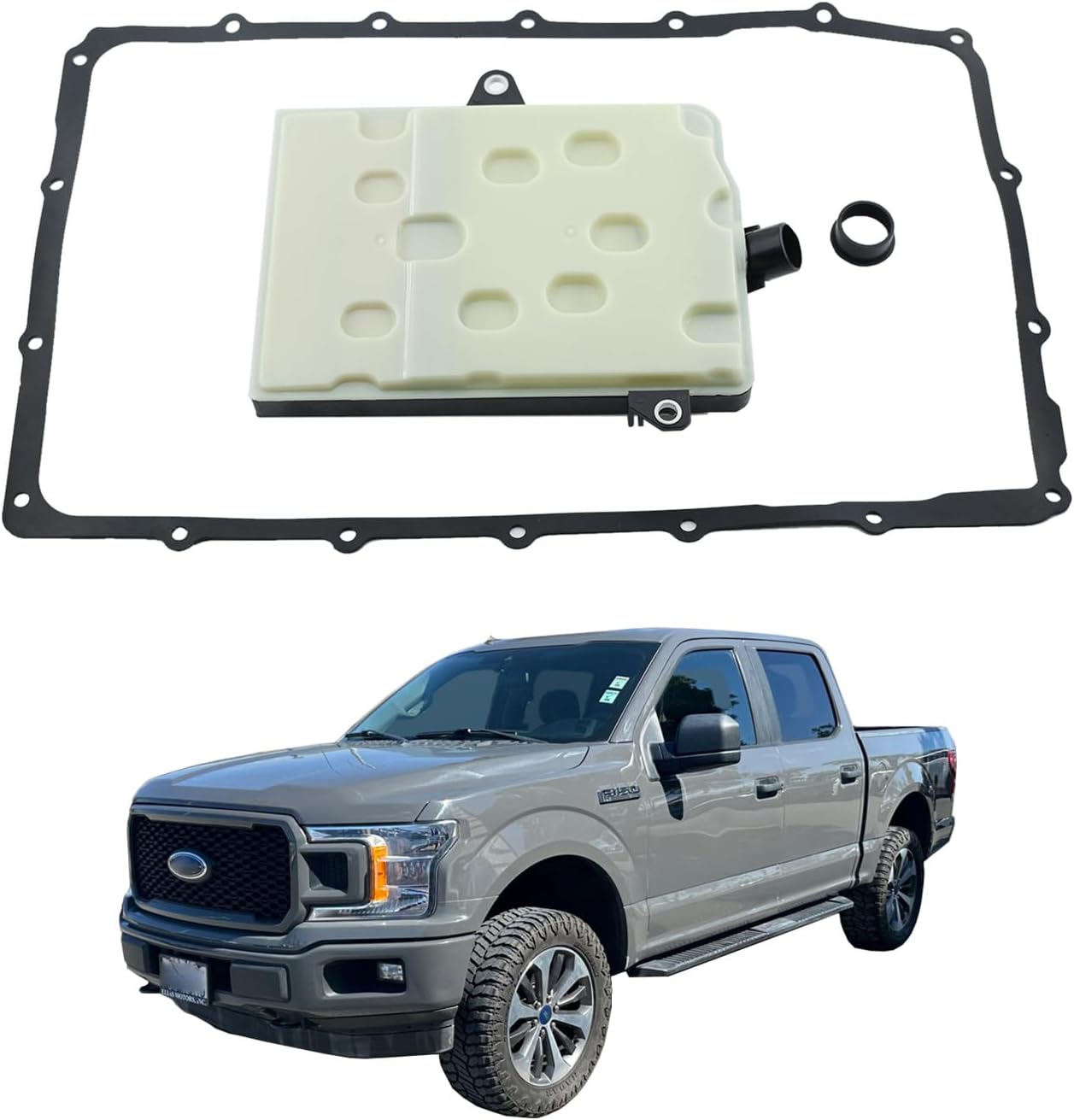
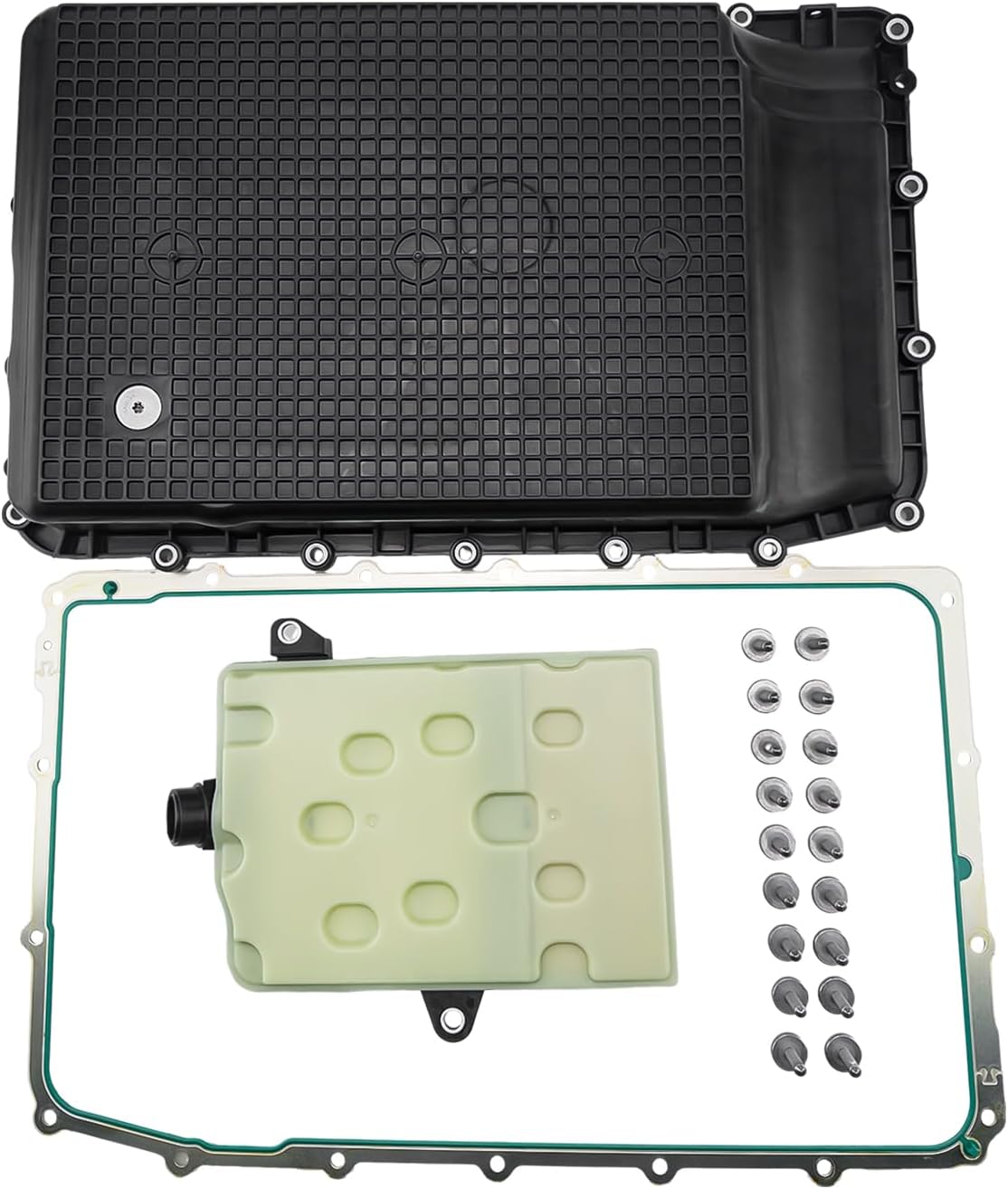
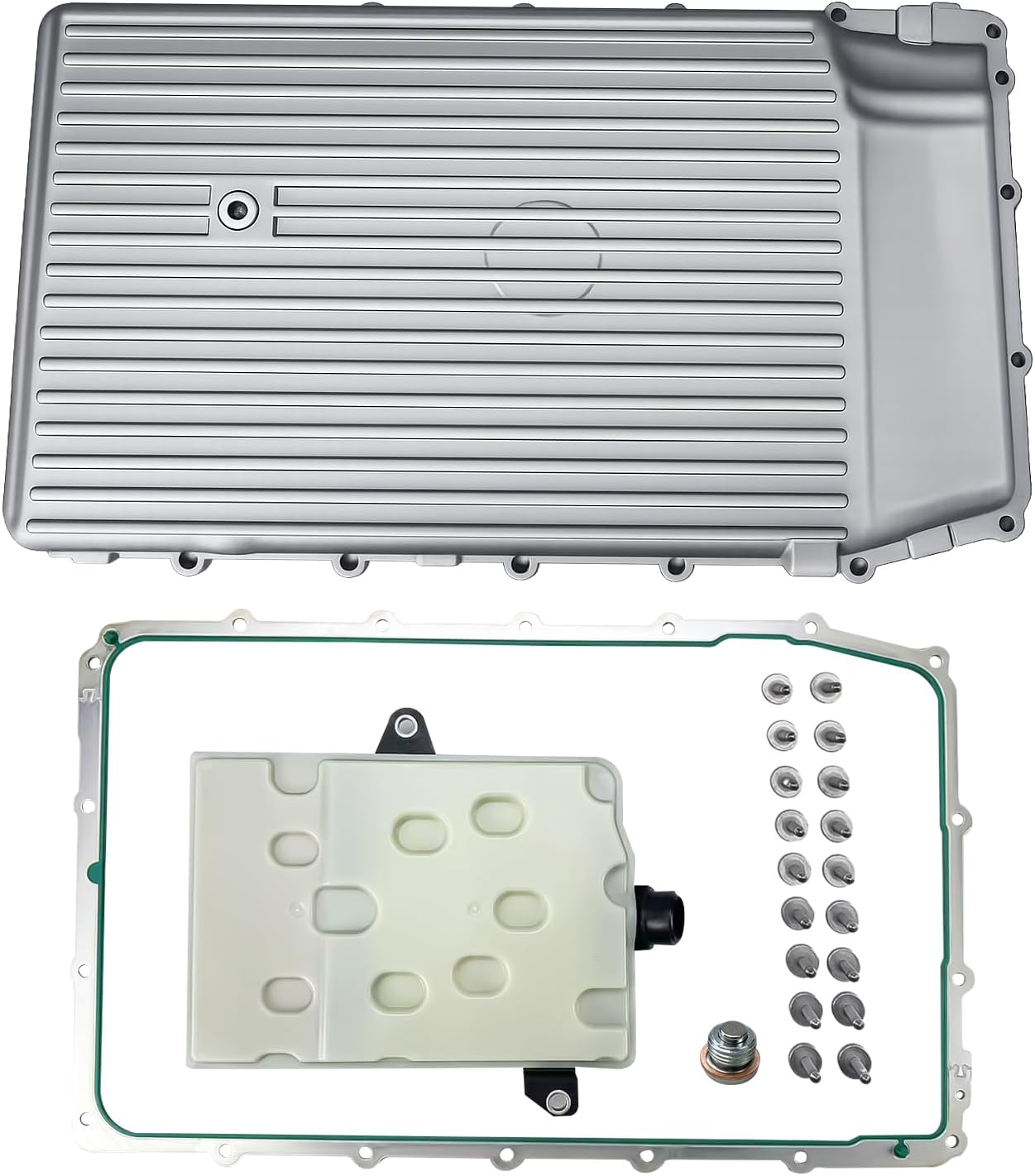
What a 10R80 pan service replaces
Ford's 10R80 bulletins list the service parts in their "inspect and replace only if necessary" tables. These are the numbers to have on the counter before the truck goes up:
| Part | Ford part number | Notes |
|---|---|---|
| Fluid filter, F-150, Expedition, Navigator, Mustang, Ranger | HL3Z-7A098-A | Per TSB 23-2152. TSB 24-2254 also lists it for the Explorer |
| Fluid filter, 2020 Explorer, Aviator, PIU (10R80) | L1MZ-7A098-A | Per TSB 21-2046. Raybestos cross-references both numbers to one filter |
| Fluid filter, Transit | LK4Z-7A098-A | Per TSB 24-2254. Do not assume an F-150 filter fits |
| Fluid filter seal | 7T4Z-7Z302-A | The seal the filter neck plugs into |
| Pan gasket | HL3Z-7A191-B | Same number across F-150 and Explorer bulletins |
| Auxiliary pump tube O-ring | HL3Z-7J227-A | Auto Start-Stop units only |
| Fluid | XT-12-QULV (MERCON ULV) | Never MERCON LV |
Raybestos Powertrain, which builds OE-replacement parts for this unit, catalogs the factory pan (OE HL3Z-7A194-A, -B and -C) as a plastic pan with 18 bolt holes and a magnet, and its matching gasket as a reusable gasket with metal limiters, cross-referenced to OE HL3P-7A191-AB. Both details matter when the pan goes back on, and I will come back to them.
When to do it
Ford's own schedule is lighter than most owners expect. The 2022 Expedition owner's manual lists "Change the automatic transmission fluid" at every 150,000 miles (240,000 km) in its Other Maintenance Items table, and none of the Special Operating Conditions tables adds a transmission line for towing or heavy idling. The schedule says fluid, not filter. In every 10R80 bulletin I have read, the filter and pan gasket are "if needed" parts.
My practice is different, and I say so to customers: if the pan comes off, the filter gets replaced, and a truck that tows, plows or idles on a job site gets serviced well before 150,000. GEARS Magazine notes that the 10R units already run warm, with a normal range of 206-215 F (97-102 C). A truck working near its tow rating is not a normal-duty truck. That is a rebuilder's call, not a Ford interval.
The other time to drop the pan is when there is a shift complaint. Ford's harsh-shift bulletins start with a scan for codes, a strategy update and an adaptive drive cycle. If those do not fix it, the next step is a valve body overhaul, and the pan comes off either way. Looking at the magnet first costs nothing.
Before the pan comes off
- Scan first. Pull codes and record TFT and any stored adaptive data. If a harsh-shift TSB applies, the pan service is part of a bigger job and you want to know that now.
- Get the fluid warm, not hot. Warm fluid drains faster and carries more debris out with it. A pan full of fluid at 200 F on your forearm is how people get burned.
- Have the fluid on hand. Most factory 10R80 pans have no drain plug, so the fluid comes out when the pan does. Two 6-packs of ULV covers a pan drop with room to spare.
- Get a wide drain pan and a measuring container. You are going to measure what came out, because that is how you know what goes back in.
Step by step: pan drop and filter change
- Loosen, do not remove, every pan bolt. With 18 bolts in a plastic pan, back them all out a few turns, then remove the ones at one end and let that corner tip down and drain. Controlling the drain keeps fluid off the exhaust and off you.
- Note the stud-bolt locations. Some 10R80 pans use stud-bolts in specific holes for harness or line brackets. Mark where they came from. They go back in the same holes.
- Lower the pan level. There is still fluid in it. Pour it into your measuring container along with what drained, and set the magnet aside without wiping it. You want to read it first.
- Remove the filter. Pull it straight down. The neck seal, Ford 7T4Z-7Z302-A, sits in the bore the filter plugs into. Look up into that bore. If the old seal stayed behind, it has to come out, or the new filter will not seat and the pump will pull air past it.
- Install the new seal and filter. Lube the new seal with clean ULV, seat it square, then push the filter home by hand until it is fully seated. Do not use the pan to push the filter up.
- Clean the pan and the sealing surfaces. Clean the pan with a lint-free rag and solvent, then let it dry. Wipe the case rail. No scrapers on either surface, and no sealer. The gasket is designed to seal dry.
- Install the gasket and pan. Line the gasket up on its locating tabs, put the pan up, and start every bolt and stud-bolt by hand in its original location.
- Torque in a cross pattern to the spec in the service information. This is a plastic pan with a gasket that has metal limiters in it. The limiters are there to stop the gasket from being crushed, which means the torque is low and is given in inch-pounds. Owners who have posted the Ford workshop page quote 96 lb-in for the pan bolts and 108 lb-in for the stud-bolts. Confirm those against the Workshop Manual (Section 307-01) for your exact truck. Do not use an impact, and do not go by feel. A cracked 10R80 pan flange is a common enough failure that Raybestos sells a replacement pan specifically for builders dealing with cracked and damaged pans on cores.
Reuse the gasket or replace it?
The factory 10R80 gasket is a molded, reusable design with metal limiters, and Ford lists a new one as "if needed" in its bulletins. My rule: if it is not torn, not swollen, not cut and it still sits flat in the pan groove, it can go back on. If it has taken a set, has a nick where it crosses a bolt hole, or the pan was leaking before you started, replace it. At the price of a filter kit that includes one, I rarely reuse it on a customer truck.
Reading the magnet and the filter
This is the part of the job that tells you whether you are doing maintenance or delivering bad news. Ford's TSB 23-2152 says it plainly: when the pan comes off, metal flakes may be present on the magnet, and this is a normal condition. The bulletin includes a photo of what normal looks like: a fine gray paste of flake on the magnet.
What I do not want to see:
- Clutch material. Dark, fibrous debris in the bottom of the pan or packed in the filter screen means friction plates are coming apart. Ask what the truck has been doing and check the level history before anything else.
- Bright metal chunks or slivers you can pick up with your fingers. That is not wear paste. That is a part breaking.
- Brass or bronze glitter. Bushing or thrust washer wear, usually worse on a unit that has run low or hot.
- Burnt smell and dark fluid at low mileage. Check the cooler circuit. GEARS reports that rubber ATF cooler lines on the 10R units can rupture internally and restrict or stop cooler flow, causing overheating, and recommends an infrared gun or thermal camera on the lines in and out of the transmission and the heat exchanger.
Photograph the magnet and the pan before you clean them. If this truck comes back with a complaint, that photo is worth more than anything you will write on the repair order.
The filter you are not changing
The sump filter is not the only filter in a 10R80. Raybestos catalogs a second part for the 10R80 and 10R60, a pump cartridge filter, OE HL3P-7P086, supplied with its O-rings. It lives in the pump circuit, not on the bottom of the valve body, and it is not part of a pan service. It gets replaced when the unit is apart. If someone sells you "both 10R80 filters" for a fluid service, one of them is going back on the shelf.
On trucks with Auto Start-Stop, the auxiliary pump tube O-ring (HL3Z-7J227-A) is also in Ford's parts tables. If the valve body is not coming out, you will not see it. If the pan service turns into a valve body job, have one on hand, because an auxiliary pump circuit leak can show up as a slow or harsh engagement after a restart.
Refill and set the level hot
Put back what came out. That is the whole capacity rule for a pan drop, because the converter, cooler and case passages kept their fluid. Sonnax, working from Ford service information, puts a dry 2020 F-150 4x4 at 13.0 qt (12.3 L) of MERCON ULV, and a pan drop takes a good deal less than that. Our 10R80 fluid type and capacity guide covers the numbers in detail.
Then set the final level the way Ford intends it: TFT at 96-101 C (206-215 F) on a level surface, engine running, selector held about 6 seconds in each range, then check at the level indicator in the fill plug. Level belongs at the center of the B area, or between 4 and 5 on a numbered indicator. Transend's install guide gives 20 lb-ft (27 Nm) for the indicator. Sonnax found that as little as 1 qt of overfill causes overheating and fluid venting on Ford 10-speeds, and the usual cause is a cold fill to the top mark. Do not hand the truck back until it has been driven up to temperature and checked.
After the service, recheck the pan rail for seepage once the unit has been hot. A plastic pan that was torqued unevenly will show it at the first heat cycle.
Stock pan or a drain-plug pan?
The factory pan works. Its weaknesses are that it has no drain plug and that the plastic flange does not forgive an over-torqued bolt or a bad jack placement. An aftermarket pan with a drain plug makes the next service a plug pull, gives you a magnet you can check without dropping the pan, and on the cast-aluminum versions adds capacity. On a truck that tows and will see several services, it earns its cost. On a light-duty truck that sees one service at 100,000 miles, the stock pan and a new gasket are fine.
10R80 pan kit with filter, drain plug included
Replaces the no-plug plastic factory pan, so the next service starts with a drain plug instead of a pan drop. From our sister store CoreTransmissionParts.
Shop the part for this fix →Need more for the 10-speed? The 10-speed parts collection covers the Ford and GM 10-speed valve body kits, clutches and hard parts.
Need parts for this job?
The 10R80 filter and gasket kit, drain-plug and aluminum pan kits and ULV-spec fluid are all on our 10R80 parts page, with checkout on site.
FAQ
How often should a 10R80 filter be changed?
Ford's owner's manual schedules a 10R80 fluid change at 150,000 miles and lists the filter as an if-needed part in its bulletins. I replace the filter every time the pan comes off, and I service trucks that tow, plow or idle for long periods well before 150,000 miles.
What is the 10R80 filter part number?
Ford lists HL3Z-7A098-A for the F-150, Expedition, Navigator, Mustang and Ranger, LK4Z-7A098-A for the Transit, and L1MZ-7A098-A for the 2020 Explorer, Aviator and Police Interceptor Utility. The filter neck seal is 7T4Z-7Z302-A and the pan gasket is HL3Z-7A191-B.
Does the 10R80 pan have a drain plug?
Most factory 10R80 pans do not. The stock pan is plastic with 18 bolts and a magnet, so the fluid comes out when the pan is lowered. Aftermarket pans with a drain plug make later services a plug pull.
Can you reuse the 10R80 pan gasket?
Yes, if it is undamaged. The factory gasket is a reusable molded design with metal limiters, and Ford lists a new one as if-needed. Replace it if it is torn, cut, swollen, has taken a set, or the pan was leaking.
Is metal on the 10R80 pan magnet normal?
A fine layer of gray flake is normal. Ford TSB 23-2152 states that metal flakes on the pan magnet are a normal condition. Clutch material, chunks you can pick up with your fingers, or brass glitter are not normal and point to internal wear.
Related guides
- 10R80 Fluid Type and Capacity
- 10R80 Fluid Change Cost
- 10R80 Common Problems and Fixes
- 10R80 Harsh and Delayed Shifts
- 10R80 Valve Body Problems and Testing
Sources
- Ford Motor Company, Technical Service Bulletin 23-2152, "10R80 - Harsh Engagement And/Or Harsh/Delayed Shift," 22 May 2023, via NHTSA. Backs the HL3Z-7A098-A filter, HL3Z-7A191-B pan gasket, 7T4Z-7Z302-A filter seal and HL3Z-7J227-A auxiliary pump tube O-ring as "if needed" parts, the diagnostic sequence (codes, strategy update, adaptive drive cycle, then valve body overhaul), and the statement that metal flakes on the pan magnet are a normal condition. static.nhtsa.gov (PDF)
- Ford Motor Company, Technical Service Bulletin 24-2254, "10R80 Transmission - Harsh/Delayed Engagement And/Or Harsh/Delayed Shift," 23 August 2024, via NHTSA. Backs HL3Z-7A098-A for the F-150, Expedition, Navigator, Mustang and Explorer, LK4Z-7A098-A for the Transit, and the 7T4Z-7Z302-A filter seal. static.nhtsa.gov (PDF)
- Ford Motor Company, Technical Service Bulletin 21-2046, "10R60/10R80 - Harsh Engagement/Harsh Shift/Delayed Shift With Or Without DTCs," 30 March 2021, via NHTSA. Backs the L1MZ-7A098-A 10R80 filter for the 2020 Explorer, Aviator and Police Interceptor Utility. static.nhtsa.gov (PDF)
- Raybestos Powertrain, RP10R80 Ford 10R80 Transmission Pan. Backs the plastic factory pan, OE HL3Z-7A194-A/B/C, 18 bolt holes, the included magnet, and the replacement pan being made for builders with cracked and damaged pans on cores. raybestospowertrain.com
- Raybestos Powertrain, 14G280 Ford 10R60/10R80 Reusable Pan Gasket. Backs the reusable gasket design with metal limiters, OE HL3P-7A191-AB, 18 pan bolts. raybestospowertrain.com
- Raybestos Powertrain, 515280 Ford 10R80 Transmission Filter and 515281 10R80/10R60 Pump Cartridge Transmission Filter. Backs the sump filter cross-reference to both HL3Z-7A098-A and L1MZ-7A098-A, and the separate pump cartridge filter, OE HL3P-7P086, supplied with O-rings. 515280 and 515281
- Ford Motor Company, 2022 Expedition Owner's Manual, Scheduled Maintenance. Backs the automatic transmission fluid change at every 150,000 miles (240,000 km) and no added transmission line in the Special Operating Conditions tables. Owner's manual (PDF)
- GEARS Magazine (ATRA), Keith Clark, "Ford's 10R Series Transmission: More Need-to-know Information Inside the Unit!" Backs the 206-215 F (97-102 C) normal operating range and internally ruptured rubber cooler lines restricting cooler flow, with the infrared or thermal camera check. gearsmagazine.com
- Sonnax, Jim Mobley, "Tips for Troubleshooting Ford 10-Speed ATF Venting & Overheating." Backs the 13.0 qt (12.3 L) dry fill for a 2020 F-150 4x4, the 96-101 C (206-215 F) check temperature, and 1 qt of overfill causing overheating and venting. sonnax.com
- Transend, 10R80 Installation Guide. Supplementary remanufacturer documentation. Backs the level check steps (about 6 seconds in each range, center of B or between 4 and 5) and the 20 lb-ft (27 Nm) level indicator torque. cdn.transend.us (PDF)