A torque converter clutch that will not lock, locks and unlocks on its own, or shudders when it applies is one of the most common reasons a 10R80 lands on my lift with a vague complaint like "it feels like it's hunting on the highway." The 10R80 has a documented history here: a real factory TSB for a sticking valve on early builds, and a separate, well-documented wear pattern on later ones. Mixing those two up wastes a diagnosis. Here is what the TCC actually does, what P0741 and P1744 mean, and how to tell which failure you are actually looking at before you order a valve body.
What TCC lockup is doing on a 10R80
The torque converter couples the engine to the transmission hydraulically, which lets it multiply torque off idle but also means it slips, by design, converting some of that slip into heat. The torque converter clutch is a friction clutch built into the converter cover that, once the PCM commands it, mechanically locks the converter cover to the turbine so the engine and transmission input shaft spin at the same speed with no slip. On a 10-speed unit like the 10R80, Ford schedules TCC apply early and often, including partial, controlled-slip apply in multiple gears, because every bit of converter slip that gets eliminated improves fuel economy and keeps the fluid cooler. That aggressive lockup schedule is also exactly why a sticking valve or a worn hydraulic bore shows up as a drivability complaint on this transmission sooner than it might on an older, less aggressively locked-up unit.
The TCC solenoid is a variable force solenoid: it is not an on/off switch, it modulates hydraulic pressure to a TCC control valve in the main control valve body, which in turn meters apply pressure to the converter clutch. The PCM schedules how hard and how fast that pressure builds based on brake pedal state, accelerator position, engine speed, and commanded torque. Anything that disrupts that metering, a solenoid problem, a stuck valve, or a worn valve bore that lets pressure bleed off unevenly, shows up as either no lockup at all, intermittent lockup, or a shudder as the clutch slips while partially applied.
What P0741 and P1744 actually mean
P0741, Torque Converter Clutch Circuit Performance or Stuck Off, sets when the PCM commands TCC apply and does not see the result it expects, either no lockup or more slip across the converter than the calibration allows once lockup is commanded. P1744 is Ford's own manufacturer-specific torque converter clutch code, and on the 10R80 it is commonly reported alongside P0741 rather than by itself. Both codes point at the same control circuit rather than two unrelated faults, which is exactly how Ford's own TSB for this transmission describes them.
The documented TSB: a sticking TCC valve, with a hard build-date cutoff
Ford Technical Service Bulletin 20-2117, "10R80 - Illuminated MIL - DTCs P0741 And P1744 - Built On Or Before 20-Nov-2017," is the clearest factory-documented root cause on this transmission. It applies to 2017-2018 F-150 and F-150 Raptor, and 2018 Expedition, Mustang, and Navigator vehicles with a 10R80, built on or before November 20, 2017, that set P0741 and P1744 together. Ford's stated cause is direct: a sticking torque converter clutch (TCC) valve in the main control valve body assembly. The fix in the bulletin is not a solenoid swap or a reflash, it is a full main control valve body replacement, with separate part numbers for each application: HL3Z-7A100-B for the 2017 F-150, JL3Z-7A100-C for the 2018 Expedition/F-150 with column shift, JL1Z-7A100-A for the 2018 Expedition/Navigator with electronic shift, and JL3Z-7A100-B for the 2018 Mustang.
Two details in the bulletin matter for anyone doing this job. First, Ford lists Motorcraft MERCON ULV (XT-12-QULV) as an "as needed" part on the job, meaning the valve body swap is expected to need a fluid top-off, not a full drain and refill in every case. Second, Ford explicitly warns that because the 10R80 uses an adaptive transmission shift strategy, replacing the valve body resets that learned data, and the computer has to relearn the unit's unique parameters. Expect firmer-than-normal upshifts and downshifts for several days after the repair, and tell the customer that ahead of time so a normal relearn period does not come back as a comeback complaint.
The build-date cutoff is not a suggestion. If the VIN build date falls outside November 20, 2017, or the vehicle is not one of the four listed applications, this TSB's cause and fix do not apply, and continuing to chase a "sticking valve" on a later truck is the wrong diagnosis.
A later-build case: worn TCC damper valve, not the TSB valve
Later 10R80 units get TCC complaints too, and the root cause is often mechanical wear rather than the TSB's sticking valve. A documented shop case covered by Gears Magazine involved a 2020 F-150 (2.7L EcoBoost, 10R80) brought in for erratic transmission operation, an intermittent burning smell, and a running-hot condition. A scan showed P0218 (transmission over-temperature) and P0741 stored, cleared, then re-checked on a road test while the shop logged transmission fluid temperature (TFT), solenoid commands, torque converter slip, and engine coolant temperature (ECT) through city, idle, and freeway driving up to 65 mph.
The data told the story: TFT climbed to 240-250 degrees F while ECT held steady at 198 degrees F, and TCC slip was erratic, swinging from 10-20 RPM at light load up to 70-80 RPM under heavier load, rather than settling to a consistent lockup. A valve body vacuum check found the TCC damper valve and its bore excessively worn. The damper valve's job is to dampen the pressure pulses feeding the TCC control valve; once its bore wears, those pulses get through unevenly, which is exactly the kind of inconsistent, load-dependent slip this truck showed on the scan tool. The shop replaced the torque converter, flushed the cooling system, and because the OEM valve body was on national back-order at the time, installed an aftermarket drop-in TCC damper valve kit (sleeve, piston, spring, and plug) into the existing lower valve body, along with a new filter, pan, and fluid. On the final test drive, TCC slip held steady at 10-20 RPM and TFT settled at 190 degrees F.
That is the pattern to recognize: a sticking valve on an early build sets codes with no real in-between state, apply works or it does not. A worn damper valve and bore produces a slip number that moves around with load and gets worse as fluid temperature climbs, which is a different repair even though both can trigger P0741.
Why the valve body gets blamed so often on this unit
Gears Magazine's broader coverage of the 10R80 backs up why valve body and TCC complaints are a recurring theme on this transmission rather than a one-off. The 10R80's solenoid pack uses six linear force shift solenoids (A through F), each controlling its own clutch, plus CIDAS (Casting Integrated Direct Acting Solenoid) units that are normally low and modulate current-to-pressure linearly: zero current gives zero pressure, maximum current gives maximum pressure. Sticking valves and sticking CIDAS solenoids are called out as an increasingly common complaint as these units age. The same coverage notes that roughly 80 percent of shift-quality and TCC complaints on the 10R80 are resolved by a PCM/TCM reprogram followed by an Adaptive Learning Drive Cycle, before any hardware is touched, which is why a reflash and relearn is a reasonable first diagnostic step on a unit outside the TSB's build window and with no contamination found in the pan.
Worth separating out: a newer, unrelated 2025 recall (25V-164) also touches the 10R80's main control valve body, but it is not a TCC complaint. Ford traced it to two out-of-specification bores in the Outer Valve Body machined at its Livonia plant, which stuck the E-Clutch shift solenoid ON and could prevent the transmission from engaging reverse gear, on a narrow population of 2024-2025 F-150, Ranger, Mustang, Explorer, Bronco, and Aviator units built between November 2024 and February 2025. Don't let a customer's mention of "a Ford transmission recall" steer a TCC diagnosis toward the wrong fix; check the actual DTCs and symptoms, not the headline.
Diagnostic approach on the bench
- Pull the build date first. If it is a 2017-2018 F-150/Raptor or 2018 Expedition/Mustang/Navigator built on or before 20-Nov-2017 with P0741 and P1744 both stored, you are very likely looking at TSB 20-2117's sticking TCC valve, and the fix is the main control valve body, not a solenoid.
- Outside that window, road-test with the right PIDs logged: transmission fluid temperature, solenoid commands, torque converter slip, and engine coolant temperature, across varied load (idle, city, steady highway). A slip number that is erratic and grows with load and heat, rather than a flat "no lockup ever," points at valve or bore wear rather than a simple stuck valve or dead solenoid.
- Check fluid condition and type. Confirm it is Motorcraft MERCON ULV (or an equivalent ultra-low-viscosity fluid meeting the same spec), not a substituted MERCON V/SP/LV fluid, since the wrong viscosity changes TCC apply feel on its own. Debris or discoloration in the pan points toward converter clutch material breakdown, not just a valve body issue, and the converter should come out with the pan inspection rather than being reused on a hunch.
- Vacuum-test the valve body rather than assuming a part from the symptom alone. A worn TCC damper valve and bore, like the case above, is found this way, not by code alone.
- Try reflash and adaptive relearn first on a unit with clean fluid and no TSB-window match, since it resolves the majority of shift and TCC complaints on this platform before any valve body work is justified.
Shop the part for this fix
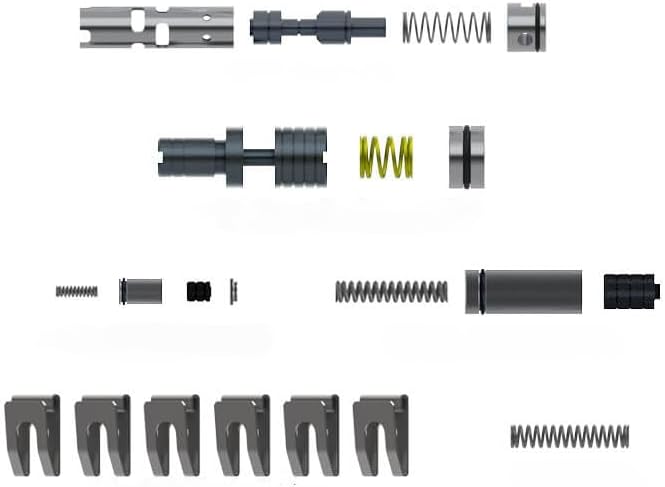
A worn TCC regulator valve spring is one of the specific wear points behind erratic lockup on these 10-speed valve bodies. From our sister store CoreTransmissionParts.
Shop the part for this fix →Need more for the 10-speed valve body? The 10-speed parts collection covers the shared Ford/GM 10-speed Sonnax kits, solenoids, and hard parts.
Need parts for this job?
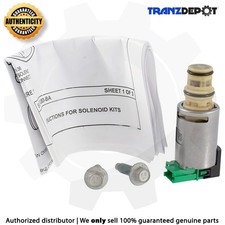
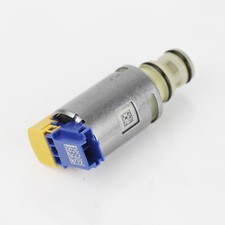
The TCC solenoid, pressure control solenoid, and a Sonnax zip kit for worn valve body bores are all on our 10R80 parts page, with checkout on site.
FAQ
What does P0741 mean on a 10R80?
P0741 is Torque Converter Clutch Circuit Performance or Stuck Off. The PCM commanded the TCC to apply and either saw no lockup or saw slip well beyond what it expects once the clutch is applied. On 2017-2018 10R80 trucks built on or before 20-Nov-2017, Ford's TSB 20-2117 ties this code, often paired with P1744, to a sticking TCC valve in the main control valve body. On later builds it is more often a worn TCC damper valve and bore, or converter clutch material breaking down, so the build date is the first thing to check before you order a part.
What is P1744 on a Ford 10R80?
P1744 is Ford's manufacturer-specific torque converter clutch system code, and on the 10R80 it commonly sets alongside P0741 rather than alone. Both codes point at the same TCC control circuit, so a scan tool pulling both together is consistent with Ford's own TSB 20-2117 description of a sticking TCC valve in the main control valve body, not two separate problems.
How do I tell if a 10R80 TCC problem is the TSB valve or something else?
Start with the build date. TSB 20-2117 only covers 2017-2018 F-150/Raptor and 2018 Expedition/Mustang/Navigator units built on or before 20-Nov-2017 with P0741 and P1744 stored. If the truck is outside that window, log transmission fluid temperature, solenoid commands, torque converter slip, and engine coolant temperature on a road test. A documented shop case found TCC slip swinging from 10-20 RPM to 70-80 RPM under load with fluid temperature climbing to 240-250 degrees F, traced to a worn TCC damper valve and bore in the lower valve body, not the sticking valve the TSB describes.
Can a reflash fix 10R80 TCC lockup problems?
Sometimes. Gears Magazine's coverage of the 10R80 reports that around 80 percent of shift-quality and TCC complaints on these units clear up after a PCM/TCM reprogram followed by an Adaptive Learning Drive Cycle, before any hard parts are touched. That makes a software update and relearn a reasonable first step on a truck with no fluid contamination and no codes tied to the TSB's specific build window, saving a valve body teardown for cases the reflash does not resolve.
What fluid does the 10R80 need and does it affect TCC lockup?
Motorcraft MERCON ULV (Motorcraft part XT-12-QULV), an ultra-low-viscosity fluid built specifically for the 8F front-wheel-drive and 10R rear-wheel-drive families. It is not interchangeable with MERCON V, MERCON SP, or MERCON LV. The wrong viscosity fluid changes how quickly and how firmly the TCC applies, which can produce a shudder or erratic lockup that looks like a hardware fault but is really a fluid mismatch, so confirming the fluid is correct is a cheap first check before condemning a valve or converter.
Related guides
- 10R80 P0741 Fix
- 10R80 P1744 Fix
- 10R80 Valve Body Problems and Testing
- 10R80 Harsh and Delayed Shifts
- Ford 10R80 Torque Converter Shudder Fix
- 10R80 Common Problems and Fixes
Sources
- Ford Motor Company, Technical Service Bulletin 20-2117, "10R80 - Illuminated MIL - DTCs P0741 And P1744 - Built On Or Before 20-Nov-2017," 14 April 2020 (supersedes 18-2160), via NHTSA. Backs the sticking TCC valve root cause, the four main control valve body part numbers, the build-date and application cutoff, the XT-12-QULV "as needed" fluid note, and the adaptive-learning relearn warning after valve body replacement. static.nhtsa.gov (PDF)
- Gears Magazine (ATRA), "Keep Those Trannys Rolling," March 2024, case study "10R80 with Erratic TCC Operation." Backs the real-world diagnostic case: P0218/P0741 codes, the PIDs monitored (TFT, solenoid commands, torque converter slip, ECT), the measured TFT of 240-250°F and TCC slip range of 10-80 RPM, the worn TCC damper valve and bore found on a vacuum check, and the repair (converter replacement, cooling system flush, aftermarket damper valve kit, new filter/pan/fluid). gearsmagazine.com
- Gears Magazine (ATRA), "The More You Know About the 10R80, the Better Off You Are," September 2020. Backs the six linear force shift solenoids (A-F), the CIDAS (normally-low) solenoid design and current-to-pressure behavior, that sticking valves and sticking CIDAS solenoids are an increasingly common complaint, and that roughly 80 percent of shift/TCC complaints are resolved by reprogramming plus an Adaptive Learning Drive Cycle. gearsmagazine.com
- Ford Motor Company, NHTSA Part 573 Safety Recall Report 25V-164 (Ford internal 25S19), submitted 14 March 2025. Backs the separate, unrelated 2024-2025 10R80 valve body recall: two out-of-specification Outer Valve Body bores machined at Livonia Transmission Plant, the E-Clutch shift solenoid stuck ON, the resulting reverse-gear engagement risk, and the affected population across F-150, Ranger, Mustang, Explorer, Bronco, and Aviator built November 2024-February 2025. static.nhtsa.gov (PDF)
- Ford Motor Company / Motorcraft, FCSD Chemicals and Lubricants product catalog, "MERCON ULV Automatic Transmission Fluid" (part XT-12-QULV). Backs that MERCON ULV is the fluid Ford specifies for the 8F front-wheel-drive and 10R rear-wheel-drive transmission families, its ultra-low-viscosity formulation, and that it is not interchangeable with MERCON V, MERCON SP, or MERCON LV. fcsdchemicalsandlubricants.com